

 SA
SA  KW
KW  IE
IE AU
AU UAE
UAE UK
UK USA
USA  CA
CA DE
DE  QA
QA ZA
ZA  BH
BH NL
NL  MU
MU FR
FR [ LET’S TALK AI ]
X
Discover AI-
Powered Solutions
Get ready to explore cutting-edge AI technologies that can transform your workflow!



Get ready to explore cutting-edge AI technologies that can transform your workflow!


One thing always tops the list of taboos in every part of the world – sex education. But, of course, you might feel that it’s not the case anymore. People discuss and talk about “adult things” (so to say) or that there is more awareness now, but more doesn’t mean complete, right?
Yes, there is more awareness than before but it is still relatively less. You still don’t believe me?
Well, read this – the internet gatekeepers are blocking content about reproductive awareness. Why? Because the algorithms mistake them for porn.
You read that right – now machines, too, are discriminating against sex. Whether it’s laughable or worrisome, you decide.
But in 2026, sex education is not limited to classrooms or hushed discussions. It lives on mobile screens, inside apps, and increasingly, within AI-powered platforms.
There are sex education apps and anonymous consultation tools available and people are using them. So it is true that technology is quietly reshaping how people learn about their bodies, relationships, and reproductive health.
But the real question is – is this transformation truly helping, or is technology still creating barriers in disguise?
That’s why, this blog has more importance because of several reasons, and the core reasons are:
– sex-ed
– better and smarter algorithms
– making people aware and conscious of their reproductive health, etc.
– And when it comes to sex talk, proving the whispering process wrong too.
So, let’s break down the details and the stereotypes both. Keep reading to know more…
This education isn’t only about pleasure or procreation; it is also about a person’s sexual orientation. Therefore, it is an essential part of good quality education.
It is life skills-based, comprehensive and supports people in making conscious, healthy and respectful decisions about their sex lives and procreation. In addition, the focus is to disseminate essential info that helps people develop skills, ethical values and attitudes to do the former.

For the same purpose International Technical Guidance on Sexuality Education was released by the UN in 2009. Efforts have been going on ever since to make the global citizenry better informed about sex, different sexualities and reproductive health.
Sex-ed becomes all the more important because this domain lacks attention. The fact that it is mandatory and still hasn’t achieved success worldwide screams for attention.
Since we all are in this world, we need to put conscious efforts into normalising and discussing sex. Conversations are important – they help in destigmatising and spread awareness too!
Even today, access to structured and reliable sex education remains limited in many parts of the world.
According to UNESCO, comprehensive sexuality education plays a critical role in improving health outcomes and awareness among young people.
Similarly, UNFPA highlights that a significant portion of adolescents still lack access to accurate reproductive health information.
This gap is exactly where digital platforms, especially mobile apps, are stepping in.
Over the past few years, sex education apps have emerged as a powerful alternative to traditional learning methods. With privacy, accessibility, and personalization at their core, these apps are helping users access reliable information without fear or judgment.
From menstrual tracking and fertility insights to LGBTQ+ education and relationship guidance, these platforms are expanding rapidly.
For businesses, this space is no longer niche. It is growing and upgrading into a high-impact digital segment where a reliable mobile app development company can create meaningful solutions like platforms and mobile apps for sex ed.
With the advent of technology and the latest innovations, many creators are working towards creating user-friendly content. It is being created to help users spread awareness about reproductive health and education. The following are the GOOD changes in present times, with the help of tech, of course.
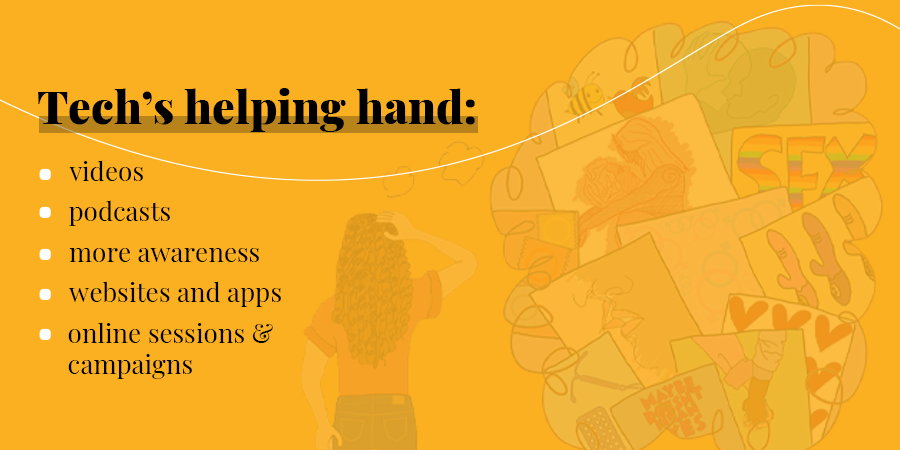
We have two factors to thank here – first, different platforms have rendered creators independent to create and publish content. Second, the changing times have brought down hesitation levels than earlier years.
They not only share essential information related to this domain but also host experts to do the same.
The conversational part makes it easy and comfortable for listeners to take in the information and stay attentive too!
Mark it – this type is NOT pornographic content. Instead, they are educational videos that aim at making viewers better aware about sex, reproductive health and hygiene.
Websites and mobile apps promote sexual health knowledge among adolescents. Such platforms also provide tracking functions directed towards reproductive and sexual activities.
Online sessions and campaigns exist that cater to the young audience and they prove immensely helpful.
It’s not just about automation anymore, and honestly, artificial intelligence has already entered almost every field possible, and now, it is slowly, but very clearly, becoming a part of sex education apps as well.
AI is redefining how these sensitive topics are delivered, because the way people learn about sex education was never really structured or comfortable to begin with. And now, with smarter systems in place, things are changing… gradually, but meaningfully.
Did you know?
More than 70% of adolescents prefer digital platforms for sensitive topics due to privacy and accessibility. That’s why…
So, in a space where people were hesitant, unsure, and often silent, AI is creating an environment that feels safer, more private, and, in a way, more human.
And for businesses, this shift is not just interesting, it is important because it opens up opportunities to build intelligent, scalable platforms, especially when it is built and launched by an experienced AI app development company, one that understands both the technology and the sensitivity of the domain.
This one might be a bit bizarre, but simultaneously, technology is proving helpful and an obstacle to sex-ed. For example, AMAZE, a sex-ed platform, faced similar issues on YouTube.
Let’s learn how and why well-intended content gets rejected:

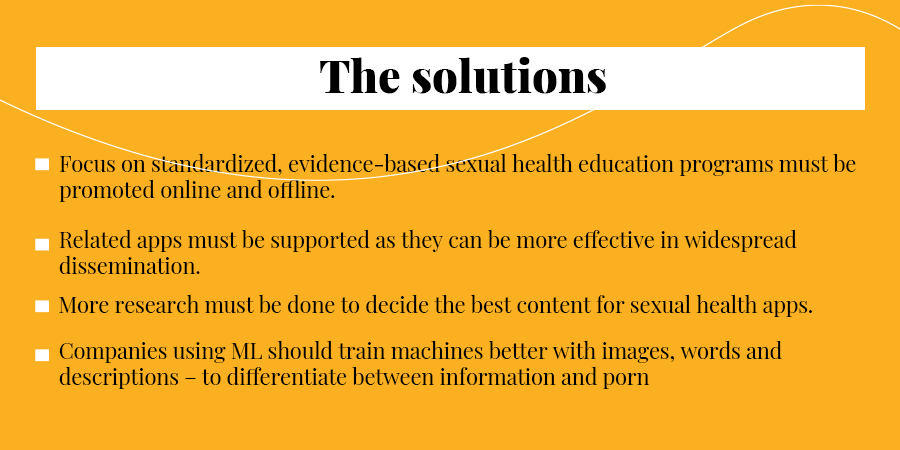
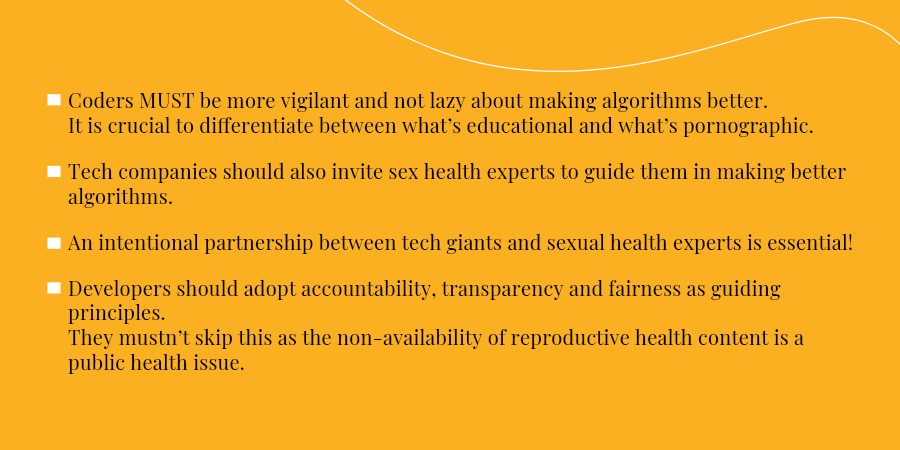
Misinformation / Unverified Content
Privacy Concerns
Digital Divide / Accessibility Issues
Cultural & Regional Restrictions
Lack of Human Guidance
Over-reliance on Tech
Innovative solutions necessitate expert guidance and support. And when it comes to a topic like sex-ed, which is still a sensitive one – creative ways are a dire need.
How is exploring such a field lucrative, you might think! For starters, it is still unexplored and needs people to contribute to building a better-aware population.
So, a domain that still hasn’t gotten exhausted and wants people to be creative and enterprising is a gold mine for entrepreneurs.
And the users can benefit by freshly consuming informative and essential content.
What is required for creative minds is to give it a shot! And to say the least, it’s worth a try.
When the human race is evolving and our societies are becoming technologically advanced at a blinding speed, why should we still get hung up on myths and taboos right?
In 2026, the intersection of technology, AI, and sex education is not just an opportunity but a responsibility. The need is clear, the audience is ready, and the impact is undeniable.
So, build a wonderful solution to break stereotypes and stigma attached to sexual education – it is as important as any other kind of education. Make an app for sex education that caters to the corresponding needs without getting rejected online or mistaken as porn.
How to do it?
Connect with us at Techugo – a leading education app development company.
We won’t simply take you onboard, but we will share our expertise and experience in creating a sex education solution. We not only build dreams, we nurture them – test us yourself. Get in touch with us today!

When someone decides to build an app in France the question everybody asks is never related to design, user experience, or the functionality of the ap..

For entrepreneurs, startups, and established companies looking to break into the largest digital market in Europe, launching a mobile app in Germany p..


Write Us
sales@techugo.comOr fill this form