

 SA
SA  KW
KW  IE
IE AU
AU UAE
UAE UK
UK USA
USA  CA
CA DE
DE  QA
QA ZA
ZA  BH
BH NL
NL  MU
MU FR
FR [ LET’S TALK AI ]
X
Discover AI-
Powered Solutions
Get ready to explore cutting-edge AI technologies that can transform your workflow!



Get ready to explore cutting-edge AI technologies that can transform your workflow!






Israel’s tech scene moves fast. Ideas turn into products quickly, and most businesses want apps that can scale from day one. But when you start planning your own app, the first question that hits you is the most confusing one…how much does it cost to build an app in Israel today?
The truth is, there’s no fixed cost to develop a mobile app in Israel. It varies based on what you’re building, your industry, your feature set, and your development methodology as well. For example, a fintech app development cost in Israel would not be similar to an ecommerce app. Among other factors, an MVP app development cost in Israel would also be different than developing a full custom app.
So in this blog, we’ll see the industry as well as platform wise app development cost. You’ll also learn the developer hourly rates in Israel, and tips to reduce the overall budget of mobile app development.
Bookmark this, so you don’t miss it.
The cost to develop a mobile app in Israel isn’t the same for every project. It depends on a few core things, like…
In general, the cost to develop a mobile app in Israel is in the range of ILS 36,032 – ILS 90,081. As certain apps can fall outside that price range if they are high-end apps.
The best way to do this is to assess a multitude of teams, learn about their fee structures, and find a rate fairly priced against quality, reliability, and transparency – not necessarily the lowest rate you can find.
Here is a simple breakdown of estimates for your convenience.
| App Complexity | Estimated Cost (ILS) |
| Simple Mobile App | ILS 36,032 – ILS 54,048 |
| Medium Mobile App | ILS 54,048 – ILS 72,065 |
| Complex Mobile App | ILS 90,081+ |
| Industry | Estimated Cost Range (ILS) |
| Fintech App Development | ILS 54,000 – ILS 145,000+ |
| Healthtech App Development | ILS 50,000 – ILS 160,000+ |
| Ecommerce App Development | ILS 45,000 – ILS 150,000+ |
| AI Mobile App Development | ILS 65,000 – ILS 180,000+ |
Fintech apps typically cost more to develop since those types of apps need a considerable amount of security, speed and seamless payments, plus a good amount of compliance features as well too (think KYC, digital wallets, dashboards, real-time data, and those specific types of functions).
While it may get up to about ILS 54,000 for a basic fintech app, the more complex fintech projects can easily be higher than ILS 145,000, especially with all the encryption, KYC, digital wallets, dashboards, heavy integrations, and those various types of features.
If you plan to incorporate banking APIs into your app, and/or develop AI-based risk checks into your app’s functionality, costs can increase significantly.
Healthtech apps require secure data transfer, reliable app performance, & additional meaningful app features offered, such as telemedicine, patient profiles, or medical records.
Costs can also rise significantly because there are higher expectations for health applications from both end-users and the “government” when it comes to privacy regulations and “sensitive” technology behind the applications.
Health apps can also begin around ILS 50,000 for the basic design, features, and popular formats, but if you start implementing video calls, e-prescriptions, and device integrations etc., the budget and rate of expenditure would naturally rise upward in cost (ILS 160,000+) and also require additional consideration too.
Ecommerce apps depend a lot on features.
A basic ecommerce app with product listings and normal checkout stays affordable. It can start from ILS 45,000.
A marketplace with multiple sellers, inventory systems, order tracking, and advanced analytics can cross ILS 150,000. Smooth UI and payment flow also add to the total budget.
AI apps come with higher development costs because they rely on machine learning models, automation, or GenAI features.
Using simple AI APIs is cheaper; the cost may start around ILS 65,000. Building custom AI or training models is more expensive.
Should your app incorporate image recognition, predictions, or chat automation, expect a more expensive budget (also with more impact). Cost can reach ILS 180,000+.
More data = more complexity = higher development effort.

In Israel, industry norms and integrations will greatly increase the cost. Fintech and healthtech typically are the largest area simply due to compliance, security audits, and relationships with third-party system. Ecommerce and generic apps are cheaper simply because the tech stack is more predictable.
Apps in finance, health, and AI often need strong encryption, role-based access, fraud checks, and protected APIs. These are not “optional”. They’re mandatory in Israel’s high-trust ecosystem. This pushes budgets up, but it also protects the product long-term.
If you add AI, the cost depends on whether you use pre-built AI APIs (cheaper) or custom ML models (expensive). Many founders underestimate the data-cleaning and training effort. In Israel, custom AI work is one of the fastest-moving budget escalators.
Payment gateways, healthcare systems, logistics APIs, and banking rails in Israel often need extra compliance checks. These integrations can easily add 10–20% more to the budget.
Industries like ecommerce and AI apps need cloud scalability from day one. It’s not just development cost. There’s architecture setup, load handling, and analytics pipelines. Planning this early saves you from painful rebuilds later.
| Platform Type | Estimated Cost Range (ILS) |
| MVP App Development | ILS 35,000 – ILS 75,000 |
| Custom App Development | ILS 75,000 – ILS 180,000+ |
| Native App Development (iOS & Android) | ILS 90,000 – ILS 200,000+ |
| Cross-Platform App Development | ILS 55,000 – ILS 130,000 |
| Enterprise App Development | ILS 120,000 – ILS 250,000+ |
An MVP is the simplest version of your app. Just the must-have features.
In Israel, an MVP usually costs ILS 35,000 to ILS 75,000. The price depends on how many screens you need and how polished the user flow should be.
Startups prefer MVPs because they save money and help test the idea early.
Custom apps take more time because everything is built from scratch –design, features, and backend logic.
The cost normally starts from ILS 75,000 and can go up to ILS 180,000+.
More unique features = more development effort.
If the app requires deep integrations or special workflows, the price increases further.
Native apps are built separately for iOS and Android. This gives better performance but increases the cost because you’re basically building two apps.
In Israel, native development generally starts around ILS 90,000, but can go over ILS 200,000 for more advanced apps. Caveat here is if you require both platforms simultaneously, this generally doubles your budget.
Cross-platform apps work with one codebase at once for both iOS and Android, and therefore are faster and cheaper to develop.
In Israel, cross-platform apps are generally costing between ILS 55,000 and ILS 130,000 depending on how many features you add. Flutter and React Native are the go-to choice.
Enterprise apps are the most expensive because they involve multiple modules, user roles, dashboards, integrations, and higher security.
These apps usually start from ILS 120,000 and can go way beyond ILS 250,000 depending on scale.
Companies often need admin panels, analytics, and cloud architecture, which adds to the cost.
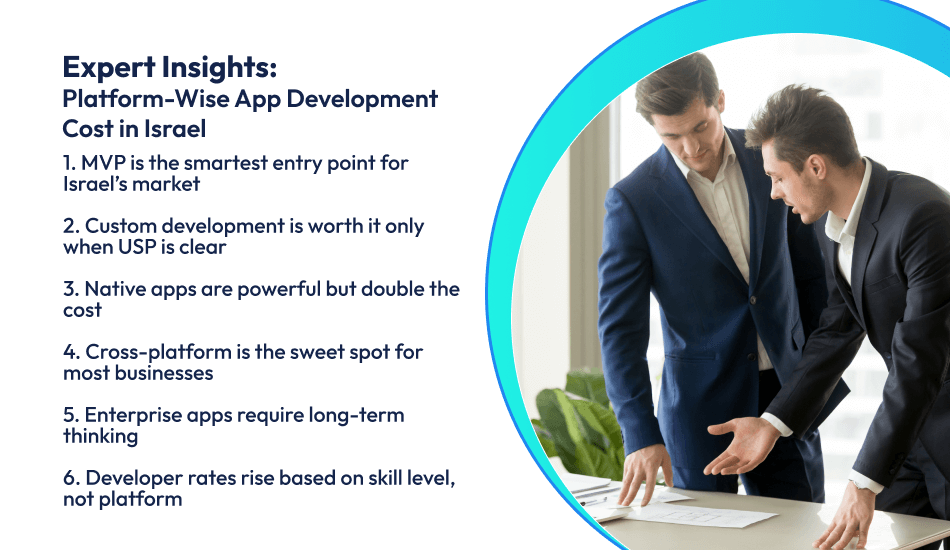
If you’re unsure about traction, build an MVP first. It reduces risk, saves money, and lets you validate the idea. Many Israeli startups launch with lean MVPs and scale after proving demand.
If your app needs unique workflows or experience, custom is great. But if 70% of your features are standard… don’t overpay. Many founders in Israel overscope early versions and burn through budget unnecessarily.
Native iOS + Android gives the best performance and feel, but it means two separate builds and two teams. Go native only if the app depends on speed, sensors, or high-quality animations.
Flutter or React Native can cut development time up to 30–40% in Israel. For most apps, cross-platform is more than enough and gives you faster launches with lower budgets.
Enterprise clients should expect higher architecture costs, admin dashboards, role-based systems, and multi-module apps. These need professional maintenance, strong backend engineering, and long-term support. The upfront cost is high, but downtime in enterprise systems is even more expensive later.
Most Israeli development companies charge higher rates for senior engineers. Complex projects (AI, fintech, heavy backend) always demand senior hands, which naturally increases platform-based budgets.

Here are common hourly rate ranges (USD) you can expect, based on experience & role:
| Developer Level | Approximate Hourly Rate (USD) |
| Junior / Entry-level | $30 – $50 / hour |
| Mid-Level Developer | $50 – $90 / hour |
| Senior Developer / Expert | $90 – $150 / hour |
Because of its mature tech ecosystem, developer pay in Israel is quite competitive. If you hire mobile app developers here, it is more expensive than in many outsourcing regions.
Junior developers charge far less than senior or expert-level engineers.
For strategic, high-complexity work (like AI, fintech, or enterprise apps), you’ll likely need senior developers who command higher hourly rates.
If you hire mobile app developers locally in Israel, the country gives you strong communication, domain familiarity, and high trust, but at a premium.
If cost is a big driver, hybrid or partial offshore models can help, though you may lose some “Israeli-market advantage.”
Mobile devs with Kotlin / Swift / native expertise cost more than generalists.
Developers working on cross-platform (Flutter / React Native) might fall somewhere in the mid-range.
Backend, DevOps, and QA rates also influence the “effective hourly cost” of the whole team.
When planning your app, estimate the number of hours per role before talking rates.
Factor in buffer for reviews, QA, maintenance…not just pure development time.
Be transparent with your dev partner: tell them the budget band you have in mind, and let them suggest the right mix of experience.
Big idea? Tight budget?
Techugo helps startups scale smart with affordable mobile app development services in Israel.
Hire app developers at Techugo, share your idea with us, and get a transparent cost plan in minutes.
If you aim to build an app in Israel, you will want a team with experience in the tech landscape as well as the business rationale for the product being developed. That’s where we come into play.
We take the time to understand the product you want to build, why it’s important, and for whom it will be built, so that we can adequately put together a clear roadmap that is attractive to your budget and timelines.
At Techugo, a leading mobile app development company in Middle East, USA, and India, you get access to an entire development team (strategists, UI/UX designers, developers, QA engineers, and project managers). Everyone collaborates together, and you aren’t left to coordinate several vendors to have the project move forward smoothly and efficiently.
And because we develop apps for enterprises, government agencies, and startups, we have a habit of figuring out risk early and guiding you around it.
So, whether you need native, cross-platform, enterprise-grade, or AI apps, we have the engineering depth, product experience, and industry knowledge to provide you with a working product.
If you’re investing in the emerging app economy in Israel, Techugo, being the best custom mobile app development company, will help you build an app that won’t simply be another one in the app store. We help you develop a product that people rely on, use, and are loyal to.

The cost to develop a mobile app in Israel which is simple, starts around ILS 36,032 – ILS 54,048.
A mid-level app can go ILS 54,048 – ILS 72,065.
Complex or enterprise apps can cross ILS 90,081+.
The exact number depends on features, design, and the platform you choose.
App development is a bit more expensive in Israel because Israeli developers are skilled and pay a moderately higher hourly rate. When you choose to develop an app in Israel, you’re paying for developed quality engineering and security, as well as relatively fast delivery timelines.
Yes. An MVP usually costs ILS 35,000 to ILS 75,000. You build only the core features. It saves money, reduces risk, and helps you test the market before investing more.
If you are looking for a high performing, native app (iOS/andriod) is the way to go. If you are looking to save on costs and build out something more quickly, take the hybrid route (Flutter/React Native). Most Israeli tech startups will start with a cross-platform app in order to save time/money.
The easiest ways to save some budget are:
Even these small decisions can easily help you save 20-40% of the total mobile app development cost in Israel.
As the rate of energy consumption in mature and emerging markets drives the new phase, it has become evident to understand the benefits that IoT is br..

Do you think that building a fintech app like Citi Mobile requires a huge investment? What if we told you that you simply need $30K to get started? Ye..


Write Us
sales@techugo.comOr fill this form