

 SA
SA
 KW
KW
 IE
IE AU
AU UAE
UAE UK
UK USA
USA
 CA
CA DE
DE
 QA
QA ZA
ZA
 BH
BH NL
NL
 MU
MU FR
FR
















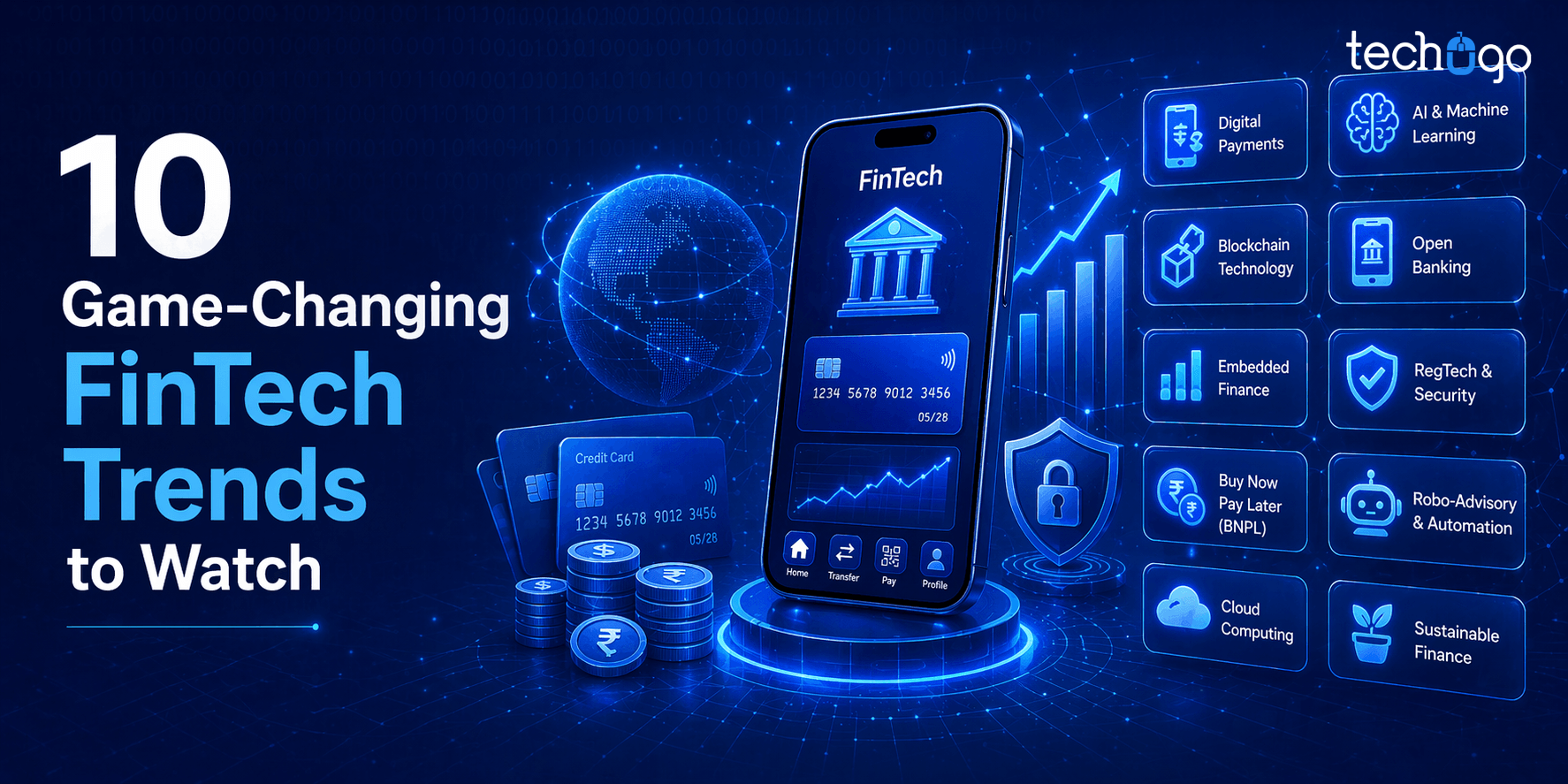


The global shift toward digital transformation has accelerated significantly over the past few years, reshaping how businesses and consumers interact with financial services. What began as a reactive move during the pandemic has now evolved into a full-scale financial revolution.
In 2026, FinTech stands at the core of this transformation—driving innovation, improving accessibility, and redefining user experiences across industries. From AI-powered banking to decentralized finance ecosystems, FinTech is no longer optional—it is essential.
In this blog, we explore the most impactful FinTech trends in 2026 that are revolutionizing the financial landscape and shaping the future of digital economies.
Let’s dive in together…
DeFi- Decentralized Finance
As the name suggests, DeFi is one of the most promising decentralized financing instruments, working along with loans, savings, insurance, and trade. In simple words, it is an open financial network offering products but without an intermediary and is based on peer-to-peer. In 2026, DeFi is increasingly integrated with traditional financial systems, creating hybrid models that combine trust, security, and decentralization. From lending and insurance to asset trading, DeFi is unlocking new financial possibilities globally.
Key Global DeFi Trends
- More global companies and institutions are adopting DeFi
- DeFi and traditional finance are starting to work together
- Real-world assets like property and stocks are being tokenized
- Faster and cheaper cross-border payments are increasing
- Better security and identity verification systems are emerging
- Governments are slowly introducing regulations for DeFi
- Transactions are becoming faster with new blockchain solutions
- DeFi platforms are improving user experience and simplicity
If you look at how things are moving globally, DeFi is not something separate anymore. It is slowly becoming part of the larger financial system. Earlier, people had to rely fully on banks for every transaction, but now there are more options. Overall, DeFi is not replacing banks overnight, but it is clearly changing how finance works globally. And going forward, it will continue to grow as a strong part of the financial ecosystem.
Embedded Finance
Embedded finance is quickly becoming one of the biggest FinTech trends globally. Simply put, it means integrating financial services directly into non-financial platforms—so users don’t have to go to a bank or a separate app to access them.
In 2026, this trend is everywhere. Whether you are shopping online, booking a ride, or using a business tool, financial services like payments, lending, or insurance are already built into the experience.
Globally, embedded finance is making financial services more invisible yet more accessible. Companies across industries are turning into financial service providers by partnering with FinTech platforms. The goal is simple—make transactions faster, smoother, and part of the natural user journey.
Key Global Trends
- Non-financial platforms offering payments, loans, and insurance
- E-commerce platforms providing instant checkout financing
- SaaS platforms enabling built-in payment and billing systems
- Rise of “buy now, pay later” options globally
- Partnerships between banks and tech companies increasing
- APIs making financial integrations faster and scalable
- Personalized financial services within apps
Cloud Computing
Cloud computing is no longer just an option—it is the backbone of modern financial infrastructure. In 2026, financial institutions are adopting multi-cloud and hybrid cloud strategies to ensure scalability, security, and regulatory compliance.
Cloud-powered platforms allow seamless data management, faster deployment of financial services, and improved customer experiences, making banking more agile and resilient than ever.
AI-Powered Financial Automation
Artificial Intelligence is not just supporting FinTech anymore—it is driving it. In 2026, AI is deeply embedded into financial systems, making services faster, smarter, and more predictive.
Global AI Trends in 2026
Globally, financial platforms are moving toward full automation, where decisions are not just assisted by AI but actually executed by it in real time.
Key Global Trends
- AI handling loan approvals and risk assessment instantly
- Predictive analytics for spending and investment decisions
- AI chatbots replacing traditional customer support
- Hyper-personalized financial recommendations
- AI-driven fraud detection and prevention
3D Printing
While 3D printing has influenced multiple industries, its role in FinTech is more indirect. In 2026, its application is primarily seen in secure hardware prototyping and ATM component manufacturing, enhancing physical security infrastructure.
However, cybersecurity and digital fraud prevention technologies have largely taken precedence over 3D printing in financial innovation
Blockchain
Blockchain continues to revolutionize data security and transparency in financial systems. In 2026, it plays a crucial role in cross-border payments, smart contracts, and digital identity verification.
Financial institutions are leveraging blockchain to reduce fraud, enhance trust, and streamline operations, making it a foundational technology in modern finance.
Open Banking and API Economy
Open banking is becoming a backbone of modern FinTech. It allows different financial systems to connect and share data securely through APIs.
Global Open Banking Trends in 2026
Across regions like Europe, the UK, and parts of Asia, open banking is expanding into a full open finance ecosystem, where multiple financial services are connected.
Key Global Trends
- Secure data sharing between banks and third-party apps
- Rise of API-driven financial ecosystems
- Better financial products through shared data insights
- Increased competition and innovation in banking
- User-controlled data access and transparency
Now, earlier, your financial data was locked within one bank. But today, things are changing.
You can connect multiple accounts, use different apps, and still have a unified experience. That’s the power of open banking.
Digital Assets and Tokenization
Digital assets are becoming a serious part of the global financial system. And it’s not just about cryptocurrencies anymore, tokenization is the real game changer.
Global Digital Asset Trends in 2026
Globally, financial institutions are exploring how real-world assets can be converted into digital tokens, making them easier to trade and access.
Key Global Trends
- Tokenization of assets like real estate, stocks, and commodities
- Growth of institutional investment in digital assets
- Central Bank Digital Currencies (CBDCs) gaining traction
- Faster and more transparent asset trading
- Increased liquidity in traditionally illiquid markets
If you look at it simply, tokenization is about breaking big assets into smaller, tradable pieces.
This means more people can invest in things that were earlier out of reach. And that’s a big shift toward democratizing finance.
At the same time, governments and institutions are stepping in to regulate and structure this space, which is making it more stable and trustworthy.
So overall, digital assets are moving from a risky experiment to a more structured financial opportunity in 2026.
Food for thought
The ‘fintechization’ that has stirred our global economy for something better, will keep on evolving. As the financial services are everywhere: transportation apps, food-ordering apps, corporate membership accounts, the list goes on and on.
The FinTech trends are not slated to stop anytime soon, as the hunger for improved financial technologies is growing stronger than ever before. What’s interesting is that users no longer compare financial services with other banks, they compare them with the best digital experiences they’ve had anywhere. That expectation is pushing FinTech companies to innovate faster, simplify processes, and build more trust-driven solutions.
Are you ready to UP your game?
At Techugo, we very well comprehend your requirements hence we empower fintech companies and their workforces with innovative app solutions and approaches.
Give a call to our experts and discuss the ways your business can benefit from the fintech revolution.
FAQ
1. What are the key FinTech trends 2026 shaping the future of finance?
The FinTech trends 2026 are mainly driven by AI automation, decentralized finance trends, embedded finance, blockchain in finance, and advanced digital banking trends. Overall, the future of fintech is moving toward faster, more personalized, and fully digital financial experiences.
2. How is AI in fintech transforming digital banking trends?
AI in fintech is making digital banking trends more intelligent and user-focused. It enables real-time insights, fraud detection, automated support, and personalized financial recommendations, improving both speed and customer experience.
3. What is the role of blockchain in finance and decentralized finance trends?
Blockchain in finance ensures secure, transparent, and tamper-proof transactions. It also supports decentralized finance trends by enabling peer-to-peer financial services like lending and trading without traditional intermediaries.
4. How do cloud banking solutions and biometric authentication fintech improve security?
Cloud banking solutions help financial systems scale securely and efficiently, while biometric authentication fintech adds stronger protection through face, fingerprint, and behavioral verification. Together, they enhance both security and user trust in digital banking.
5. How is Techugo contributing to the future of fintech and fintech innovations?
We build scalable and secure fintech innovations aligned with the future of fintech, including AI-powered systems, blockchain-based platforms, and cloud-native banking solutions. The focus is always on creating user-friendly and future-ready digital financial products.

Get in touch
We'd love to hear from you.