

 SA
SA  KW
KW  IE
IE AU
AU UAE
UAE UK
UK USA
USA  CA
CA DE
DE  QA
QA ZA
ZA  BH
BH NL
NL  MU
MU FR
FR [ LET’S TALK AI ]
X
Discover AI-
Powered Solutions
Get ready to explore cutting-edge AI technologies that can transform your workflow!



Get ready to explore cutting-edge AI technologies that can transform your workflow!






Do all the old as well as new ride-hailing apps make the market feel overcrowded? It’s a common doubt. Many founders wonder whether it still makes sense to build a ride-sharing app like Grab when users already have multiple options on their phones.
But here’s the real problem users face every day. You open three different apps in the morning. One shows no drivers. Another keeps loading. The third cancels after five minutes.
A ride-sharing app like Grab works because it understands these frustrations and fixes them from the user’s point of view. That’s exactly why building the right app still matters…and why demand hasn’t slowed down at all.
If you’re planning to start an on-demand taxi app like Grab, stick to this post, and you’ll learn the top reasons why you must invest, along with the cost and development guide.
Grab started in 2012. It was simply an app for taxi-booking services, but over time, it turned itself into a super app. That means it started offering multiple services, such as – food and grocery delivery, digital payments, as well as some other everyday services. Users can just open the Grab app and book a ride, they can order food, they can send packages, and they can even pay with a wallet inside the same app.
Its growth tells a clear story. Grab now serves tens of millions of users across Southeast Asia, with around 47.7 million monthly transacting users as of late 2025, and network effects that make its ecosystem stickier as people use more services in one place.
Grab’s success didn’t happen overnight. It solved daily transport problems and then added high-frequency services (like food delivery and digital payments), and finally it turned into a platform that millions use daily…and that’s exactly the kind of user-first thinking worth studying when you’re planning to build a ride-sharing app like Grab.
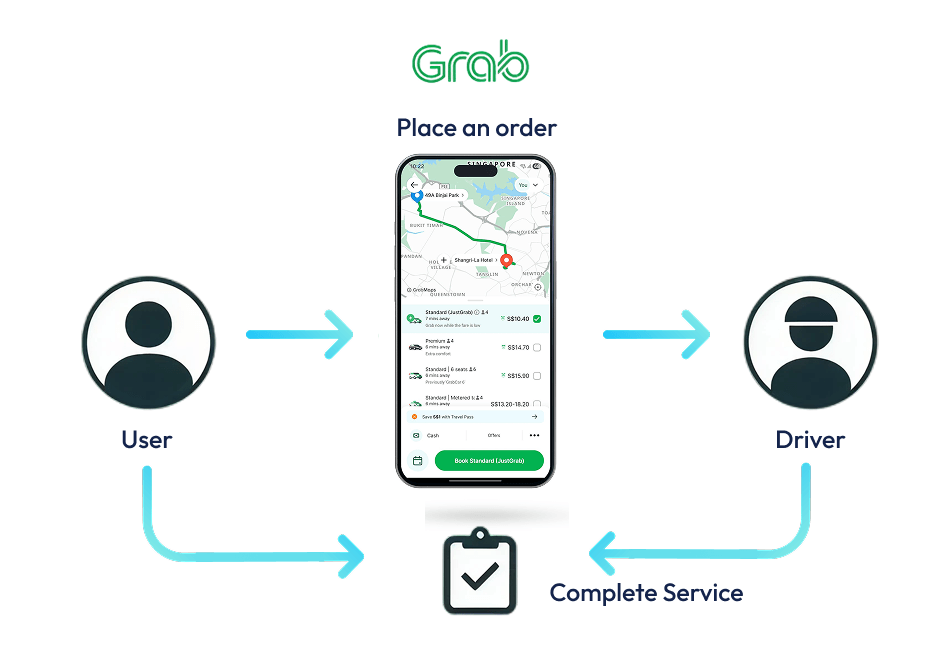
Grab App for Passengers – where users can easily order a ride.
Grab App for Drivers – the app for drivers who offer ride service.
Administrative Dashboard Panel – the web panel to manage drivers as well as orders.
| Top Features of Grab Passenger App are… | Top Features of the Grab Driver App are… | Features of Grab Taxi’s Admin Web-Panel… |
| Registration/Login | Registration/Login | Create Sub-Admins |
| Specify a pick-up & drop location | Specify a pick-up & drop location | Multi-Level Admin Access |
| Real-Time GPS Tracking | Real-Time GPS Tracking | Complete Dashboard |
| See the Ride Price Before Ordering | See the Ride Price Before Ordering | Driver/Passenger Management |
| In-App Payment Integration | In-App Payment Integration | Analytics & Reports |
| Push Notifications | Push Notifications | God’s Eye View |
| Feedback and Reviews | Feedback and Reviews | View Transaction History |
| Booking History | Booking History | Block Driver/Passenger |
| Add/Edit/Delete Various Profiles | ||
| Manage Payment Accounts |
Ride-sharing app like Grab app makes money when anybody, like any rider, driver, or any merchant, interacts on the platform. One thing that makes Grab so powerful is that it does not depend on just one service. To better understand, look at the following points:
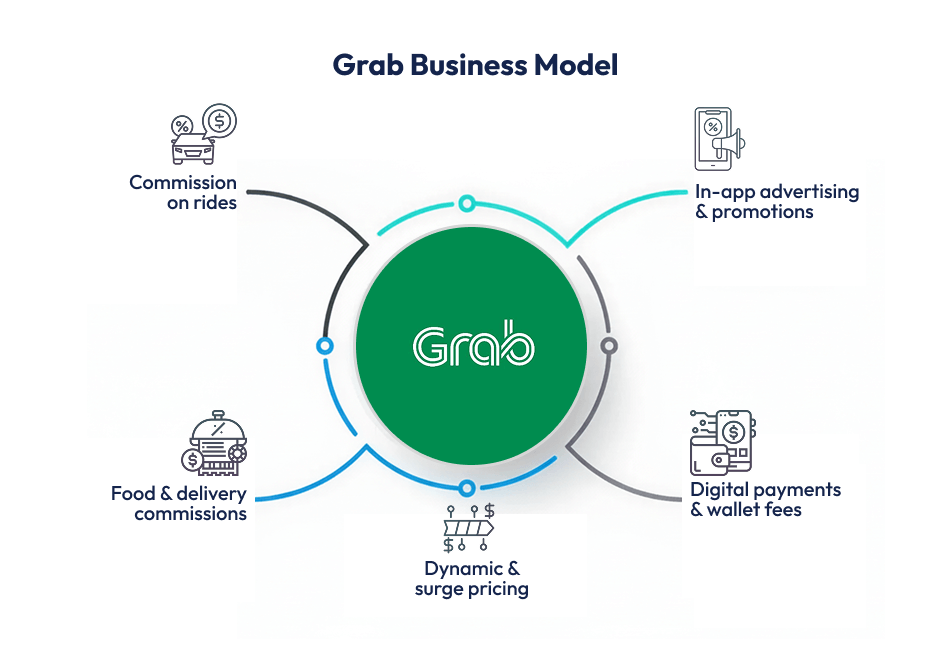
The revenue model of ride-sharing apps like Grab is built for scale. Rides attract users. Daily services keep them engaged. Multiple income streams reduce risk, and these are one of the core reasons why investment in ride-sharing apps continues to make business sense.
Now let’s come to the main point, why you must invest in ride-sharing app development.
Grab taxi app was the very first startup to offer online taxi booking services in Asia, and it mainly operates in Asian countries, so, if you want to invest in a taxi app development like Grab; you first read these core reasons:
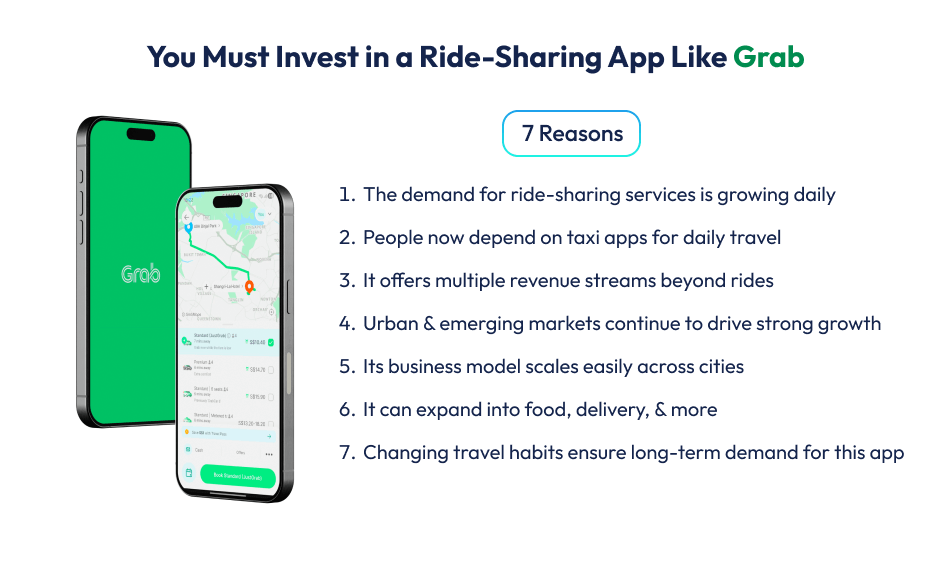
The growing popularity of ride-sharing apps has now made the overall global value of the ride share and ride-hail market more than $140 billion. The ride-share market is expected to continue growing in value over the next ten years. Customers from all over the world book millions of rides daily in various cities because they want to have access to speedy and convenient transportation options, as well as a way to travel without needing their own vehicles. And this consistent usage is why so many founders plan to build a ride-sharing app like Grab.
A well-designed on-demand ride-sharing app easily fits into daily lives of people; they use it for office commutes, airport runs, and to take short trips around the city. It is therefore not surprising that ride share app development is seeing continued growth in demand due to the increase in the number of customers who daily need transportation.
So many people now use ride-sharing apps daily…not occasionally, like office workers, students, and even gig-economy workers who book rides every morning, every evening. In fact, millions of rides are completed daily in Singapore via popular ride-hailing platforms.
This shows that a ride-sharing mobile app is now a part of everyone’s daily life, so, when you plan to build a ride-sharing app like Grab, you are trying to enter into routines on which people are already dependent. That constant usage of app ensures that your app will stay relevant and will keep users coming back.
It is obvious to say that a ride-sharing app doesn’t earn only from trips, but from multiple ways, like Grab makes money in several ways at the same time, for example –
This diversity is why it’s smart to build a ride-sharing app like Grab because even if one service slows down, so others keep revenue flowing.
Travelling in busy cities is still a real headache if there are traffic jams, limited taxis, and long waits, therefore, people are now using ride-sharing apps more and more. There is a huge growth seen in ride-sharing adoption in urban areas of Asia, Africa, and Latin America. In fact, Southeast Asia alone has recorded millions of rides daily, and new users in smaller cities are joining quickly.
This growth shows that building a ride-sharing app like Grab is not only about crowded big cities, but emerging markets also offer huge potential because people need safe and affordable transport…and they’re ready to use an on-demand ride-sharing app daily.
Expanding a ride-sharing app isn’t as hard as it seems because once the app, driver network, as well as operations are in place in one city, the same system can be launched in others with minimal changes. This is why companies like Grab grew so fast across Southeast Asia.
The process of ride-sharing app development involves establishing a model for each city where the app will be used, and then modifying that model in order to comply with local regulations, follow local traffic patterns, and accommodate the various forms of payment available in that particular city. For investors and founders, this means a ride-sharing mobile app can grow quickly, can reach new users and can generate revenue in multiple cities without starting from scratch every time.
Not just taxi services (ride-hailing and ride-sharing), but your app can also offer many more services like a one platform for all services, which is also called super app development.
When users start trusting your app for taxi services, you can start offering food delivery, grocery orders, and even package deliveries through the same app. Great examples are Careem and Grab that offer multiple services. This expansion lets users open your app daily and opens new revenue streams for you.
A very few city residents want to own a car because the problem is that parking is limited, fuel is expensive, obviously, and public transport seems unreliable to them. That’s why they want convenient, on-demand rides that easily fit their daily routines…and this is a long-term opportunity for ride-sharing apps or online taxi apps.
Peak commute hours, weekend outings, or airport trips – if you understand these habits, you can design your app strategically and offer features that cater to such habits, such as ride scheduling or multi-service bundles.
If you have these insights in your mind when going to build a ride-sharing app like Grab, you will surely meet current demand as well as you will position your app to stay relevant as people increasingly rely on shared, flexible transport solutions.
With daily demand growing, multiple revenue streams, and cities ready for expansion, it’s clear that now is the right time to build a ride-sharing app like Grab.
Many people complain about ride-hailing apps being confusing. Too many steps. Too many buttons. Hard to find what they actually need. If users feel this way, it’s a signal…that there’s room to build something better.
That’s exactly how successful platforms are born. Here’s a practical, step-by-step way to build a ride-sharing app like Grab, without overcomplicating the process.
We are more than happy to show you a step-by-step way to build a ride-sharing app like Grab that will help millions of unhappy users.
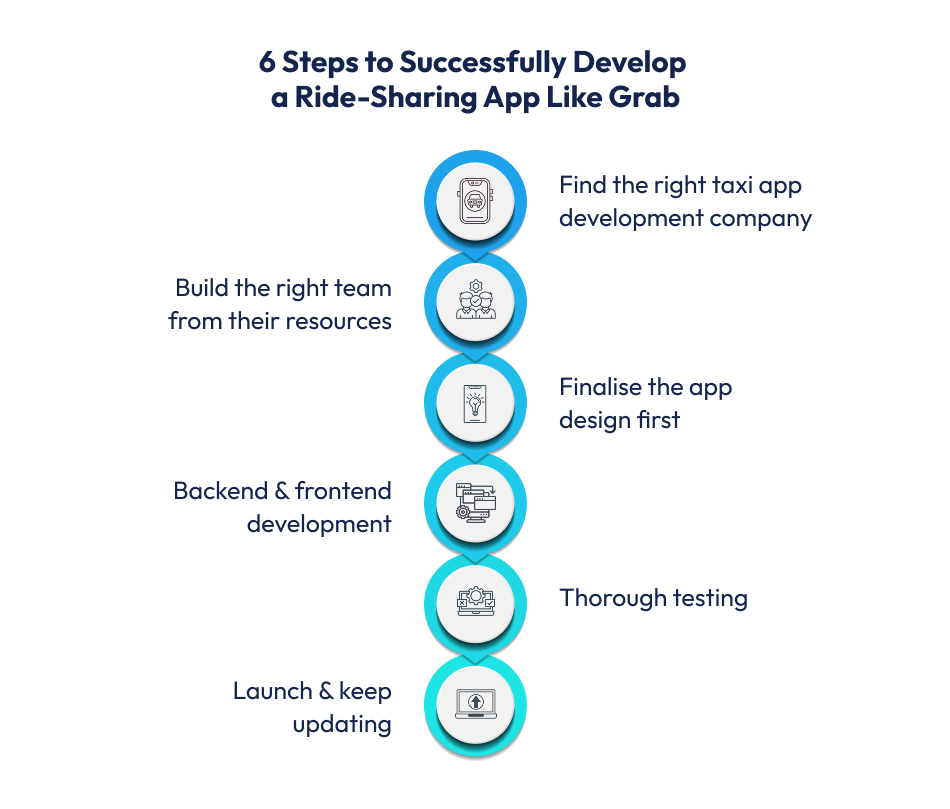
To be honest, rarely any founder knows how to build a ride-sharing app from a technical point of view…and that’s completely normal because not everyone comes from a technical background. So, the very first and most important step is to find and connect with a trusted taxi mobile app development company that has good experience in ride-sharing app development. They’ll help you avoid costly mistakes, help you plan strategically from the start, help you decide the core features first, and will share the clear and transparent pricing and timelines.
Even the best mobile app development company will have a large team. You don’t need everyone, you just need the right people. Being a non-technical founder, interviewing developers can feel overwhelming, that’s why, it’s a very smart move to work closely with an experienced project manager or a senior technical lead who can guide you the process and translate technical decisions into business terms. This step is important when you’re planning a scalable ride-sharing mobile app.
Before development starts, the app design must be clear. This will include user flow, screens, buttons, as well as overall experience. A clean and simple design matters more than flashy visuals, so, if users can book a ride in seconds, that means, your on-demand ride-sharing app already has an advantage. So, once the design is approved, it’s passed on for development.
Here is the most important stage where the actual development starts, and mostly, two teams work in parallel – backend and frontend. Backend developers handle logic, databases, GPS, payments, and matching drivers with riders. While frontend developers build what users see and interact with on the app, but together, they turn the concept and design into a working ride-sharing app like Grab.
You can’t ignore testing before going live, therefore, the app goes through multiple checks before launch. Each feature and function is tested and how it works in the real world so that app doesn’t crash, bookings work smoothly, and payments are secure. Always remember that a poorly tested app can damage trust from day one.
Once testing is complete, the app is launched on the App Store and Google Play. Most ride-sharing mobile app development companies in Singapore, handle this for you, but see, launch is not the end. Successful ride-sharing apps keep improving, so you should keep adding features, refining the app’s design, and adapting to user behaviour. If your app stays relevant, you will turn it into a long-term business.
One size never fits everybody, and the same goes for the cost to build a ride-sharing app. There is no fixed cost as well as there are several factors that matter the most and affect the cost, but still, to give you an overview, see the cost below:
It will include user and driver apps, GPS, basic payments, booking, ratings, and the estimated cost can range between $40,000 – $80,000
It will include advanced features like in-app wallet, dynamic pricing, multi-language support, analytics dashboards, and admin panel, and the estimated cost can range between $90,000 – $180,000+
If you want to add food, delivery, or digital wallet services later, the ride-sharing app development cost will be dependent on the complexity.
What Affects Cost Most?
These numbers are realistic averages and help you set expectations before you build a ride-sharing app like Grab. If you need a more accurate quote for your specific idea, Techugo can help break it down.

One of the biggest fears founders have is spending too much, too early…only to realise the app needs changes after launch, and developing everything at once increases risk. So when planning to build a ride-sharing app like Grab, one of the first decisions is whether to start with an MVP or go for a full-scale app. Let’s decide:
An MVP is basically a product that only focuses on core features like ride booking, driver matching, GPS tracking, and payments of course. MVP’s main motive is to help you enter the market quickly, test real user behaviour, as well as control the ride-sharing app development cost. This approach is ideal if you want to validate the idea before investing heavily.
A full-scale app includes advanced features such as in-app wallets, dynamic pricing, analytics, and expansion into delivery services, and multi-language support as well. It works well when your business model is clear and funding is already secured.
The smart approach – most successful platforms start small. Founders launch an MVP, then learn from users, and then scale into a full ride-sharing app like Grab with confidence.
If you’ve read this far, you are surely interested in building an online taxi app or ride-sharing app.
So, founded in 2015, Techugo brings years of hands-on experience in mobile app development, backed by a strong portfolio across industries. With 50+ AI solutions and 1,400+ apps developed, Techugo team knows what works, what doesn’t, and how to build products that scale.
Being a pre-eminent ride-sharing mobile app development company in Singapore, we let businesses build a ride-sharing app like Grab and even better, with the right technology and architecture that is ready for future. We will help you decide whether to start with an MVP or a full-scale online taxi app. Once you’re ready, just message us to let us know, our team will get back to you. Your success is our first priority.

Founders often worry about long timelines and delayed launches. In reality, an MVP ride-sharing app can take 3–5 months to build. A full-scale app with advanced features may take 6–9 months, depending on complexity and testing.
Many investors fear the market is too crowded. But the demand hasn’t slowed. Profitable apps focus on local markets, daily use cases, and multiple revenue streams. With the right model, investment in ride-sharing apps still offers strong long-term returns.
Startups often struggle with cost control, driver onboarding, and user retention. Technical complexity can also feel overwhelming. These risks are manageable when you start with an MVP, choose the right development partner, and scale based on real user data.

Over the last few years, the software market in Saudi Arabia has moved from a support function to a growth engine. Businesses, government bodies, as w..

Saudi Arabia's Gen Z population has a unique relationship with Snapchat. Unlike the curated, often idealised content found on Instagram or the vir..


Write Us
sales@techugo.comOr fill this form