

 SA
SA  KW
KW  IE
IE AU
AU UAE
UAE UK
UK USA
USA  CA
CA DE
DE  QA
QA ZA
ZA  BH
BH NL
NL  MU
MU FR
FR 

















📌 Key Takeaways
- AML software development is no longer just compliance, it’s a strategic CEO decision.
- The cost to build an AML software ranges from $30,000 to $300,000+ in 2026 based on complexity and AI features.
- Investing in AML software is often cheaper than paying regulatory fines, reputational damage, or compliance failures.
- Businesses choose between off-the-shelf AML solutions (fast, limited) and custom AML system development.
What if your biggest business risk isn’t the competition… but the compliance?
In 2026, financial crime is evolving faster than ever, and the regulators are not playing catch-up anymore. They are setting the pace. And for the CEOs, this means one thing: that AML software development is no longer optional, it is strategic, and it has become something you simply cannot ignore.
Now, the cost to build an AML software is not exactly small, and it typically ranges between $30,000 and $300,000+, depending on how powerful and how future-ready you want it to be, because the more advanced it is, the more it demands.
But here’s the twist, and it’s important: in a world where even one compliance failure can cost more than that, this so-called “expense” starts to look very different, and it becomes one of the smartest investments you can make.
Today, compliance is not just about avoiding penalties, but it is also about building trust, unlocking partnerships, and scaling responsibly, so that your business is not only safe but also growing stronger. The right anti-money laundering software doesn’t just protect your business, it actually strengthens your brand and your revenue engine, and therefore it plays
In this guide, you will see how AML software development really works, and why it matters, and what key features you should be looking at, but also how the role of AI is shaping everything, and what the cost to build an AML software actually looks like from the ground up.
So let’s get started!
What exactly is AML software development?
Let’s break it down simply.
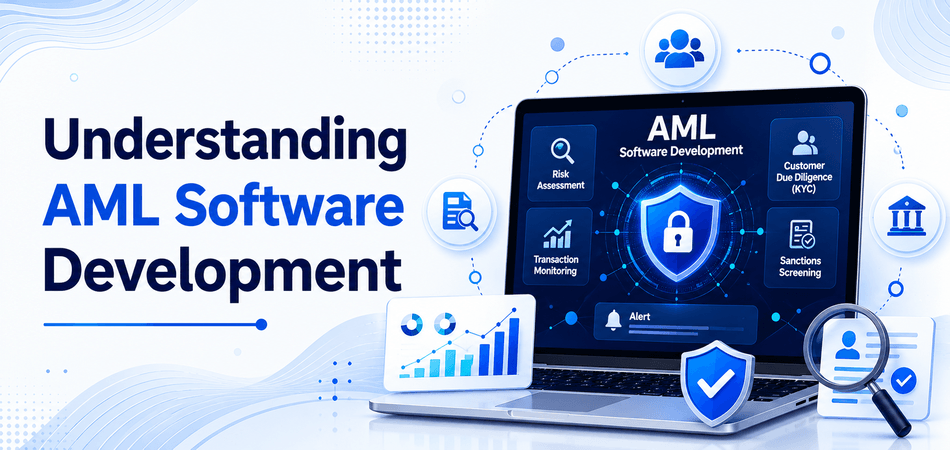
AML software development refers to building systems that help businesses detect, monitor, and report suspicious financial activities. Think of it as your digital watchdog: always scanning for risks you can’t afford to miss.
At its core, an AML system focuses on three things:
- Detecting unusual transactions
- Monitoring customer behavior
- Reporting suspicious activity to authorities
Now, here’s where CEOs need to decide:
Do you go for a ready-made solution or invest in custom AML system development?
- Off-the-shelf solutions → faster to deploy, but limited flexibility
- Custom solutions → tailored to your business, scalable, and future-ready
If your business is growing or operating in fintech, banking, or crypto, custom is usually the smarter long-term play.
The strategic importance of AML software for CEOs
Let’s be direct, this isn’t just a tech upgrade. It’s a business decision.
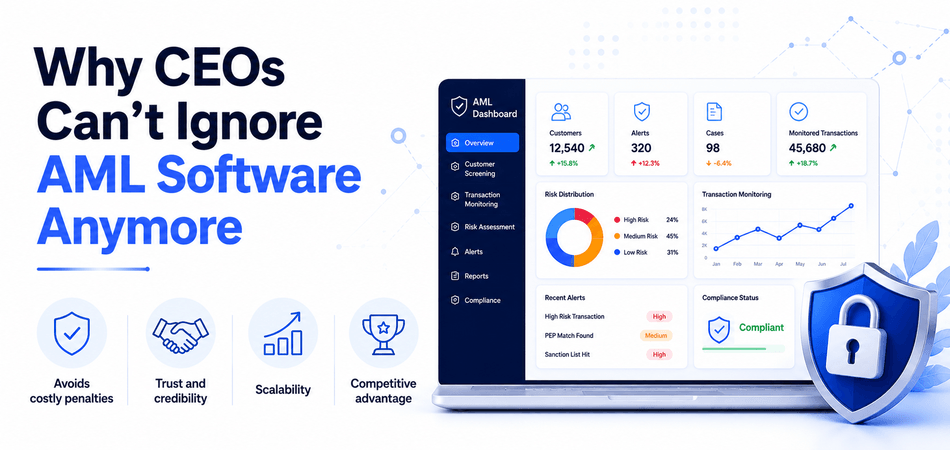
Here’s why investing in AML software development makes sense:
Avoids costly penalties
Regulatory fines are not only high, they are massive, and they can run into millions. Therefore even a single compliance gap can undo years of growth and the effort that you have been putting in. This is where the AML software development becomes important, because it helps you stay aligned with the regulations, and it reduces the risks before they actually turn into real problems.
Trust and credibility
Customers and the partners are more likely to work with businesses that take compliance seriously, because it shows that you are reliable and that you have been doing things the right way. The right anti-money laundering software does not just protect your operations, but it also builds trust, and therefore it strengthens your brand, and your positioning in the market.
Scalability
As your business grows, the manual compliance processes start to break, and they become inefficient, but also risky at the same time. With proper AML system development, you are able to automate things, and therefore you can scale without the chaos, so that your growth does not come with hidden risks, or unnecessary slowdowns.
Competitive advantage
In industries like banking and fintech, speed matters, but so does security. And the companies that invest in compliance have been moving faster and safer. Whether it is AML software for banking or the AML solutions for fintech, businesses with strong systems are able to adapt quickly, and therefore they stay ahead, not just in compliance, but also in competition.
Key features of AML software that matter in 2026
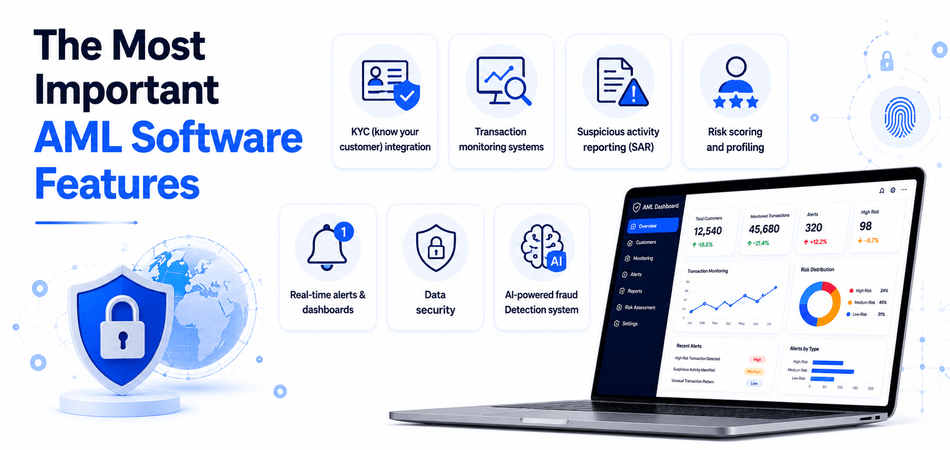
Not all AML tools are built the same. The right system should include:
KYC (know your customer) integration
Verify the customer identities at the very first step, and ensure only legitimate users enter the system because onboarding is where risks usually begin… and it matters more than people think, honestly. In modern AML software development, KYC is not just a step, it is the first real filter, therefore it reduces fraud exposure and also makes onboarding smoother, faster, and more controlled.
And when you look at AML software for banking, it was always about strict verification, but now it is also about speed, and accuracy, and trust building at the same time… so that banks are able to onboard users without unnecessary friction, but still stay fully compliant, which is very critical.
Transaction monitoring systems
Track financial activity in real time, continuously, and without breaks so that unusual patterns are caught early, but sometimes it was not possible with older systems. In AML software development, this becomes the core layer of visibility, and in custom AML system development, it is shaped around your business behavior so that detection becomes more accurate… and less noisy.
Suspicious activity reporting (SAR)
Automatically flag and report suspicious transactions to regulatory authorities, and do it without delay, because timing is everything here. It ensures compliance teams are always ahead, and therefore nothing critical gets missed, or left unreported… which was a common issue in manual systems.
Risk scoring and profiling
Assign dynamic risk levels to customers based on behavior, transaction history, and patterns, so that high-risk users are identified early, and decisions become easier. The system keeps learning from data, and therefore risk scoring is not static, it changes, it adapts, it evolves with time.
Real-time alerts & dashboards
Deliver instant insights to decision-makers so that they can act before risks escalate, but not overwhelm them with unnecessary data. It was designed to highlight what actually matters, and therefore teams are able to respond faster, and with more clarity, even when volumes are high.
Data security
Ensure every action, update, and transaction is securely recorded and fully traceable so transparency is never compromised. Both AML software for banking and AML solutions for fintech depend on this layer to meet strict regulatory and audit requirements.
AI-powered fraud Detection system
This is where modern compliance becomes intelligent, adaptive and slightly unpredictable in a good way. The system learns continuously from data, user behavior, and past patterns so that hidden fraud signals can be detected even when they are subtle. It reduces false positives, improves accuracy, and therefore transforms compliance into something proactive rather than reactive, which is what advanced AML software development has been moving toward for years.
The role of AI in AML software development
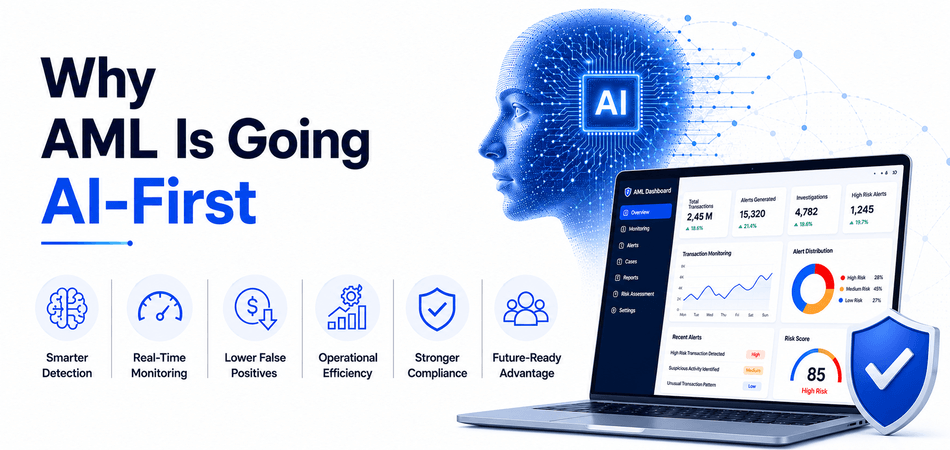
Here’s where things get interesting. Traditional AML systems rely on fixed rules. But financial crime does not follow rules. It evolves. That’s why AI-powered AML software is becoming the new standard.
So, what does AI actually change?
- Better fraud detection
AI can identify patterns humans simply can’t see - Machine learning for smarter monitoring
Systems learn from past data and improve over time - Fewer false positives
No more wasting time chasing harmless transactions - Real-time decision-making
Predict risks before they become problems
AI vs traditional systems
| Feature | Traditional AML | AI-Powered AML |
| Detection | Rule-based | Pattern-based learning |
| Accuracy | Limited | High, adaptive |
| False Alerts | More | Fewer |
| Speed | Slower | Real-time |
| Updates | Manual | Continuous learning |
We are basically moving toward autonomous compliance systems where AI handles detection, analysis, and even recommendations with minimal human input.
Final take for CEOs
- Faster decisions
- Lower operational costs
- Scalable risk management
So, in short, AI doesn’t just improve AML, it transforms it.
AML software for CEOs: what to look for
Choosing the right solution is merely about features. It is about fit.
So here is what you should prioritize:
- Scalability → Will it grow with your business?
- Customization → Does it align with your industry (banking, fintech, crypto)?
- Integration → Can it work with your existing systems?
- Regulatory adaptability → Can it keep up with changing laws?
- Vendor expertise → Do they understand compliance or just code?
The right choice today saves you from major headaches tomorrow.
The actual cost of AML software development
Time to talk numbers, because this is where most CEOs hesitate.
The cost of AML software development depends on:
- Feature complexity
- AI integration level
- Compliance requirements
- Customization needs
Rough breakdown:
- Basic solutions → lower cost, limited scalability
- Advanced AI-driven systems → higher upfront cost, but significantly better ROI
Custom vs ready-made
- Ready-made → cheaper initially
- Custom → higher upfront cost, but better long-term value
This is what pricing for AML software development usually looks like in practice:
| Type of solution | Estimated cost Range | What you get |
| Basic AML System | $30,000 – $60,000 | Standard KYC, basic transaction monitoring, simple reporting |
| Mid-Level AML Platform | $60,000 – $150,000 | Advanced monitoring, risk scoring, dashboards, integrations |
| AI-Powered AML Solution | $150,000 – $300,000+ | Real-time detection, machine learning models, predictive analytics, full automation |
Think of it in a different way. Like you are not only spending… you’re investing in risk prevention and business continuity.
Final take
If you look at everything together, AML is no longer just a compliance layer sitting quietly in the background… it has become something much bigger. It is strategy, it is trust, and honestly, it is survival in a highly regulated financial world.
For CEOs, the real shift is this: you are not just investing in tools, you are investing in intelligence and control so that your business can scale without constantly worrying about hidden risks. And that is where modern systems really stand out, because they are not static anymore, they are evolving with your data, your users, and your transactions.
This is also why AI-powered AML software is becoming such a turning point, because it does not just follow rules, it learns patterns, adapts quickly, and helps you catch risks before they turn into real problems… and that changes everything. So the takeaway is simple: AML is not an “extra” anymore, it is a core part of how modern businesses grow safely, and the ones that understand this early are the ones that stay ahead.
The reason businesses trust Techugo for AML and enterprise app development
AML software is not something you “just build”… it has to work under pressure, at scale, in real financial chaos. That’s why you don’t just hire developers for it. You work with a team like Techugo that gets the system, not just the software.
Techugo is a globally trusted mobile app development company that builds future-ready digital products.
With over a decade of experience in building enterprise-grade digital solutions, Techugo focuses on creating systems that are not just functional but also future-ready. From secure architecture to advanced integrations and AI-driven capabilities, the approach is always built around real business outcomes, not just code delivery.
What makes us even more relevant is the ability to build custom AML system development solutions that align with your specific industry needs. Be it banking, fintech, or other regulated sectors. The focus is always on making compliance smarter, faster, and more reliable.
So, if you’re thinking long-term, let’s create AML software that protects your business today and prepares it for tomorrow. Connect with Techugo!
FAQs
Q1. What is AML software development?
Ans) AML software development is the process of building systems that help businesses detect, monitor, and report suspicious financial activities so that they can stay compliant with regulatory requirements and reduce the risk of financial crimes.
Q2. How much does it cost to build AML software?
Ans) The cost to build AML software typically ranges between $30,000 and $300,000+, depending on features, complexity, and whether you include advanced capabilities like AI, real-time monitoring, and custom integrations.
Q3. Why is AI important in AML software?
Ans) AI is important in AML software because it helps detect hidden fraud patterns, reduces false positives, and improves decision-making through continuous learning, making compliance faster, smarter, and more accurate.
Q4.What is the difference between AML software and traditional compliance systems?
AML software uses automation and intelligent monitoring to detect suspicious financial activity in real time, while traditional systems rely heavily on manual checks and rule-based processes that are slower and less adaptive.
Q5.How does AI improve AML software development?
AI improves AML systems by detecting hidden fraud patterns, reducing false positives, and continuously learning from transaction data so that risk detection becomes faster, smarter, and more accurate over time.
Q6.Can AML software be customized for different industries?
Yes, AML systems can be tailored for industries like banking, fintech, and insurance so that compliance rules, workflows, and risk models align with specific business requirements and regulations.
“`html
“`

Get in touch
We'd love to hear from you.