

 SA
SA  KW
KW  IE
IE AU
AU UAE
UAE UK
UK USA
USA  CA
CA DE
DE  QA
QA ZA
ZA  BH
BH NL
NL  MU
MU FR
FR [ LET’S TALK AI ]
X
Discover AI-
Powered Solutions
Get ready to explore cutting-edge AI technologies that can transform your workflow!



Get ready to explore cutting-edge AI technologies that can transform your workflow!






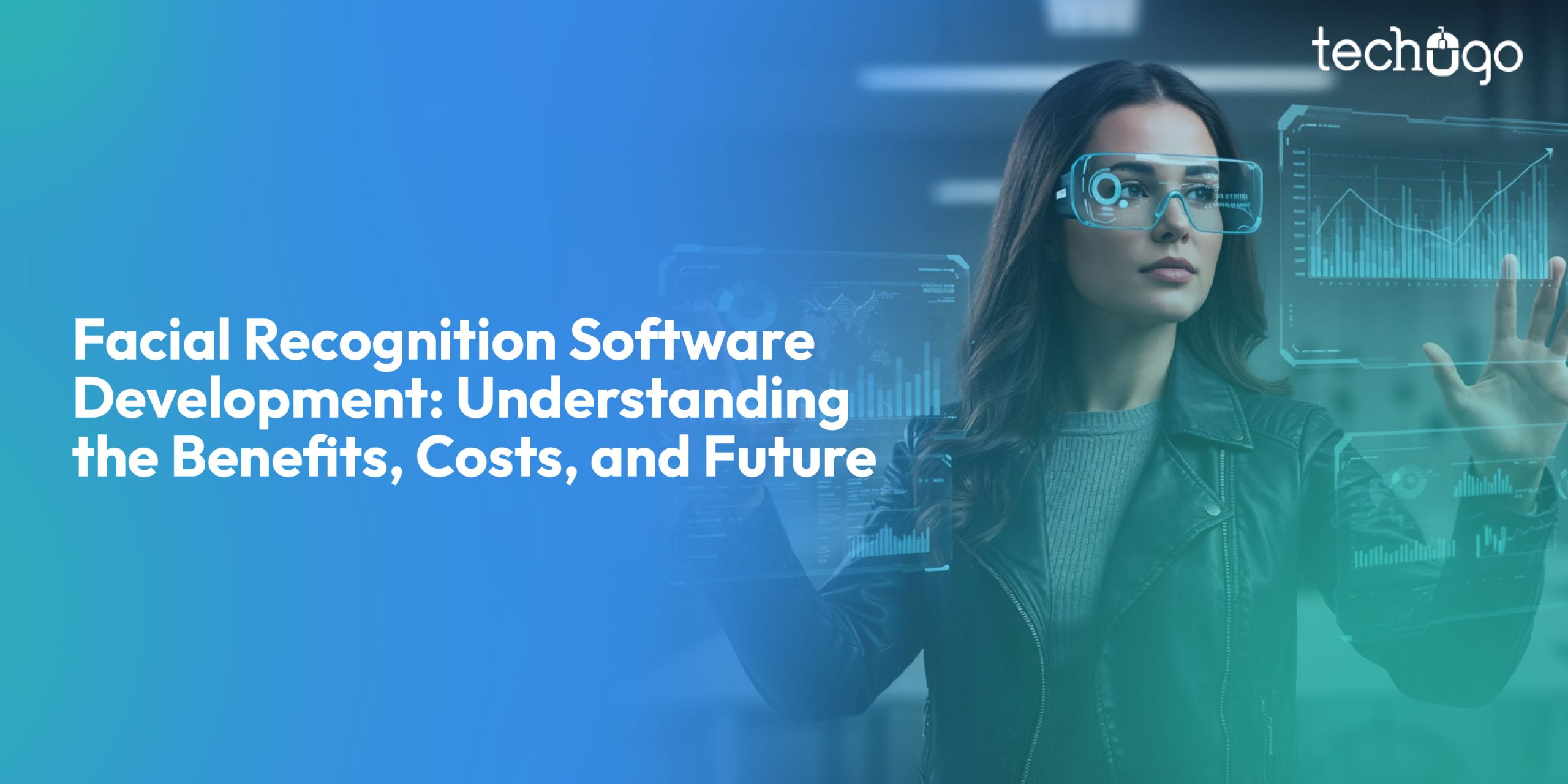
When was the last time you really stopped to appreciate just how handy it is to unlock your phone with just your face? We use facial recognition software in daily life but never think about how easy it makes our regular security checks. I am sure whenever you are goingto but some devices such as a mobile phone or a laptop, you check if it has an option for facial recognition or not?
We’ve come a long way with the technology behind facial recognition software development, as it’s a very helpful tool in protecting our sensitive data from being breached. Businesses today are investing heavily in facial recognition software development to improve authentication systems and digital security infrastructure. From healthcare to finance, retail to security, nearly every sector is beginning to adopt this technology. The facial recognition feature offers versatility and adaptability.
Curious how facial recognition turned into such a non-negotiable deal with its powerful features and benefits?
In this blog, we have discussed how it is changing the industry with more advanced security, enhanced convenience, seamless personalization, and mobility, and more decoupled transactions to the point that everyone can benefit from easy, secure and safe access to everything, making it indispensable for businesses and consumers.
Facial recognition is a digital identity tracker that uses the unique characteristics of your face to unlock a device or verify your identity. It examines your facial features, including the shape of your eyes, nose and chin, and compares them against the database to verify your identity.
So you have already dabbled with some facial recognition software features in your daily life,
whether you’ve used one to unlock your phone with just a look or punch in your office attendance. You’ve noticed that even in government institutions, there are cameras or software that scan your face to allow you to move on to the next stage or obtain paperwork. But have you ever wondered the reason behind the significance of this technology?
You hear about someone stealing your phone and cracking your PIN, getting access to your bank or personal information. With facial recognition, even if they have your phone, they can’t make it theirs without your face. Your face is one-of-a-kind and can’t be stolen or guessed, which provides an even stronger layer of security to protect your data. This is why companies are increasingly exploring facial recognition software development solutions to strengthen identity verification systems.
Also Read – Witness The Unstoppable Impact Of Facial Recognition Technology
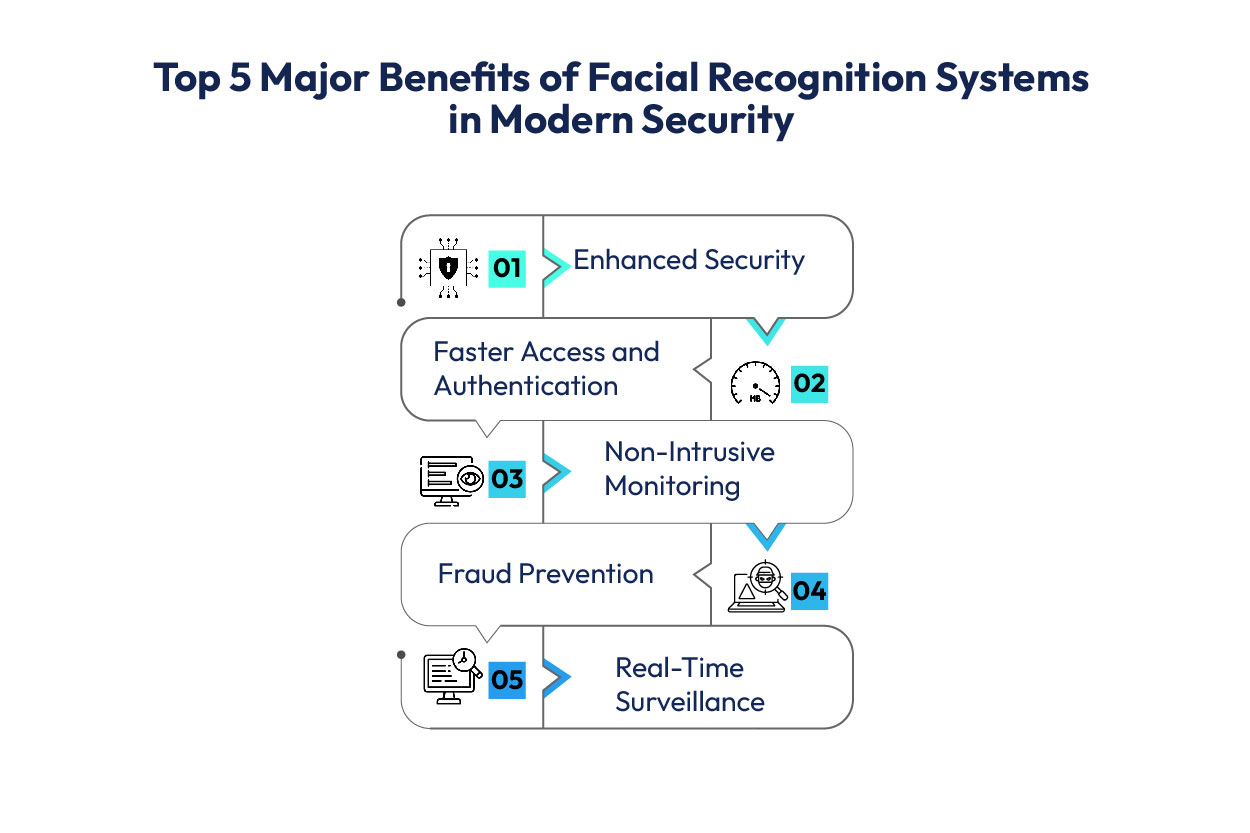
1. Enhanced Security: This feature provides advanced security so that only authorized users can access sensitive information. Through custom facial recognition software development company services, companies can easily tailor their requirements by using advanced technologies such as AI Integration. This enhanced access to any system by ensuring only authorized individuals can access sensitive information.
Example: Airport security systems checks peoples facial features and scan
2. Faster Access and Authentication: It is faster and easier to verify your identity with just a look. That reduce time and complexity of carrying hard copy or, identity cards or documents. Rather than typing passwords, checking phone for OTPs, or carrying physical documents, it provides one click solution. It also reduces human error that can often occur with traditional methods.
Example: Your smartphone may be able to unlock with just a glance at your face, providing faster access compared to typing a password. Or in office where you can mark your attendance without carry Id cards.
3. Non-Intrusive Monitoring: It provides contactless access of system which enhances hygiene as it reduces physical touch such as fingerprint biometric systems. These type of systems run in the background, especially in crowded areas such as airports, retail stores, or office buildings.
Example: In a corporate office environment, individuals may be able to walk past a security camera to gain access to restricted areas without any invasive touch points.
4. Fraud Prevention: Facial recognition reduces fraud and identity theft to a great extent, as it is almost impossible to reproduce or steal an individual’s facial features. This provide high security in sectors such as banking and finances where a small breach can loss to high losses. This ensures that only the rightful owner can complete sensitive actions, making it far more secure than traditional methods
Example – financial institutions are using facial recognition to create secure mobile banking applications that can only be accessed by the owner of the account.
5. Real-Time Surveillance: It provides real time surveillance, unlike traditional CCTV, where you have to monitor and find individually this allows security teams to take immediate action if suspicious behavior is detected or if an unauthorized individual attempts to enter a restricted space.
Example – law enforcement agencies can use facial recognition to identify known criminals or persons of interest in large public gatherings such as concerts or sports games.
A reliable custom facial recognition software development company can design these systems based on specific industry security requirements.
AI in facial recognition software development works as the main engine because it handles vast data with its advanced capabilities. AI works in finding each recognized face in the database and find the exact entry. Every time it sees a new face, the AI learns and adapts, becoming more intelligent with each experience. It’s not just crunching the numbers; it’s interpreting them, identifying the important information that distinguishes one face from another.
Modern facial recognition software development relies heavily on AI algorithms and deep learning models to achieve higher accuracy and faster identification. With deep learning technology, AI is becoming increasingly better at identifying faces from all angles and under any circumstances — be it on a busy street or in a dark room.
No matter how intricate it gets, AI can go into the data, find patterns, and give you a match that it thinks is accurate, so that not a single face gets missed. It is the linchpin of all of the process, converting dross data into valuable intelligence.
Also Read – A New Era for Industries and Society Via Artificial Intelligence
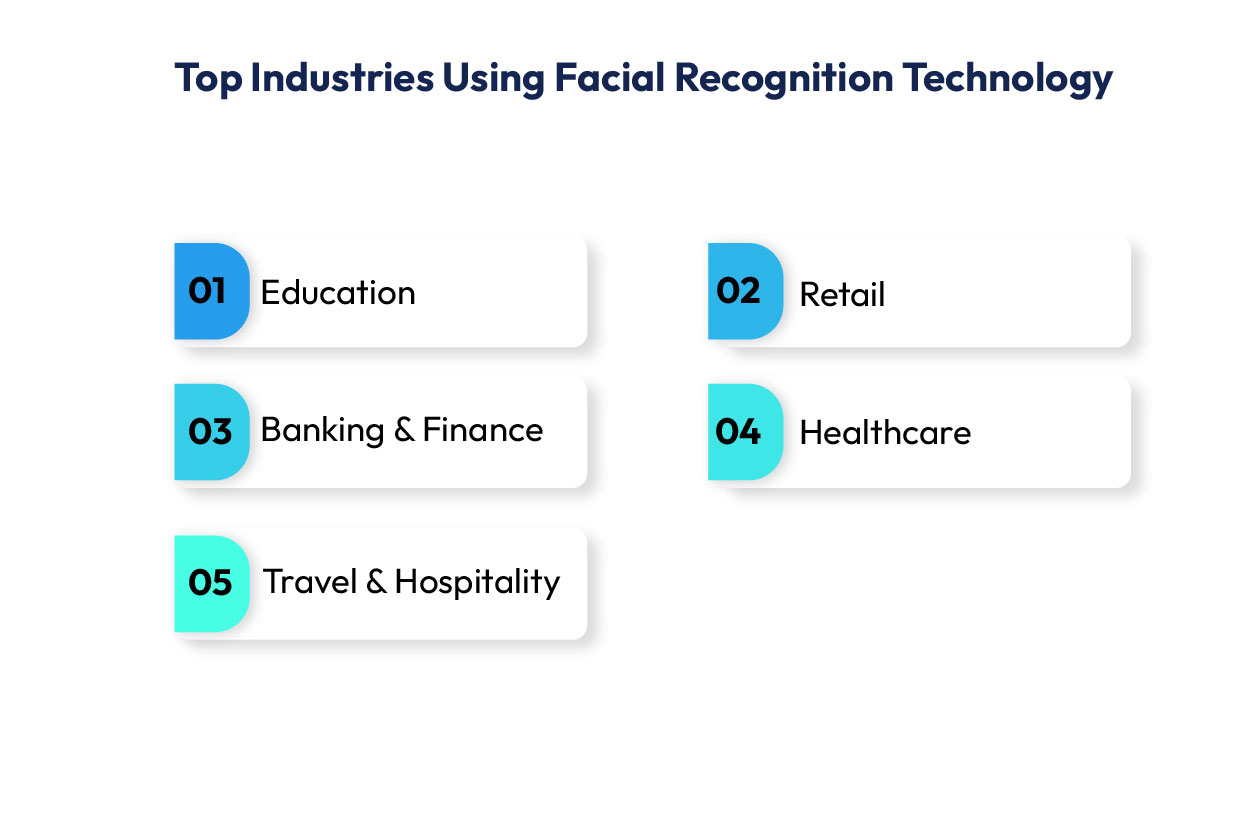
Due to its growing importance, facial recognition software development is now being adopted across multiple industries worldwide.
Have you ever skipped class and somehow still managed to make it onto the attendance sheet? Well, those days might be behind us, thanks to the rise of facial recognition technology in education. Schools, universities etc are shifting towards facial recognition technology because of its accuracy and security features. By using deep learning algorithms these systems can accurately scan and recognize faces in real-time, eliminating the possibility of proxy attendance or fraudulent sign-ins.
The whole scenario is being changed by cashless stores in Japan. Japan used facial recognition features to enhance the usability and remove human errors in the retail stores. Using such features, the identity of a retailer and shoppers can be verified, reducing fraud and identity theft.Many stores have incorporated this feature within their system in order to create a frictionless user experience by tracking their information as proof of identity, earning points or getting discounts for each and every purchase automatically
Facial recognition technology is rapidly changing the banking and finance sector, enabling quicker, safer, and more convenient transactions for users. Online procedures for KYC or bank account opening are adapting face recognition technology to confirm the identities of users.
Facial recognition technology is rapidly advancing in the healthcare industry and making a positive impact on security, patient care and operational efficiency. With the increasing demand for better management of patients to provide security and efficiency, use of facial recognition technology in healthcare is also expanding into patient identification, access control and customised treatment.
In the Travel & Hospitality sector, the use of facial recognition is revolutionizing how users engage with services to provide hassle-free and safer traveling experiences. At airports, it’s employed for biometric check-in and boarding, which helps to expedite the procedure by eliminating boarding passes with a simple look.
The process of facial recognition software development involves several stages, including data training, face detection, feature extraction, and real-time recognition.
Data Collection: A basic thing that needs to be done is to collect some data to train your model. FW (Labeled Faces in the Wild), CelebA, or VGGFace2 are available in the market for real time uses.
Face Detection: In this step, developers clean and prepare the collection of images for detection. This is called preprocessing for a facial recognition model.
Feature Extraction: After facial detection, this process takes place, an AI system, instead of analysing each image pixel by pixel, extracts unique features such as nose, shape of eyes etc.
Model Training: Using machine learning techniques next step is to train the system to identify and differentiate the facial features of an individual.
Face Matching: Once system scans any face, it matches it with the faces stored in the database to match the exact value.
Real-Time Recognition: Apply the trained model to identify faces in live video or images instantly.
Testing and Optimization: Continuous testing and updating your AI facial recognition model is the key to being competitive.
| Category | Tools/Technologies | Purpose |
| Deep Learning Frameworks | TensorFlow, PyTorch, Keras | For training facial recognition models |
| Computer Vision Libraries | OpenCV | For face detection and image processing |
| Face Detection Models | Haar Cascades, Dlib, MTCNN | For detecting faces in images or video frames |
| Face Embedding Models | FaceNet, OpenFace | For creating unique face identifiers (embeddings) |
| Cloud Platforms | AWS Rekognition, Microsoft Azure Face API | For cloud-based facial recognition solutions |
| Hardware | High-quality cameras, GPUs | For capturing images and training models faster |
The facial recognition software price can vary significantly depending on the complexity, features, AI models, and infrastructure required for development.
Description: This system only finds if a human face exists in real life or not. It does not match any stored images or database. It is mainly used in photo apps, camera focus features, etc. Its major task is to detect, not identify personality and features of a person.
Estimated Cost: $10,000 – $30,000.
Description: It is an advanced version of the basic model. Through this system, a human face is detected and matched with the data stored in the database or cloud. This system analyzes unique features of you, such as nose shape, eye, jawline structure, and other biometric patterns.
Cost: $30,000 – $100,000.
Description: This system is use ti identify facial features from real time vides, live streams or camera feeds. Major areas where these types of systems uses is mobile unlocking, payment authentication, surveillance systems, and security checkpoints. It works in milliseconds and identifies because of its high-level algorithm, optimized machine learning models, and efficient hardware or GPU support.
Cost: $50,000 – $150,000.
Description: Cloud-Based Facial Recognition are ready made systems that developers use to integrate them in any app or system. These types of systems are not built from scratch. Platforms such as Amazon Rekognition, Microsoft Azure AI Face, and Google Cloud Vision API provide integrated services.
Cost: $1,000 – $50,000
Description: A facial recognition system that is used by companies works in really big places like airports, government offices and security systems for companies. It handle large amount of human facial data with high-level security. Enterprise systems generally have the highest facial recognition software price because they require large-scale databases, cloud infrastructure, and advanced AI models.
Cost: $200,000 – $500,000
Facial recognition is rapidly becoming an essential component in modern digital security. With AI and the latest computer vision technology, it enables faster authentication, stronger fraud protection and a consistent user experience across industries such as financial services, healthcare, retail and travel. With enterprises continuing to focus on secure and contactless solutions, the future of security and identity verification is clearly being moulded by facial recognition.
Partnering with a custom facial recognition software development company helps businesses build scalable systems while optimizing the overall facial recognition software price.
A custom facial recognition software development company can build software that meets your business needs. These companies provide systems that can grow with your business advanced AI integration and ongoing technical support.
Many industries use facial recognition technology, such as banking, healthcare, retail, education, travel and government services. They use it for identity verification, surveillance and to give customers an experience.
It depends on the project. A simple system may take a months but a more advanced system can take up to a year.
Yes modern facial recognition systems use AI, encryption and other technologies to stop fraud and identity theft. It is more secure than using passwords or PINs.
Some common technologies used are AI and deep learning frameworks, computer vision libraries face detection models and cloud services, like AWS Rekognition or Microsoft Azure Face API. These technologies help make facial recognition software

In the current technologically driven environment, where making a name for startups is difficult, it is best highlighted with the presence of a mobile..


The most expensive part of healthcare AI isn’t always the algorithm. It’s the data. When we talk about AI in healthcare, we usually hear about brea..


Write Us
sales@techugo.comOr fill this form