

 SA
SA  KW
KW  IE
IE AU
AU UAE
UAE UK
UK USA
USA  CA
CA DE
DE  QA
QA ZA
ZA  BH
BH NL
NL  MU
MU FR
FR [ LET’S TALK AI ]
X
Discover AI-
Powered Solutions
Get ready to explore cutting-edge AI technologies that can transform your workflow!



Get ready to explore cutting-edge AI technologies that can transform your workflow!






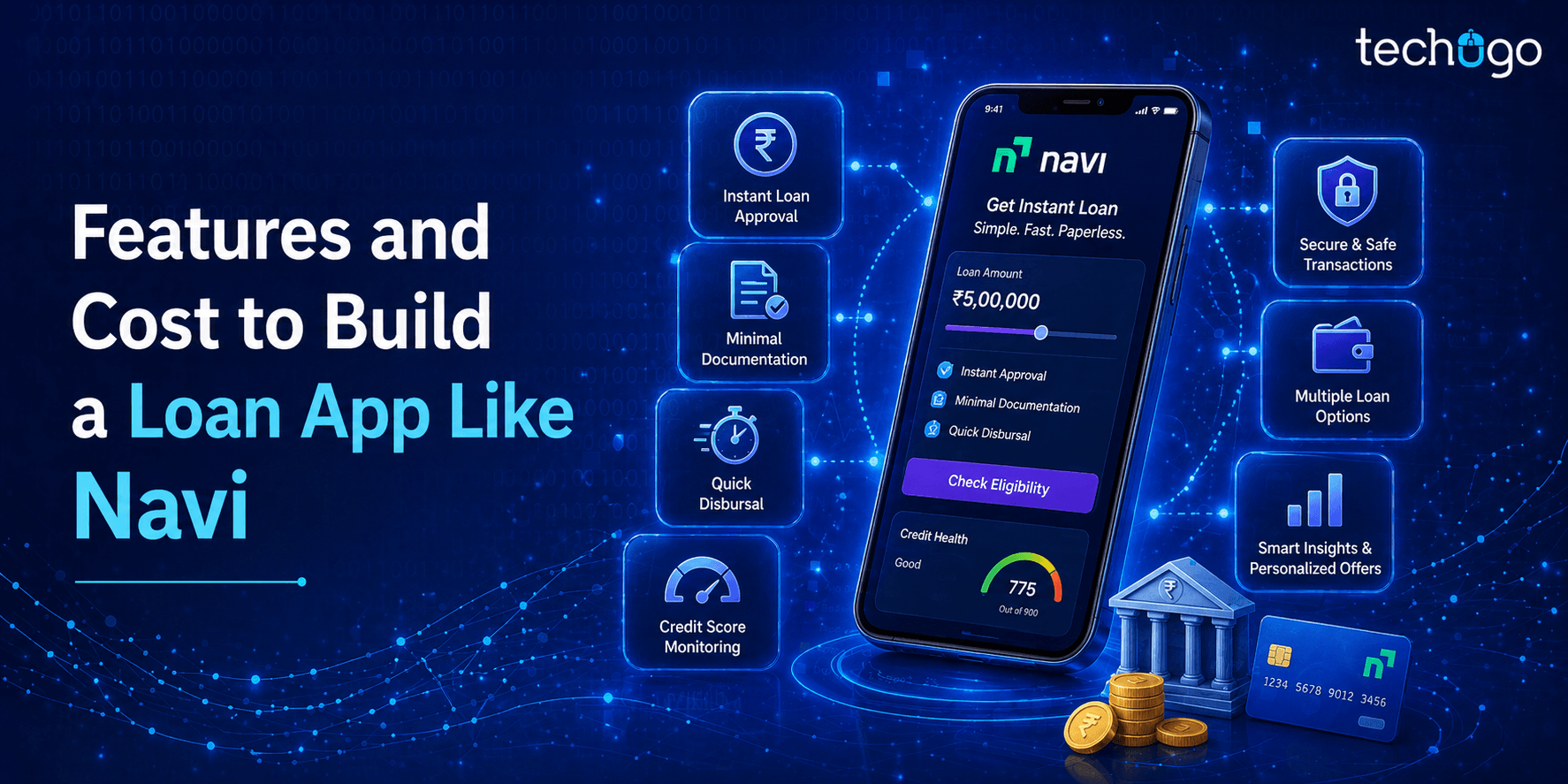
What if getting a loan felt as simple as ordering food online?
No bank visits. No paperwork. No waiting for days. Just a few taps, and money in your account.
That’s exactly what instant loan apps have made possible. Over the past few years, digital lending has completely reshaped how people in India access credit. Instead of relying on traditional banks, users now prefer fast, app-based solutions that deliver funds within minutes.
Apps like Navi have set a new benchmark in this space by combining speed, simplicity, and smart technology. They’ve shown that lending doesn’t have to be complicated to be effective, which is why loan app development like Navi is gaining so much attention among businesses today.
But how big is the investment?
The cost to build a loan app like Navi in India can land anywhere between ₹8,00,000 and ₹40,00,000 (or even more). It all depends on how far you want to push features and scale.
For businesses looking to enter this space…
A great idea is just the start. A fintech app development company like Techugo makes sure your loan app actually delivers.
In this blog, we’ll break down everything you need to know, from features and technology to cost and development process, so you can understand what it really takes to build a successful loan app like Navi.
Also read – 10 Must-Have Next Gen Banking App Features Every User Wants in 2026
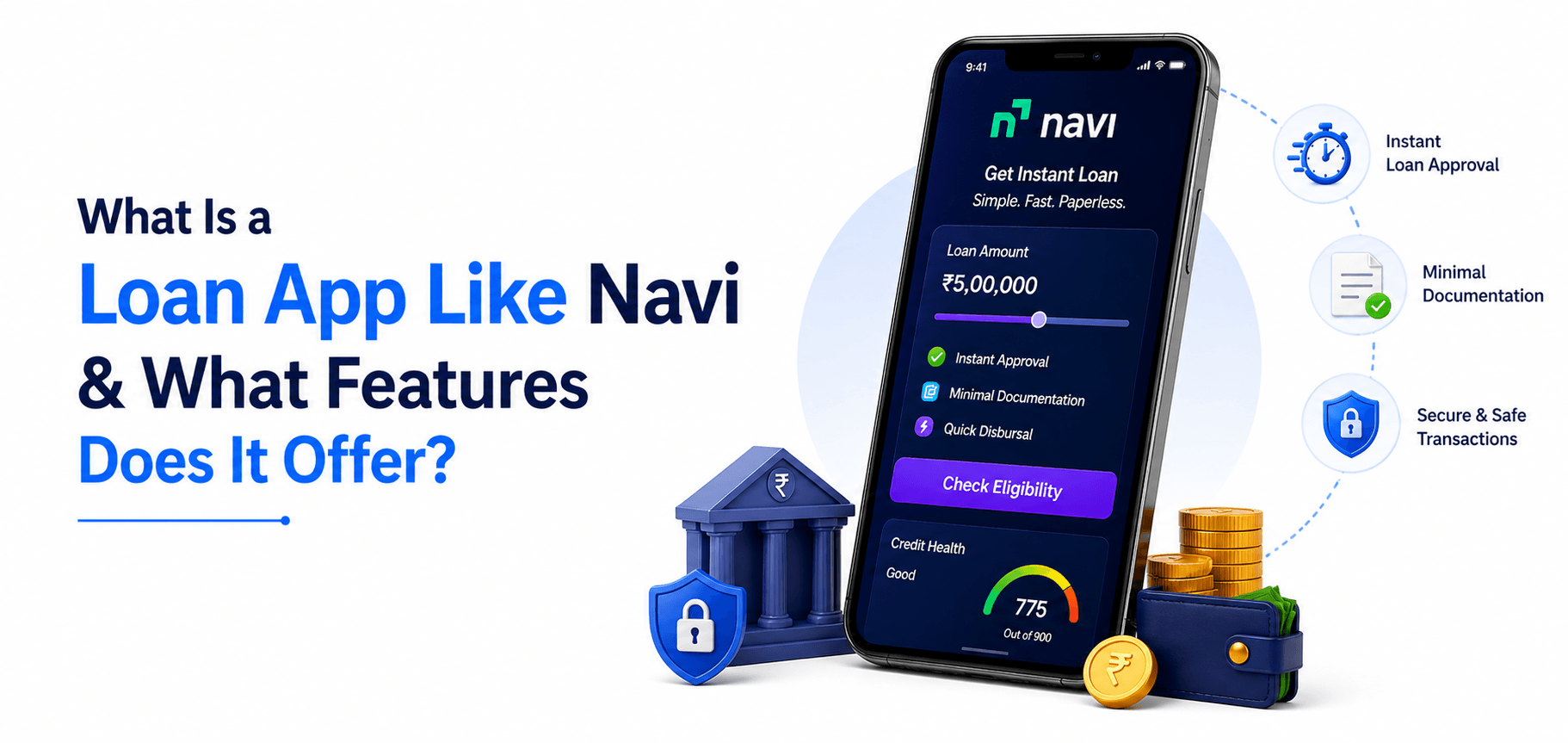
A loan app like Navi is a digital platform that allows users to apply for and receive loans directly through their smartphones. Unlike traditional banking systems, these apps eliminate the need for physical documentation and long approval cycles.
The process is designed to be quick and user-friendly. A typical user journey looks like this:
The difference between these apps and traditional banking is that they are fast, automated, and accessible. They are very dependent on technology, particularly AI and data analytics, in order to make real-time lending decisions.
They do not rely on credit scores alone and evaluate the behaviour of users, their past transactions, and financial habits. This will enable them to cater to more clients who would not otherwise be able to borrow money in the conventional way.
In order to build a successful loan app, both functionality and user experience should be prioritised. The appropriate features provide efficient operations and make the users interested.
Core Features?
At the foundation, every loan app should include essential functionalities that support the lending process:
These features create a seamless experience and reduce friction during the user journey.
Want to know why platforms like Navi have become so popular?
Instant loan apps have completely changed the way people access credit. These apps, unlike the old banks, eliminate the barriers of paperwork, long queues and lack of certainty. Instant loan apps are a viable solution to consider in the fintech arena when a business needs to venture into the market.
Here are some of the key benefits that make instant loan app development worth considering:
The need for fast, application-based loans is booming in India. A higher number of users would rather borrow using digital means than go to a bank. Businesses can exploit this growing market and attract more people by investing in instant loan app development.
The instant loan apps provide credit to individuals who would not be adequately served by conventional banking. The apps enable more individuals to access the money they require when they require it, including freelancers and small business owners, which promotes financial inclusion.
These applications provide several sources of revenue- interest revenue, processing fees, collaborating with other financial service companies, and cross-selling. An effective app may be developed into a scalable and lucrative business in a short period.
The app can support additional users, who can be many, without a high investment in the app once constructed. Scaling is easier and more affordable with features such as automated approvals, AIs that do credit scoring, and built-in repayment tracking.
To the point, instant loan apps development is not just a product creation, but it is a process of creating a solution that consumers desire, a business that will grow quickly and create a competitive niche in the thriving digital lending market.
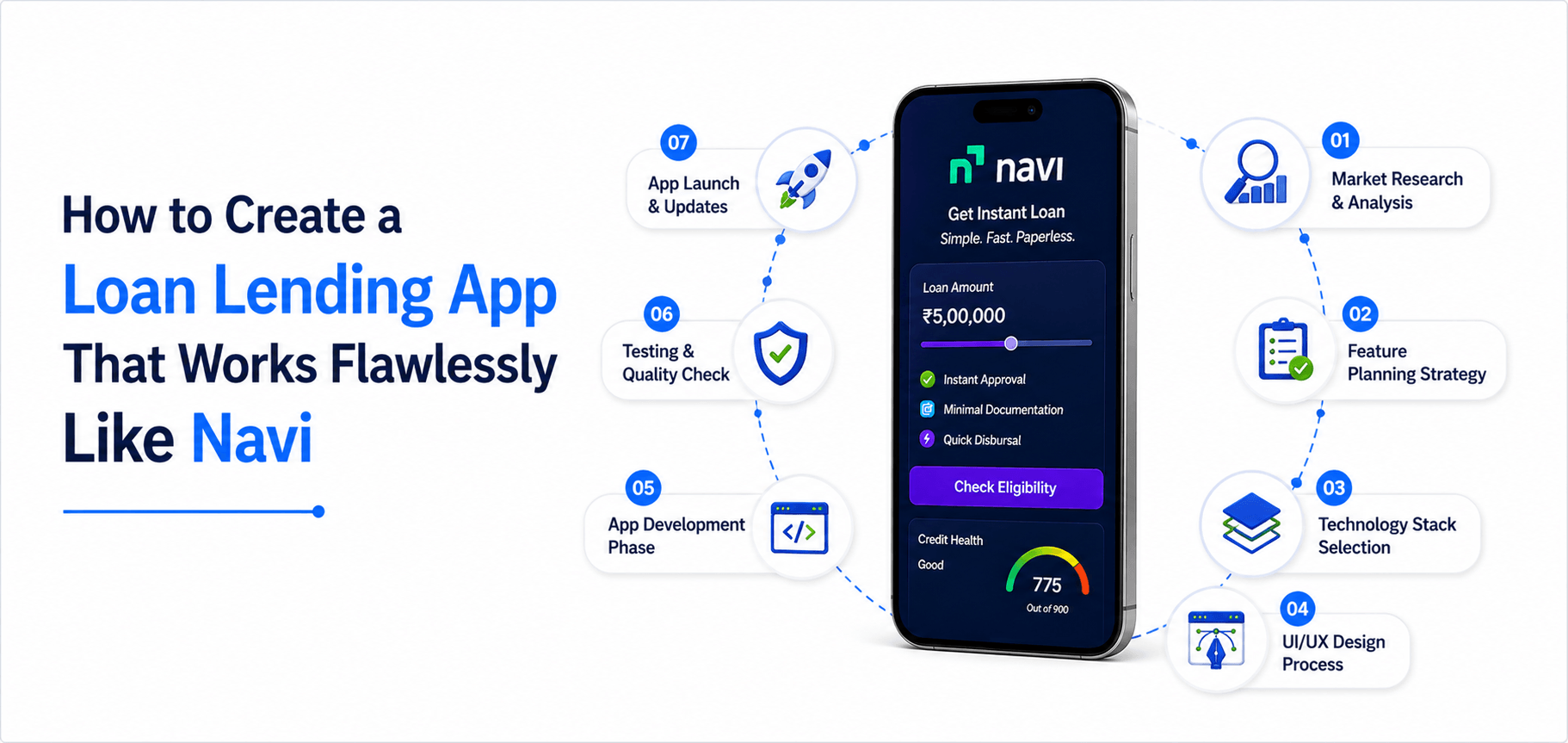
Creating a loan lending app starts with market research. You should find your target market, learn how they behave in borrowing and competition. This will assist you in identifying areas of weakness and clearly defining a value proposition.
The process of developing a loan lending application begins with intensive market research. You must find out who you are targeting, how they borrow and study competitors already in the market. This is an exercise to assist you in identifying the gaps, including the user segments that are underserved or fail to deliver features, and clarifying a clear value proposition. Powerful research means that your app would not only be useful, but relevant and competitive as well in the market.
The next step is feature planning, in which you make decisions on what your app will provide and how users will use it. This will include fundamental functions such as loan applications and eligibility checks, EMI tracking and user dashboards. At this point, it is necessary to find the golden mean. It must provide sufficient features and still make the experience simple and easy to browse. The well-thought-out characteristics immediately affect the user satisfaction and retention.
Then proceed to tech stack selection. The right technologies are significantly important in guaranteeing both scalability, speed, and security. The type of tech stack you choose will determine its capacity to handle high user traffic as well as the ease with which it can be revised or scaled in future. It also has a strong technical base to be better integrated with third-party services.
The design phase is UI/UX oriented and aimed at the establishment of a smooth and intuitive user experience. One should not feel lost in a loan application, as the loan app should have steps that direct a person along the application until repayment. Clearly laid out layouts, easy navigation and clear instructions are used to build trust and minimise the drop-offs in the process.
Next follows development in which the frontend system and the backend system are constructed and assembled. This phase involves the implementation of the features, configuring databases, and integrating APIs, including payment gateways and KYC providers. Effective development also makes the app reliable and accommodating of transactions.
An app is tested once it has been developed. This includes bug detection and resolution, security inspection, and even cross-platform compatibility. It is essential to test to prevent software bugs and possible mistakes that may leak into the system if the error is not detected.
Lastly, the application is released on the top platforms. But that is not always the end of the process. It needs constant up-to-date monitoring of its performance, and improvement according to the user feedback, in order to remain competitive and relevant to the changing market needs.
So, you know the steps to build a loan app. But have you ever wondered what really goes into building a loan app that feels instant on the outside? Just behind that Get Loan in Minutes button, there is a complete system running quietly in the background: data checking, decision making and taking all the precautions. And that is what the Loan App Development Process is all about.
Let’s have a look:
The process of developing the loan application starts with the discovery stage, during which the requirements must be collected, the goals need to be identified, and the roadmap should be developed. This phase provides sanity prior to the commencement of development.
Then comes the design stage, during which one develops wireframes and prototypes to chart the structure of the app and user flow. This assists in the visualisation of the final product at an early stage.
This is followed by the development stage, during which the developers develop the frontend and backend and add the required features and services.
The app undergoes a testing phase following development. In this case, performance, functionality and security are well checked as a way of being sure that it is reliable.
Finally, the app goes to deployment and maintenance. It is released on platforms, and it is regularly updated by fixing bugs, enhancing performance and introducing new features.
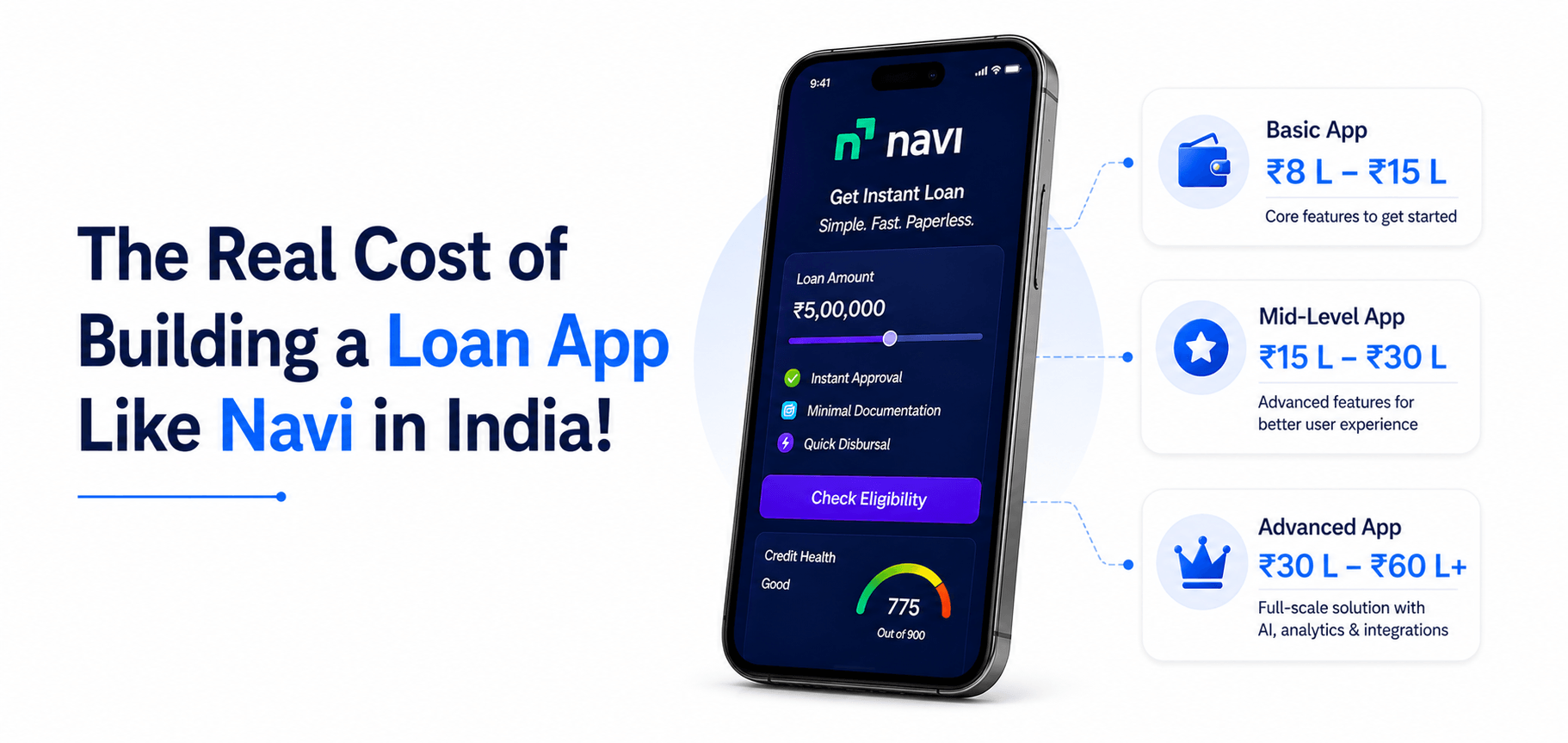
Building a loan app like Navi isn’t just about development; it’s about the level of capability you want your platform to deliver. A basic version with limited features can cost around ₹8 lakhs, while a more advanced app with AI-based credit scoring, real-time integrations, and strong security layers can go beyond ₹40 lakhs. The final cost depends on how complex, scalable, and feature-rich you want the app to be.
At a high level, the cost is distributed across multiple stages, from design and development to integration and testing. Each component plays a role in shaping both the user experience and the app’s performance, which is why cutting corners in one area can impact the overall quality.
| Component | Estimated Cost Range |
| UI/UX Design | ₹1,00,000 – ₹4,00,000 |
| App Development | ₹5,00,000 – ₹20,00,000+ |
| API Integrations | ₹1,00,000 – ₹5,00,000 |
| Testing & QA | ₹1,00,000 – ₹4,00,000 |
| Maintenance | Ongoing (monthly/yearly) |
Several factors influence how much you’ll actually spend on development. The complexity of features is one of the biggest drivers; adding AI models, fraud detection, or advanced analytics will increase costs. The technology stack and third-party integrations you choose also play a role, especially when dealing with payment gateways and KYC systems.
The development team you hire matters just as much. A larger team with extensive experience in fintech can be more expensive in the short term, but will be less costly in the long-term due to fewer faults and more scalability. Finally, the place where the development company will be situated will influence prices, and areas such as India provide a balance between the price and quality.
After all, it is smarter not to pursue the cheapest, but to invest in the appropriate features and base that will help grow in the long run.
The appropriate technology is to develop a loan application that functions properly. And with that said, we will dive into the technology stack of loan applications and discover how applications such as Navi are able to make all this come together so easily and safely.
The frontend is the aspect of your application, and Flutter or React Native provide a user-friendly experience on devices. The operations, including processing loans all the way to connecting with credit bureaus and payment systems, are executed by the backend, which is driven by either Node.js or Python.
Your database (MongoDB or PostgreSQL) is the safe where sensitive user and transaction information is stored, APIs, and integrations introduce all the necessary services, such as KYC verification, notifications, and payment gateways. To top it all, the security layer is very strong and will provide encryption, fraud detection and compliance to your users as well as your business.
Each layer not only works together but also flows with the app. Users receive approvals instantly, repayments run smoothly, and your business is provided with a platform that grows, scales, and adapts effectively.
The right tech stack is like the engine of a sports car. It’s smooth. It’s reliable. And it is built to grow as your user base grows. Nail it, and your app feels fast, secure, and effortless, just like Navi.
Anyone can build a loan app. Few can build a user’s trust with their finances.
As a leading mobile app development company in India, Techugo blends strategy, design, and advanced tech to create secure, scalable loan apps that actually perform. From AI-driven credit scoring and seamless onboarding to bank-grade security and regulatory-ready architecture, every solution is built for real-world fintech challenges.
With a strong portfolio of globally launched apps, multiple industry recognitions, and experience across startups to enterprises, Techugo has consistently delivered products that drive user adoption and business growth. Their expertise lies in turning complex financial workflows into smooth, intuitive digital experiences.
Don’t just launch a loan app, launch a fintech experience users rely on. Partner with Techugo.
An average loan application, such as Navi, would cost between 8 lakhs to 40 lakhs or even more, depending on the features, complexity and technology application. Such features as AI-based credit score, real-time integrations, and a higher level of security may add to the total cost.
On average, it may take 3 to 6 months to design a loan application. The time frame will be based on the complexity of the app, the number of features, and the professionalism of the development team.
The user registration, eKYC verification, loan eligibility checks, instant approvals, EMI calculators, and repayment trackers are some of the must-have features. The app can be improved with advanced functions, such as AI-based credit score and fraud detection.
Loan apps are developed based on such technologies as Flutter or React Native (for frontend), Node.js or Python (for backend), MongoDB or PostgreSQL (as databases), and a variety of APIs, which are required to make payments and conduct KYC.
Instant loan applications are in high demand, have high revenue growth, and can be scaled. They further enable companies to access the digital lending market that is expanding and reach more people.
The application of loans receives interest rates, processing charges, and late payments, along with providing other financial products such as insurance or investments.

Ever noticed how ordering food has gone from a “maybe tonight” thing to an everyday habit? That shift didn’t just happen; it was built. Apps like EatS..
You buy something online… and then you get money back. Sounds too good to be true, right? But yes, this is true. But wait… If users are getting paid t..


Write Us
sales@techugo.comOr fill this form