

 SA
SA  KW
KW  IE
IE AU
AU UAE
UAE UK
UK USA
USA  CA
CA DE
DE  QA
QA ZA
ZA  BH
BH NL
NL  MU
MU FR
FR [ LET’S TALK AI ]
X
Discover AI-
Powered Solutions
Get ready to explore cutting-edge AI technologies that can transform your workflow!



Get ready to explore cutting-edge AI technologies that can transform your workflow!






As we all know, the Middle East is now heavily investing in digital communities. In Qatar, people are connected, mobile-first, and the government is driving digitization. This changes how they find homes, jobs, services, and events.
One platform that stands out and everyone is talking about is: Qatar Living. People use it daily for housing, jobs, events, advice, and local news. It earns attention, trust, and repeat visits, making it an essential infrastructure rather than just a website.
Therefore, investors are seeing it as a key growth channel. Many businesses now ask: should we build a community platform like Qatar Living? The first question is always: what is the cost to build a platform like Qatar Living?
So, a scalable MVP typically starts around QAR 109,200 – QAR 254,800 ($30,000 – $70,000). And a full-scale platform with advanced search, monetization, moderation, multilingual support, and high performance can exceed QAR 2,184,000+ ($600,000+).
Though the total cost of online community platform development depends on features, launch speed, and future needs.
This blog breaks down the Qatar Living app development cost, key features, and factors that affect pricing. By the end, you’ll understand what it takes to build a social community app that works for your growth strategy.
Also Read: How Much Does It Cost to Create an App in Qatar?
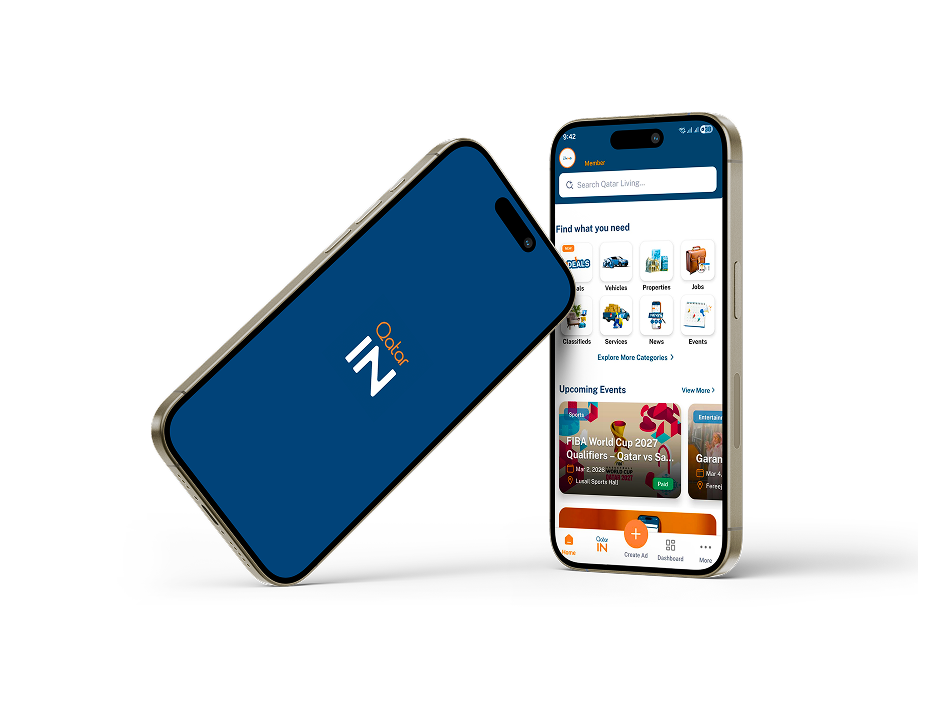
Qatar Living is a website, but more than that, it’s a full social community app that connects people in Qatar. It was launched in 2005. Now it has become the country’s largest online community platform. It serves both expatriates and locals. It helps people with housing, jobs, classifieds, vehicles, events, and everyday advice. Its success comes from a few key factors:
Qatar Living was one of the first platforms in Qatar to serve both expats and locals digitally. This gave it a strong, loyal user base early on.
The platform is tailored for Qatar’s unique multicultural community. It understands local customs, regulations, and lifestyle needs.
Users don’t need multiple apps. Qatar Living combines housing, classifieds, jobs, vehicles, events, and local services in one place.
Every feature solves a real daily problem. It’s built around user habits, not trends.
Qatar Living didn’t grow because of a single feature. It grew because it became part of daily life. People check it repeatedly for updates on housing, jobs, and local events. That habit builds trust, attention, and retention which are the key factors for any community platform development.
Another reason for its success is simplicity and usability. The platform is easy to navigate, which makes engagement high. Users can find what they need quickly, whether they’re looking for a new apartment or a local service.
From a business perspective, Qatar Living shows that custom app development for community works best when the focus is on solving real problems at scale. If you want to build a community platform like Qatar Living, the fastest path is to start small. Focus on one segment, like real estate, jobs, or lifestyle services, and then expand gradually.
Platforms that understand users, prioritize trust, and meet repeat needs grow naturally. In markets like Qatar, word-of-mouth and community influence are stronger than paid marketing. Relevance, utility, and consistency are what keep users coming back.
Key takeaway from Ankit Singh, COO at Techugo, for businesses –
“A forum app, a classifieds app, or a social network app for the community will not be successful simply because you copied the features of another application. What distinguishes them from one another is the success of the centric use case and the everyday problems that your application is able to resolve. The more value that your application provides to the community, the more integrated it will become into the daily routine of the person using that application, just like Qatar Living!”
Building a platform like Qatar Living is not about a single number. The cost to build a platform like Qatar Living depends on features, complexity, and business goals. Costs vary based on platform type and development stage. Here’s a clear breakdown:
| Platform Type | Investment Range (QAR) | Investment Range (USD) | Timeline |
| Minimum Viable Product (MVP) | 109,200 – 254,800 | 30,000 – 70,000 | 3-4 Months |
| Mid-Complexity Platform | Up to 1,092,000 | Up to 300,000 | 6-8 Months |
| Enterprise-Grade Platform | 2,184,000+ | 600,000+ | 12-18 Months |
Start with the core features that solve real user problems. Launch early to test the market. Collect feedback and improve gradually. This keeps costs low while validating your idea.
Focus: Basic social community app development, forums, classifieds, and user profiles.
Also Read: Understanding MVP App Development Costs: A Comprehensive Guide for Startups
Add features like payment systems, messaging, detailed user accounts, and improved navigation. Turn your MVP into a monetized platform. Strong user growth shows market acceptance.
Focus: Enhanced online community platform features for engagement and revenue.
Include AI-based recommendations, microservices architecture, integrations with external systems, and detailed reporting. Build a platform that can handle millions of users smoothly.
Focus: Advanced Qatar Living clone app development for large-scale operations.
The final community platform development cost depends on the features you choose, the tech stack, and whether you hire an in-house team, hire mobile app developers or freelancers, or benefit from mobile app development services from a reputable company.
Also Read: Cost to Hire Blockchain Developers in the Middle East: Country-Wise Rates Explained
Building an app like Qatar Living involves multiple stages. Understanding each stage helps you plan your community platform development cost better.
| Development Stage | Cost (QAR) |
| Research & Planning | 18,200 – 36,400 |
| Design Phase | 27,300 – 54,600 |
| Development Phase | 91,000 – 163,800 |
| Testing & QA | Adds 15–20% |
This is the foundation. Teams study the market, analyze competitors, and choose key features. Costs usually range from QAR 18,200 to QAR 36,400.
Next comes UI/UX design. Designers create wireframes, mockups, and test layouts to make the app intuitive. This adds QAR 27,300 to QAR 54,600. Total investment now: QAR 45,500 – QAR 91,000. Good design ensures users will actually want to use your social community app.
Here, your app comes to life. Backend systems, databases, APIs, and the user interface are built. Costs range from QAR 91,000 to QAR 163,800. Cumulative investment: QAR 136,500 – QAR 254,800. This is the core of online community platform development.
Testing runs throughout development. Teams fix bugs, check performance on all devices, and ensure security. Testing adds about 15–20% to the total cost.
This breakdown shows exactly what you’re paying for at each step. By understanding each stage, startups, enterprises, and investors can budget for a Qatar Living clone app development without surprises.
Before setting a budget, remember this: platform cost is not just about screens. It depends on architecture, scalability, and how much users rely on it daily. If you’re planning community portal development in Qatar or the Middle East, these are the main factors that affect the cost of Qatar Living app development.
A simple listings portal costs much less than a full social community app with conversations, jobs, rentals, and services. Adding advanced search, dashboards, admin controls, monetization, and moderation increases cost. More features make the platform sticky but also more complex to build.
Platforms for 5,000 users are very different from platforms for 500,000. Handling traffic spikes, multiple logins, and real-time updates needs a strong backend, caching, and scalable databases. Treat infrastructure as a core product decision when estimating community platform development cost.
Community apps have multiple roles: admins manage content, moderators ensure safety, advertisers track engagement, and users post and interact. Each role adds complexity to permissions and workflows. Costs rise as governance and paid listings grow. Many projects underestimate this effort.
Not all platforms are built the same way. Monolithic systems launch faster but get expensive to maintain as they grow. Microservices or modular architectures need more effort upfront but scale better long-term. Smart engineering choices early save money later, even if initial budgets are higher.
Your tech stack affects performance, data flow, and future upgrades. Cloud hosting, content delivery networks, search engines, analytics, and security tools all influence costs. Mature technology reduces risk but can cost more. Lean setups are cheaper but need stronger engineering skills. Balancing stability and scalability is one of the biggest levers in online community platform development.
Platforms in Qatar need Arabic support, right-to-left design, and culturally aligned UX. This adds QA, UI adjustments, and content structuring. Deep localization increases Qatar Living app development cost, but it boosts engagement and adoption. Global templates often fail in regional markets without it.
Open communities need protection. Reporting tools, content filters, admin oversight, and AI moderation take time to build. In social community app development, trust is a feature, not a setting. Proper safety systems protect the platform and its users, but they add cost.
Advertising engines, featured listings, subscription tiers, and dashboards are not plug-and-play. Each revenue stream adds complexity to UI, backend, and accounting. Planning monetization early increases initial spend but ensures long-term sustainability. Skipping this step can lead to expensive rework later.
Handling user data comes with legal requirements. Data protection, content liability, and operational transparency must be included. Compliance adds testing and security costs but reduces regulatory risk. Cutting corners here may lower upfront community platform development cost, but it increases business risk.
These factors show that most of the cost in online community platform development comes from early technology and architecture decisions, not just screens or features.

Even after launch, building a community platform like Qatar Living involves costs that many businesses overlook. These hidden expenses can significantly impact your Qatar Living app development cost if not planned for.
Platforms need constant updates for security, bug fixes, and new features. Skipping this slows performance and increases long-term spend.
New communities need posts, discussions, and active engagement. Moderation is continuous, especially in social community app development, to maintain user trust.
Real users reveal hidden issues. Optimizing speed, search, and database queries costs time but ensures smooth performance at scale.
Promoting your platform isn’t only about ad spend. Tools like push notifications, email campaigns, analytics, and CRM systems are part of your tech infrastructure and add cost.
Users often ask for extra features. Adding them mid-project or after launch increases development time and community platform development cost. Prioritize features early to manage budgets.
Managing multiple admin roles, permissions, and dashboards adds backend complexity. Detailed governance increases development and testing effort.
Cloud hosting, caching, and elastic servers allow your platform to handle growth. This upfront investment avoids crashes during high traffic periods.
As the platform expands, you may need architecture upgrades or partial rebuilds. Early planning reduces surprises, but scaling still requires budget.
These hidden cost areas show that Qatar Living clone app development involves more than just screens and features. Planning for maintenance, moderation, scalability, and admin complexity is key to long-term success. So, when estimating the total cost to build a platform like Qatar Living, don’t forget to include such hidden costs.
A large budget isn’t always needed for success. Strategic social community platform development can deliver a high-quality platform without overspending. Smart cost optimization lets businesses and entrepreneurs build strong community platforms while keeping finances efficient and maximizing ROI.
The key to cost-effective community portal development is making smart decisions early. These strategies can cut your overall investment by 40–60% while keeping essential features for a competitive launch.
The most effective way to optimize the cost to build an online community platform like Qatar Living is to validate your idea first. An MVP focuses on core features like user registration, basic listings, and simple messaging. This reduces initial costs by 60–70% and provides real user feedback to guide later development.
Use the MoSCoW method (Must have, Should have, Could have, Won’t have) to focus on launch-critical features. For community portal development, “Must have” features include user profiles, content posting, and search. Advanced features, like AI recommendations, can wait for later phases.
Frameworks like React Native or Flutter let you build for iOS and Android from a single codebase. This reduces mobile development costs and time by 30–40% compared to separate native apps.
Partner with regional development teams in the GCC or Middle Eastern tech hubs. They offer cultural alignment, local market knowledge, and competitive pricing.
Combine local project management with offshore development resources. This ensures clear communication, oversight, and cost efficiency. Fixed-price contracts with defined milestones also help control budgets.
Following these strategies can optimize your Qatar Living app development cost while building a scalable, sustainable social community app that meets market needs.
Building a Qatar Living clone app is not just about features. It is also about revenue. A smart social community app can earn through multiple streams while serving its users. Here are the most common monetization models:
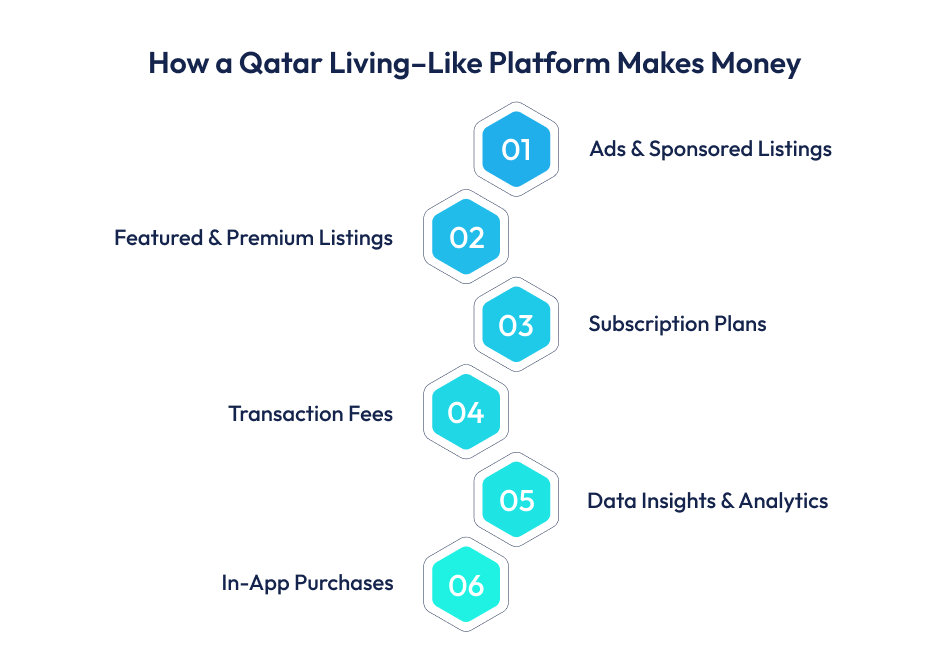
Display ads, banner campaigns, and sponsored posts generate steady revenue. Local businesses, real estate agents, and service providers often pay to reach your community.
Offer users the option to highlight their posts such as jobs, properties, or classifieds, for a fee. Featured listings improve visibility and create a premium revenue stream.
Provide paid memberships for exclusive features, such as advanced search, analytics, or ad-free browsing. Subscriptions ensure recurring income while enhancing user experience.
If your platform enables payments for services, rentals, or classifieds, you can charge a small fee per transaction. This turns community platform development into a direct revenue engine.
Aggregate anonymized user data to offer market insights to businesses. This requires careful compliance with privacy regulations but can be a valuable monetization option.
For engagement-focused features such as badges, premium content, or enhanced messaging, users can pay small amounts inside the app. This works well in social community app development focused on active user engagement.
Choosing the right monetization model depends on your audience, market, and Qatar Living app development cost. Many platforms use a combination of these models to balance revenue and user experience.
Building a community platform like Qatar Living takes careful planning and execution. Follow these steps to create a scalable, engaging social community app:
Start by choosing a trusted social media app development company or development team. Look for experience in community platform development, cultural understanding, and scalable architecture. A good tech partner guides design, development, and launch efficiently.
Decide the focus of your platform. Are you targeting expats, locals, or a niche community? Understand user needs and daily problems you aim to solve.
Identify core features for your MVP as shown below and then gradually add advanced features as your platform grows. Decide on monetization strategies such as ads, premium listings, subscriptions, or transaction fees.
| Core Features | Advanced Features |
| User profiles and identity | Smart recommendation engine |
| Advanced search and filters | Paid listings and promotions |
| Listings and posting system | Live chat and direct messaging |
| Moderation and reporting controls | Advanced analytics and reporting |
| Mobile-first experience | Multilingual and localization support |
| Notifications and alerts | AI-powered moderation and search |
| Admin dashboard and controls | User role management |
| Event and marketplace integration |
Create intuitive wireframes and mockups. Focus on UX/UI that encourages repeat usage. Make it easy for users to find, post, and interact with content.
Build the backend, databases, APIs, and user interface. Use scalable architecture and consider cross-platform frameworks like Flutter or React Native for faster deployment.
Conduct thorough QA to fix bugs, optimize performance, and ensure security. Test on multiple devices to guarantee smooth user experience.
Release a minimum viable product to collect user feedback. Monitor engagement, identify areas for improvement, and refine features based on real-world usage.
Gradually add advanced features like AI recommendations, advanced search, and analytics dashboards. Scale infrastructure to handle growth and user traffic efficiently.
Following this structured process ensures you build a Qatar Living clone app that is efficient, scalable, and ready to capture user attention in your target market.
Also Read: AI Development Cost in 2026: What Businesses Should Expect
Building a community platform like Qatar Living requires experience, technical skill, and a deep understanding of the local market. That’s where Techugo stands out as a leading mobile app development company in Qatar.
Techugo has a proven track record in social community app development. We design and build scalable platforms that engage users, support multiple roles, and handle high traffic. Our teams combine local market knowledge with global engineering expertise, making us ideal for projects in Qatar and the GCC region.
From MVP to enterprise-grade platforms, Techugo ensures that your Qatar Living clone app development is smooth, efficient, and cost-effective. We focus on intuitive UX, advanced features, robust backend systems, and long-term maintainability.
Choosing Techugo means choosing a partner who understands your vision, delivers high-quality community platform development, and helps your platform grow sustainably in Qatar’s digital world.
A basic community platform can take 3 to 4 months to build.
A mid-level platform with custom design and multiple features may take 5 to 7 months.
Large platforms like Qatar Living with advanced scalability and security can take 8 months or more.
Popular choices include React or Angular for the frontend and Node.js or Laravel for the backend.
Cloud services like AWS or Azure help manage traffic and data securely.
The best tech stack depends on your budget, scalability needs, and long-term roadmap.
Yes, it can be monetized in multiple ways.
Common monetization models include paid listings, banner advertising, featured posts, and subscription plans.
Some platforms also earn through business promotions and sponsored content.
A strong user base makes monetization easier and more profitable.
Yes, it can be built with location-based filters and city-wise categories.
This allows users to view listings and posts relevant to their area.
It also helps businesses target local audiences more effectively.
People in Saudi Arabia order food on apps, shop on apps, and look for discounts on apps. They make payments on apps and even look for ride hailing ser..
The whole process from conception through young children is a huge transition that can lead to a lot of stress, uncertainty, and difficulties in findi..


Write Us
sales@techugo.comOr fill this form