

 SA
SA  KW
KW  IE
IE AU
AU UAE
UAE UK
UK USA
USA  CA
CA DE
DE  QA
QA ZA
ZA  BH
BH NL
NL  MU
MU FR
FR [ LET’S TALK AI ]
X
Discover AI-
Powered Solutions
Get ready to explore cutting-edge AI technologies that can transform your workflow!



Get ready to explore cutting-edge AI technologies that can transform your workflow!






Agriculture has always been the backbone of human survival, but now modern farming is dependent on technology. Farmers and agribusinesses use digital tools to manage field activities, track resources, and minimize manual errors as well through a centralized farm management system.
Operations such as crop planning, soil monitoring, pest control, irrigation scheduling, and weather analysis…all can be handled more accurately now with the help of farm management software. AI in agriculture and cloud-based farm management software has further transformed traditional farming into a data-driven business model.
In fact, research says that the global farm management software market is projected to more than double to USD 10.6 billion by 2030.
Demand is growing and making farm technology a promising investment opportunity for agribusinesses and startups alike. However, before investing, one major question arises: what is the farm management software cost? More importantly, what determines the cost to build farm management software?
Also Read – Leveraging Drones for Livestock Management: Essential Best Practices
In this blog, we provide a complete breakdown of farm management software development cost, along with key factors that impact pricing and ways to plan your investment efficiently.
Let’s get started.
Image Source: Grand View Research
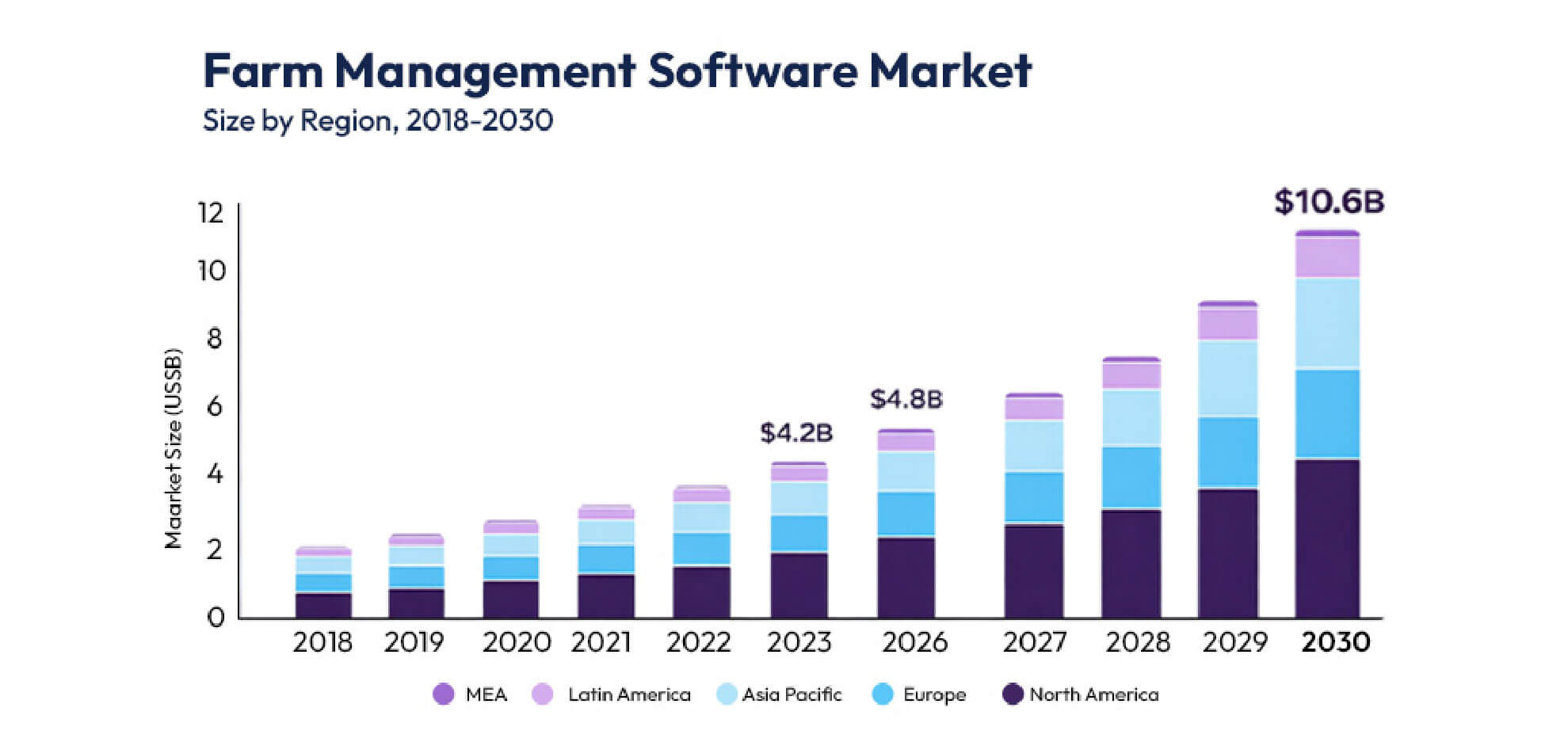
Farming today is not limited to just manual planning and paper records. It is becoming a data-driven industry where decisions are based on real-time information about crops, soil, weather, and resources. This shift is one of the main reasons why farm management software is gaining strong attention from farmers, agribusinesses, and investors.
Recent industry data shows that the market is projected to cross USD 10 billion by the early 2030s. This strong growth reflects how quickly digital tools are being adopted in agriculture.
This rise is happening because farming is becoming more complex. Farmers now deal with unpredictable weather, rising input costs, and the need to produce more food with limited land and water. A farm management system helps solve these problems by bringing all farm operations such as crop planning, soil data, irrigation, and livestock tracking, into one digital platform.
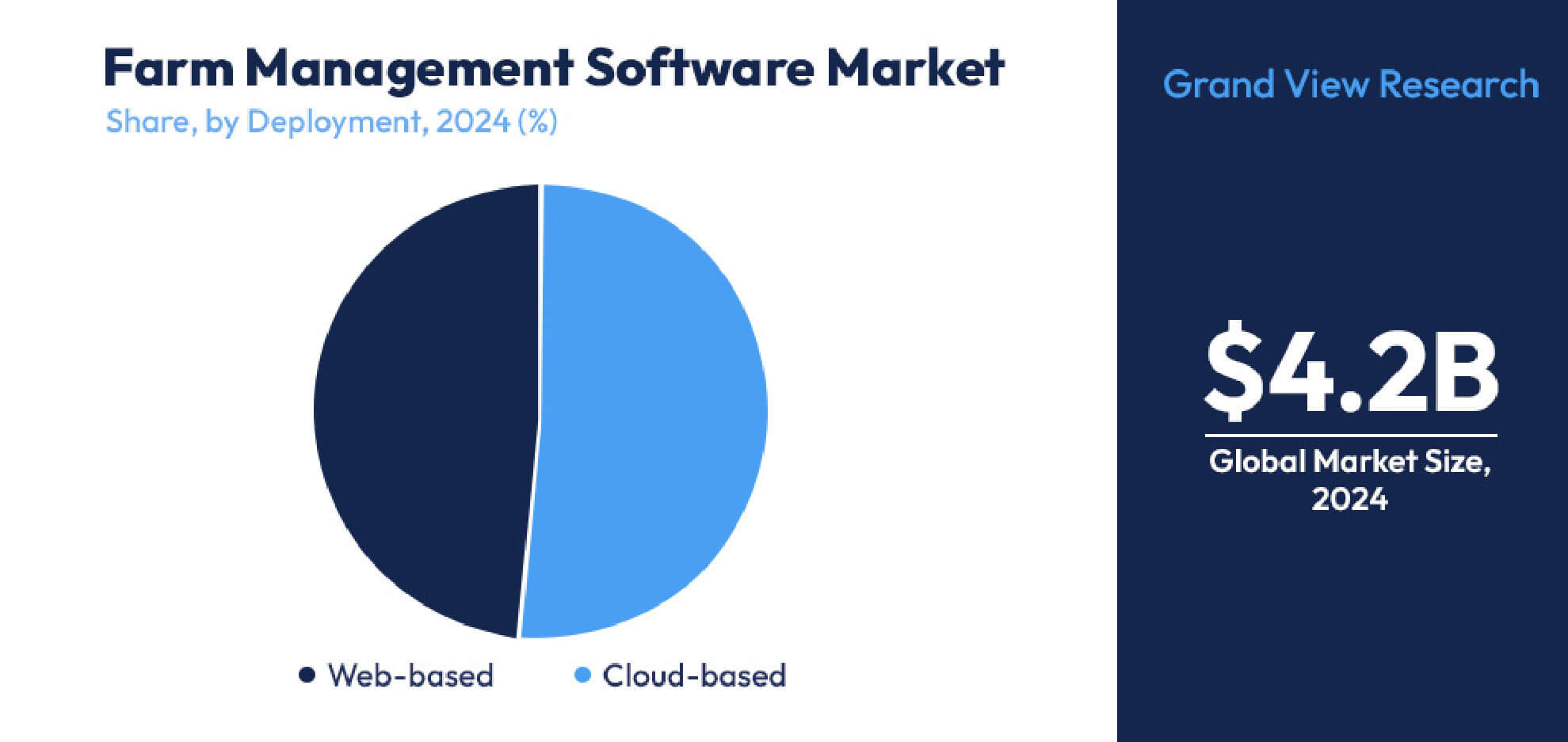
Another key driver is the shift toward cloud-based farm management software. Cloud solutions allow farmers to:
This makes software useful not only for large agribusinesses but also for small and mid-sized farms.
Region-wise, North America currently leads the market due to early adoption of smart farming tools. At the same time, countries in Asia-Pacific and Latin America are catching up because of rising food demand and government support for digital agriculture.
Farm management software is also being used across different farming areas such as:
These use cases show that farm software is no longer optional. It is becoming a core part of modern agriculture.
In short, the market growth proves one thing clearly: investing in farm management software is a long-term opportunity. As agriculture continues to move toward automation and data-based decision-making, digital farm solutions will play a major role in improving productivity, reducing losses, and supporting sustainable farming practices.
Farm management software is a digital tool that helps farmers and agribusiness owners manage their daily farming activities in one place. Instead of using paper records or separate tools for each task, this software brings everything together on a single platform.
It is mainly used to plan, monitor, and control farm operations such as:
In simple terms, it helps farmers know what is happening on their farm, what needs to be done next, and how resources are being used.
Farm management software works by collecting data from different sources and turning it into useful information.
First, farmers enter basic farm details such as land size, crop type, and farming schedule into the system. The software then stores this information securely and organizes it in an easy-to-read format.
Next, the software connects with tools like weather systems, sensors, and sometimes drones or GPS devices. This allows it to track soil condition, weather changes, and crop growth. It also tracks water usage and pest or disease risks.
Based on this data, the system provides reports and alerts. For example, it can notify farmers when irrigation is needed, when crops are ready for harvest, or when fertilizer use should be adjusted.
Most modern solutions are built as cloud-based farm management software, which means farmers can access their farm data from a mobile phone, tablet, or computer at any time. This makes it easier to manage farms remotely and make quick decisions.
Overall, a farm management system helps farmers reduce manual work, avoid guesswork, and improve productivity by using real-time data and smart planning tools.
Also Read: Get Multiple Agriculture Benefits with Security Drones for Farms
Farm management software is available in different types based on farming needs. The most common ones include:
Below are some widely used farm management software solutions that show how digital tools are applied across different farming operations. These platforms are often referenced when businesses plan features, scale, and farm management software cost.
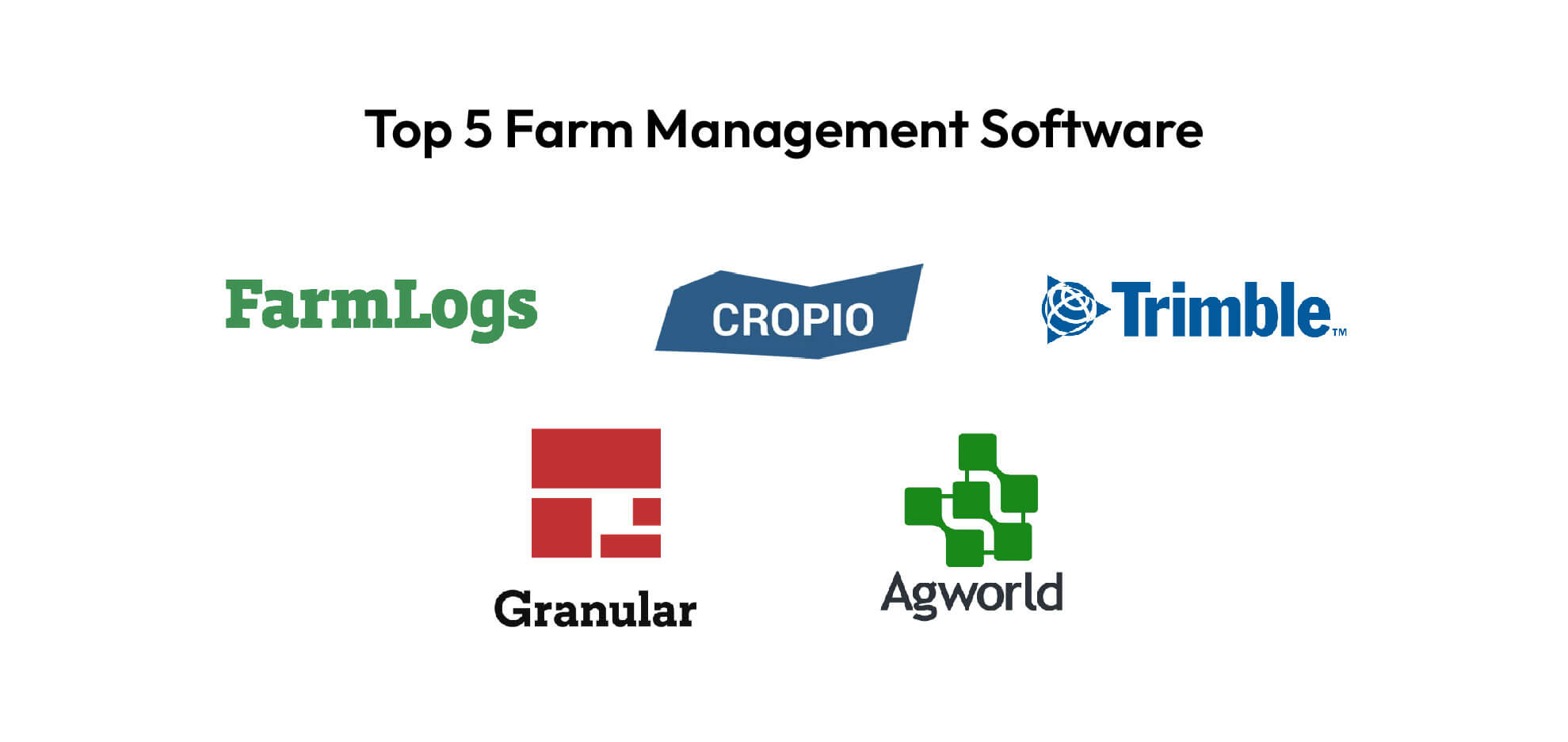
FarmLogs is commonly used by small to mid-sized farms. It helps farmers plan crops, track field activities, monitor weather conditions, and analyze basic farm performance data. It is often considered a starting point for digital farm management.
Granular is designed for large-scale and commercial farming operations. It focuses on budgeting, cost tracking, yield analysis, and profitability insights. Many agribusinesses use it as a farm business management software to manage complex operations.
Agworld supports collaboration between farmers, agronomists, and farm managers. It helps manage tasks, inputs, and field data in one place, making it useful for teams working across multiple farms or locations.
Cropio is mainly used for precision farming. It relies on satellite imagery and real-time data to track crop health, field conditions, and productivity. This type of solution reflects the growing use of AI in agriculture and data-driven farming.
Trimble Ag Software offers advanced tools for precision agriculture, GPS-based field mapping, equipment tracking, and productivity analysis. It is often used by farms looking for high-level automation and accuracy.
These examples show how best farm management software solutions support different farming needs—from crop monitoring and field planning to financial management and large-scale farm operations. They also help businesses understand what features influence development scope and overall cost when building a custom solution.
The farm management software cost depends on the type of solution you want to build. Some businesses need only basic features, while others require advanced tools powered by analytics and automation. Because of this, the cost to build farm management software is usually divided into four main levels: basic, mid-level, advanced, and MVP. Below is a clear breakdown to help you understand the expected investment.
| App Level | Estimated Cost Range |
| Basic Farm Management Software | $15,000 – $30,000 |
| Mid-Level Farm Management Software | $30,000 – $60,000 |
| Advanced Farm Management Software | $60,000 – $120,000 or more |
| Farm Management Software MVP Cost | $10,000 – $20,000 |
Estimated cost range: $15,000 – $30,000
A basic system focuses on essential farm operations such as crop and field records, weather tracking, task scheduling, and simple reports as well. This type of software is suitable for small farms or startups that want to digitize operations without complex technology.
This level keeps development simple and helps control the overall agriculture software development cost by limiting advanced features and integrations.
Estimated cost range: $30,000 – $60,000
Mid-level solutions include more functionality and better user experience. Common features include:
This category is often used by growing agribusinesses that need better control over farm activities and performance. At this stage, the farm management app development cost increases because of added features, user roles, and data processing capabilities.
Estimated cost range: $60,000 – $120,000 or more
Advanced platforms are designed for large farms and enterprises. These systems may include:
Such solutions work as a complete farm management system and sometimes as a farm ERP software, handling operations, finance, and planning together. This level usually results in a higher custom farm management software cost because of complex architecture, third-party integrations, and advanced technology like AI in agriculture.
Estimated cost range: $10,000 – $20,000
An MVP (Minimum Viable Product) includes only core features needed to test the idea in the market, such as basic farm data management, simple crop tracking, and user login and dashboards. This approach is useful for startups that want to validate their product before building a full-scale solution. MVP helps reduce initial investment and gives better clarity on future development scope and budget.
Also Read: Why Does Your App Require an MVP Model | Mobile Application
Overall, the total farm management software cost depends on your feature list, technology stack, and long-term goals. A simple system will cost less, while a full-scale platform with automation and analytics will require a higher budget.
Working with an experienced software development company can help you estimate the right budget and build a solution that fits both your business needs and financial plan.
Apart from the main development budget, there are some hidden costs that can affect the total farm management software cost. These usually include cloud hosting charges, third-party API fees (for weather, maps, or payments), ongoing maintenance, security updates, and customer support. If your system uses advanced features like AI or IoT devices, hardware integration and data storage can also add extra expenses over time. Planning for these costs early helps avoid budget surprises after launch.
The total farm management software cost depends a lot on the features you choose. Basic features keep the budget low, while advanced technologies increase the cost to build farm management software because they require more development time, testing, and integrations. Below are the main features and how they affect development cost, explained in simple terms.
| Feature | Cost Impact | Estimated Cost Range |
| Crop & Field Management | Low | $5,000 – $10,000 |
| Weather & Soil Monitoring | Low to Medium | $8,000 – $15,000 |
| Inventory & Equipment Management | Medium | $10,000 – $20,000 |
| Financial & Expense Management | Medium | $12,000 – $22,000 |
| GIS & Satellite Mapping | High | $25,000 – $40,000 |
| Offline-First Functionality | Medium | $15,000 – $25,000 |
| Mobile App Access | Medium to High | $20,000 – $35,000 |
| Precision AI & Machine Learning | High | $30,000 – $60,000 |
| IoT & Hardware Integration | High | $35,000 – $60,000 |
| Cloud-Based Data Storage | Medium | $15,000 – $30,000 |
This feature helps farmers plan crops, record daily farm activities, and track crop growth. It is the foundation of any farm management system and is usually included in all versions.
Cost impact: Low
This feature provides weather updates and soil condition data so farmers can decide when to irrigate or fertilize. It may use third-party APIs, which slightly increases the farm management software cost.
Cost impact: Low to medium
It tracks seeds, fertilizers, tools, and machinery usage. This helps reduce waste and avoid shortages. Since it requires structured data and dashboards, it adds moderate complexity.
Cost impact: Medium
This feature records income, expenses, and profits, turning the system into a farm business management software solution. It involves reporting and calculations, which raises development effort.
Cost impact: Medium
This feature uses maps and satellite images to show field boundaries, crop health, and land usage. It is useful for monitoring large farms and improving planning. Adding GIS and satellite data increases the custom farm management software cost because of mapping tools and data processing.
Cost impact: High
Many farms are in areas with weak internet. Offline mode allows farmers to use the app without a connection and sync data later. This improves usability but requires extra logic for data storage and syncing.
Cost impact: Medium
Mobile access allows farmers to manage their farm from anywhere. It increases the farm management app development cost because separate mobile interfaces must be built and tested.
Cost impact: Medium to high
This feature uses AI in agriculture to predict crop yield, detect diseases, and suggest better farming practices. It needs advanced models and large data handling, which makes development more complex.
Cost impact: High
This feature connects the software with sensors and devices such as soil moisture meters, temperature sensors, and irrigation systems. It enables real-time monitoring but raises the agriculture software development cost due to hardware and data integration.
Cost impact: High
Farmers can access data from any device and store large records securely with cloud-based farm management software. Cloud hosting improves scalability but adds infrastructure and security costs.
Cost impact: Medium
Simple features like crop records and weather tracking keep the farm management software cost lower. Advanced features such as GIS mapping, AI predictions, and IoT integration increase the budget but also increase the value of the system.
If you pick the right mix of features based on farm size and business goals, it helps control the cost to build farm management software while still delivering useful and scalable functionality.
The farm management software cost does not stay the same for every project. It changes based on several technical and business factors. Understanding these elements helps you estimate the real cost to build farm management software and plan your budget better. Below are the main factors that influence development cost.
The number and type of features play the biggest role in pricing. Basic tools like crop records and task management cost less, while advanced features such as AI-based predictions, GIS mapping, and IoT integration increase development time and complexity. More features mean higher custom farm management software cost.
Also Read – Generative AI and IoT in Smart Vehicles: Trends & Challenges
A simple web-based tool costs less than a complete farm management system with mobile apps, dashboards, and real-time monitoring. If you want a full farm business management software or ERP-style solution, the cost will be higher.
The choice of technologies affects performance and price. Using advanced tools like AI in agriculture, cloud services, and data analytics increases the agriculture software development cost because they require skilled developers and testing.
Building cloud-based farm management software requires servers, databases, and security layers. Cloud hosting improves scalability and access but adds infrastructure and maintenance costs.
Connecting the software with weather APIs, satellite maps, payment systems, or hardware devices increases development work. These integrations directly affect the overall farm management app development cost.
Off-the-shelf solutions cost less, while fully customized platforms cost more. A highly tailored system designed for specific crops, regions, or workflows increases the custom farm management software cost due to unique logic and design.
Simple layouts cost less to build. Advanced dashboards, interactive charts, and mobile-friendly designs require more design and development effort, which raises the farm management software cost.
The hourly rate of developers depends on their experience and region. Working with a professional and trusted mobile app development company in USA may cost more than small teams, but it also ensures better quality and long-term support.
Farm software handles sensitive farm and business data. Adding strong security, data backup, and thorough testing increases the development timeline and overall cost.
In short, the final farm management software cost depends on how advanced your system is, how much customization you need, and what technologies you use. A simple system costs less, while a smart, data-driven platform with automation and integrations requires a higher investment.
Reducing the farm management software cost is mainly about smart planning and choosing only what is necessary at the start. Here are practical ways to control the cost to build farm management software without lowering quality:
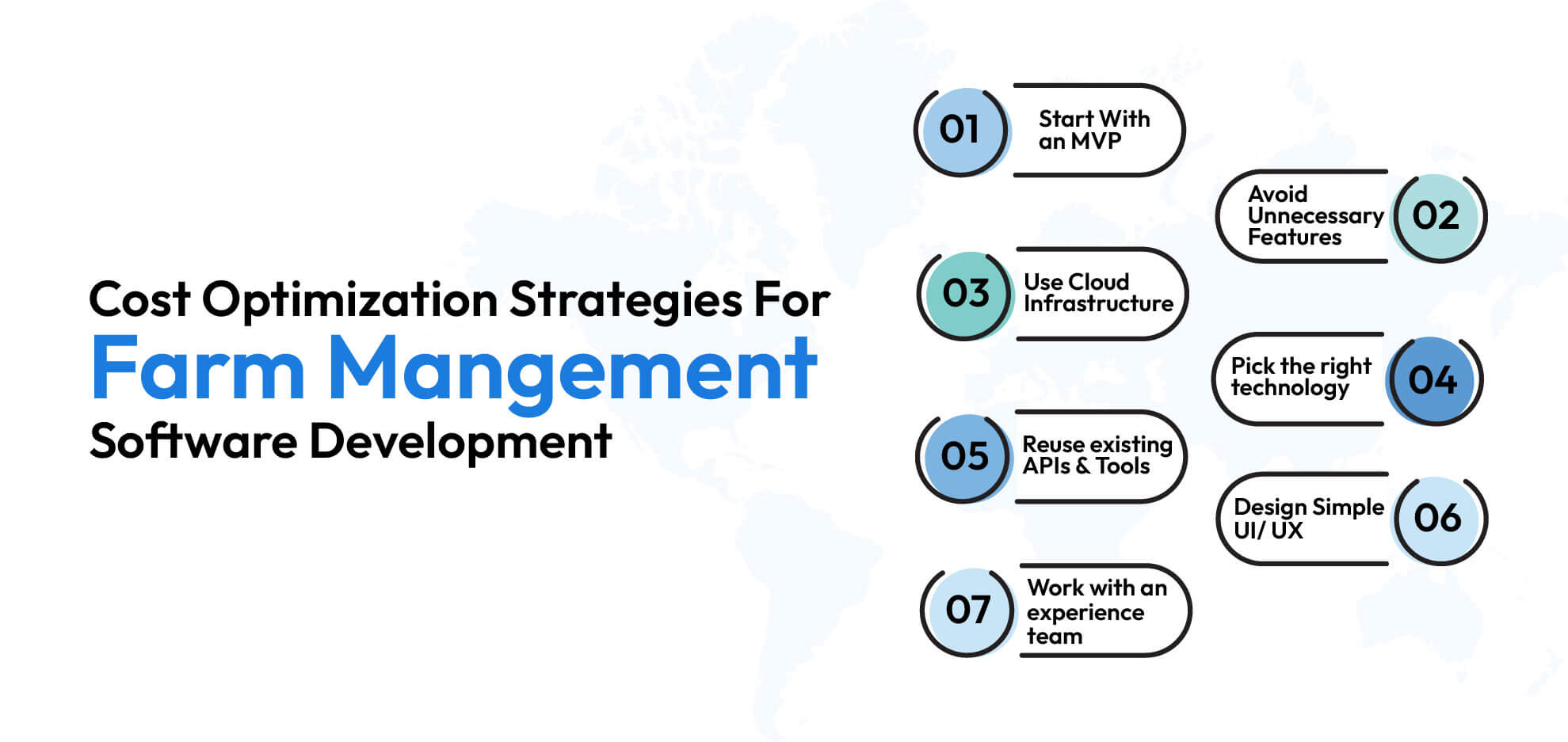
In short, focusing on essential features first and scaling gradually is the most effective way to reduce the farm management software cost while still building a useful and scalable product.
Building a reliable farm management system is not something most businesses do on their own. In practice, companies work with a trusted technology partner to turn their idea into a working product. Below is a simple and practical development process.
The first and most important step is choosing a reliable development team. A professional mobile app development company understands both technology and business needs. They help you define features, select the right tools, and plan the overall development roadmap. Working with an experienced partner also helps avoid technical mistakes and unexpected costs later.
In this stage, the team studies your farming model and business goals. They gather details such as:
Based on this, they prepare a feature list, technical structure, and development timeline. Good planning helps control the farm management software cost and reduces rework.
Design focuses on making the software easy to use for farmers and field workers. Simple screens, clear dashboards, and easy navigation are created. If needed, the design can support mobile access and multiple languages. A clean interface improves adoption and reduces training effort.
Now the actual system is built. Developers create modules such as:
Advanced features like AI in agriculture, GIS mapping, or IoT integration can also be added at this stage based on your budget and scope.
Before launch, the software is tested to make sure it works correctly and securely. This includes:
Testing helps reduce errors and ensures the system runs smoothly in real farm conditions.
Most solutions are launched as cloud-based farm management software, so users can access the system from mobile phones, tablets, or desktops. After deployment, the software is monitored to make sure everything works as expected.
Farm needs change over time. Regular updates are required to add new features, fix bugs, and improve performance. Ongoing support keeps the system secure and scalable.
In short, developing farm management software is a step-by-step process that starts with choosing the right development partner and ends with continuous improvement. A structured approach helps control the cost to build farm management software and ensures the final product meets real farming needs.
Farm management software can generate revenue in multiple ways, depending on the target users and feature set. These are the most practical and commonly used monetization models:
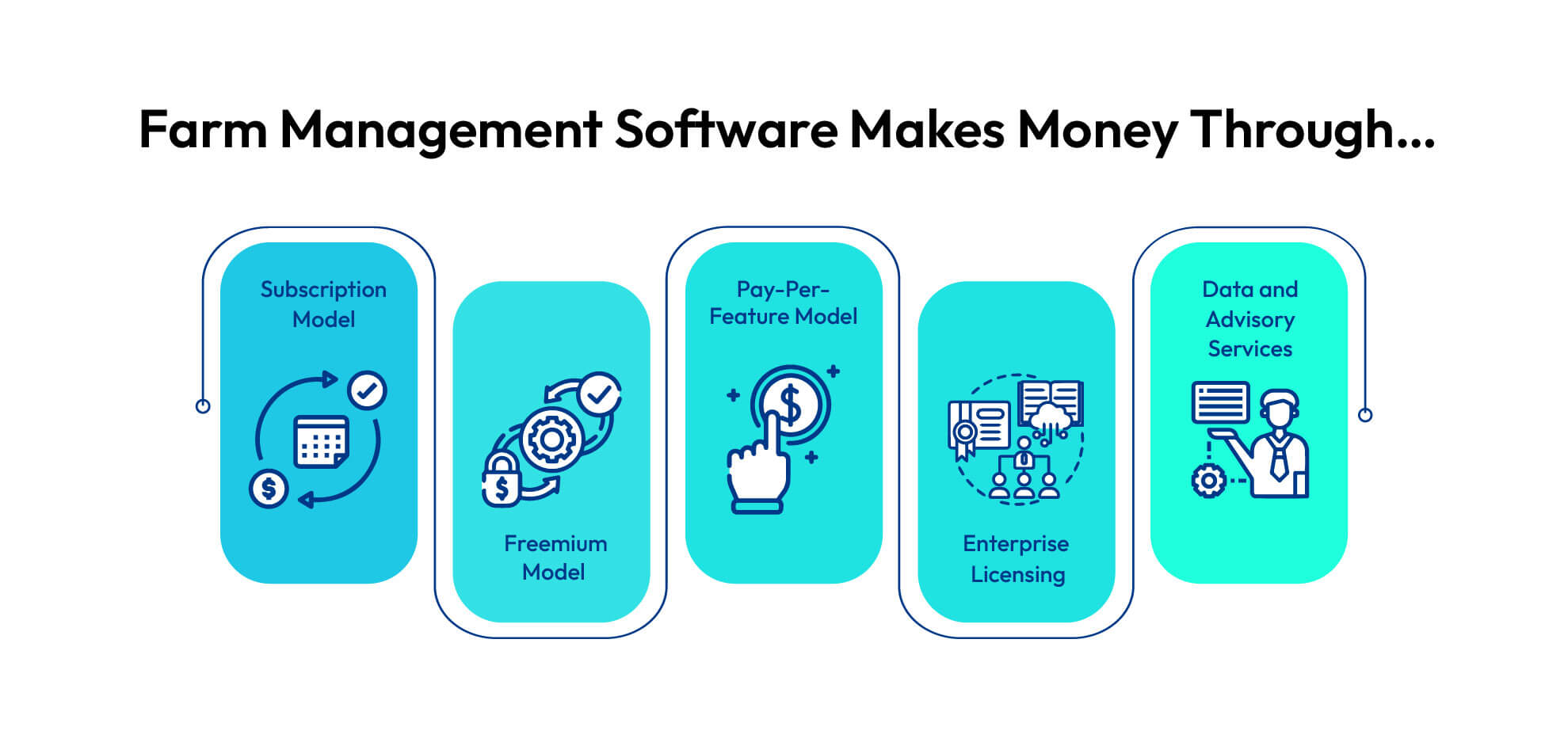
Users pay a fixed fee to access the software. Pricing is usually based on features, number of users, or farm size. This is the most common model for cloud-based farm management software.
Basic features are offered for free, while advanced tools such as analytics, AI-based insights, or automation are available in paid plans. This helps attract users first and convert them later.
Farmers pay only for the features they need, such as crop monitoring, inventory management, or financial reports. This model works well for customizable farm management systems.
Large agribusinesses pay a one-time or annual license fee for a full-scale solution with advanced modules and support. This approach is often used for farm business management software and ERP-style platforms.
Some platforms earn money by offering premium insights, yield predictions, or expert recommendations using AI in agriculture and farm data analytics.
These monetization methods help recover the farm management software cost over time and create long-term revenue while delivering value to farmers and agribusinesses.
The farm management software cost depends on your features, technology choices, and long-term goals. A well-planned solution can improve productivity while keeping development expenses under control.
With the right strategy and technical support, building a scalable farm management system becomes easier and more cost-efficient.
Techugo, as a leading software development company, helps businesses design, develop, and scale custom farm management software with the right mix of technology, performance, and budget planning.
Development time typically ranges from 2 to 6 months. An MVP or basic system can be built faster, while advanced software with automation, integrations, and custom features takes longer.
Yes. Small farms can start with simple or MVP-based solutions that focus on basic features like crop tracking and task management. This keeps the initial farm management software cost low and allows gradual upgrades as the farm grows.
A standard farm management system should include crop and field management, weather tracking, inventory control, financial reporting, and user dashboards. Advanced versions may also include GIS mapping, AI-based predictions, and IoT device integration.

Suppose an Australian recruitment agency that is struggling to handle hundreds of job applications every day. And the manual processes of sorting resu..

Watching a long queue build up (waiting in line) can be frustrating. Regardless of your location (New York City, Dubai, or Washington D.C.), tradition..


Write Us
sales@techugo.comOr fill this form