

 SA
SA  KW
KW  IE
IE AU
AU UAE
UAE UK
UK USA
USA  CA
CA DE
DE  QA
QA ZA
ZA  BH
BH NL
NL  MU
MU FR
FR [ LET’S TALK AI ]
X
Discover AI-
Powered Solutions
Get ready to explore cutting-edge AI technologies that can transform your workflow!



Get ready to explore cutting-edge AI technologies that can transform your workflow!






Each package that goes out in Saudi Arabia or Dubai carries more than just goods. It carries expectations of speed, of accuracy, of a smooth digital experience. Logistics is no longer a background operation in the Middle East; rather, it has become a core business driver.
A few years back, most delivery operations depended on paperwork, phone calls, and manual tracking. So, delays were common. Customers waited without knowing where their shipment was. Then platforms like Aramex changed the rules. Real-time tracking replaced guesswork. Mobile apps replaced endless follow-ups. Logistics became digital, measurable, and scalable.
Many founders and delivery businesses had started asking a serious question. Should I build my own system instead of relying on third-party platforms? More importantly, what is the cost to build a logistics app if i replicate Aramex like platform?
The logistics app development cost is not an expense, but rather an investment in long-term growth, that is why, companies in UAE and Saudi Arabia are already planning to build a logistics app like Aramex. Whether it is a courier app, a parcel delivery app, or a full last mile delivery app, the goal is the same – to create a system that works in real time and grows with demand.
In this guide, we break down what it really takes to launch an Aramex-like app development project. You’ll learn the cost as well as key features impacting logistics app development cost in the Middle East.
By the end, you will have a clear view of how to plan your budget and avoid costly mistakes.
Let’s first understand Aramex.
Initially Aramex was started as a local courier service; it provided only local deliveries for companies. Now it has become one of the most well-known logistics brands in the Middle East providing end-to-end solutions involving express shipping/delivery, freight forwarding, and supply chain solutions. They provide integrated solutions to businesses as a result thereof and due to their global network of more than 600 cities and 70 countries they have become the go-to partner for business who require consistent management of shipments on a single source basis.
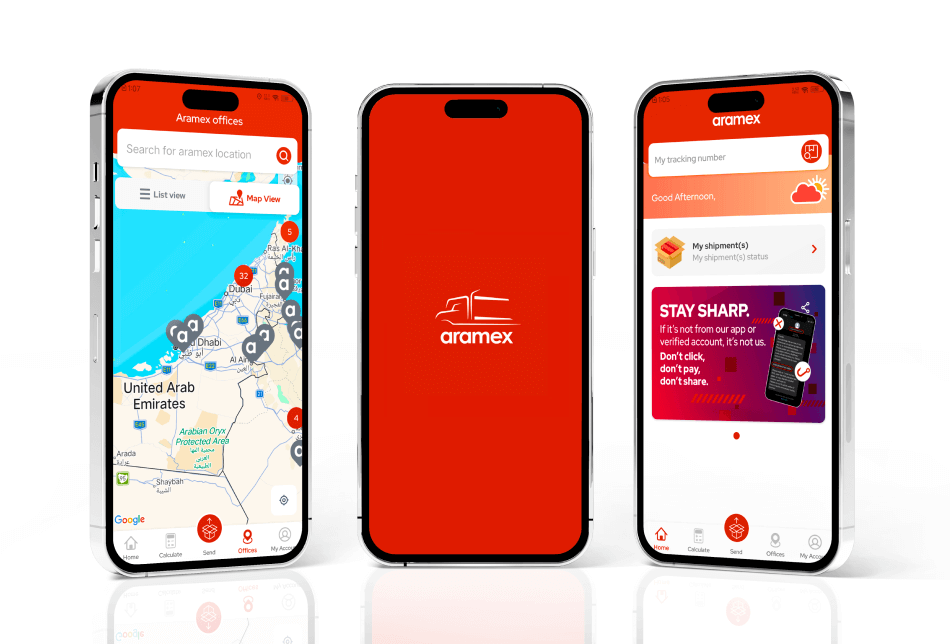
Over the years, Aramex didn’t just scale its network; it invested deeply in technology. It has app-based tracking, flexible delivery options, smart warehouse automation, and much more. Aramex logistics app sets a new standard for how modern logistics should work in the region and it’s digital approach helped reduce operational friction, increase transparency, as well as deliver faster service, and these are the things customers now expect as standard. Some key players in the logistics and delivery app niche in the Middle East are –
Now let’s understand why you must invest in an Aramex-like platform.
Today, the Middle East is undergoing a broader transformation. Logistics is no longer a back-office function. It is central to how businesses compete and grow.
Mobile-first consumer behaviour, rising e-commerce demand, and digitally savvy populations mean that traditional logistics processes struggle to keep up.
Logistics companies without efficient tracking, real-time visibility, or automated delivery management face delays, higher costs, and lost customers as well.
The opportunity to build a logistics app like Aramex is clear. A dedicated app with real-time tracking, automated routing, and digital proof of delivery helps businesses:
In the UAE, Saudi Arabia, and the broader Middle East, logistics has become a technology-driven competitive advantage, and companies that are ready to invest in digital logistics solutions (whether it’s a courier app, a parcel delivery app, or a full last mile delivery app) can easily tap into faster growth and better customer retention as well.
This is why now is the perfect time to invest in logistics app development in the Middle East because as we know, the market is ready and the demand is genuine. Also, the foundation set by leaders like Aramex shows the way forward.
Let’s come to one of the core questions founders ask: “What is the cost to build a logistics app like Aramex?”
The most correct answer is that there is no single fixed price. The Middle East market needs features, compliance layers, and bilingual design that are not required everywhere else. If you plan to build a logistics app like Aramex, your budget reflects not only development time but also operational complexity.
In the UAE and Saudi Arabia, users expect Arabic-English interfaces, mobile-first booking, and cash-on-delivery support. Add local data residency rules under PDPL laws, and the backend becomes more complex than a typical Western delivery platform. This is why the logistics app development cost in this region is shaped by technology, plus regulation, language, and payment behaviour.
A simple logistics app usually covers basic order creation, driver assignment, and shipment tracking. It works well for startups testing the market. A mid-level platform adds automation, route planning, and better reporting for daily operations. An advanced platform moves closer to enterprise systems, with optimisation engines, predictive ETAs, and full compliance layers. This is where most Aramex-like app development projects fall.
The cost to build a logistics app also changes depending on how deep your workflows go. A basic courier app or parcel delivery app costs far less than a full last mile delivery app with smart routing and financial reconciliation. This is why companies prefer custom app development instead of ready-made tools when planning for scale.
| App Complexity | Estimated Cost (AED) | Estimated Cost (SAR) |
| Simple Logistics App (MVP) | AED 220,000 – 330,000 ($60,000 – $90,000) | SAR 225,000 – 335,000 ($60,000 – $90,000) |
| Mid-Level Logistics App | AED 365,000 – 730,000 ($100,000 – $200,000) | SAR 375,000 – 750,000 ($100,000 – $200,000) |
| Advanced Logistics App (Aramex-Like Platform) | AED 800,000 – 1,230,000 ($220,000 – $335,000) | SAR 825,000 – 1,260,000 ($220,000 – $335,000) |
Simple Logistics App (MVP)
Best for testing operations and early market entry. It includes the customer app + driver app, admin panel, basic shipment tracking, and simple payment setup
Mid-Level Logistics App
Built for growing delivery businesses. It includes live tracking, route optimisation, COD workflows, and notifications and reports.
Advanced Logistics App (Aramex-Like Platform)
Designed for enterprises and high-volume operations. It includes a smart routing engine, ETA prediction, multi-hub management, and enterprise security and compliance.
The logistics app development in the Middle East is usually divided into structured phases. Each phase adds to the overall budget depending on complexity.
| Development Phase | UAE Cost (AED) | Saudi Arabia Cost (SAR) | What’s Included |
| Discovery & Design | 18,000 – 55,000 | 18,750 – 56,250 | Market research, wireframes, Arabic–English UI |
| App Development | 73,000 – 440,000 | 75,000 – 450,000 | Customer app, driver app, admin panel |
| Backend & APIs | 73,000 – 440,000 | 75,000 – 450,000 | Dispatch logic, live tracking, payments |
| Optimization Engine | 36,500 – 220,000 | 37,500 – 225,000 | Route planning, traffic analysis, ETA |
| Compliance & Testing | 18,000 – 73,000 | 18,750 – 75,000 | PDPL checks, localisation, performance testing |
This is one of the first strategic choices when planning to build a logistics app like Aramex.
Moving straight to a full platform can push your logistics app development cost very high before you know what actually works in your market.
Starting too small, on the other hand, can limit your ability to run real delivery operations. The decision should match your business stage, not just your vision.
“For many businesses, the best route is phased growth. Start with an MVP in one city. Learn from live usage. Then expand into a full Aramex-like app development model with smarter routing, deeper tracking, and analytics. This approach balances speed, cost, and long-term scalability while keeping your custom app development aligned with real business needs.”
When founders calculate the cost to build a logistics app, they usually focus on design and development. What often gets missed are the costs that appear after the first version goes live. These are not obvious in proposals, but they directly affect the real logistics app development cost over time.
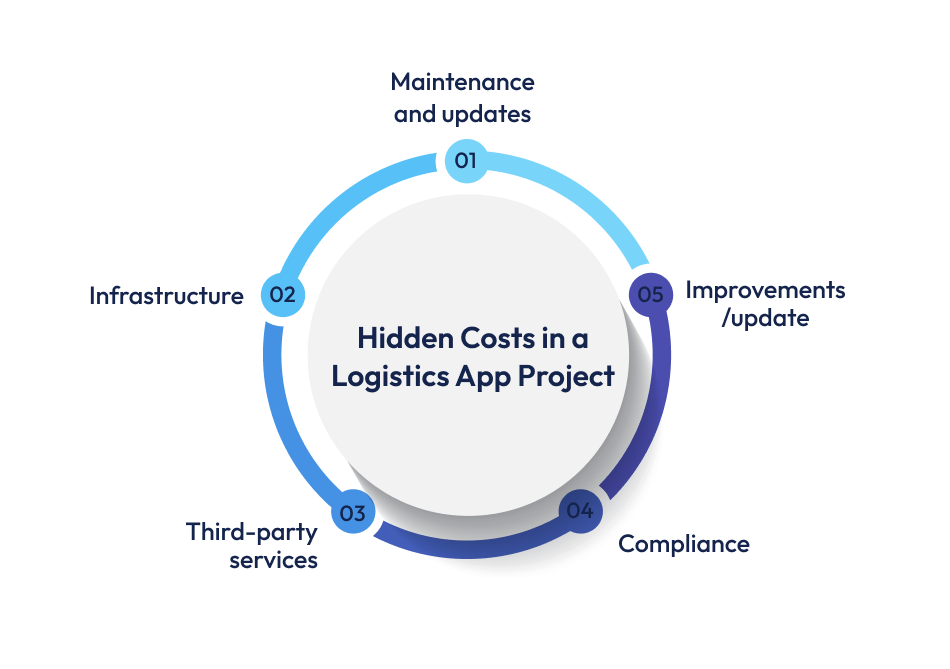
A courier app or parcel delivery app is not a one-time build. Maps change. Payment gateways update their rules. Operating systems release new versions. To keep your shipment tracking app stable and secure, you need regular updates. This usually adds a yearly support budget on top of the original build cost.
As your orders grow, so does your server usage. Live tracking, route calculations, and notifications all depend on cloud services. For a last mile delivery app, higher traffic means higher hosting and data processing charges. These costs grow quietly as your business scales.
SMS alerts, map APIs, push notifications, and payment gateways charge per use. At low volume, this feels small. At scale, it becomes a steady monthly expense. This is especially true for businesses trying to build a logistics app like Aramex, where real-time updates are a core feature.
In the Middle East, PDPL rules require ongoing audits, security checks, and data handling updates. Many teams treat this as a one-time task. In reality, it is recurring. For logistics app development in the Middle East, compliance is part of operations, not just development.
Once drivers and customers start using the app, they will ask for improvements. Faster checkout. Better tracking screens. Easier COD handling. These are business-driven updates, not technical problems. But they still require development time. Over a year, these small changes add up.
So when estimating the cost of logistics app development in UAE or the logistics app development cost in Saudi Arabia, it helps to think beyond launch day. The real cost is not just about building the app. It is about running it, improving it, and keeping it compliant while your delivery volume grows.
A logistics app doesn’t win users because it has more screens. It wins because it removes small, everyday friction. When a customer can book a pickup without guessing the price, when a driver doesn’t get stuck outside a gated compound, and when a business team can reconcile COD without chasing spreadsheets, that’s when features turn into real value.
Below is how the core features of an Aramex-style logistics app are usually structured in the Middle East, and how each group affects development cost.
Customers in the UAE and Saudi Arabia care about clarity. They want to know what they’ll pay, when the parcel will arrive, and where it is right now in Arabic or English.
A strong customer app usually includes a rate calculator (based on weight and service type), pickup scheduling, real-time tracking with ETAs, COD support, push and SMS alerts, and a bilingual interface with proper right-to-left design.
These features reduce support calls and increase repeat usage. COD handling alone plays a major role in retention, especially in Saudi Arabia where cash is still common.
Cost impact (Customer App):
Drivers are the backbone of the system. If their app is slow or confusing, deliveries fail no matter how good the customer app looks.
A driver app typically includes route optimisation, digital proof of delivery (signature and photo capture), earnings dashboards, and offline mode for low-network areas like industrial zones or remote compounds.
These features directly affect delivery success rates and driver retention. Route optimisation reduces fuel and time. Digital PoD reduces disputes. Offline mode prevents failed check-ins when signals drop.
Cost impact (Driver App):
If the customer app is the face, the admin panel is the brain. This is where operations teams manage fleets, routes, money, and performance.
Core admin features usually include fleet and warehouse tracking, SLA monitoring, billing and invoicing (AED, SAR, USD), COD reconciliation, and analytics dashboards for failed deliveries and cost per order.
This panel decides whether the business scales smoothly or collapses under volume. Good analytics and financial visibility are what separate a logistics company from a courier chaos machine.
Cost impact (Admin Panel):
Once the core system works, many companies add forward-looking layers. Green delivery slots, micro-fulfilment integrations, AI demand forecasting, and drone-ready APIs are becoming more relevant in Gulf markets.
These are not day-one features for most startups. But designing your system so they can be added later is cheaper than rebuilding everything after launch.
Cost impact (Advanced features):
A logistics app like u is not one app. It is three connected systems (customer, driver, and admin) all talking to the same backend in real time. Every feature you add increases:
That is why two “delivery apps” can differ in price by 2x or 3x. One is just booking and tracking. The other is a full logistics engine with money, routes, and analytics built into it.
In short, features don’t just shape user experience. They shape your entire cost structure.
Future-proof your logistics business with smarter dispatch and tracking. Talk to an Expert at Techugo.
There’s no fixed timeline, because you’re not building just one app. You’re building a system — customer app, driver app, and admin panel, all connected in real time.
A focused MVP with core features (booking, tracking, driver app, basic admin) usually takes 3 to 5 months. This is enough to launch in one city and test real operations.
A full-scale platform with COD workflows, bilingual UX, analytics, and compliance layers typically takes 6 to 10 months, depending on feature depth and integrations.
What really stretches timelines isn’t design. It’s:
So the smarter move is speed with structure. Launch small. Learn fast. Then expand without rebuilding everything.
A logistics app doesn’t make money just by moving parcels. It makes money by controlling how those parcels move, how fast they move, and how smoothly payments settle.
In the Middle East, the strongest revenue models are built around volume, reliability, and merchant trust.
Here are the most practical monetisation models for an Aramex-like logistics app:
The most successful platforms don’t rely on just one model. They combine delivery fees + subscriptions + COD + premium services. That’s how a logistics app like Aramex turns operations into a scalable revenue engine.
Selecting a partner is as important as knowing about the features and cost of an app. Because the success of your logistics app depends heavily on who builds it.
Techugo, as an experienced mobile app development company in Saudi Arabia, has hands-on experience creating scalable mobile platforms for businesses in the UAE and Saudi Arabia. Their team understands what Aramex-like app development really needs, such as – bilingual UX, reliable tracking, COD workflows, and systems that can handle high delivery volumes.
Instead of building generic apps, Techugo designs logistics platforms around real regional behaviour. Arabic–English interfaces, local payment integrations, and compliance-ready architecture are planned from day one. This helps reduce rework and keeps logistics app development cost predictable.
Whether you are starting with an MVP or launching a full-scale platform, Techugo works as a long-term technology partner. As a trusted provider of mobile app development services in UAE and Saudi Arabia, Techugo helps you build a logistics app that is stable and ready for growth.
For most businesses, starting with an MVP is the smarter choice. An MVP lets you launch in one city, test core features like tracking and COD, and learn from real users before investing in a full platform. It reduces risk, controls logistics app development cost, and helps you validate demand before scaling across regions.
Startups can absolutely build an Aramex-like logistics app. The key is to begin with focused features instead of trying to copy everything at once. Many logistics platforms grow city by city, adding automation, analytics, and integrations over time. With the right roadmap, startups can compete by offering faster service or niche delivery models.
The core technology cost is similar in both markets, but differences come from compliance and infrastructure. Saudi Arabia may require additional investment in data hosting and regulatory alignment, while UAE projects often spend more on design, multilingual UX, and payment integrations. These regional factors can shift the total cost of logistics app development even when the feature set stays the same.
As we all know, the Middle East is now heavily investing in digital communities. In Qatar, people are connected, mobile-first, and the government is d..

People in Saudi Arabia order food on apps, shop on apps, and look for discounts on apps. They make payments on apps and even look for ride hailing ser..


Write Us
sales@techugo.comOr fill this form