

 SA
SA  KW
KW  IE
IE AU
AU UAE
UAE UK
UK USA
USA  CA
CA DE
DE  QA
QA ZA
ZA  BH
BH NL
NL  MU
MU FR
FR [ LET’S TALK AI ]
X
Discover AI-
Powered Solutions
Get ready to explore cutting-edge AI technologies that can transform your workflow!



Get ready to explore cutting-edge AI technologies that can transform your workflow!






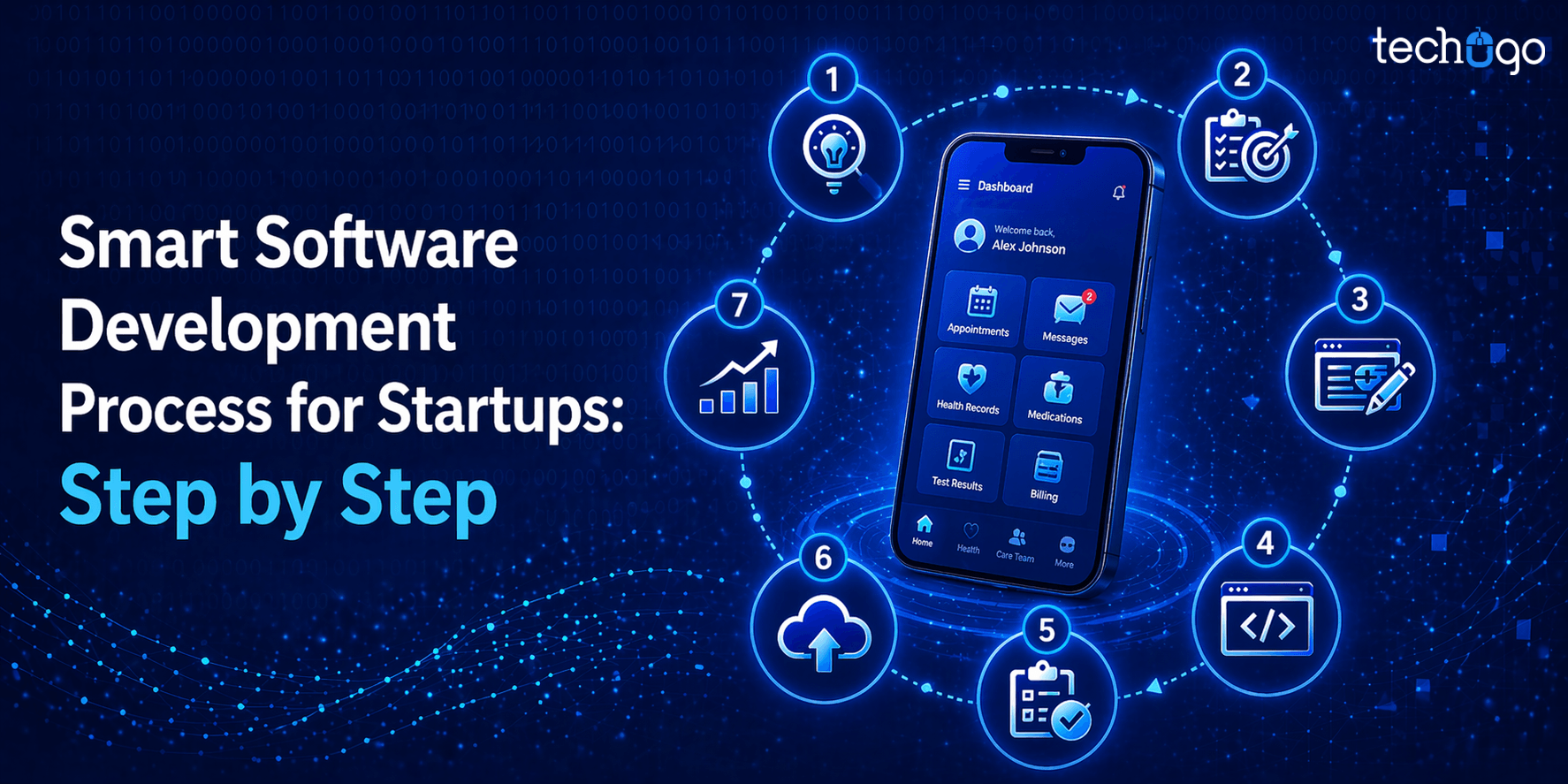
Every startup starts with an idea. The hard part? Knowing what to do next.
You may be considering developing an app or a platform, but where are you going to start? This is where the software development process for startups comes in, along with the right software product development services for startups. It provides a form to your thought, so you are not just flailing your way along in development.
The fact is, it takes very little time to create software that is not designed with a roadmap, and it becomes costly, messy, and frustrating. However, with the right startup app development process, it begins to seem a lot more manageable.
It can currently cost between 30K and 500K+ to build a startup app. And where you land largely hinges on how sophisticated, feature-rich, and expandable you wish it to be (based on industry standards).
Want to know how to develop software for a startup?
This guide will show you all the steps in an easy manner, whether you are trying to create software to start a business or you are attempting to bring your idea to life. No complicated jargon. Simply clear steps that you can follow.
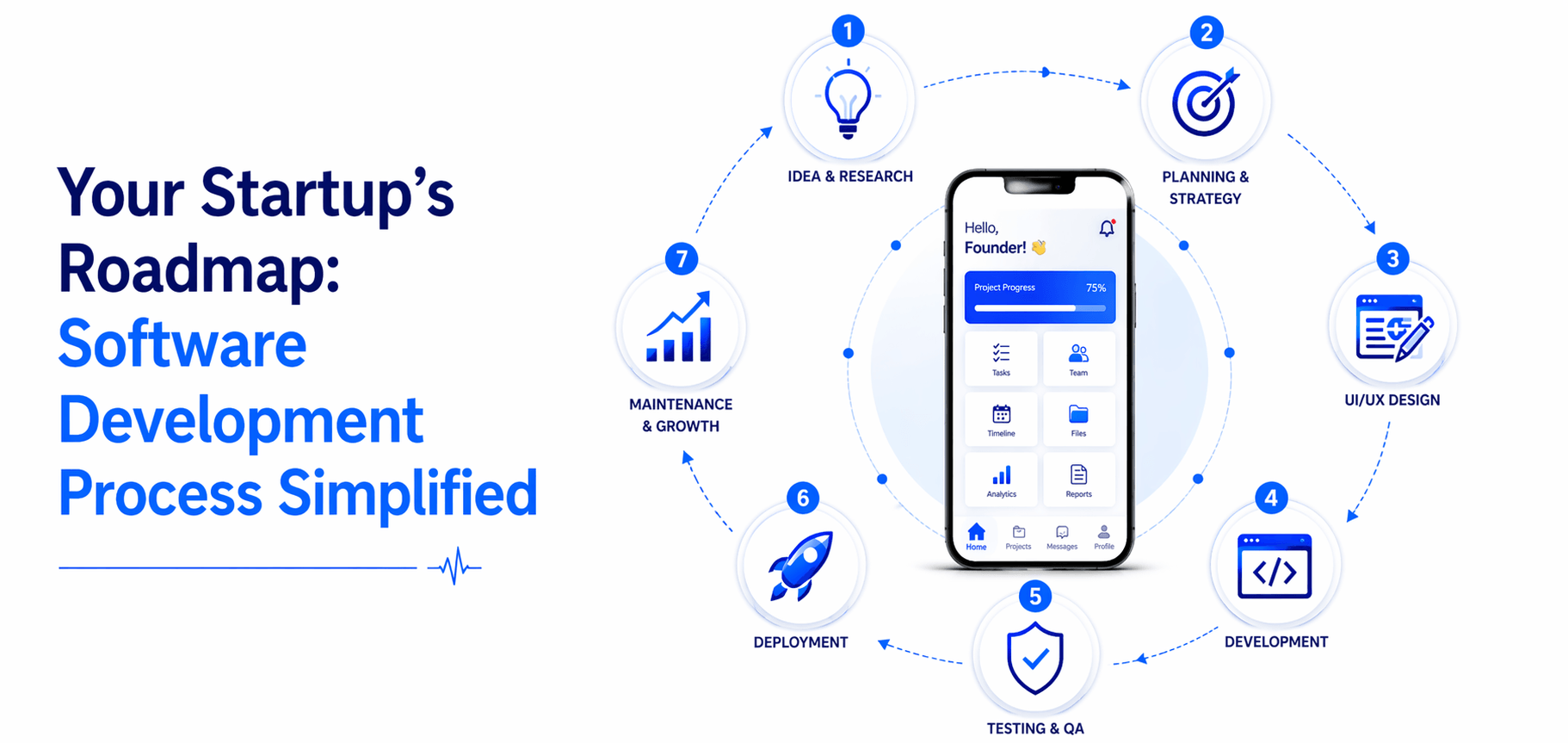
Let’s keep this simple.
The software development lifecycle for startups is basically a step-by-step way to go from an idea to a working product. It includes planning, designing, building, testing, and improving your software over time.
But here’s the thing: startups don’t work like big companies.
They don’t have unlimited budgets or years to build something. That’s why most startups follow an agile software development for startups approach. It means building fast, testing early, and improving as you go.
Instead of trying to create the “perfect” product from day one, you focus on building something useful first and then making it better.
That’s what a smart startup software development strategy looks like.
A lot of startups skip structure. And that’s usually where things go wrong.
Some build too many features too soon. Some don’t validate their idea. Others spend money without a clear direction.
These are common startup software development challenges.
Having a clear process helps you:
One of the biggest advantages is that it helps you focus on MVP development for startups. Instead of building everything, you build only what’s necessary.
Skipping structure often leads to the most common software development mistakes startups make: overbuilding, overspending, and underdelivering.
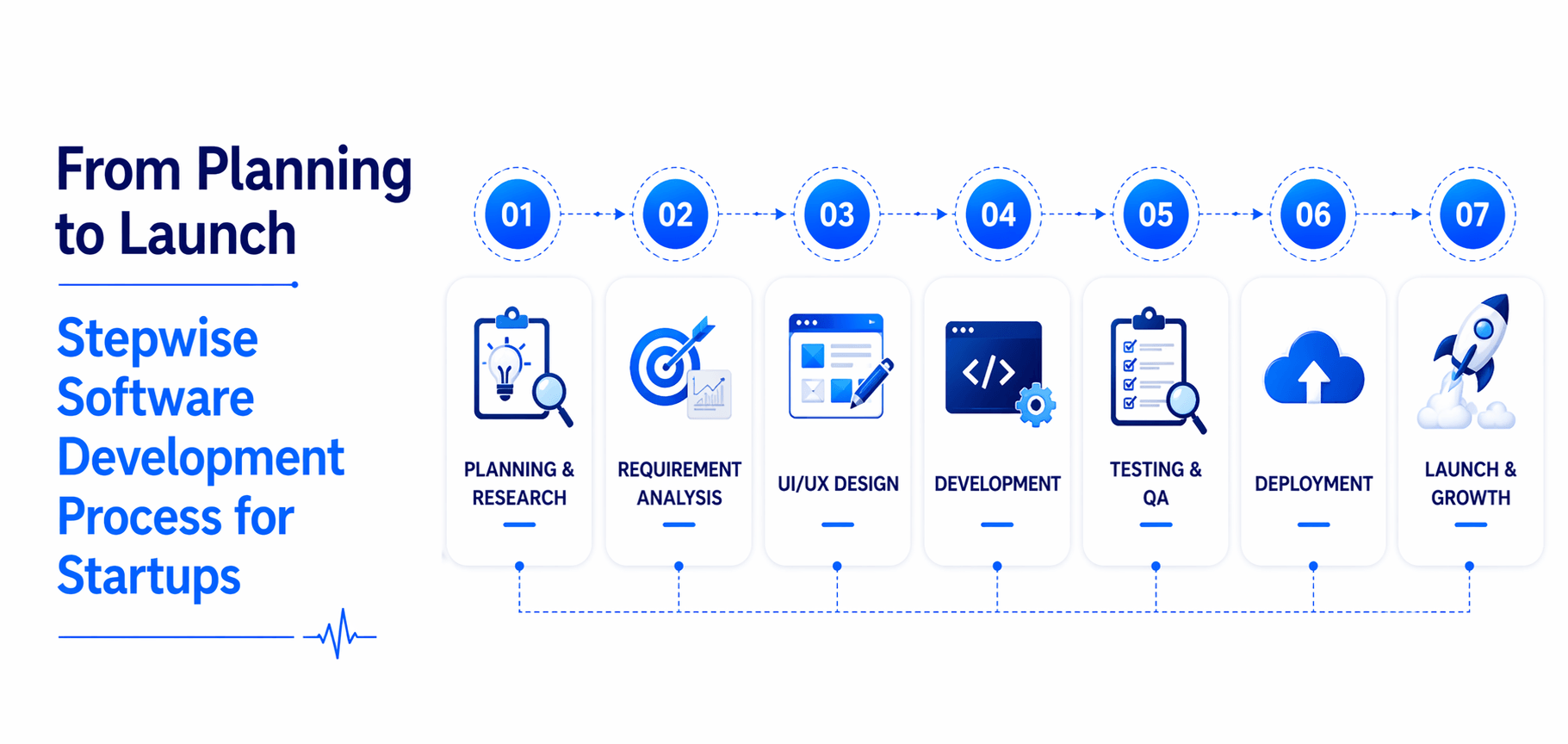
Let’s be honest, building software can feel like a lot at first.
There is the concept, the functions, the design, the technology, the price, all these, and in the middle of all that, you might be left without knowing what to do next. The majority of startups do not fail due to having a bad idea. This becomes difficult as the execution becomes untidy.
This is precisely the reason why the software development process for startups is important.
It gives you direction. It is a way to go step by step rather than attempting to figure it all out. Better still, it helps you stay concentrated on what is really important and construct something that is helpful, rather than something complex.
The good part? You don’t need to overthink it.
You do not have to have a 50-point plan or a blueprint in order to start. You just require a basic, pragmatic flow that will lead you through the thought to launch without wasting time, money, or energy.
This is what this section is all about.
We’re breaking down the startup software development process into easy steps that are manageable, so you understand what to do, when to do it, and why it is important.
Before writing a single line of code, you need clarity.
Question yourself what problems you are solving. Enquire who this is to and why people need to use this at all.
This is referred to as startup idea validation.
Many founders are in love with their idea without even asking whether people need it or not. Don’t skip this step. Engage users, conduct surveys and observe behavior. This initial product discovery process spares you the trouble of developing a product that nobody desires.
This is the foundation of software development planning for startups.
Once your idea feels solid, look at the market. Who else is doing something similar? What are they doing well? Where are they lacking?
This is where competitor analysis for startups comes in. You’re not copying. You’re learning. At the same time, do proper market research for app development: Find out who your users are, what they expect, and what actually frustrates them.
This step helps you position your product better.
Now comes a very important decision. What features do you actually need?
Not everything you can build should be built right now. This is where the MVP development process for startups becomes critical. An MVP (minimum viable product) is the simplest version of your product that still solves the main problem.
Focus on:
This is smart minimum viable product development. Good startup feature prioritization keeps your costs in control and your product focused.
And here your product begins to form in form. But UI/UX is not about making things look good. Actually making things easy.
Startups with good UI UX design guarantee:
The difference between your users remaining in your app and leaving it can be a clean app design process.
Now comes the actual build. Frontend is what users see, and the backend is what makes everything work behind the scenes. This is where custom software development for startups happens. All you need is clean code, strong architecture, and secure systems.
At the same time, think long-term. It helps, indeed. You want scalable app development, so your app can grow with your users.
Both frontend and backend development should work seamlessly together.
Don’t rush this part, even the best apps fail if they’re buggy. Proper software testing for startups ensures that features work correctly. If there are crashes or not. And the most important part is whether the app is actually reliable.
A strong QA process in app development helps you catch issues before users do.
Now it’s time to go live. Your app deployment process should be smooth and well-planned. But launching doesn’t mean you’re done.
A good product launch strategy for startups includes:
Think of launch as the beginning, not the end.
Once users start using your app, you’ll learn a lot. This is where software maintenance for startups becomes important.
You’ll need to fix bugs, improve performance, and add features. That’s it. As your user base grows, focus on scaling startup applications. Regular updates and app performance optimization keep your product relevant and reliable.
If you’ve made it this far, you already know one thing: there’s no fixed price tag when it comes to building software.
And that’s not a bad thing.
The cost of development in the U.S is not merely the amount you are spending but what you are creating and to what extent. Other startup enterprises require a rudimentary product to test an idea. Others are constructing something long-range, scaled, and full-featured early in its creation.
That’s why, instead of looking for a single number, it makes more sense to understand the range and what sits behind it.
Here’s a rough idea:
| Project Type | Estimated Cost |
| MVP (Minimum Viable Product) | $30,000 – $50,000 |
| Mid-Level Application | $50,000 – $120,000 |
| Advanced / Scalable Product | $500,000+ |
Your startup app development cost in USA depends on:
To make things clearer, let’s break this down into what startups typically spend at different stages.
| Project Type | Estimated Cost | Timeline | What You’re Really Paying For |
| MVP (Minimum Viable Product) | $30,000 – $60,000 | 2–4 months | Core functionality, basic UI, quick launch to test your idea |
| Mid-Level Product | $60,000 – $180,000 | 4–8 months | Custom features, smoother UX, third-party integrations |
| Advanced / Scalable Software | $180,000 – $400,000+ | 8–12+ months | Complex backend systems, scalability, high performance |
| Enterprise-Level Solution | $400,000 – $500,000+ | 12+ months | Full-scale platforms, advanced security, heavy integrations |
In the USA, the MVP development cost is usually lower because you’re building only the essentials.
The key is to start small and scale smart.
Choosing the right tools matters more than people think.
Choosing the right tools might not sound exciting at first, but it plays a huge role in how your product performs in the long run.
A good tech stack for startup app development makes your app faster, safer, and easier to scale.
For startups, this decision is even more important. You’re not just building for today, you’re building for what your product might become in the next few months or years. Choosing the wrong technologies initially may slow you down in the future, and doing the correct ones may make updates, scaling, and maintenance far easier.
Flexible, widely supported, and scalable technologies are the most popular among startups today. On the backend, popular options are Node.js and Python, which have good performance and are well-suited to creating fast, responsive systems. Similarly, React and Flutter frameworks aid in the creation of clean and user-friendly interfaces on the frontend and can also reduce the development time.
As far as handling data is concerned, MongoDB and PostgreSQL are popular databases, depending on the kind of application you are creating. And in hosting and infrastructure, cloud providers like AWS and Firebase enable you to operate and manage servers, store data, and scale your application without really thinking much about technical overhead.
Using the right software development technologies for startups ensures your product runs smoothly.
Always think long-term and choose a scalable technology stack.
Let’s keep this real. Startups make mistakes, but some are avoidable.
Common startup software development mistakes include:
These are real app development challenges startups face.
Making mistakes is part of the journey. But the tricky part is that some of these mistakes are completely avoidable, and they can slow you down more than you expect.
Like when they try to do too much at once. Founders often feel the need to pack their product with features, thinking more equals better. In reality, it usually leads to confusion, higher costs, and a product that’s harder to manage.
Or ignoring user feedback or delaying it for later. Early users are your biggest advantage; they tell you what’s working and what’s not.
This decision to choose the right software development company matters a lot. Especially if you’re a startup. Because building a startup product isn’t just about following steps, it’s about having the right support along the way.
That’s why many founders choose to work with an experienced startup app development company like Techugo early in the process.
You no longer have to work everything out on your own, but rather have a team that knows how to transform ideas into actual, scalable products, without any unnecessary delays or misunderstandings.
Techugo, being a leading mobile app development company in USA, partners with startups at all levels, including the idea validation and design stage, development, and scaling of a startup after launch. It is not just about creating an app but creating something that people would not only use but keep using.
Having 10+ years of experience in creating digital products, Techugo has collaborated with startups, enterprises, and even global brands in different industries, producing hundreds of applications that are scalable and performant. Having a combination of mobile app development, AI, cloud, and emerging technologies knowledge, our team works with businesses to transform ideas into actual, practical products.
Because sometimes, the difference between a good idea and a successful product isn’t just the idea itself, it’s the experience and expertise behind how it’s built, which is exactly where teams like Techugo make a difference.
So, if you’re ready to build it right, Techugo is a smart place to start.
Startup software development is a formalized manner of transforming an idea into a product. It is usually known to involve planning, designing, developing, testing, launching, and continuous improvement of the software. In the case of startups, it tends to be more flexible and speedy, and oriented toward building rapidly, testing the ideas at the earliest possible stage, and refining them according to the actual user response instead of keeping designing the product until it is perfect.
The timeline will be based on how complex your product is and how many features you are intending to add. Generally, it can take 3-6 months to create an MVP (Minimum Viable Product), and 6-12 months (or longer) to create a more complicated or more expansive product. A startup is also a smaller version that can be expanded as time goes on, depending on the user feedback and business requirements.
An MVP, or Minimum Viable Product, is the barebones version of your product that has the bare minimum of features to address the primary issue. Rather than creating it all initially, startups develop an MVP, which helps them launch quicker, test their idea in the actual market, and understand what users genuinely desire. This will assist in minimizing risk, saving expenses, making wiser decisions, and scaling up further.
The price of software development in the USA can vary extensively depending on aspects such as features, complexity, team structure, and technology preference. Startups can always count on spending between 30,000 and 500,000+ on average. The end of the spectrum would be simpler products with simple functionality, whereas the top would be much higher and feature-rich, scalable platforms with advanced integrations.

Ever wonder why some airlines are always on time, offer the best deals, and seem to know exactly what passengers want? In the meantime, other peopl..

Suppose a world where managing your health is as easy as checking your messages. That’s exactly what apps like MyChart have done. Patients can schedul..


Write Us
sales@techugo.comOr fill this form