

 SA
SA  KW
KW  IE
IE AU
AU UAE
UAE UK
UK USA
USA  CA
CA DE
DE  QA
QA ZA
ZA  BH
BH NL
NL  MU
MU FR
FR [ LET’S TALK AI ]
X
Discover AI-
Powered Solutions
Get ready to explore cutting-edge AI technologies that can transform your workflow!



Get ready to explore cutting-edge AI technologies that can transform your workflow!






Online Shopping App Like MAF Carrefour is the benchmark today. Now that online shopping is the norm, the bigger question is: how do you build an app like MAF Carrefour without overspending?
Most ecommerce apps fail before they scale. Why? Because they misjudge the cost.
Cost to build an online shopping app is the first thing eCommerce startup founders want to know.
Online shopping isn’t the future anymore, it’s the default. In markets like the UAE, building an online shopping app isn’t a small investment. The cost to build an app like MAF Carrefour depends on how advanced you want it to be. A basic version can start at around AED 110,000, while a fully loaded (enterprise-grade app) can easily cross AED 550,000 or more.
But cost is only one part of the equation. What really determines success is the process behind building the app.
So if you’re planning to build an online shopping app, the real question isn’t “Can I build one?”
It’s “What steps does it take to build an online shopping app like MAF Carrefour the right way?”
Let’s read more…
Also Read: Best Ecommerce Apps in the Middle East: Insights for Mobile App Development
In the UAE, people don’t just use apps, they expect them to work flawlessly.
Fast delivery, smooth payments, clean design – that’s the standard. If an online shopping app lags, glitches, or feels even slightly confusing, users won’t sit around trying to figure it out. They’ll simply move to the next option.
In this market, “good” is rarely enough. And the reason is – UAE is deeply mobile-first.
The UAE runs on mobile. With one of the highest smartphone penetration rates in the world, a huge chunk of online purchases happens straight through apps, not desktops.
Retail, grocery, and marketplace app downloads keep climbing every year. And the spike is real during Ramadan or big sale seasons.
So if you’re planning to build an online shopping app like MAF Carrefour in UAE, mobile isn’t some extra channel you “also” consider. For most users, it is your storefront.
The UAE consumers will demand rapidity and convenience. One of the main features, rather than a premium one, is same-day or next-day delivery. Users can also compare prices between apps immediately and seek loyalty flexibility, offers personalized, and simple returns.
Brand trust is also a big factor. When people shop online, they want to feel safe. Easy payments, clear return policies, and a checkout that just works – these things decide whether they hit “buy” or close the app.
In short, the experience has to feel effortless. The moment it feels complicated, users leave.
Supposing you intend to build an online shopping app like MAF Carrefour in UAE, compliance must be part of the structure. User data, payment information, delivery details, everything must align with UAE privacy and cybersecurity regulations.
In this market, security isn’t a backend detail. It’s part of the experience.
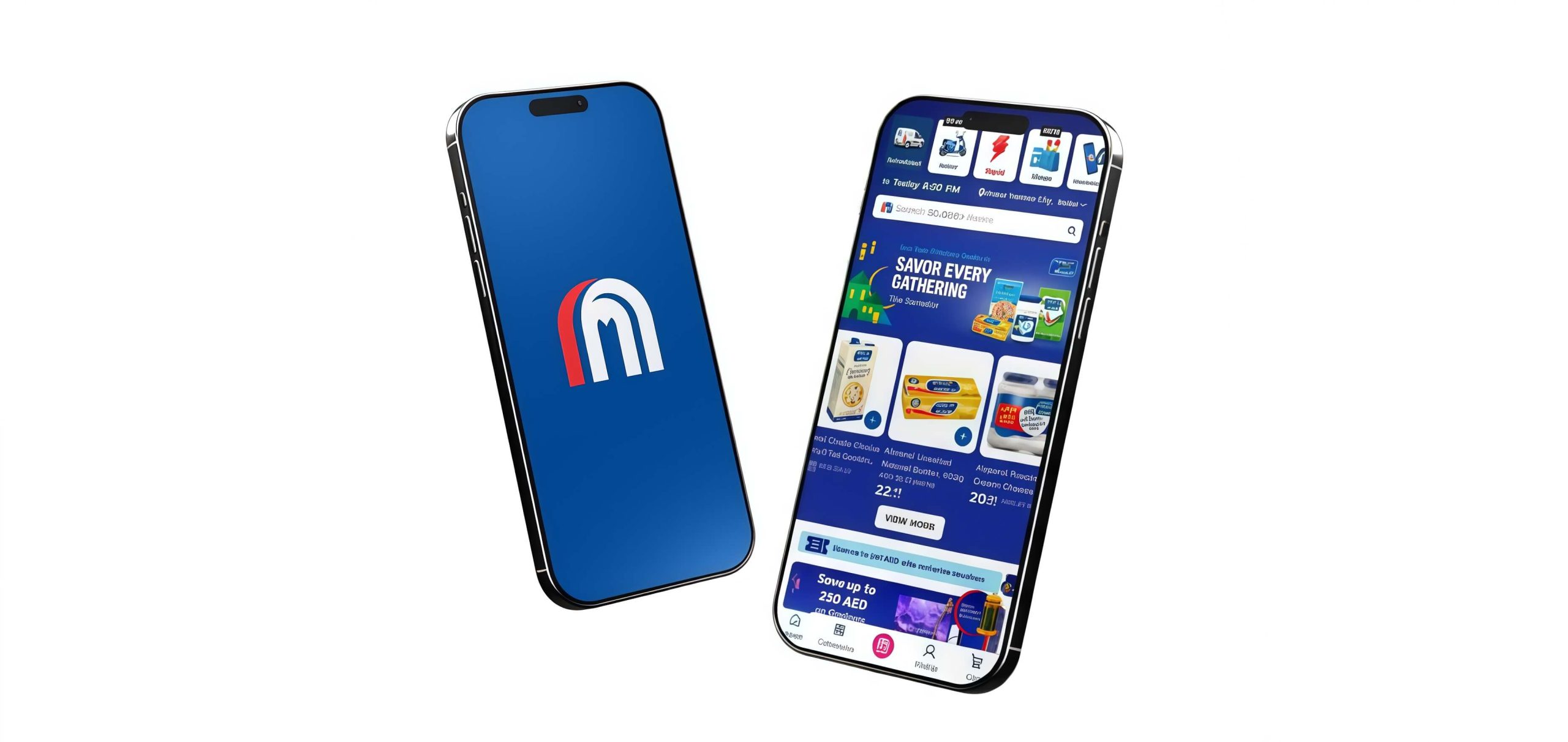
The MAF Carrefour Shopping App is basically the mobile version of shopping at Carrefour in UAE, operated by Majid Al Futtaim.
It’s just Carrefour, but on your phone. The same grocery runs, the same weekly restocks – just without the drive, the parking, or the checkout line. You open the app, search what you need, add it to your cart, choose when you want it delivered, and you’re done.
But what makes it impressive isn’t what you see, it’s what you don’t.
Every time you tap “add to cart,” the app is checking store availability, adjusting prices if there’s an offer, updating your loyalty points, and coordinating with delivery systems in the background. All of that happens in seconds.
That’s exactly the kind of experience businesses aim to create when building an online shopping app like MAF Carrefour.
Now, the real question is – ‘how to develop an app like MAF Carrefour?’
To develop an app like the MAF Carrefour Shopping App, you need more than design. You need a system built for real-time retail at scale.
That’s why the type of app you choose matters.
Before anything else, you need to decide what kind of app you’re actually building. Because an online shopping app isn’t just about how it looks; it’s about how it’s built underneath.
This decision becomes even more important if you’re planning to build an online shopping app like MAF Carrefour, where performance and scale really matter.
There are three main development types to choose from.
Think of native apps as the “built from the ground up” option. You’re creating one version for iOS and another for Android, separately. It’s more work, yes. But the payoff?
Everything feels polished, fast, and solid, which is why native apps usually fall on the higher side of the AED 110,000 – AED 200,000+ range.
If you’re building something big and long-term (something that needs to handle serious traffic without breaking a sweat), choose native.
It’s not the cheapest choice, but it’s the strongest foundation, especially if the goal is to build an online shopping app like MAF Carrefour that can support large product catalogs
Hybrid apps are the smart middle ground – one codebase, two platforms, quicker launch, and a budget that usually sits around AED 110,000 – AED 330,000 (depending on how ambitious you get.)
For many eCommerce startups, this is where things start to make sense. You still get a proper mobile app presence on both iOS and Android, without doubling your development effort.
A web app is basically your store living inside a browser instead of an app store. It’s easier to launch and much lighter on the budget (you’ll often see builds fall in the AED 55,000 – AED 184,000 range), but here’s the thing – it doesn’t feel the same.
It’s great if you’re testing your idea or starting small, but if you’re planning to build a serious retail presence, it’s usually just the starting point, not the end goal.
Also Read: Native vs Hybrid Apps: What to Choose in 2026 (Guide for Businesses)
When building an online shopping app at this level, it’s not necessary to support both platforms.
Each one brings something different to the table:
| Factor | iOS | Android |
| User Behavior | iOS users in the UAE often spend more on apps and engage actively with loyalty programs. | Android users make up the majority of shoppers across the UAE and GCC region. |
| Market Reach | Smaller share of users but often includes high-value customers. | Much larger user base, making it ideal for reaching more shoppers. |
| Ecosystem | A controlled ecosystem helps maintain smooth performance and a consistent user experience. | More open ecosystem with many device types and price ranges. |
| Business Advantage | Great for premium positioning and stable monetization. | Ideal for scaling quickly and reaching the mass market. |
| For Apps Like MAF Carrefour | Works well for retail apps like MAF Carrefour that attract loyal shoppers who tend to spend more. | Perfect for reaching more people and helping an online shopping app like MAF Carrefour grow faster. |
| Estimated Development Cost | AED 110,000 – AED 440,000+ | AED 128,000 – AED 550,000+ |
Why the cost to cost to build an online shopping app for Android is slightly higher:
That’s what it truly takes, the right platform strategy backed by strong technical architecture.
Building an online shopping app at this scale isn’t just about hiring developers and starting to code.
It’s a phased process where each stage builds on the previous one. When done right, it reduces risk, controls cost, and ensures the app is built for long-term growth, not just launch day.
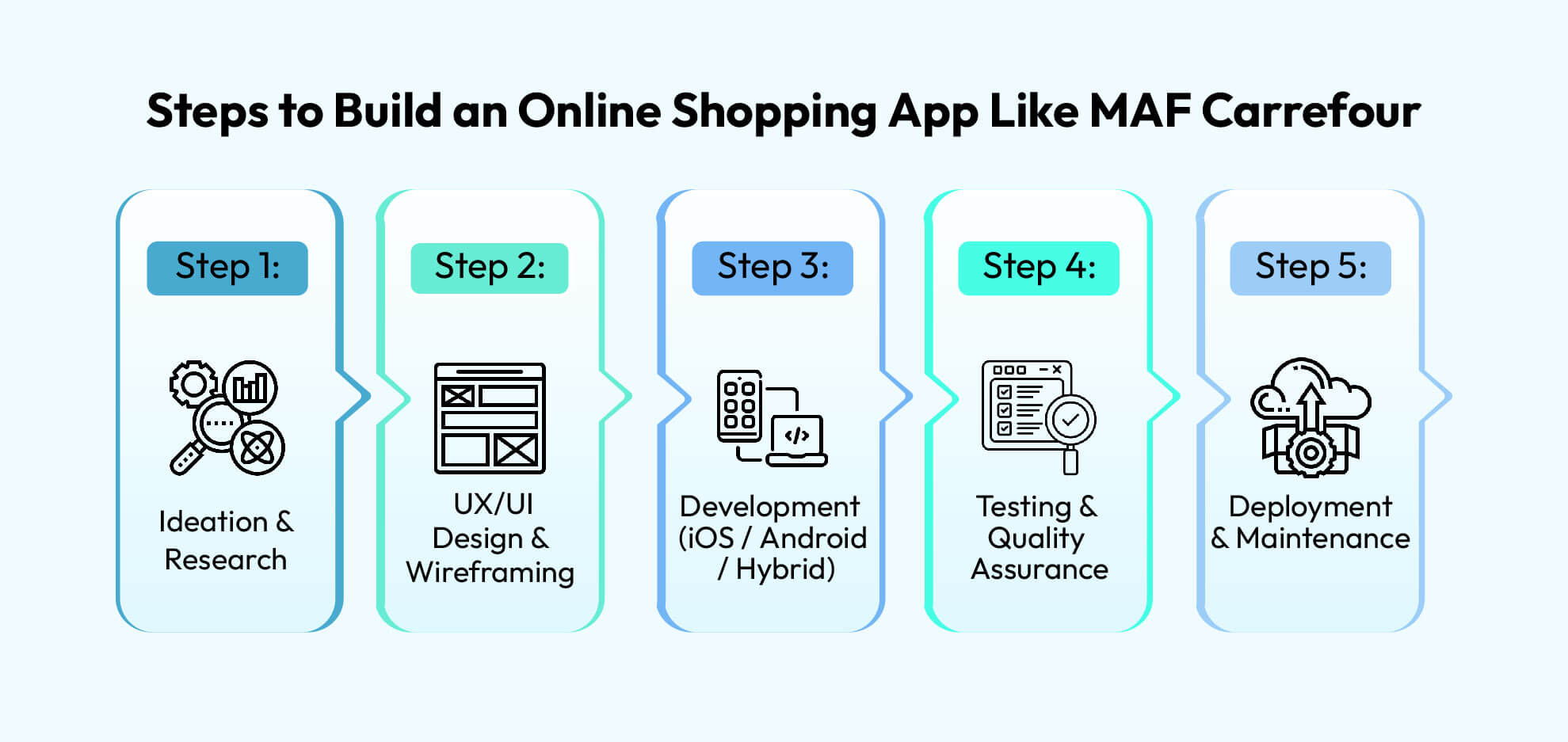
Every serious retail app starts with strategy, not screens.
It is the point of identifying the type of digital retail business you are actually constructing. Do you re-create a hypermarket experience on-line? Linking various stores on a single system? Reaching up-scale urban shoppers or a broader mass market in the UAE? All this depends on the responses to this.
This is not the stage where you are making color and design decisions. You are determining the basic framework of the business: its means of earning, its clients, its growth.
Here are the key focus areas:
Once these basics are defined, the strategy naturally moves forward.
Once the strategy is locked, the experience takes shape.
This is where the structure of the app is mapped out. The wireframes define the movement of a user between the home page and the checkout page. The design stage makes the journey experiential, quick and frictionless.
For an online shopping app like MAF Carrefour, simplicity drives conversions. The easier it is to browse and pay, the stronger the retention.
Design Process Flow:
Wireframes
↓
User Journey Mapping
↓
Visual Design
↓
Prototype Testing
Good design doesn’t just make the app look modern. It directly impacts how much users buy.
This is where architecture matters most.
Depending on the approach you use (native or hybrid) the developers will develop the frontend and backend systems in parallel. The backend deals with integrations, logic and databases. And the front-end provides a smooth user interaction .
For an online shopping app like MAF Carrefour, this phase must account for scalability. Traffic spikes during promotions, flash sales, and seasonal campaigns can stress weak systems.
Development Structure:
System Architecture Setup
↓
Frontend Development
↓
Backend Integration
↓
Platform Synchronization
Before launch, everything is challenged.
An online shopping app handles payments, personal data, delivery coordination, basically everything that can go wrong if not tested properly. Even a small checkout glitch or slow loading time can cost real revenue, especially during peak traffic.
This stage focuses on making sure everything works the way it should:
In-depth testing defends your launch. This may save some money in the short term, but rushing it normally leads to larger (and more costly) problems in the future.
Launch is not the goal, it has become the starting point of real-life validation.
App store submissions, live server configuration, monitoring systems, and performance tracking are all deployed. As people begin to interact, constant upgrades, enhancement, and expansion upgrades are incorporated as part of the process.
Post-Launch Cycle:
App Launch
↓
Live Monitoring
↓
User Feedback
↓
Updates & Scaling
A shopping application is developed online. There is a change of customer expectations. Competition among the markets increases. Maintenance is to make sure your app does not lag behind.
Building an online shopping app like MAF Carrefour in UAE is a full process, not something you wrap up in a few weeks.
The duration that it takes is actually determined by the level of ambition that you have. On average, there should be approximately 3 to 6 months before anything is stable, and it can be used by real people. When you are creating at an enterprise level, you can only expect that timeline to lengthen. It is just the truth of construction of something serious.
And there’s a reason for that.
Consumers are comparing prices when they are in the physical stores. Groceries are reorganized within less than two minutes. They want to see fast delivery, convenient returns and no friction.
This change was noticed early by the retail leaders such as MAF Carrefour. Also they did not develop an app to be online. They built a connected system where browsing, payments, loyalty rewards, and delivery work smoothly together. That’s the difference between simply having an app and running a serious digital retail operation.
And building at that level connects directly to budget too. In the UAE, most online shopping apps fall somewhere between AED 110,000 and AED 550,000+.

Here’s the average cost to build an app like MAF Carrefour, based on typical UAE market pricing and complexity levels:
| Project Scope | Estimated Cost (AED) |
| Basic MVP (core shopping features) | AED 110,000 – AED 184,000 |
| Mid-Level App (payments, delivery integrations, admin panel) | AED 184,000 – AED 367,000 |
| Advanced / Enterprise Build (custom backend, loyalty systems, heavy integrations, scalability focus) | AED 367,000 – AED 550,000+ |
The cost mainly depends on three things:
The more complex and connected your app needs to be, the higher the investment.
One major mistake is overbuilding too early. Businesses try to launch with every possible feature instead of validating what users actually need first. That inflates cost and slows down go-to-market.
Another issue many teams face while developing an online shopping app like MAF Carrefour. A sleek interface means nothing if inventory, payments, or delivery systems fail under real traffic.
And a big one in the UAE market is underestimating user expectations. Shoppers expect speed, smooth checkout, and reliable delivery. If the experience feels even slightly frustrating, retention drops quickly.
When businesses look for eCommerce app development, they’re not just looking for someone to build features. They’re looking for a team that understands what this market demands. An eCommerce app here has to be fast. It has to handle real users, real payments, and serious traffic without cracking under pressure.
That’s exactly where Techugo fits in.
At Techugo, we understand what it takes to build apps that perform in a market like the UAE.
With over 10 years of experience in mobile app development, we’ve worked with startups, scaling brands, and enterprise clients to build apps that are not just visually appealing but technically strong.
Our team works with modern technologies like React Native, Flutter, and AI-driven systems, but we always choose what fits your business best.
As a trusted Mobile app development company in UAE, Techugo builds apps that are designed to grow with your business. In a market where execution defines success, businesses choose Techugo for strategy, precision, and scalable results.
In most cases, building an online shopping app like MAF Carrefour usually costs somewhere between AED 110,000 to AED 550,000+. The final number depends on how complex the app is – things like the features you include, whether you launch on iOS, Android, or both, and how powerful the backend needs to be.
The first step is ‘planning’. To develop a supermarket mobile app, businesses first plan how the shopping experience will work. Then developers build the app with product catalogs, checkout, payments, and delivery features before testing and launching it.
Grocery delivery apps typically consist of items such as easy search of the products, categories, a cart to add products, and easy check out. The majority of the apps also provide various payment methods, tracking of their orders, scheduling of their delivery and even notifying the user in case they need to know the status of their order.
The cost of grocery eCommerce app development mostly depends on the app’s features, the platforms you choose (iOS, Android, or both), and how complex the backend system is. Things like payment integrations, delivery tracking, and loyalty programs can also push the cost higher.
Each year, hundreds of horoscope and zodiac apps are released to the market, but only a few really grab attention, build trust, and keep users engaged..


‘What’s the cost to build an app like Yandex Go?’ is often the first question businesses ask. When you’re starting from zero, with no existing infr..


Write Us
sales@techugo.comOr fill this form