

 SA
SA  KW
KW  IE
IE AU
AU UAE
UAE UK
UK USA
USA  CA
CA DE
DE  QA
QA ZA
ZA  BH
BH NL
NL  MU
MU FR
FR [ LET’S TALK AI ]
X
Discover AI-
Powered Solutions
Get ready to explore cutting-edge AI technologies that can transform your workflow!


Get ready to explore cutting-edge AI technologies that can transform your workflow!


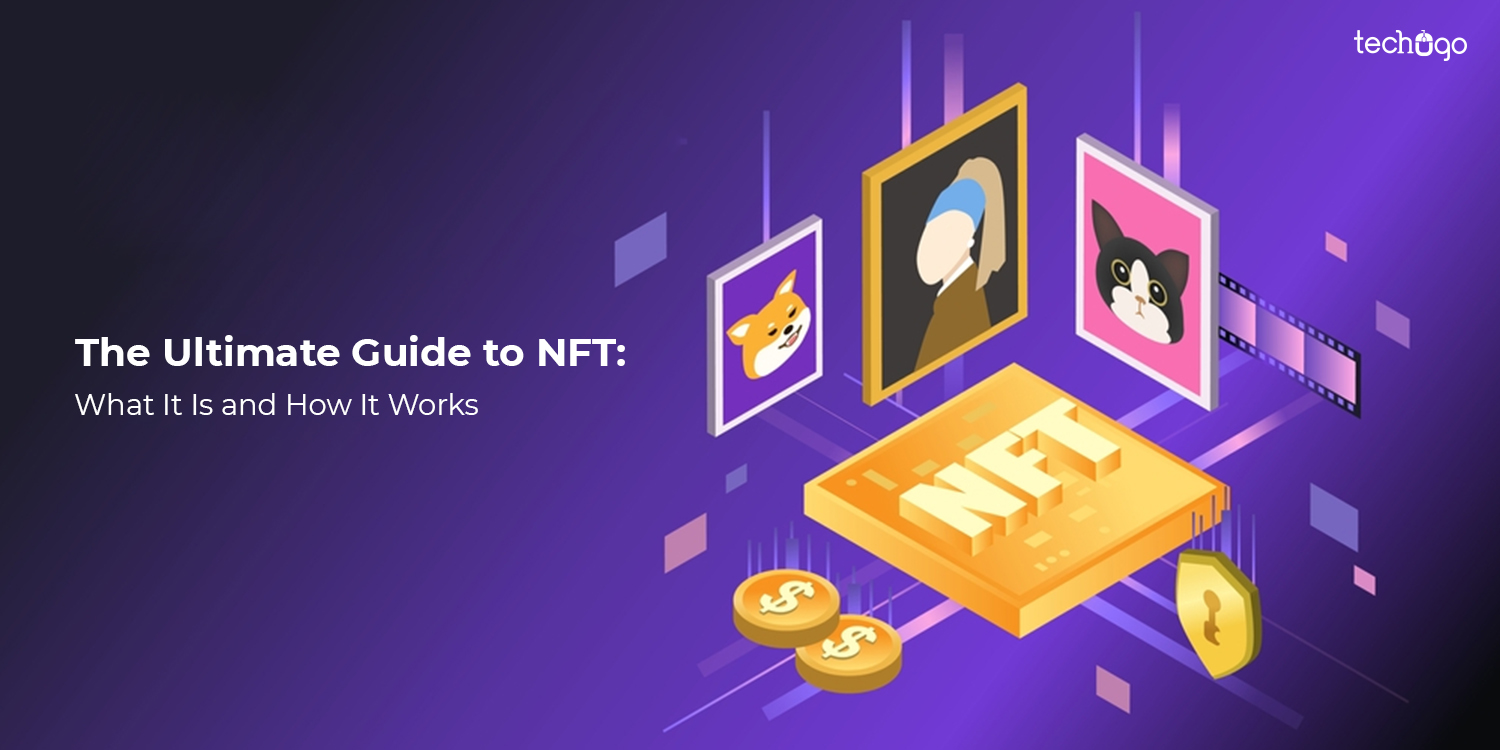
Since digital art has changed the conventional outlines of the art world, giving a new potential in the field of the arts. Creating digital art has become easy, and replicating it has become easier. Now, numerous copies are available on the internet for an art piece that might confuse you to identify the original one.
Well, it has become a concern for artists and creators worldwide to keep their digital art safe from getting copied.
While physical works incorporated copyright law and auction houses for sale and purchase, NFTs (Non-fungible tokens) emerged as a savior for digital art. NFTs are utilized in almost every industry, from education to real estate, not limited to digital art.
Now, this raises a lot of questions, like what is NFT? How does it work? How reliable is it? And so on. Indeed, these questions must be rattling into your head. But don’t worry, as this article has covered every ounce of doubt that you can get about NFT. So, clear all your questions and start reading this complete guide to NFT.
Fungibility: It is an ability of an asset that you can change with other types of assets. It simplifies the trade and exchange processes. It clearly implies equal value between the assets.
Non-fungibility: Interchanging the assets is not possible for a non-fungible item. Each digital asset has a unique property that is not equivalent to other similar goods.
Still, the mind is hovering around what is fungible and non-fungible…
Well, let us consider an instance to understand it better. Suppose you are a person who lends a car to his friend. Now, your friend can’t return a different car of the same make and model that is lent to him. Because you have ownership of your car as it is registered in your name. On the other hand, the fuel used for driving it can be returned in the same quantity from different brands. So, exchanging a car is non-fungible because you have ownership of it, but fuel is a fungible exchange as you don’t own fuel, which can be exchanged in the same quantity from another brand.
Simply put, to understand NFT (Non-Fungible Token) in simple words is OWNERSHIP. NFT allows you to have ownership of your digital assets like videos, paintings, virtual real estate, and postcards. Since it is a non-fungible asset, it cannot be replicated and equated with another similar property because of its uniqueness.
Now we know what is NFT. Let’s explore it in detail through this guide to NFT!
Back Story: NFT is getting popular swiftly now, but as we look into it, we realize that it started almost a decade ago.
Back in 2008, when the United States was plunging into a financial crisis because big banks gambled clients’ money on high-risk ventures, blockchain was developed to fix a broken exchange system.
Using this technology, all cryptocurrencies and NFTs were created. Furthermore, blockchain makes every transaction secure; it is next to impossible to break the chain, hack or cheat the system. For this, Bitcoin was created, which became the global currency while keeping track of every single activity.
The next evolution came up in the form of Ethereum. It is also a cryptocurrency that enables developers to create “Smart Contracts,” which are explained in detail here.
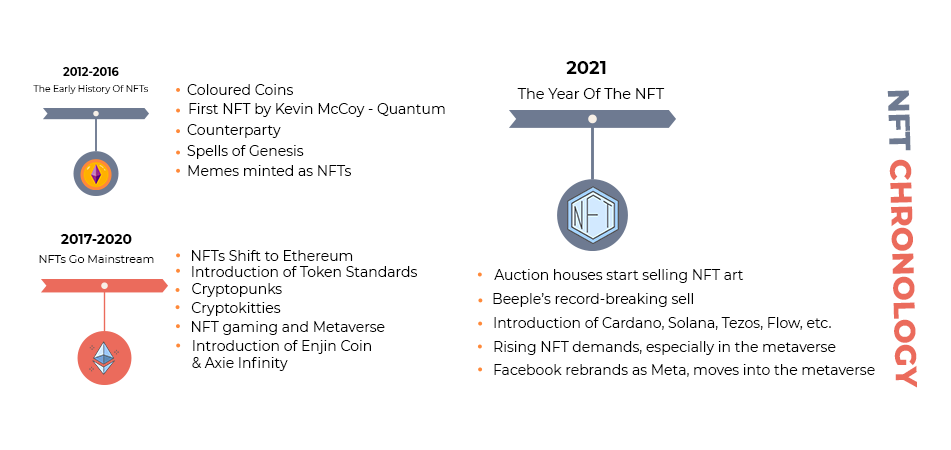
Origin of NFT: It is speculation that Colored Coins are the first NFTs that exist today – a depiction of real-world assets on the blockchain. Back in 2012, Yoni Assia’s blog titled “bitcoin 2.X (aka Colored Bitcoin) — initial specs.” mentioned Colored Coins for the first time. Later, the Rare Pepes trade on Ethereum was witnessed when the first NFT was released, named Crypto Punks.
Afterward, the trades are started through NFTs and using a secured platform for trading. As a result, rare Bits emerged as a marketplace for NFTs that raised $6 million in investment.
Non-fungible tokens are no longer limited to digital art or collectibles. Today, NFTs are being used across multiple industries to create verifiable ownership, improve transparency, and unlock new business models using blockchain technology and smart contracts.
One of the earliest and most popular use cases of NFTs is digital art. Artists can tokenize their artwork as NFTs and sell them directly on an NFT marketplace without relying on intermediaries. These digital assets carry proof of authenticity, ownership history, and royalty rights embedded through smart contracts.
This model allows creators to earn recurring income whenever their NFT is resold, making NFT development a powerful tool for artists, photographers, and designers.
NFTs have transformed the gaming industry by enabling true ownership of in-game items. Players can buy, sell, or trade gaming NFTs such as weapons, skins, characters, and land across NFT marketplaces.
Unlike traditional games, where assets remain locked within one platform, blockchain-based NFTs allow players to carry their digital assets across compatible games and metaverse environments. This has introduced the concept of play-to-earn models and digital economies driven by NFTs.
NFTs are widely used for tokenizing rare collectibles such as sports moments, trading cards, music albums, and fan merchandise. These non-fungible tokens represent scarcity and exclusivity, making them valuable digital collectibles.
Brands and celebrities also use NFTs to launch limited-edition content, offering fans verifiable ownership of unique digital memorabilia.
In the music and entertainment industry, NFTs are used to represent ownership of songs, albums, concert tickets, and even royalty shares. Musicians can mint NFTs to sell exclusive tracks or access passes to fans, reducing dependence on centralized streaming platforms.
This use case of NFTs allows creators to monetize their work directly while giving buyers access to exclusive digital content.
NFTs are widely used to represent virtual land, buildings, and digital spaces in the metaverse. These tokenized properties can be bought, sold, and leased using blockchain-based smart contracts.
Virtual real estate NFTs are becoming part of broader digital economies where users can build experiences, host events, and create NFT-based business models within metaverse platforms.
NFTs can be used to store and verify digital identity and credentials such as academic certificates, professional licenses, and training records. These non-fungible tokens help prevent fraud by offering immutable proof of authenticity on the blockchain.
Institutions and enterprises are increasingly exploring NFT development for issuing tamper-proof digital certificates.
NFTs are also used in supply chain management to track products from origin to consumer. Each product can be tokenized as an NFT, allowing buyers to verify its authenticity, manufacturing history, and ownership trail.
This use case is particularly useful for luxury goods, pharmaceuticals, and high-value items where counterfeiting is a major concern.
Tokenization of physical assets such as real estate, artwork, and rare commodities is another growing NFT use case. By converting physical assets into NFTs, businesses can enable fractional ownership and improve liquidity.
These NFTs act as digital representations of real-world assets, making them easier to trade and manage using blockchain technology.
NFTs are increasingly being used as digital membership cards. Owning a specific NFT can grant access to private communities, premium content, events, or exclusive services.
This model allows brands and creators to build token-gated communities where NFTs function as access passes rather than just speculative digital assets.
NFTs are also used to represent blockchain-based domain names and digital identities. These NFTs can replace complex wallet addresses with human-readable names and can be traded like other digital assets on NFT marketplaces.
When Beeple in partnership with Christie’s sold the “Everydays: The First 5000 Days” digital artwork for $69 million (42329.453 ETH), NFTs started gaining mainstream attention. It resulted in a surge in demand and supply of NFTs that involved other blockchains creating their own versions of NFTs. After this, blockchains such as Cardano, Tezos, Solano, and Flow came into the limelight, which curated some new standards ensuring the authenticity and originality of the digital assets.
In addition, when Facebook rebranded as Meta, it sparked NFT demands, especially within the metaverse.
NFTs and cryptocurrencies use similar innovations and standards based on blockchain technology. However, both possess quite a similarity in their work. To understand it better, NFTs can be seen as a subset of the broader crypto ecosystem that usually requires cryptocurrency (such as ETH) to buy, sell, or trade NFTs. This is why businesses often work with a blockchain app development company to build secure NFT platforms and crypto-based applications.
Moving ahead, as the name suggests, cryptocurrency is a digital currency. It works like traditional money but in a decentralized way. Moreover, it is associated with some economic value and is fungible. With this, it concludes that no matter what type of crypto token you have, it carries the same value. For instance, 1$ETH = 1 #ETH.
On the other hand, non-fungible tokens are associated with a value not limited to economic values. NFTs derive value from their uniqueness, ownership history, utility, and real-world or digital use cases such as digital art, gaming assets, music rights, and virtual property.
| Feature | NFT (Non-Fungible Token) | Cryptocurrency |
| Fungibility | Non-fungible (each NFT is unique) | Fungible (each unit has equal value) |
| Purpose | Represents ownership of a unique digital asset | Used as a medium of exchange or store of value |
| Value Basis | Rarity, utility, creator, demand, and metadata | Market price and supply-demand dynamics |
| Interchangeability | Cannot be exchanged on a 1:1 basis | Can be exchanged equally (1 BTC = 1 BTC) |
| Common Use Cases | Digital art, gaming items, collectibles, virtual real estate, memberships | Payments, trading, remittances, investments |
| Standards | ERC-721, ERC-1155 (mostly) | ERC-20, native coins (BTC, ETH, etc.) |
| Ownership Proof | Blockchain-based proof of ownership of a unique asset | Blockchain-based proof of token balance |
It is evident that NFTs are rapidly growing in acceptance of making financial investments. It offers a mechanism to store bitcoin (more precisely, Ethereum) as a digital asset. An NFT offers investment potential that might increase in value more quickly and considerably than an equivalent position in bitcoin, similar to using money to purchase the actual property (like real estate). So, here are some points highlighting the importance of NFTs.
All major brands have understood that to be at the top in the market, they must incorporate technology into their business. As a result, almost all top brands have started trialing products digitally over traditional physical forms. As it is a much quicker approach to creating a digital image, marketing and advertising are easy for businesses.
Moreover, the popularity of such products as digital assets in the form of NFTs will enhance the marketing front while receiving valuable consumer behavior insights. It surely helps to hype physical products before they even get manufactured.
The biggest benefit of non-fungible tokens is that they address something extraordinary, whether in the digital or real world. Thus collectibles and gaming are one of the main sectors where you can find the fine use of NFTs. But it is not limited to that only; it could similarly be applied to unique items in the real world. For instance, you can use NFTs for houses, vehicles, craftsmanship, or potentially even personalities. In addition, NFTs are useful for specific access to Airbnb on particular occasions or air travel tickets.
Since there are many other tokens, NFTs have the biggest advantage over them: security. While smart contracts/agreements and fungible tokens might process a part of non-fungible tokens, NFTs hold all information in the NFT Market.
Moreover, the token can carry additional information like asset ownership, history, and related data. In addition, NFTs can hold information like an image of a property that the token shows, previous owners, and the count of character skins in a game.
One of the most prominent aspects of NFTs is that “Blockchain” and “Smart Contracts” support them. A contract that underpins NFTs is the term that confers specific benefits on its creator and the owner/buyer of NFTs, which has commercial application.
To understand it better, let’s view Coachella’s (American Music Festival) auction for limited Non-Fungible Tokens. The contract, as just mentioned, specifies that the owner or buyer of NFT will be entitled to lifetime festival access, VIP privileges, and other perks. Such contracts benefit both buyer and the creator. The contract confers special benefits for the buyer while making the deal more valuable and desirable for resale. For the creator, the underlying agreements benefit the creator by auctioning off expensive items while providing strong marketing. Also, the creator receives a royalty fee every time the NFT is sold to someone else.
The best benefit of NFTs is they can represent more complex financial products trading on secondary markets like insurance, bonds, and other options. Also, NFTs as collateral is one of the secure ways to obtain cryptocurrency loans (much like how you might use your house as collateral to get a loan from a bank).
In the forthcoming years, it is projected that businesses will increasingly employ NFTs as a fundamental aspect of advertising and marketing, fee-generation, and larger business models. In addition, the blockchain technology that keeps a public record of every transaction involving a particular currency, including a specific asset, is here to stay. NFTs are a fascinating and forward-thinking invention in that field, with a wide range of commercial applications.
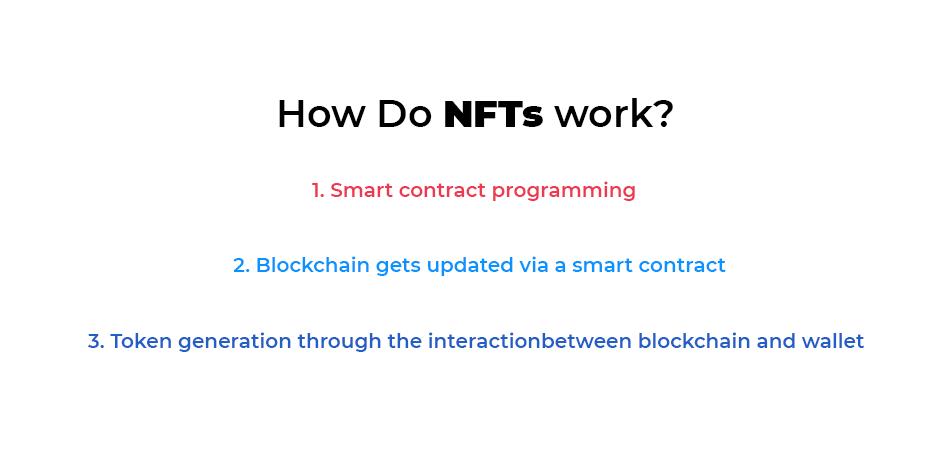
A smart contract generates NFTs as a token on the blockchain. Following are the procedures:
Let’s expand it to get it better…
The blockchain stores a computer program called a smart contract. It differs from previous programs and scripts in that it may only be created once before it becomes immutable after being uploaded to the blockchain network unless otherwise specified in the code at specific locations.
These smart contracts comply with Ethereum network standards. Also, Ethereum request for comments (ERC) like ERC-721 and ERC-1155 assists the developers in complying with the requirements within the codings.
While ERC-721 enables generating tokens, setting supply limits, and other functions, ERC-1155 enables to transfer of multiple tokens lessening the gas fees along with the same functionality as ERC-721.
Ethereum Improvement Proposals (EIP) initiate the ERCs influencing the blockchain programming standards. And developers write code for developing smart contracts through Solidity programming language. Once the smart contracts are programmed, they are saved in the blockchain network that securely interacts with wallets.
Blockchain is a network of computers worldwide that monitors and verifies network activity, including smart contract and wallet user transactions.
The Ethereum Virtual Machine (EVM) is running on computers connected to the blockchain network, where it monitors the state of smart contracts and completes operations they initiated.
In simple words, there are two types of accounts on the blockchain: user accounts, which are wallets, and contract accounts, which are smart contracts. A smart contract is a piece of code we may use to accomplish our goals, such as buying, selling, or any other purpose.
Lastly, the smart contract code based on the parameters mint price, random token, ID, and media file/link generates the NFT.
Some smart contracts allow direct uploading to marketplaces, while others will acknowledge that NFTs created on the market were actually minted on the creator’s website.
This is how an NFT works, and the process completes. But, now, you must be thinking about minting an NFT. Don’t worry; the next section explains it all. Read along!
Simply defined, minting an NFT entails creating a digital asset or crypto collectible on the blockchain from digital files such as JPEG, GIF, or PNG. Once the tokens are publicly available, you can sell your unique token on the blockchain. However, to mint an NFT, you must pay a fair quantity of cryptocurrency.
Making a collectible is possible from a single image or several photographs. You may give your token a name, a description, and other metadata, depending on the marketplace used to host the NFT. On your NFT, you can also specify royalty levels, which represent percentages of the proceeds from each future sale made on the secondary market.
If you’re eager to begin your own NFT collection, you’ll need to purchase the following essentials:
Digital Wallet: To start trading in NFTs, you must purchase a digital wallet that enables you to store cryptocurrencies and NFTs. Once you get it, you can also easily access digital artwork like the meta-verse and other valuables. Many NFT wallets are on the market; therefore, you should consider many things before choosing one.
Purchase Some Cryptocurrency: Depending on your NFT provider’s currencies, you’ll probably need to buy some cryptocurrency, such as Ether. You can purchase cryptocurrency with a credit card on websites like Coinbase, eToro, Kraken, PayPal, and Robinhood. After that, you’ll be able to transfer it from the exchange to your preferred wallet.
Keep the exchange fees in mind as you search for your choices. When you acquire cryptocurrency, most exchanges charge at least a portion of the transaction.
NFTs require a medium for purchase and sale. And NFT marketplace is the decentralized platform where all NFT trading happens. By minting a digital work (Explained in the previous section), an individual who wants to sell NFTs can list it there. Then all buyers worldwide can browse for NFTs and purchase seamlessly.
Such platforms require wallets for both buyers and sellers to make transactions smoother. However, the sellers have plenty of options for selling NFTs. For instance, a seller may set an amount for a particular NFT to purchase so that a buyer can get it at a fixed price. Or, the seller may put the NFTs on the auction list with a minimum bidding price, and buyers can participate in the auction bid and buy the NFTs. At the end of the auction, the buyer holds the NFTs.
Moreover, there are some NFT marketplaces where you can buy and sell NFTs. Check them out!
OpenSea is undoubtedly the most popular NFT marketplace and a great choice if you’re just starting with NFTs. However, it’s a perfect place for you if you want to look at more than only NFT art. OpenSea offers domain names, trading cards, virtual worlds, and sports collectibles for those looking to venture beyond digital photographs.
Launched in 2017 as an Ethereum marketplace, OpenSea has expanded to include USDC and Solana support. However, it’s crucial to remember that fiat currencies, such as pounds, euros, and dollars, are not useful on OpenSea. Besides, it offers a quick registration process, and starting your shopping and browsing on the OpenSea marketplace simply takes a few minutes.
The Rarible NFT marketplace is one of the platforms where new users can learn the most quickly. Making an account and getting started with buying and selling NFTs just takes a few minutes. Alternatively, you can use the Rarible minting feature to make your own NFTs.
On the Rarible marketplace, anyone can create NFTs. Also, making NFTs doesn’t require any pre existing art or a large upfront cryptocurrency deposit. It’s among the top starting NFT platforms available. You can create, purchase, and sell NFTs to your heart’s content once you’ve linked a wallet to Rarible. Above all, you can create an NFT portfolio or purchase artwork that you believe will be booming in the future.
If you’re into gaming, the next marketplace on our list is where you can get NFTs. GameStop is trying to diversify its business beyond gaming and hopes to establish a reputation in the NFT industry.
GameStop is setting up a sizable fund that will be used to entice developers away from rival marketplaces and platforms. In addition, the Layer-2 Ethereum protocol Immutable X is used in the company’s NFT marketplace.
Nevertheless, GameStop’s NFTs will emphasize gaming accessories like weapons, skins, costumes, upgrades, and other things. Further, GameStop works with well-known game developers to give unique NFTs that appeal to players that favor particular titles.
Since there are many NFT marketplaces other than these mentioned marketplaces, be sure to conduct your research before buying any NFT. And go through a complete guide to NFT for sell and buy your digital assests. Impersonators have listed and sold certain artists’ works without their consent, causing some of them to suffer losses.
Additionally, different platforms have different verification procedures for creators and NFT listings; some are stricter than others. For example, for NFT listings, OpenSea and Rarible do not demand owner verification. Therefore, when purchasing NFTs, it may be wise to analyze everything before concluding anything.
Despite the debate on if NFT is an over-hyped trend or a nascent technology with a larger use case, NFTs are here to stay. And they will play a significant role in the future of the digital art world. Moreover, the art market has significantly changed in recent years. Now that NFT has become a part of the mainstream market, they have limitless opportunities and potential, moving beyond the age of innovation and disrupting the world.
Besides, the market hasn’t witnessed its full potential, and there’s much more to innovate. In addition, experts argue that in forthcoming years, NFTs will be taking over the traditional way of trading. Since it provides a more secure way of exchange, businesses can explore it and rule the NFT marketplace by providing futuristic services.
If you still have any queries related to NFTs and their exposure, feel free to connect with Techugo’s team. Our NFT experts will be in touch with you at the earliest possible time.
An NFT (non-fungible token) is a unique digital asset stored on a blockchain that represents ownership of a specific item such as digital art, music, videos, or virtual goods. Unlike cryptocurrencies, NFTs cannot be exchanged on a one-to-one basis because each token has distinct value and metadata.
NFTs work through blockchain technology and smart contracts, which record ownership, transaction history, and creator details. When an NFT is minted, its data is permanently stored on the blockchain, allowing buyers to verify authenticity and scarcity on an NFT marketplace.
In most cases, buying an NFT does not automatically grant intellectual property (IP) rights to the buyer. The NFT usually represents ownership of a digital token linked to an asset, not the copyright of the asset itself.
Legal IP rights depend on the terms defined in the smart contract or the license agreement provided by the creator. Some NFTs grant commercial usage rights, while others only provide personal ownership. This makes it important for buyers to review licensing terms before purchasing NFTs.
Creators earn royalties through smart contracts embedded in NFTs during the NFT development process. These smart contracts automatically allocate a fixed percentage of each resale back to the original creator.
For example, if an NFT is resold on an NFT marketplace, a portion of the transaction value is transferred directly to the creator’s wallet without intermediaries. This royalty model enables artists, musicians, and content creators to generate recurring income from their digital assets.
In fact, many creators and platforms collaborate with a mobile app development company to build NFT applications that support secure transactions and royalty distribution.
There is no single “best” blockchain for NFTs, as the choice depends on factors such as transaction fees, speed, and ecosystem support. Ethereum remains one of the most widely used blockchains for NFTs due to its mature infrastructure and large NFT marketplace network.
Other popular blockchains for NFT development include Polygon, Solana, Tezos, and Binance Smart Chain, which offer lower fees and faster transactions. The ideal blockchain depends on the project’s budget, audience, and scalability needs.
NFTs can be profitable, but they are highly speculative and volatile digital assets. Their value depends on factors such as rarity, creator reputation, community demand, and real-world utility.
While some NFTs have generated significant returns, others lose value quickly due to market trends and low liquidity. NFTs should be approached as high-risk digital investments rather than guaranteed financial assets. Buyers should conduct research and evaluate long-term utility before investing in non-fungible tokens.

A healthcare team decides to build an AI app; the goal is to detect a rare disease early because patient data already exists inside the Electronic Hea..


The idea of pharmacy app development in the UAE can feel overwhelming at first. From planning the features to understanding regulations and prepar..



Write Us
sales@techugo.comOr fill this form