

 SA
SA  KW
KW  IE
IE AU
AU UAE
UAE UK
UK USA
USA  CA
CA DE
DE  QA
QA ZA
ZA  BH
BH NL
NL  MU
MU FR
FR [ LET’S TALK AI ]
X
Discover AI-
Powered Solutions
Get ready to explore cutting-edge AI technologies that can transform your workflow!



Get ready to explore cutting-edge AI technologies that can transform your workflow!






Everyone wants an app like Komoot today. And there’s a clear reason behind it.
Many people use smartphone apps to plan routes for running or discover new hiking trails or even find new places to ride their bikes on weekends. A route planning app like Komoot has become one of the most preferred choices among individuals who enjoy these outdoor activities…as the application provides accurate maps, offers activity-based recommendations for users, and provides smooth navigation to users throughout their rides.
As this demand grows, more businesses want to build similar apps. But the first question they ask is simple – what is the cost to develop a route planning app like Komoot? And how does the route planning app development cost compare if you want advanced features or want to cost to build an app like Komoot?
So, the MVP can start at $30k (€25.5k–34k), while a fully scalable, enterprise-ready route planning app can go up to $400k (€340k+), depending on the app’s complexity.
Continue reading this blog to know why businesses are increasingly investing in route planning app development, the detailed Komoot app development cost with tips to reduce it.
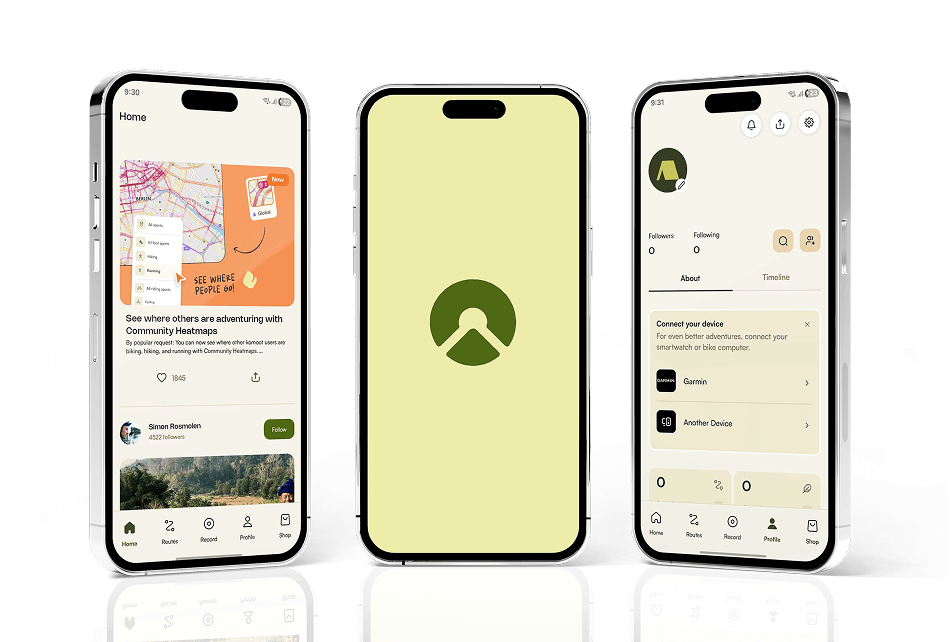
Komoot is a route-planning and navigation app for outdoor activities (hiking, cycling, and running) and it is the first choice of most individuals who love outdoor activities, as this app offers clear routes, smart suggestions, and reliable navigation (which are a must). This is why many brands are inspired, and now see it as the model for building a route planning app like Komoot.
The reason for being popular in the market is that Komoot…
Komoot has more than 40 million users. It leads Europe’s route planning market. It also supports cycling tourism and outdoor recreation. Both sectors are growing fast.
Komoot stands out because users stay active on the platform. It offers personalized routes. It builds trust through a strong community.
If you plan to build an app like Komoot, now you know why people trust it so much…and why the demand for smart navigation apps keeps rising.
Since you’re reading this blog, you must be one of those who are inspired and want to build a route planning app like Komoot, hence, want to know the cost to develop a route planning app today.
So the answer is simple…how big or advanced your app is!
This means the cost to develop a route planning app is entirely based on the number of features you want (and their complexity), the team you hire, the technologies you use, integrations you want, UI/UX, and so on…
In simple words, an MVP costs less because it only includes the core routing features. A mid-level app costs more because it adds voice navigation, analytics, and premium regions. An advanced product costs the highest, especially if you want AI, AR overlays, weather-based rerouting, and a global-ready architecture.
Your route planning app development cost also changes based on team size, timeline, and your chosen mobile app development company. Here’s a simple breakdown so you know what to expect before you plan the cost to build an app like Komoot.
| App Level | What You Get | Estimated Cost (USD) | Estimated Cost (EUR) |
| MVP App | Core routing, offline maps, multilingual UI, GPX import/export, basic community features | $30,000 – $40,000 | €25,956.06 – €34,608.08 |
| Mid-Level App | Advanced routing, turn-by-turn voice navigation, premium regions, payments, analytics, moderation | $40,000 – $400,000 | €34,608.08 – €346,080.80 |
| Advanced App | AI personalization, AR overlays, weather-aware rerouting, marketplace, internationalization | $400,000+ | €346,080.80+ |
Bonus Points

As we know that a route planning app like Komoot has many features, and many of which are advanced features; some are basic and essential for the first version of your app and define user experience, routing accuracy, and basic navigation.
The following is a list of the minimum basic features needed for your route planning application along with a range of estimated costs for each feature to give you a better idea of the actual route planning app development cost.
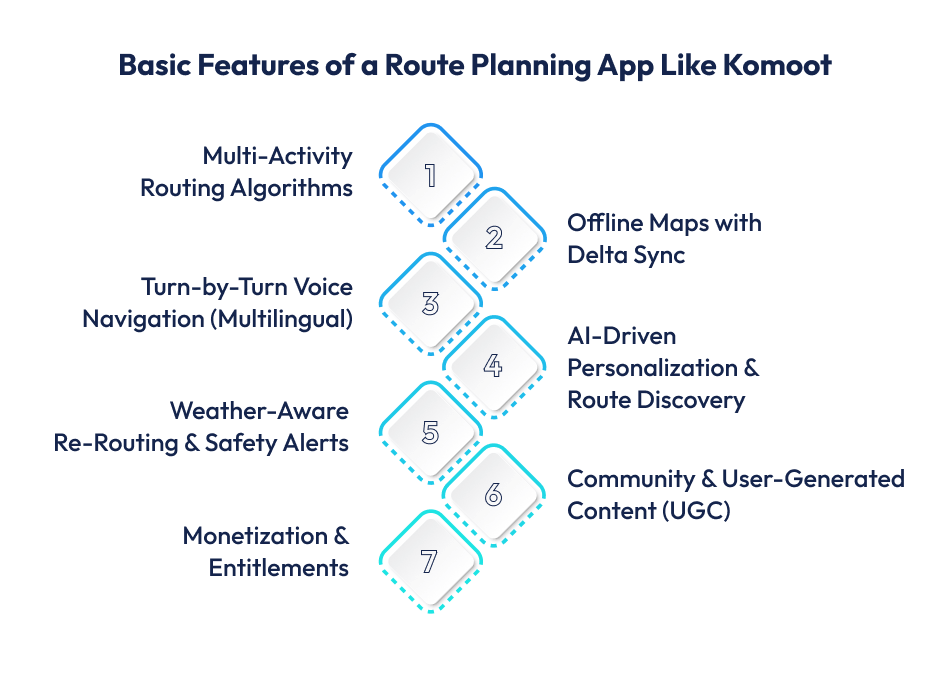
These algorithms help users plan routes for running, hiking, cycling, and more. They keep routes safe and realistic.
Users can download maps and access them without the internet. This is important for remote areas and outdoor trips.
The app gives voice instructions while the user moves. It supports multiple languages and offers offline fallback.
The app recommends routes based on user activity, location, and interests. This makes the experience more engaging.
The app updates or reroutes when weather changes. It alerts users about unsafe conditions.
Users can share photos, reviews, and GPX files. It builds trust and makes the platform more social.
Enables subscriptions and premium map regions. Helps your app generate revenue.
Once the basic features are done, advanced features help your app stand out. They make the experience smoother, smarter, and more personalized. These features also influence the route planning app development cost, but they add real value for long-term growth.
If you’re planning the cost to develop a route planning app, these additions make your product feel premium.
Here are the most useful advanced features:
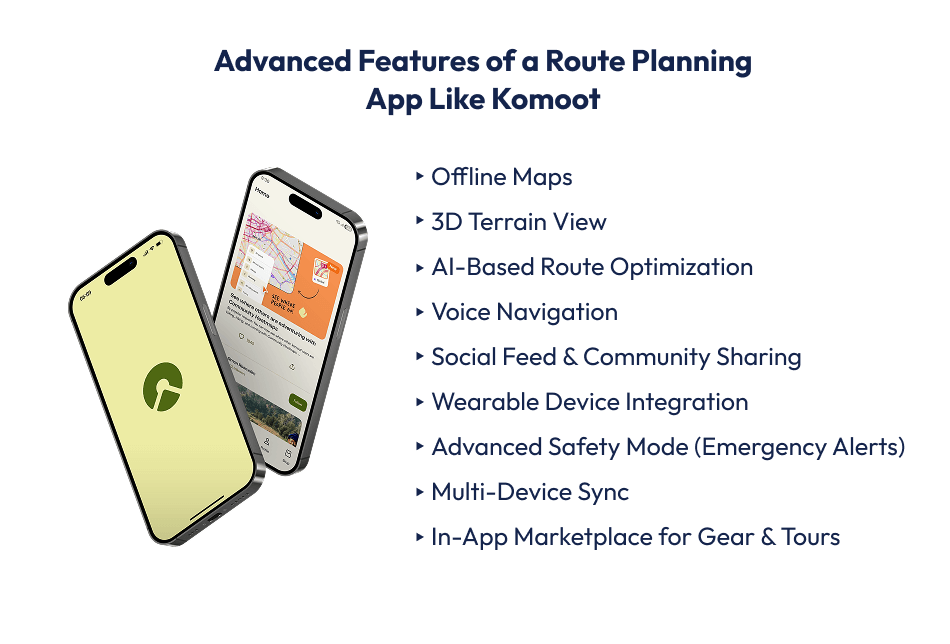
Offline maps are important as sometimes network issues cause disturbance. Users can download routes and navigate easily
When activated, this feature provides an interactive visual display of slopes/hills/elevation in a 3D format, enabling users to create safe and accurate outdoor routes for themselves.
Using data from the app, the AI will analyze user behavior to determine the best route based on distance/time/weather/crowd size and terrain type, which will make the app “smart” and provide users with a more personalized experience.
Users will be able to navigate without looking at their mobile by voice-activated prompts which increases safety related to biking/hiking on trails.
When you share photos, routes, your activity updates, etc, you build a community, and this feature does the same, it lets you build a community by sharing, improve trust, and encourage engagement.
This feature allows users to connect their mobile apps to their smartwatch/fitness tracker. Users will receive real-time navigation information/displayed distance and hear their heart rate.
The app can send alerts or live location to emergency contacts. It increases user safety during long outdoor trips.
Users can plan on mobile and continue on smartwatch or desktop. It ensures seamless switching.
Users discover nearby tours, gear shops, and premium content. It also opens revenue opportunities.
Yes, there can be hidden costs if you don’t plan ahead. Most teams think only about design and development. But apps like Komoot depend on many external systems, data pipelines, and ongoing updates. These add extra expenses over time.
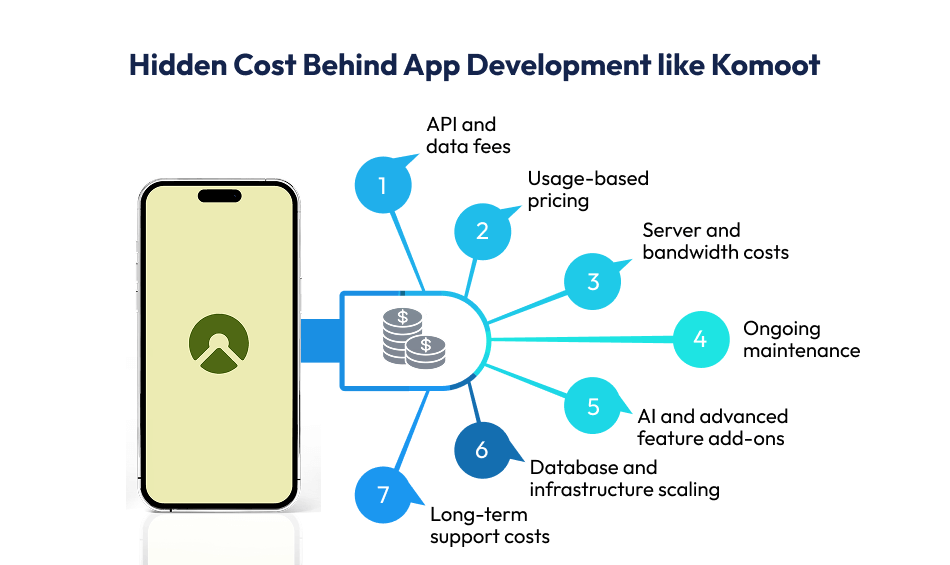
You may need to pay for map APIs, terrain data, weather feeds, and routing engines. These services charge based on usage. So your cost increases as your user base grows.
Server hosting can also fluctuate. A routing application that uses real-time traffic data from GPS must consider the costs of high data transmissions and the expenses associated with providing relevant map tiles to its users.
Maintaining bug fixes, operating system upgrades, support for new mobile devices and security updates will require a team dedicated to continuing the products and support lifecycle. This expense will continue.
Adding AI-assisted options, voice navigation, and integrating wearables are all likely to be expensive and require additional infrastructure and third party tools.
While there is a predictable cost associated with developing a routing application like Komoot, there are many additional hidden costs associated with database maintenance, data transfer usage and providing long-term support that can increase unexpected expenses.
It is beneficial for businesses to factor these additional costs when doing initial planning so as to decrease the likelihood of surprises later in the development process.
The cost to build a route planning app like Komoot is influenced by many technical and design decisions. Each of these decisions will have a direct impact on the estimated cost of the routing application. The following provides a high-level overview of the major cost factors that will influence the total cost.
The design of the application has more impact on the overall development budget. For example, a Komoot-like app will need to have an intuitive user interface, support offline use, and provide support for multiple languages, primarily for European-based customers. The addition of European languages will significantly increase the number of hours required to design the app. Accessibility and region-specific layouts also raise design costs.
The backend is the most expensive part. It manages routing, maps, weather, user data, and millions of requests. Costs rise when you add advanced routing algorithms, scalable servers, and heavy GPS processing. A complex backend directly increases the Komoot app development cost.
Integrations add both time and cost. You may need payment systems like SEPA or Sofort, social sharing tools, map APIs, weather APIs, and GPS device sync. More integrations = more development + more testing.
European users expect strong protection. Security features like encryption, safe login, secure databases, and fraud prevention increase cost. But these features are essential if you want user trust.
GDPR compliance is mandatory. You must add consent controls, data minimization, anonymization, and audit logs. This requires extra engineering time. Skipping GDPR can lead to massive fines, so early investment saves money long-term.
Your target platform affects the budget.
iOS and Android apps built natively cost more but give better performance.
Cross-platform apps lower initial cost but may limit advanced mapping features.
Choosing the right approach affects the total cost of developing a Komoot-like app.
Advanced tech increases development effort. AI drives personalized recommendations. AR overlays help with trail markers and POIs. Weather-aware rerouting uses real-time data and complex logic. Each one raises cost but improves the product.
More features = higher cost.
Offline maps, multi-activity routing, turn-by-turn navigation, community features, and subscription systems all require extra development. These features also require long rounds of testing.
A significant amount of investment is required to build a route planning app like Komoot (the high-quality one) but, if you make wise choices, you can still lower the route planning app development cost. Just look at these 3 most effective ways that help control your budget without harming quality.

An MVP helps you launch early and save money. Focus only on features users need on day one (offline maps, real-time GPS navigation, multilingual support, & basic community tools). It lets you test demand before spending more on advanced features like AI or AR.
The cost to develop a route planning app at MVP level usually falls between $30,000 and $40,000.
Your final budget depends on team size and the complexity of your first version.
If you separately build for iOS and Android, this doubles the cost. But cross-platform tools (Flutter or React Native) let you create both apps with one codebase. This reduces development time and testing effort.
It works well for apps that need offline maps and moderate real-time updates. Choosing a cross-platform can reduce the cost to build an app like Komoot by 20–30%.
Developer rates differ across regions. Western Europe has some of the highest hourly costs. But teams in Central or Eastern Europe offer the same skill level at lower rates. This helps you maintain quality and still control your Komoot app development cost.
A hybrid model (design in Western Europe, development in more affordable regions) gives the best balance. Talk to our team and reduce your development cost smartly!
Here are top 5 reasons clearly showing why businesses are increasingly investing in route planning app development.
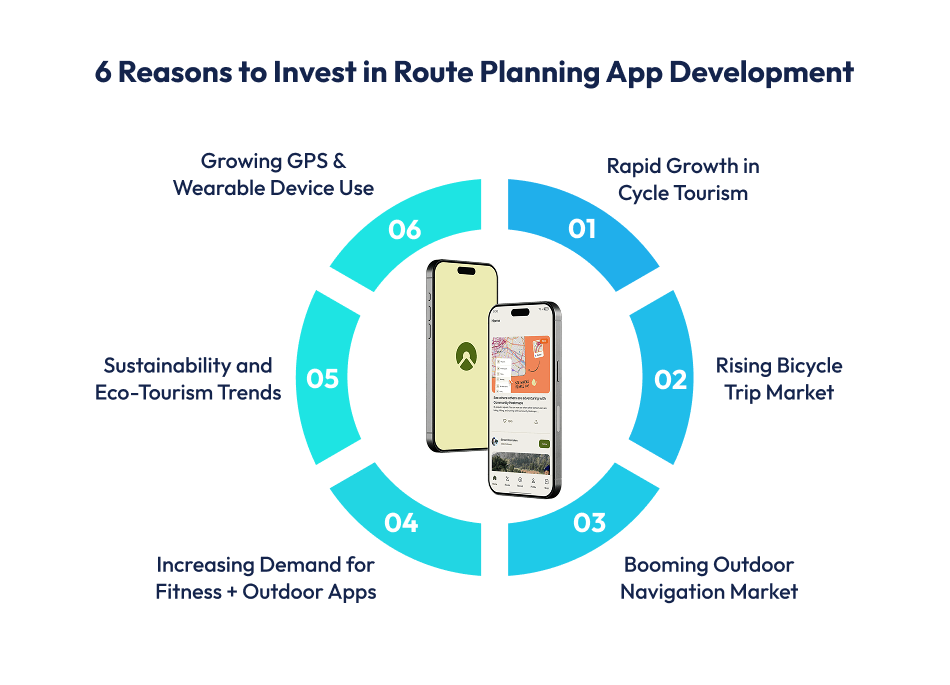
Cycle tourism is a major growth engine, and in Europe alone, cycling tourism is worth €44 billion per year, in which around 2.2 billion cycle trips for tourism taken by Europeans every year.
So it is clear that route planning app development is surely a fruitful business move for travel companies, tour operators, and app developers as well who focus on improving cycling experiences.
The global bicycle trip market is expanding rapidly. Europe accounts for nearly 31.8% of the global bicycle trip market, offering a huge base for apps targeting cyclists. As more people choose cycle-based travel/business trips, they need smart route optimization and navigation.
In 2024, the global market for outdoor navigation app was US$ 2.85 billion and now by 2033, it is expected to reach US$ 7.06 billion, which is a huge growth shows, and this is proof of why people are demanding navigation tools or apps that are designed for hiking, cycling, and outdoor recreation.
Hiking apps alone were valued US$ 0.37 billion in 2024, and now research says that this number can go up to US$ 0.82 billion by 2033, which is a good growth, so for businesses, building a route planning app like Komoot (in both tourism and fitness markets) can capture a large audience.
As we all know that cycling is one of the most sustainable forms of tourism; that’s why many organizations and governments too, are supporting cycling infrastructure.
This alignment with sustainability helps businesses position their route planning apps as green, eco-friendly travel tools.
The market for outdoor GPS devices is also growing fast. As more users rely on wearables and GPS-enabled devices, apps that integrate with these devices become more valuable. Businesses know this and invest in apps that sync with wearables.
Ankit Singh, COO at Techugo, says —
“Companies are betting on route planning apps because they sit at the intersection of outdoor tourism, fitness, and sustainable travel. Markets are also expanding. Plus, user behavior favors smart navigation. So overall it’s a high-growth, data-backed opportunity for investors & enterprises.”
It’s not a casual project to build a route planning app. It needs accurate maps, strong routing logic, offline performance, as well as a backend that doesn’t break when traffic grows.
These are the reasons why businesses prefer working with experts, things become easy as…
Working with a professional route planning mobile app development company in Germany ensures your app is fast, stable, and future-ready.
Now, if you want a partner who actually understands GPS-heavy apps, offline maps, AI recommendations, and clean architecture, Techugo fits that role well.
Since 2015, Techugo has been developing apps and platforms for businesses across the globe.
Till today, the team has delivered 1400+ mobile apps across 50+ industries, ranging from startups, leading enterprises, and even Fortune 500, Fortune 200, and Global 2000 brands.
Techugo has also partnered closely with the Indian government, and has completed 30+ large-scale digital projects so far.
Here’s what Techugo, as a leading mobile app development company in Germany, brings to the table:
If you’re planning to build a route planning app like Komoot and want it to be stable, scalable, and genuinely user-friendly, Techugo is equipped to make that happen.

The cost usually ranges from $30,000 to $400,000+ (€25,860 to €345,840), depending on what you want the app to do. If you add features like real-time traffic prediction, fleet analytics, and AI-based optimization, the cost goes up. A basic MVP is cheaper, a full enterprise-grade system is more expensive.
A solid route planning app should have:
Typically 3 to 6 months. If it’s an MVP with basic routing, it’s faster. If you want advanced algorithms, fleet dashboards, AI-based insights, and enterprise integrations, it takes longer.
Most apps use a mix of mapping APIs and high-performance backend tech. A common stack is:

Let’s be honest, this isn’t something most people expected - AI (Artificial Intelligence) entering into spirituality, the deeply personal world of us,..

Can you imagine attending a prayer session in the metaverse? Or getting Zakat reminders straight from an AI-powered assistant? In 2026, faith and tech..



Write Us
sales@techugo.comOr fill this form