

 SA
SA
 KW
KW
 IE
IE AU
AU UAE
UAE UK
UK USA
USA
 CA
CA DE
DE
 QA
QA ZA
ZA
 BH
BH NL
NL
 MU
MU FR
FR
















Due to constant changes in consumer behavior and increasing demand for digital-first experiences, e-commerce businesses have been facing multiple challenges. From fluctuating sales to changing customer loyalty patterns, brands are now actively exploring solutions like chatbots for eCommerce businesses to stay competitive and efficient in the market.
Have you been looking for applicable solutions as well?
If your aim is to make your e-commerce business more resilient, scalable, and future-ready with the help of an AI chatbot for eCommerce, then you are at the right place.
Today in this blog, we will share detailed insights into how chatbot for online stores is becoming a game-changing technology in the expanding world of electronic and mobile commerce. So without any further ado, let us begin our journey towards a better understanding.
What is an eCommerce Chatbot?
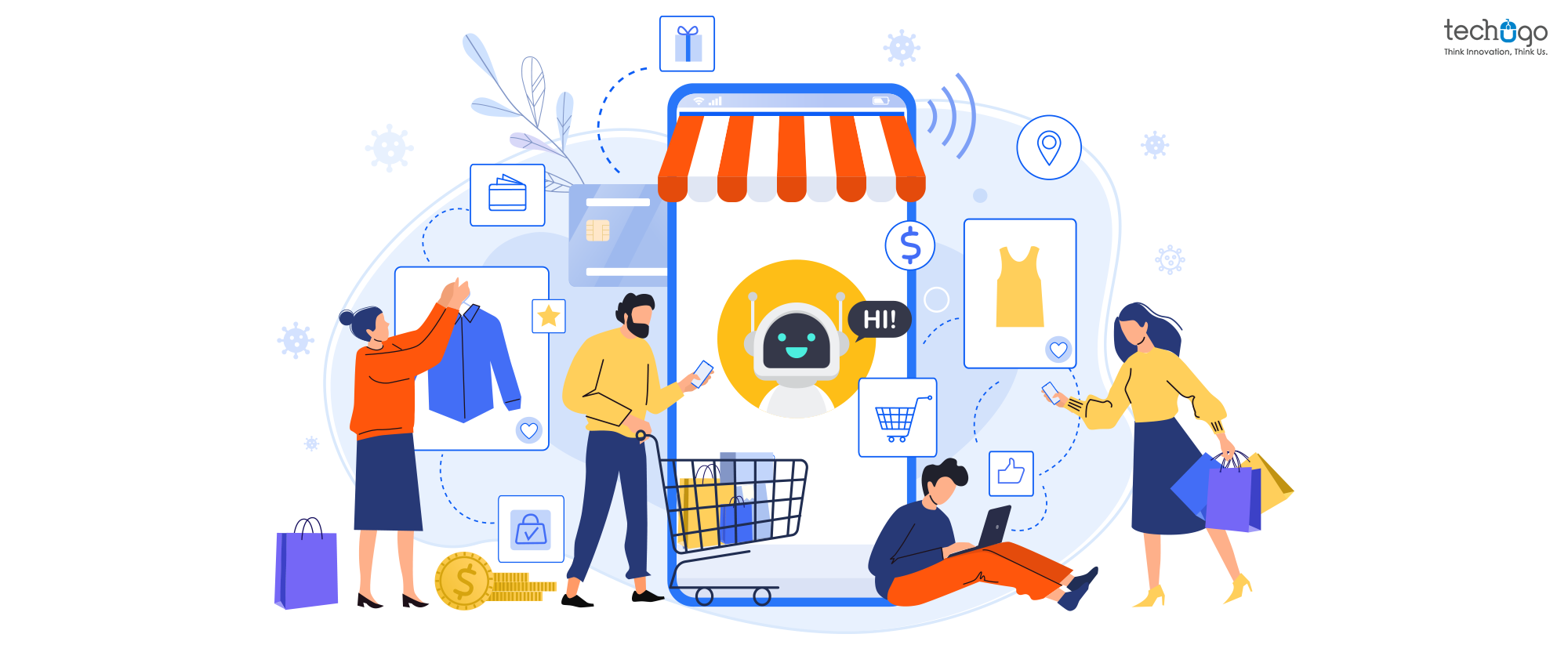
An eCommerce chatbot is a virtual assistant that is used in online stores, and it helps customers interact with a brand in real time. It can answer questions, guide users, suggest products, and even assist with purchases, so that the shopping experience becomes smoother, and faster.
It works because of technologies like Artificial Intelligence (AI) and Natural Language Processing (NLP), and these systems allow it to understand what a customer is actually trying to say. It responds in a conversational way, and sometimes it feels almost like you are talking to a real support agent, but it is not.
In simple terms it is a support tool, and also a sales assistant inside an eCommerce website, therefore businesses use it to reduce manual workload and improve response time, which have been important in online retail for years.
Many brands have been using chatbots for eCommerce businesses, because customers are expecting faster replies now, and it was becoming difficult for support teams to handle everything manually. So it helps balance things, and it makes the whole experience more efficient for both you and the business.
Types of Chatbots Used in eCommerce
There are different types of chatbots used in eCommerce, and each one works differently depending on business needs, customer behavior, and level of automation required.
1. Rule-Based Chatbots
Rule-based chatbots work on predefined rules, menus, or decision trees. They do not understand intent deeply, but they are useful for handling structured queries.
Includes:
- FAQ chatbots (answering common questions like shipping, returns, payments)
- Menu-based chatbots (users select options from buttons)
- Keyword-based chatbots (trigger responses based on specific words)
These are simple, but they are still widely used because they are easy to deploy and manage.
2. AI-Powered Chatbots
AI-powered chatbots are more advanced because they use Artificial Intelligence and NLP to understand user intent and context. They improve over time based on interactions.
Includes:
- Contextual chatbots (remember previous interactions in the conversation)
- Predictive chatbots (suggest products based on user behavior)
- Conversational commerce bots (assist users in browsing, recommending, and purchasing products)
These are commonly used in modern chatbots for eCommerce businesses because they improve engagement and conversions.
3. Hybrid Chatbots
Hybrid chatbots combine rule-based logic and AI capabilities, so they can handle both simple and complex queries.
Includes:
- Support escalation bots (switch to human agent when needed)
- Multi-purpose bots (handle FAQs + product recommendations together)
- Workflow automation bots (manage orders, returns, and tracking with mixed logic)
This model is preferred because it balances automation and flexibility.
4. Voice-Enabled Chatbots
Voice-enabled chatbots allow users to interact using voice instead of typing, making the experience faster and more natural.
Includes:
- Voice search assistants (help users find products using voice commands)
- Voice shopping assistants (support product selection and ordering via speech)
- Smart assistant integrations (connected with Alexa, Google Assistant, etc.)
These are growing in popularity with mobile-first and hands-free shopping experiences.
Switching To Chatbots For Better Customer Assistance
The biggest and most effective advantage for eCommerce businesses today is none other than technology, and more specifically, chatbots for eCommerce businesses. As traditional retail models continue to shift toward digital platforms, online stores have been growing rapidly, and customer expectations have also increased at the same time.
The credit for this transformation goes to intelligent chatbots, commonly known as bots, which are now widely used in eCommerce customer support automation.
Add a pinch of technology to the good old Q&A process, and you get chatbots. It works using Natural Language Processing (NLP) and related technologies, so that a conversation can happen between a user and a system on websites or mobile applications in a smooth and interactive way.
We live in a time where these bots are able to handle a large portion of customer queries, and therefore improve communication between users and brands. They boost engagement and enhance the overall shopping experience, which is why AI chatbots for eCommerce have become an essential part of modern online businesses.
Chatbots For Online Queries
Today, users prefer shopping online instead of visiting physical stores, and because of this shift, eCommerce businesses have been focusing more on improving digital experiences. Therefore, many brands have integrated chatbot for online stores solutions to streamline customer interactions and improve service quality.
It is now clearly visible that customer support has become faster and more efficient, and users are getting instant responses to their queries. As a result, overall customer satisfaction and engagement levels have significantly improved in online retail.
Key Benefits of Using Chatbots for eCommerce Businesses in 2026
Here are a few advantages of using bots that many eCommerce brands have been experiencing as they adopt chatbots for eCommerce businesses. Take a look:
- They are being used to handle impatient customers by providing instant replies and reducing waiting time.
- They have proven efficiency in managing a large number of user queries and customer doubts at the same time.
- Intelligent bots are now capable of handling complete order journeys, including tracking and updates.
- They help improve a brand’s customer service capabilities, making support more consistent and reliable.
- A chatbot can increase customer engagement by interacting with users throughout their shopping journey.
- They help businesses gain better insights by collecting and monitoring customer behavior data.
- They support lead generation by capturing user intent and guiding potential customers.
- They simplify the process of scaling an eCommerce business into a global market.
- Last but not least, they help save resources such as time, operational effort, and support costs. Because of this, many businesses prefer partnering with Techugo, a top chatbot development company to build scalable and customized solutions that fit their eCommerce needs.
Currently, the demand for 100% digital support experiences is encouraging brands to adopt AI chatbots for eCommerce at a faster pace. It has become essential for companies to focus on improving UX by offering consistent, accurate, and instant support. By automating customer service through eCommerce automation tools, brands are now able to handle a large volume of queries without compromising quality.
Bots Deflection Rate & AI Efficiency in Customer Service
Have you heard about bot deflection rate? It is a key metric in AI chatbot for eCommerce performance that measures how effectively a chatbot can resolve customer queries without involving a human agent. In simple terms, it reflects how many customer issues are handled through self-service automation in just a few interactions.
It reduces the need for human intervention, especially in routine processes such as shipments, order cancellation, status requests, refunds, and similar support tasks. This is where eCommerce customer support automation plays a major role in improving efficiency and response time.
In customer service, handling queries is not the only focus; reducing resolution time is equally important. Because of this, many brands using chatbots for eCommerce businesses have observed an increase in Customer Satisfaction Score (CSAT), as customers receive faster and more accurate responses compared to traditional support systems.
Challenges Chatbots Solve for eCommerce Brands
eCommerce businesses today face multiple operational and customer service challenges, and this is where chatbots for eCommerce businesses play a key role in simplifying processes and improving overall efficiency.
- One of the biggest challenges is handling a high volume of customer queries, especially during peak traffic periods or sales seasons. Chatbots help manage this load by providing instant responses, so that customers do not have to wait for support.
- Another common issue is slow response time, which often leads to poor user experience and abandoned carts. With the help of an AI chatbot for eCommerce, businesses can ensure real-time assistance and reduce drop-offs significantly.
- eCommerce brands also struggle with scaling customer support without increasing costs. Chatbots solve this by automating repetitive queries and enabling eCommerce customer support automation, which reduces dependency on large support teams.
- Personalization is another challenge, because traditional systems often fail to understand customer intent. Modern chatbots improve this by using AI to deliver relevant suggestions and better shopping guidance.
- Lastly, maintaining consistent support across multiple channels can be difficult. Chatbots help unify communication across websites, apps, and messaging platforms, making the overall customer experience more seamless and efficient.
How Chatbots Fit into Modern eCommerce Development
As eCommerce platforms continue to evolve, chatbots are no longer just an add-on feature but an essential part of modern digital products. Today, businesses are actively integrating them during the product design and development phase itself, especially within eCommerce app development services.
This ensures that chatbot functionality is deeply connected with core systems like product catalogs, payment gateways, order management, and customer data. As a result, businesses are able to deliver a more seamless and intelligent shopping experience, rather than treating chatbots as a separate support tool.
In A Nutshell
You now know about the different levels at which chatbots offer their assistance in eCommerce businesses. So what do you think, are bots your cup of tea?
Your interest in incorporating this technology can significantly shape the future of your business. Before jumping to a conclusion, it is always better to explore the concept in depth and understand how chatbots for eCommerce businesses can improve customer experience, engagement, and overall efficiency.
There is no harm in initiating a discussion and learning the different ways chatbots can be utilized in modern digital commerce. Stepping into a brand-new digital era simply means staying open to better possibilities and smarter automation.
If you are planning to integrate advanced chatbot solutions, connect with Techugo, a leading e-commerce mobile app development company, to explore how the right AI-driven solution can transform your eCommerce experience.
Let’s build smarter, AI-powered eCommerce experiences together. Get in touch with Techugo today.

Get in touch
We'd love to hear from you.