

 SA
SA  KW
KW  IE
IE AU
AU UAE
UAE UK
UK USA
USA  CA
CA DE
DE  QA
QA ZA
ZA  BH
BH NL
NL  MU
MU FR
FR [ LET’S TALK AI ]
X
Discover AI-
Powered Solutions
Get ready to explore cutting-edge AI technologies that can transform your workflow!



Get ready to explore cutting-edge AI technologies that can transform your workflow!






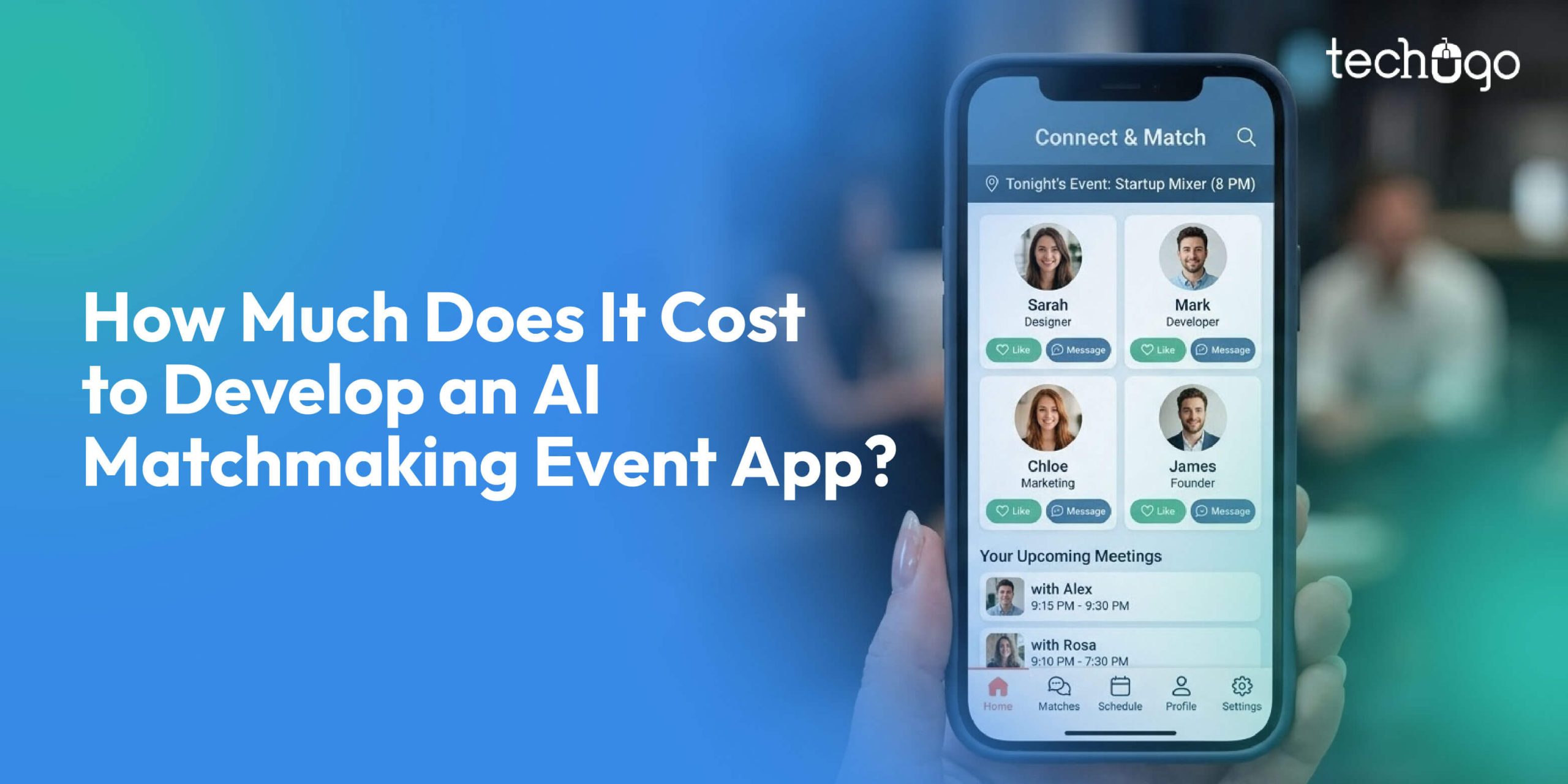
The use of AI-powered matchmaking apps is changing the dynamics of interactions during networking events, conferences, and social gatherings.
Instead of relying on coincidental meetings, these apps use AI technology and behavioral science to create connections between people based on their interests and personality traits.
With the increasing need for personalized interactions during networking and dating events, many organizations and entrepreneurs are opting for AI matchmaking app development services.
Generally, an AI-powered matchmaking app for events involves the use of machine learning technology and real-time communication tools.
The app analyzes user interactions and determines the most suitable matches during an event. The core components of app include profile matching technology and AI-powered matchmaking.
The app’s components help create a high level of engagement during events and make the overall event more effective.
From a business perspective, the app offers many opportunities for generating revenue. Therefore, organizations in the event technology and dating industries are investing a lot in AI-powered matchmaking apps.
The primary question that many entrepreneurs ask is the development cost of an AI-powered matchmaking app for events. So an average cost to develop an AI-powered matchmaking event app starts from $80,000 and it can go above $250,000, depending on the app’ features, functionalities and the developers’ geographical location.
Understanding these costs is essential before investing in the development process. So, with this article, we’re going to discuss the essential components and development costs for an AI-powered matchmaking app for events in 2026.
Come 2026, AI won’t just accompany people – it’ll shape how people meet at events through smart phone tools.
By 2024, the smart events space hit about $105.9 billion, expected to climb at roughly 20.4% each year until 2033 – driven mostly by AI upgrades and blended event styles.
Nearly 2 out of 3 users tend to stick with apps that suggest tailored matches, which helps explain why AI-powered matchmaking stands out in today’s platforms.
Because of this shift, networking tools using artificial intelligence are becoming one of the quickest rising parts of the industry scene.
Meeting people drives most professionals to attend industry gatherings.
Roughly 3 out of 4 show up mainly to connect with others. That fact pushes planners to find better ways to match individuals.
Smart systems sort through job roles, goals, fields, and preferences to pair attendees more thoughtfully.
These digital helpers cut wasted time during meetings. A growing number rely on tech like this to spark real conversations. Spending on such tools may jump from nearly $9.7 billion in 2025 to almost $15.8 billion ten years later.
Demand climbs as businesses seek sharper results from their event participation. Conferences focused on company-to-company deals benefit when links form naturally.
Trade fairs see stronger outcomes when relationships develop smoothly. Startup mixers gain value when founders meet relevant partners. Better matches often lead to measurable gains for organizers.
People at events now want things they actually like, much like how streaming sites recommend shows.
Because of artificial intelligence, meeting apps study how users act, what they enjoy, and who they’ve talked to before.
As a result, matches feel more fitting. When suggestions fit well, people leave happier – satisfaction jumps by nearly half.
That kind of boost gives event tech an edge. Firms using smart match systems tend to pull in more guests and partners without extra effort.
Startups find strong income chances with AI-powered matching tools.
Money comes via subscriptions, high-tier pairing features, entry fees linked into systems, alongside brand partnerships.
Organizers often spend on artificial intelligence since it sharpens connections and boosts participant involvement.
A recent study shows six out of ten planners intend to apply smart tech at future gatherings – clear proof interest runs deep.
What makes AI matchmaking tools stand out is how easily they spread through SaaS models.
One built, rolling them out to countless gatherings around the planet demands little extra spending.
From cities in North America to hubs in Europe and spots across Asia, planners now lean into smart systems that sharpen connections and reveal patterns hidden in attendee behavior.
With more meetings mixing online spaces and real-world venues, these tools unlock ways for people from different fields – even distant time zones – to link up smoothly.
One thing is clear by 2026 – apps that match people at events using smart algorithms are catching on fast.
Startups focused on event tech now see a shift happening. Driven less by hype, more by real need.
Scalable platforms built on subscription models make growth easier.
Personal touches, once hard to scale, now happen automatically.
Demand isn’t shrinking – it’s getting sharper. What stood separate before – data, access, timing – is blending into one tool.
Unexpected wins come from how these pieces fit, not just having them. So momentum builds quietly beneath the surface.
Matchmaking tools have grown smarter because of artificial intelligence, moving far past old-fashioned setups into fresh areas.
Driven by smart algorithms, some startups and tech teams build systems that learn from behavior to suggest meaningful matches.
These digital matchmakers rely on pattern detection, user data, and predictive logic behind the scenes.
Knowing the differences among them gives organizations a sharper view when exploring what might come next.
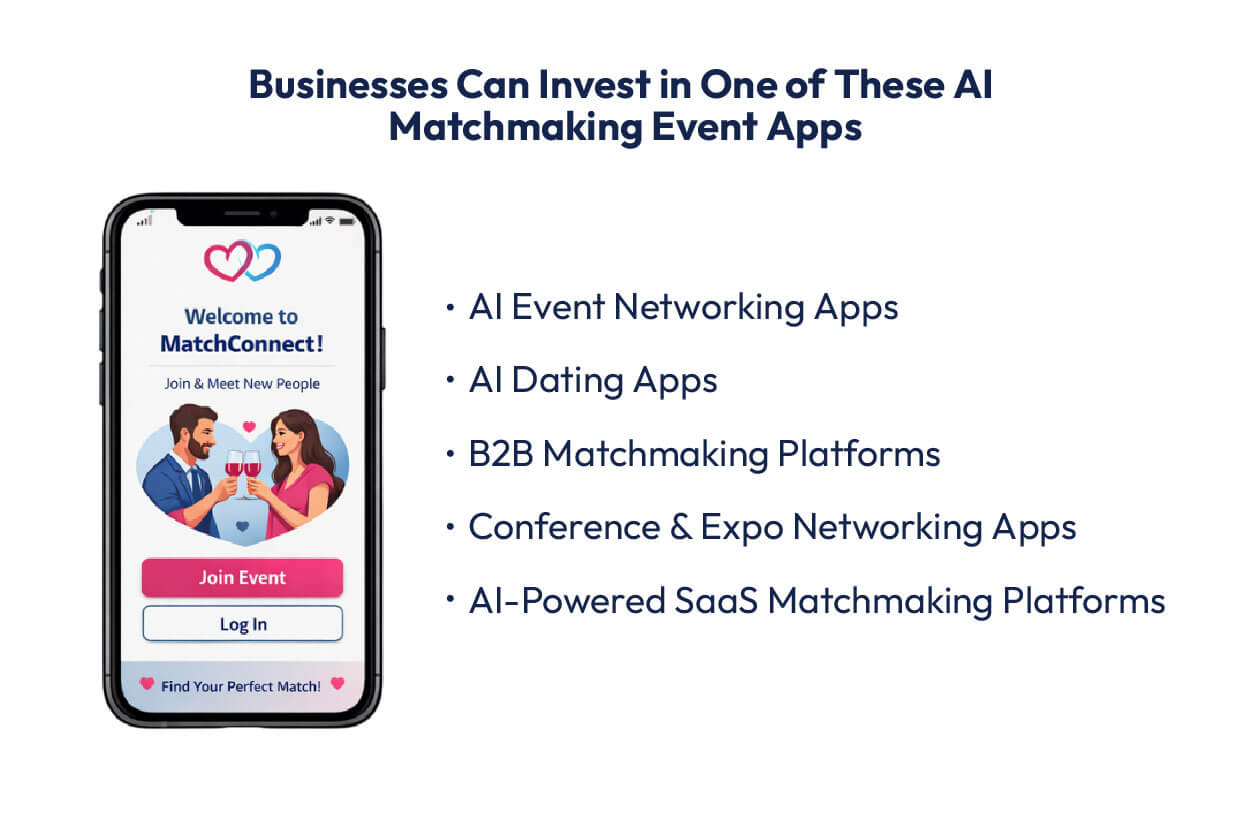
Instead of random meetups, people now find better matches at events using smart tools.
Profiles get scanned – job type, field, goals – so suggestions feel less like guesswork. One app might pair you with someone similar; another pushes opposites.
Scheduling happens inside the software, messages stay contained, plans adapt on the fly. Connections grow from shared context, not just luck.
Organizers see who talks to whom, how long they chat, whether follow-ups happen. Results become visible, not imagined.
Dating apps that use artificial intelligence have been around long enough to feel familiar within the romance tech space.
Instead of just basic filters, they learn from how people behave and what they say they want when picking matches.
Over weeks or months, smarter systems study messages, timing habits, and daily routines to adjust who gets suggested.
Some even offer chat tips generated by algorithms or calculate match percentages meant to reflect deeper alignment.
As more users join digital dating worldwide, these smart tools keep drawing attention from investors looking ahead.
Starting with business connections, these platforms link companies, backers, and experts looking for joint ventures.
Inside startup circles, investor meetups, or work-related groups, they’re often found helping people find one another.
Instead of guesswork, artificial intelligence scans details like field of operation, money needs, growth level, and partnership goals.
Because shared projects matter so much in certain fields, being able to spark deals, client contacts, or long-term cooperation makes them useful.
Their worth shows up most when working together drives progress.
Big gatherings like trade shows often struggle to spark real conversations between crowds.
Yet smart apps built with artificial intelligence make those links easier by learning what each person cares about professionally. Because of that, people get matched with fitting speakers, booths, or workshops they might actually want.
Meetings happen more naturally – say, between specialists in one field or companies looking to buy and sell. Navigation improves too, steering visitors toward topics that matter to them.
Organizers gain something valuable: clear feedback showing who engaged, how deeply, and where attention went.
Something new popping up is AI-powered matching tools offered online through subscription services.
Instead of building separate apps every time, businesses offer flexible systems that groups or planners can adapt for their needs.
Often these come with smart suggestion features, interfaces to track connections, ways to review data, plus links to existing event tools.
With this setup, providers reach clients anywhere, earning consistent income via recurring fees and large-scale contracts.
Building an app that uses artificial intelligence to match people at events means spending money on a few main parts – smart software, instant messaging tools, online servers, fast databases, and strong behind-the-scenes design.
Price shifts depending on how advanced the system is, what kind of AI features it runs, which services plug into it, plus where the developers are based.
Starting small helps test if people actually want the app before building too much.
User sign up and personal profiles show up early, along with a lightweight suggestion tool based on simple rules instead of complex AI.
Matching attendees happens through clear logic, not deep learning systems that need tons of training.
Messages inside the app let users connect without leaving the platform during events. Schedules appear with alerts so guests know when things start. A barebones control panel gives admins oversight without clutter.
Building just enough gets the product out fast, opening doors to real feedback. Data gathered from actual usage shapes how the matchmaker improves over time.
These apps come with extra tools that make using them smoother. Because of smart technology inside, they can guess what users might like.
One thing leads to another – behavior tracking improves suggestions over time. Real conversations happen through instant messaging, sometimes paired with alerts that pop up when something matters.
Scheduling events gets smarter by proposing who you should meet. Video talks fit right in, alongside digital spaces meant for group interactions.
Organizers get reports showing how things are going. Behind the scenes, strong systems support all these pieces working together.
Teaching machines to respond well takes effort and large sets of information.
Connections to outside services help everything run without hiccups. Smarter algorithms cost more, easily adding tens of thousands to the total price.
Big conference systems handle global meetups, trade gatherings, business match programs. Such tools run online, letting many event planners work at once. Because they use smart algorithms that learn who should connect, expect suggestions before you even search.
Chat helpers powered by artificial intelligence guide discussions smoothly. Video spaces open alongside live streams so talks flow without breaks.
One screen manages several happenings together, giving control across projects. Data reports show what guests prefer, how long they stay engaged.
Support comes in various tongues, works in different time zones naturally.
Strong servers form the base, fast internet hosts everything reliably.
Machine brains need constant updates to keep pace. Building it all usually takes over three hundred thousand dollars, sometimes near half a million or past that.
At the heart of every matchmaker app sits an AI suggestion system.
Though simpler setups follow fixed rules and save money during creation, smarter versions study how people act using complex math that demands heavier spending.
Building such smart cores usually takes between fifteen thousand and thirty thousand dollars, shaped by how clever they need to be.
That price tag comes from cleaning up information, teaching systems how to judge fits, then fine-tuning – costs climb when accuracy needs rise or goals grow wider.
A tailored model might take $40,000 at minimum, sometimes near $70,000 before it works right.
Messaging tools and live video matter a lot in network-focused software.
Building them means working deeply with systems like WebRTC, plus setting up instant alerts that arrive on time.
When just the camera functions start at fifteen thousand dollars, expenses climb fast.
High clarity streams and room to grow multiply costs without warning.
Outside services like calendars, customer records, tickets, and event planners often link up with matchmaking apps.
Tied into these connections?
Custom-built APIs that demand extra coding behind the scenes. More links mean more tangled development, which pushes expenses higher.
When lots of people join an event at once, the system must spread out tasks smoothly while handling info instantly.
Building that setup, along with running AI tools, often costs somewhere from ten thousand to twenty-five thousand dollars – more users usually mean higher bills.
Faraway teams often charge less each hour. Where people work changes how much it costs
Hourly pay in the UAE runs between sixty and a hundred dollars
Fees rise sharply when developing identical software across North America instead of hiring overseas groups that know just as much.
In the United Arab Emirates, hourly rates are lower than in the US but still relatively high compared to offshore markets.
One reason an AI-powered event app works well lies in what it offers users and planners alike.
When building such apps, developers face higher costs – advanced tools for instant messaging or live data tracking need more than basic coding skills.
Usually, one part of an AI matchmaking system is built for people joining events. Another section serves those running things behind the scenes.
Together, they shape how smoothly the whole setup works over time. What keeps it growing? How both sides connect and share information.
Inside the app, people build profiles to find matches while moving through events. A live feed keeps interactions going without slowing anyone down.
Profiles link up on their own when interests overlap nearby. Getting connected happens quietly in the background. Smooth movement between features helps avoid delays. Each step follows naturally, like walking from room to room.
Every bit of detail – job history, hobbies, goals for connections, fields they prefer – gets pulled together here.
Not like old-style forms; smarter tech sorts it all so matches feel less random.
Built-in tools tag facts, walk users through setup, show what matters most to them.
That kind of smart structure takes extra work to build. More pieces moving means higher price tags, yes – but it feeds the brain behind suggestions too.
Right off the bat, the AI-driven match score shapes how people connect by scanning profiles, hobbies, how they act at events, and habits.
To make it work, systems need smart suggestion tools, strong data handling setups, plus ongoing model practice – that pushes costs higher than older, simpler ways of pairing folks.
Every time someone joins or changes their information, new matches appear automatically – links to people, events, or groups that might fit.
When suggestions update instantly, the system must process data fast, leaning on strong servers and smart algorithms trained to react quickly.
This speed needs more powerful tech behind the scenes, which means heavier systems and higher expenses to keep everything running.
When it comes to conferences or expos, linking up event timetables and custom plans helps AI recommend talks or meetups based on what someone likes or does for work.
Tapping into event tools and calendar services makes setup more involved – yet users tend to stay more involved as a result.
Chatting, talking by voice, or joining live video spaces helps people connect inside the app. To make those work, you need backend message systems, alerts that pop up on time, secure data rules, along with things like WebRTC for streaming face-to-face video.
Swipe-style tools borrowed from dating apps help people say yes or no to connections, then set up time to meet.
Calendar links, alerts, signals about location – these usually come built into the plan setup.
Even if what you see looks clean and light, the code running beneath needs extra work to handle who gets picked and when things happen.
Behind the scenes, those running events tweak how matches happen by using controls built into the system.
Outcomes from each event get reviewed closely, helping spot what works. These insights feed back into improvements that sharpen how well everything runs.
Matching settings – such as job fields, personal choices, or connection aims – can be adjusted by team leaders.
Built-in flexibility requires strong behind-the-scenes architecture along with smart handling of information, which makes building it more involved.
Starting fresh each day helps keep things running smoothly when team leads check user details, clear out fake entries, one after another.
Tools like reports, rule enforcement, along with automatic checks do the heavy lifting without flash or noise.
Even though they lack smart-learning tricks, such supports hold up the space quietly behind scenes.
Metrics like who meets whom, sessions joined, appointments made show what works. Instead of guessing, they watch live updates flow into clear visuals.
Tools that draw charts need constant data feeding them. This setup takes time to build, plus extra budget. Yet it gives a clearer picture of what attendees actually do.
Worth the effort because decisions rely on actual behavior, not assumptions.
Running the admin panel means handling sign ups, paid extras, event tickets, while taking care of money transfers.
Organizers can earn through better match suggestions or tools that help people connect.
Setting up ways to accept payments and track memberships takes more work during building, yet it supports long term earnings.
Watching things closely keeps AI suggestions on track. Dashboards show how well models perform, how people interact, yet reveal patterns in actions taken.
Even though improving systems over time is possible, more support for handling information along with analysis power becomes necessary.
Where your team is based shapes how much it costs to build an AI-powered dating event app.
Starting your own development team means keeping full say over how things turn out.
Hiring usually brings in people like AI coders, app builders, server-side techs, interface artists, plus testers who check everything twice.
Talking face to face speeds up choices, cuts delays. Yet costs pile high – U.S.-based AI talent often pulls down more than 120 large a year.
Putting together a complete crew often increases daily expenses, yet hunting for talent might stretch out how long things take.
Startups building advanced AI match systems could blow past 300 grand yearly before even going live.
Teams come ready-made – filled with coders who know AI, specialists in phone software, visual creators, plus those who keep projects moving forward.
Skip long recruitment rounds; instead tap into experts already familiar with similar work.
Keeping tasks organized, checking results closely, making sure deadlines stick – that gets managed from day one.
While working with an agency usually means steeper pricing compared to solo professionals, what you get is stronger consistency in deadlines.
Projects for artificial intelligence dating platforms typically cost from eighty thousand up to two hundred fifty thousand dollars, shaped by how complex the build needs to be.
Offshore teams in places such as India or the UAE often catch a company’s eye when budgeting gets tight.
Skilled developers live there, charging far less than their American counterparts.
In the U.S., an hour of work might cost between 120 and 180 dollars; across the Gulf, it drops to 60 through 100; in India, just 25 to 45.
Savings pile up – development spending shrinks by nearly half, sometimes more, versus hiring locally.
Startups especially find this useful when chasing strong AI tools but holding slim wallets.
Mixing internal talent with external developers can shape how some teams operate.
Consider a business that keeps its planners in-house and sends coding work abroad.
Even though costs are reduced and the team size changes based on needs, oversight remains local.
Startups often find that this mix keeps costs low, brings skills closer together, and still allows for faster progress through each phase.
Figuring out how much it will take to build an AI-powered event matching app usually has companies looking at what they can see right away – things such as programming work, interface layout, features being added.
Yet hidden behind those upfront line items are extra charges tied to artificial intelligence systems, popping up while building and later once live.
Missing any piece might leave funds stretched too thin, making day-to-day management harder down the road.
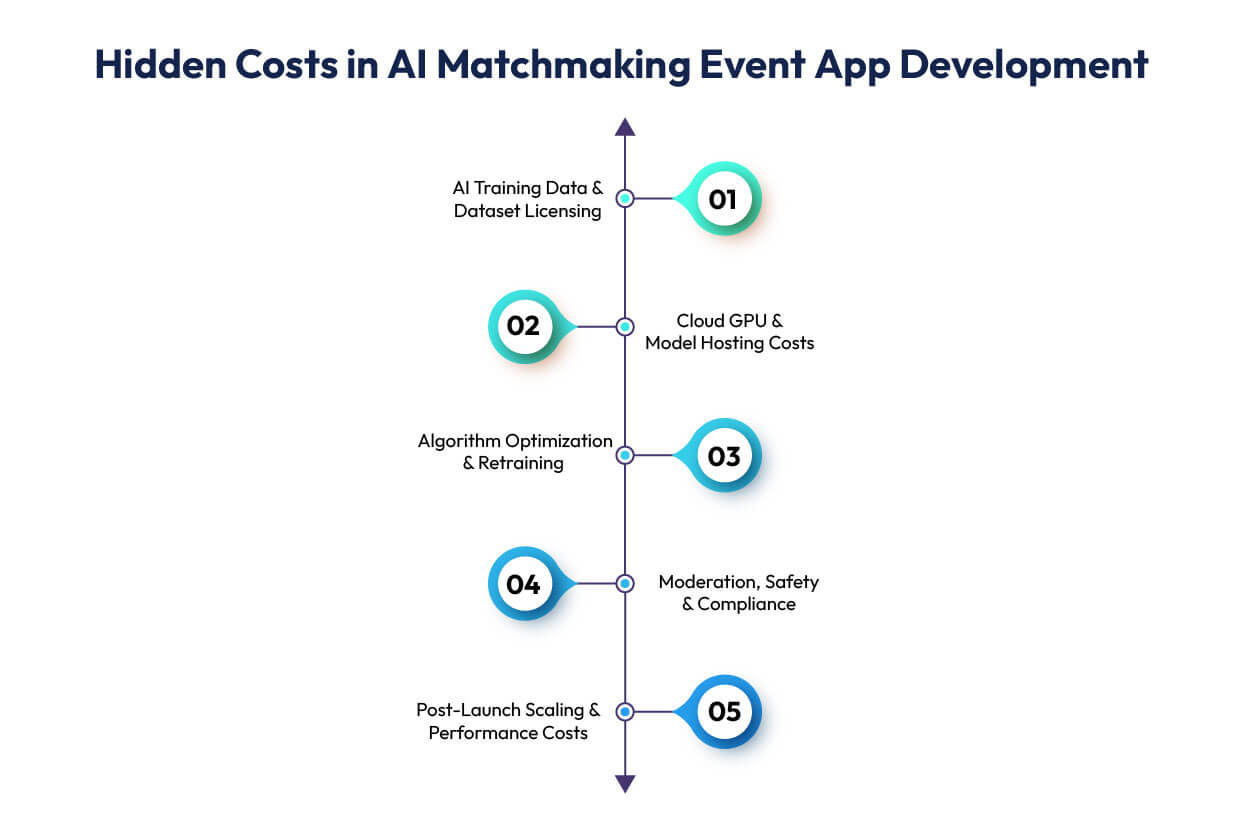
Hidden expenses often come up when getting ready-made training data into shape. Because pattern recognition needs solid exiles, AI systems depend heavily on large sets of information.
To teach matchmakers how users act, developers collect details like profiles, clicks, and time spent online. Sometimes outside data gets bought instead – pulled in to sharpen how smart the system feels.
Tools that track actions may also feed into models, nudging accuracy a bit higher. This step of getting data ready – cleaning it, adding labels, then sorting it for AI training – needs skilled people, often raising expenses across projects.
When information lacks consistency, powerful algorithms still fail to produce useful results.
Heavy-duty systems are needed to run AI models without hiccups.
Instead of regular software setups, AI matchmakers lean on cloud-based GPUs along with powerful computing tools to handle massive data while delivering instant results.
AWS, Google Cloud, and Azure supply specialized GPU options built for machine learning jobs – yet keeping them active long-term adds up fast.
On top of GPU charges, you might also pay more for storing information, managing traffic flow, plus running event-driven functions that keep matches ticking in real time.
When user numbers spike during big moments, what happens next is predictable: the bill climbs right alongside.
When fresh user information arrives, AI matching systems need updates to stay effective.
After release, engineers usually spend effort refining predictions through model retraining and tweaking suggestion rules.
Testing runs regularly, settings get fine-tuned, results reviewed – each step handled by experts in data and learning machines. Better matches emerge from such work, yet hidden expenses pile up slowly behind the scenes.
These costs come from constant tinkering, a part of upkeep that many fail to account for early on.
Every platform needs trust, particularly those built for career connections or personal relationships.
To catch bad posts or odd activity, many builders rely on smart tools that run without human help. Such tools might scan messages using artificial intelligence, let users flag issues, or bring in staff reviewers when needed.
Staying within legal lines matters just as much – guarding private details and following safety rules keeps things stable.
What holds it together often hides behind the scenes, working quietly.
Behind every message lies a need for safety. Storage must guard details carefully, using locks that only authorized systems can open.
Rules differ by region, yet each demands respect for personal boundaries. Protection layers make building harder, true, but skipping them risks trust.
Without strong shields, both users and the system grow fragile. Keeping things private isn’t optional – it shapes how well everything holds together.
When more people start using the platform, handling growth after launch matters most.
Right when big events happen, visitor spikes can hit AI networking tools hard.
Staying steady through those moments means adjusting server size on the fly, supporting many active users at once, yet keeping suggestions quick.
Through heavy loads, spreading data across global networks helps balance demand while faster databases keep pace.
Servers that grow automatically match rising usage and prevent slowdowns without manual fixes.
Smooth operations rely not just on code but how well systems adapt under pressure.
Worldwide delivery points cut delays by bringing resources closer to users everywhere.
Handling crowds comes down to preparation, smart architecture, not waiting until things break.
Real-time responses hold up only if every layer scales together, quietly behind the scenes.
Extra cloud tools aren’t optional extras – they’re what keeps everything running when demand jumps.
Maintenance never stops – fixing glitches, improving functions, or fine-tuning speed stays on the list.
Year after year, plenty of AI-based tools set aside a large chunk of their initial build funding just to keep that work going.
One step at a time, building a smart matchmaking app means more than coding for phones. A typical app development process involves the following steps:
A starting point for building an AI-powered matchmaking app is testing whether the main idea works, then choosing a specific group to serve.
While such tools can link professionals, pair attendees at events, support business partnerships, match people romantically, or connect emerging companies with backers, success often comes from focusing early.
Starting any build means first digging deep.
To move forward, companies look closely at who they aim to serve while comparing what alternatives already exist out there.
Understanding user needs shapes the path – especially the kinds of relationships people hope to form through such tools.
Gaps in today’s apps often reveal where change matters most.
From here, it becomes clearer how artificial intelligence might refine matching in meaningful ways.
Success usually comes to platforms focusing on a narrow purpose – think connecting professionals at events, aiding startups, or building private business networks.
Right from the start, picking one clear direction shapes how features are built, how information is structured, yet also influences how easily users can navigate the system.
Decisions around tools, layout, even backend logic follow naturally when the target group stays front of mind throughout creation.
Once validated, effort moves toward building the AI-driven matching mechanism.
This system mainly works by studying detailed personal data – profiles, stated preferences, personal objectives, behavior patterns – to form connections that make sense.
Instead of just linking people at random, it weighs several aspects of each user.
Insights come from how users act over time, what they say matters to them, who they engage with.
Matching relies on these signals rather than surface-level traits.
Decisions emerge from accumulated observations, subtle cues, repeated actions.
Relevance grows when background details shape outcomes. Meaningful pairings stem from depth, not coincidence.
Often, development groups apply strategies like collaborative filtering to suggest items users might prefer.
As people engage more, these methods pick up patterns – adjusting silently behind the scenes.
Instead of fixed rules, they rely on evolving datasets that grow richer over time.
Preference-based systems weigh choices carefully, while some teams lean into complex learning frameworks for sharper results.
Most AI-based matching tools depend on tailored exchanges between system and user. A design guiding people naturally toward clear, useful inputs tends to sharpen recommendation accuracy.
What matters often shows up not in grand features but quiet usability choices shaping how answers are given.
Beginning at first login, users move through a sequence shaped by product teams to guide them from account creation toward connection opportunities.
As they set up profiles, smart forms collect responses that shape later interactions. This information feeds into adaptive systems, refining suggestions over time.
Preferences adjusted during setup influence which contacts appear in recommendations. Behind these choices lies structured input, gathered carefully to sharpen results.
Match quality improves when details are precise. Each step adds clarity to what the system understands about individual goals.
Starting with subtle interactions like swipes, UX designers build momentum through visible match indicators alongside tools that simplify date planning. Because feedback loops matter, alerts arrive at measured intervals – shaping consistent interaction without overload.
A first working model often appears after setting up the AI structure and planning how people will interact with it.
Built lean, this early release tests whether the main matching feature works when real individuals start using it.
What follows usually depends on how well that basic version performs under everyday conditions.
A starting version of an AI-powered matchmaker app tends to include core functions – users sign up, build personal profiles, then navigate a simplified pairing mechanism.
Following registration, individuals interact through built-in messaging options.
Participation in gatherings is made possible by integrated scheduling aids.
One finds these elements working together quietly behind the scenes.
Each piece supports engagement without drawing attention. Functionality stays narrow but essential at this stage.
Once enough user information is gathered, attention shifts toward developing algorithms that learn from behavior.
Because profiles differ widely, systems examine everything from stated preferences to how people actually interact online.
When usage habits are tracked over time, subtle signs – like response speed or message length – help refine who gets suggested next.
As these signals build up, pairing suggestions grow more tailored without relying on obvious traits alone.
Throughout this stage, data scientists carefully train multiple algorithms while testing their ability to uncover patterns behind successful connections.
Because each model behaves differently, comparing results reveals which approach supports better recommendations on the platform.
Once live, the app enters a phase of steady refinement shaped by feedback plus data patterns.
After release, tracking systems observe core interaction indicators including match acceptance speed, messaging volume, one-on-one meetups completed.
Growth unfolds quietly, driven not by assumptions but observed behavior over time.
Building on these findings, developers can steadily improve AI systems through sharper matching methods and smoother user experiences.
Later versions might include better suggestions, improved ways to communicate, or fresh tools that deepen how people connect.
Building an AI dating app usually means spending a lot of money, especially if you add smart algorithms, live chat functions, plus systems built to grow smoothly.
Even with those high upfront prices, companies can take steps that lower costs during creation while keeping performance solid down the line.
Instead of gathering huge piles of data, waiting on powerful computers, and spending ages testing things out, teams grab what’s already built.
These existing tools learned the basics long ago, so they’re good enough to start shaping them for finding matches between people.
A little extra training with focused information about actual users makes them fit just right.
That means less time wrestling code, fewer heavy-duty machines running nonstop.
Effort moves away from grinding through algorithm math toward making the app feel smoother, smarter.
A basic matching system uses fixed rules like common hobbies, job fields, where people live, or what they hope to gain from connecting.
Early matches may lack nuance but get real results. Every click, message, and connection made by users adds up into useful information later. That gathered behavior becomes fuel for smarter systems down the line.
Testing the idea this way shows whether people actually engage before spending heavily on high-tech tools. Simplicity upfront opens space to prove value slowly.
Building too much too soon piles up technical hurdles while draining funds fast. Pick one small group first instead.
Zeroing in sharpens how matches happen, cuts down messy data work, makes interactions feel less generic.
When that corner starts humming, expansion comes naturally. Opening doors wider later keeps spending under control.
Risks stay smaller when changes unfold slowly. Growth like this builds stability without blowing budgets.
Instead of launching a sprawling system right away, try something small that handles only what’s needed.
Fewer parts mean faster setup, less complexity. Think of it like testing the water before diving in.
Real reactions matter more than guesses. Watch how users interact.
Notice what they skip. Learn from every hiccup during live use. Value shows up when users actually lean into the tool.
Feedback collected here shapes everything after. Later steps grow from what proves useful now.
When things start moving forward, with real users showing interest, growth feels natural.
A well-built AI matchmaker app can open several income paths if its monetization plan is carefully shaped.
Because these systems help people link up in smart ways, they bring real benefits through tailored suggestions and better networking chances.
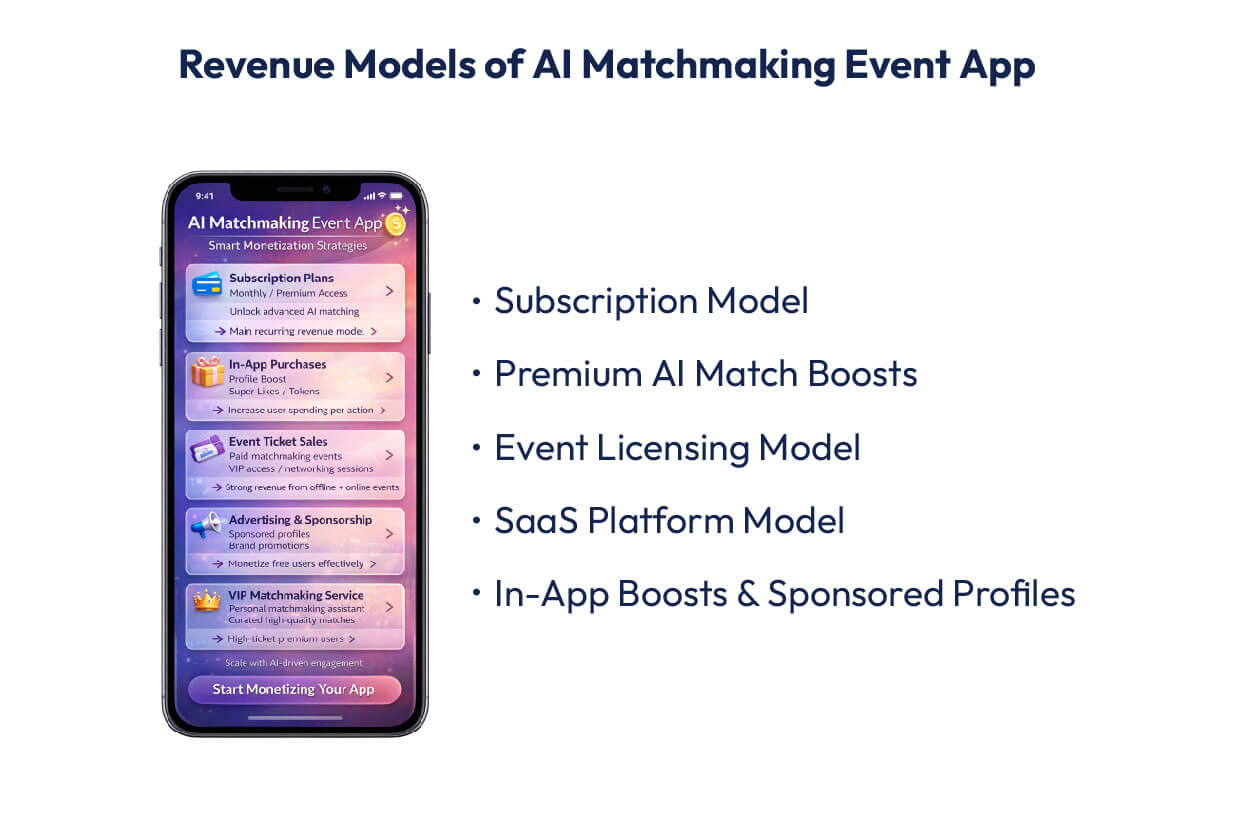
A common way to earn money involves layered subscriptions.
Access to basic matching often comes free under this setup, though extra functions require a paid plan that renews each month or yearly.
Better search options, endless connection attempts, higher visibility in matches, and upgraded communication features usually come with these upgrades.
Structured levels of service keep income flowing steadily over time, plus they give people reasons to stick around and log in regularly.
Getting extra attention in matches can come from paid AI-powered visibility upgrades.
These use smart software to push certain profiles higher in the mix when people are being paired up.
Payment lifts how often a profile shows, making introductions at gatherings more likely.
Busy professionals looking to grow circles or companies hunting key alliances often find these useful – more eyes mean better-fit links.
When depth matters more than speed, spending on features like this makes sense for those wanting stronger outcomes.
Beyond helping businesses make money, selling licenses to event planners opens another path to profit.
A fee grants them permission to run an AI-powered matchmaker shaped around their particular summit, trade show, or mixer.
Costs shift depending on how many people attend, how long the occasion runs, or whether deeper data tools are needed.
Companies paying for access add income while spreading use of the tool far beyond a single niche, quietly growing its presence wherever professionals meet.
When AI-powered matching tools grow up, they often shift toward becoming subscription-based software.
Instead of one-off solutions, these systems turn into flexible programs firms tailor for specific groups, networks, or gatherings.
Access comes through paid subscriptions or site-wide agreements, handing control to institutions without burdening them with tech upkeep.
The company behind the tool manages servers, upgrades, and refinements to how smart the system behaves over time.
Built to stretch across borders, this setup supports numerous large users at once – income flows reliably as long as usage continues.
On top of that, extra revenue comes from in-app upgrades and company-backed profiles.
Businesses, hiring teams, or event backers choose to spotlight themselves inside the matching space.
Profiles backed by sponsors show up more often when suggesting matches.
Events and meetups with support appear front and center on screens.
Developing an effective AI matchmaking platform demands expertise in AI development, scalable mobile infrastructure, and designs centered on user experience.
Techugo brings a wealth of experience in creating innovative digital solutions across various sectors, including event technology, social networking, and AI-driven applications.
Techugo’s development teams focus on crafting AI-powered mobile applications by leveraging advanced tools such as machine learning frameworks, cloud services, and cross-platform development environments.
This approach enables organizations to deploy matchmaking platforms that feature intelligent recommendation systems, real-time communication capabilities, and robust, secure backend architecture.
Covering all phases from product strategy and user experience design to AI integration and ongoing support, Techugo delivers complete mobile app development services.
Their organized development methodology aims to reduce time-to-market while upholding reliability and performance standards.
For both startups and established companies seeking to create AI-enhanced matchmaking solutions for events, Techugo provides the technical skills and strategic insight necessary to turn innovative concepts into scalable, impactful digital platforms.
Now shifting fast, healthcare leans on digital tools, where mobile apps play a key role. Not just for video visits but also tracking health data from ..

In 2026, developing an automobile app can cost anywhere from $20,000-$40,000 for a basic version to $300,000+ for a complex one using AI, depending on..


Write Us
sales@techugo.comOr fill this form