

 SA
SA  KW
KW  IE
IE AU
AU UAE
UAE UK
UK USA
USA  CA
CA DE
DE  QA
QA ZA
ZA  BH
BH NL
NL  MU
MU FR
FR [ LET’S TALK AI ]
X
Discover AI-
Powered Solutions
Get ready to explore cutting-edge AI technologies that can transform your workflow!



Get ready to explore cutting-edge AI technologies that can transform your workflow!






In 2026, developing an automobile app can cost anywhere from $20,000-$40,000 for a basic version to $300,000+ for a complex one using AI, depending on what it does and what you need.
Automobile apps are changing how we use vehicles and services. They’re used for ride-sharing, rentals, scheduling service, and booking car washes.
As people want easier and faster ways to handle transportation online, the market for these apps keeps growing.
This growth comes from people using digital services more, with AI and cloud tech getting added to apps.
AI is a big deal, helping with route planning, predicting when cars need maintenance, and setting prices. It also makes the user experience feel personal, and operations run more smoothly.
If you want to stay ahead in the automobile business, you must team up with a great automobile app development company.
Knowing what it costs to build an app and how AI affects the price is key for good planning, satisfied customers, and lasting success.
In this guide, we discuss the entire cost breakdown of automobile app development, listing all the major, minor and hidden costs that sum up to the range above.
The automobile app market is really taking off because people want easy travel and smarter cars. Back in 2024, this market was worth $9.6 billion worldwide.
It’s not just ride-sharing anymore. Apps for maps, music, car check-ups, and staying online are getting popular. Car companies are adding digital systems to their cars, which is also helping the market grow.
About ride-hailing apps like Uber and Lyft?
So, what’s driving all this?
Lots of people own smartphones, more live in cities, and everyone prefers ease and speed.
That means people are constantly using these apps for planning trips, car rentals, ride sharing, finding charging stations, and scheduling maintenance.
Most people want these car services online. When picking a new car, they want digital features for staying connected.
Electric vehicles matter, too. As more people switch to EVs and more new cars get the internet, apps are crucial.
These apps assist with directions, controlling your car remotely, running car checkups, and getting customized services.
Finally, data and AI are reshaping car apps. AI assists in guessing when your car needs work, setting ride prices, planning routes, and improving in-car entertainment.
By 2026, AI should be common in car apps, making them more user-friendly, more useful, and more profitable.
The automobile app world is vast, showing how technology has changed driving and automobile ownership. Amongst different automobile apps, car apps are the most common ones.
There are different types of car apps that help ease your life in a different way.
Getting an exact car app development cost is hard because it depends on the app’s features, the platforms it needs to work on, and the location of the developers. However, here are some industry averages to help you plan your budget.
So, let’s talk about how much an automobile mobile app might cost in 2026. Here’s a look at different app types and their price ranges in USD and AED:
These focus on easy car cleaning. Book washes and detailing, with options for mobile or fixed locations.
Pick a time, service type, and payment method. More options like subscriptions and eco-washes are popping up.
These are great for daily drivers and businesses managing fleets, saving time and cash.
Advanced versions may also include service partner dashboards, location tracking for mobile wash vans, loyalty programs, and customer feedback modules.
| App Level | Estimated Cost (USD) | Estimated Cost (AED) |
| Basic app (single platform, limited features) | USD 18,000 – 25,000 | AED 66,000 – 92,000 |
| Mid-level app (iOS + Android, subscriptions, admin panel) | USD 30,000 – 45,000 | AED 110,000 – 165,000 |
| Advanced app (real-time tracking, fleet support, analytics) | USD 55,000 – 75,000 | AED 202,000 – 275,000 |
Also Read : How Much Does It Cost to Build a Car Rental App Like Hertz?
These apps let you rent from companies or people. Find normal rentals, or peer-to-peer options like Turo and Getaround.
More sophisticated platforms also integrate driver verification, insurance management, pricing algorithms, and fleet optimization tools.
| App Level | Estimated Cost (USD) | Estimated Cost (AED) |
| MVP version (basic booking and listings) | USD 30,000 – 40,000 | AED 110,000 – 147,000 |
| Full-featured app (multi-platform, GPS, digital keys) | USD 50,000 – 80,000 | AED 184,000 – 294,000 |
| Enterprise-grade solution (fleet analytics, AI pricing) | USD 90,000 – 120,000 | AED 331,000 – 441,000 |
These apps connect you with drivers when you need a lift. This market is still growing quickly.
As cities grow and sharing becomes normal, ride-sharing should get even bigger.
These apps have sections for riders and drivers. They use GPS to track you, estimate costs, and use tech to match you with drivers and change prices with demand.
Advanced ride-hailing apps often use AI for demand forecasting, fraud detection, surge pricing, and driver performance analysis.
Also Read : How to Develop an App Like Hala Taxi Key Features Costs and Development Insights
| App Level | Estimated Cost (USD) | Estimated Cost (AED) |
| Basic ride-hailing app | USD 45,000 – 60,000 | AED 165,000 – 220,000 |
| Advanced taxi app with AI pricing and analytics | USD 80,000 – 120,000 | AED 294,000 – 441,000 |
| Scalable multi-city platform | USD 150,000+ | AED 551,000+ |
Car auction apps are designed for competitive vehicle buying and selling through live or timed bidding models.
Advanced auction apps may also include AI-driven price prediction, bidder behavior analysis, and fraud detection to ensure platform integrity and optimal pricing outcomes.
Also Read : Top 18 Features Of a Smart Car Auction App The Future Of Car Buying Selling
| App Level | Estimated Cost (USD) | Estimated Cost (AED) |
| Basic auction app (single auction model, limited users) | USD 45,000–65,000 | AED 165,000–239,000 |
| Mid-scale auction platform (live + timed auctions, escrow, notifications) | USD 70,000–95,000 | AED 257,000–349,000 |
| Enterprise auction system (AI pricing, analytics, high concurrency) | USD 110,000+ | AED 404,000+ |
Costs increase significantly with real-time bidding infrastructure, scalability requirements, and compliance-driven payment systems.
Car marketplace apps focus on listing, discovering, and directly buying or selling vehicles.
Many modern marketplace apps integrate AI-based price recommendations, demand insights, and personalized vehicle suggestions to improve conversion rates and user trust.
| App Level | Estimated Cost (USD) | Estimated Cost (AED) |
| Listing-based marketplace app (core buy/sell features) | USD 35,000–50,000 | AED 128,000–184,000 |
| Advanced marketplace app (valuation tools, payments, history reports) | USD 55,000–75,000 | AED 202,000–276,000 |
| Enterprise car marketplace (AI recommendations, analytics, CRM) | USD 100,000+ | AED 367,000+ |
Car marketplace apps generally cost less than auction platforms due to lower real-time processing needs, but expenses rise with AI integration, third-party data sources, and enterprise-grade analytics.
Keep your car in shape with these. Book repairs, schedule check-ups, and track your car’s health with reminders and data.
More apps now use car data to suggest upcoming repairs.
Advanced versions may integrate IoT data from vehicles, AI-powered maintenance predictions, and fleet dashboards for businesses.
| App Level | Estimated Cost (USD) | Estimated Cost (AED) |
| Basic maintenance app | USD 25,000 – 35,000 | AED 92,000 – 128,000 |
| Mid-level app with diagnostics and reminders | USD 45,000 – 65,000 | AED 165,000 – 239,000 |
| Advanced connected-car platform | USD 90,000+ | AED 331,000+ |
Each automobile app category serves a distinct user base and follows different monetization models, including per-service fees, subscriptions, commissions, or data-driven value-added services.
Understanding the feature scope and long-term scalability requirements is essential before finalizing a development budget for 2026.
When estimating automobile app development costs, the most critical distinction is not the platform or geography, it is whether you are building a Minimum Viable Product (MVP) or a data-intelligent, AI-driven application.
An MVP is designed to validate the idea quickly with core functionality. It focuses on essential workflows, predictable system behavior, and minimal automation.
AI-enabled applications, in contrast, rely on real-time data processing, adaptive algorithms, and continuous optimization.
This shift significantly changes both development effort and cost.
Across most automobile app categories, integrating AI and advanced intelligence typically increases total development cost by 10–30% or more, depending on the complexity of the use case.
This increase is driven by additional backend architecture, specialized engineering skills, longer development cycles, and ongoing optimization requirements.
Below is a detailed breakdown of how MVP costs compare with AI-enabled development costs across major automobile app types in 2026.
MVP Cost vs AI-Enabled Automobile App Development Cost
| App | MVP Cost | AI-Powered App Cost |
| Car Wash App | USD 18,000 – 30,000 | USD 22,000 – 40,000 |
| Car Rental & Car Sharing Apps | USD 30,000 – 45,000 | USD 40,000 – 70,000 |
| Ride-Hailing Apps | USD 45,000 – 65,000 | USD 60,000 – 100,000+ |
| Car Auction & Marketplace Apps | USD 35,000 – 50,000 | USD 45,000 – 80,000 |
| Vehicle Service and Maintenance Apps | USD 25,000 – 40,000 | USD 35,000 – 70,000 |
Car wash apps are among the simplest automobile platforms to launch as an MVP.
The primary objective at this stage is to validate demand, streamline bookings, and test operational workflows.
A typical MVP car wash app includes user registration, service selection, scheduling, payments, and a basic admin dashboard.
The system logic is mostly rule-based, making development relatively straightforward.
When AI features are added, the scope expands beyond simple bookings.
AI in car wash apps is commonly used for demand forecasting, route optimization for mobile wash units, customer behavior analysis, and dynamic pricing during peak hours.
These features require real-time location data processing, historical usage analysis, and backend intelligence layers.
While not extremely complex compared to other automobile apps, they still introduce measurable cost increases.
The added expense comes from data pipelines, predictive algorithms, and extended testing to ensure accurate recommendations and system stability.
Car rental and car sharing platforms are more complex due to inventory management, availability tracking, pricing logic, and trust mechanisms.
An MVP version typically focuses on vehicle listings, booking workflows, payments, user verification, and basic availability management.
Pricing at this stage is often static or manually configured.
AI integration significantly transforms these platforms.
AI is commonly used for dynamic pricing based on demand, vehicle utilization optimization, fraud detection, identity verification, and predictive availability management.
These systems must analyze large volumes of user behavior data, booking trends, and real-time inventory information, which increases backend complexity.
The cost increase reflects the need for advanced pricing algorithms, data security measures, and extended quality assurance cycles to prevent booking errors and misuse.
Ride-hailing apps are among the most technically demanding automobile applications, even at the MVP stage.
They require real-time location tracking, concurrent user handling, and reliable matching between drivers and riders.
An MVP ride-hailing app includes rider and driver interfaces, GPS tracking, ride matching, fare calculation, and payment processing.
Basic versions rely on predefined logic for matching and pricing.
AI-enabled ride-hailing platforms introduce advanced features such as surge pricing, demand forecasting, ETA prediction, driver allocation optimization, and fraud detection.
These systems require continuous data processing, machine learning models, and sophisticated backend infrastructure to maintain accuracy under fluctuating demand.
Costs rise due to increased computational requirements, algorithm training, simulation testing, and ongoing model optimization to ensure consistent performance and user trust.
Car auction and marketplace apps are transaction-heavy platforms where trust, pricing accuracy, and transparency are critical.
An MVP version typically includes vehicle listings, bidding mechanisms, secure payments, user verification, and moderation tools.
Pricing guidance is usually static or manually curated.
AI integration enhances these platforms through vehicle price prediction, bid behavior analysis, fraud detection, and personalized recommendations for buyers and sellers.
These features rely on historical sales data, market trends, and vehicle condition data, increasing both development and data management requirements.
The additional cost reflects the effort required to train pricing models, normalize vehicle data, and ensure predictions are reliable and explainable to users.
Vehicle service and maintenance apps often start simple but can become highly sophisticated when predictive intelligence is introduced.
An MVP typically focuses on service bookings, reminders, service history tracking, and payment integration.
Logic is mostly time-based or event-based.
AI-enabled versions introduce predictive maintenance, fault detection, service interval optimization, and cost estimation based on usage patterns or sensor data.
These features require integration with vehicle data sources, time-series analysis, and high system reliability to prevent incorrect maintenance recommendations.
The cost increase is driven by IoT integration, data accuracy requirements, and the need for specialized automotive and AI expertise.
AI-enabled automobile apps are not just feature upgrades they represent a different architectural approach.
Cost increases typically result from:
Artificial intelligence (AI) has rapidly shifted from a novelty to a core differentiator in automobile app development, driven by user demand for intelligent, personalized experiences and by competitive pressure across ride-hailing, service, rental, and marketplace segments.
The global AI in mobile apps market is projected to grow from roughly USD 27.7 billion in 2025 to over USD 322 billion by 2034.
Automotive applications are said to be among the fastest growing categories as connected cars, predictive features, and personalized in-app intelligence become mainstream.
In car wash applications, AI is used to improve operational efficiency, customer retention, and revenue predictability rather than to power core functionality.
From a cost perspective, basic AI-driven scheduling and recommendations typically range from USD 15,000 to 40,000.
More advanced demand forecasting and pricing intelligence can increase AI costs to USD 50,000 or more.
Overall, AI features usually add around 10–15% to the total development cost of a car wash app.
Car rental and car sharing platforms rely heavily on AI to manage inventory, pricing, and user trust.
AI-powered recommendations and pricing systems typically cost between USD 40,000 and 120,000.
Fraud detection and fleet optimization modules can add USD 30,000 to 80,000.
Combined, AI integration usually increases overall development costs by 15–25% for rental and sharing apps.
Ride-hailing apps are among the most AI-intensive automobile platforms.
Predictive demand and pricing systems generally cost USD 50,000 to 150,000.
Routing and ETA optimization features can add USD 40,000 to 100,000.
Overall, AI typically increases ride-hailing app development costs by 20–30%.
Car auction and marketplace apps use AI to improve pricing transparency, trust, and transaction speed.
Pricing intelligence systems typically cost USD 35,000 to 100,000, while computer vision modules can range from USD 60,000 to 200,000 or more.
AI integration usually increases development costs by 15–25% for marketplace apps.
Vehicle service and maintenance apps benefit significantly from predictive and diagnostic AI capabilities.
AI often adds 20–30% to the total development cost in this app category.
Across all automobile app types, AI increases both initial development and ongoing operational costs due to cloud compute, data pipelines, and model maintenance.
However, these investments enable smarter decision-making, higher user retention, and scalable growth in an increasingly data-driven mobility ecosystem.
Understanding how costs accumulate across each stage of automobile app development is essential for realistic budgeting and long-term success.
Each phase contributes distinct value, and underinvesting early or overloading later stages often leads to delays, rework, or runaway costs.
A structured, end-to-end view helps businesses maintain control, predict spend, and make informed trade-offs.
This phase establishes the strategic and technical foundation of the app.
It typically includes market research, user persona definition, competitor analysis, feature prioritization, technical architecture planning, and risk assessment.
For automobile apps, especially those involving mobility, fleet data, or AI, early decisions around scalability, integrations, and compliance have long-term cost implications.
Planning generally accounts for 10–15% of total development cost, usually ranging from $5,000 to $25,000, depending on scope and depth.
A strong discovery phase significantly reduces scope creep and prevents expensive architectural changes during development.
Design translates requirements into intuitive, usable experiences.
This phase covers wireframes, interactive prototypes, visual design systems, branding, accessibility considerations, and user journey optimization.
In automobile apps, good UI/UX directly impacts retention, task completion, and safety-related usability.
Design typically consumes 15–25% of the overall budget, with costs ranging from $10,000 to $35,000+ for highly customized interfaces.
Investing adequately here reduces development friction and lowers post-launch redesign costs.
This is the most resource-intensive phase and the core cost driver.
Frontend development focuses on mobile interfaces, animations, and platform-specific behaviors, while backend development handles databases, APIs, business logic, integrations, and system scalability.
Automobile apps often require real-time data handling, third-party integrations, and high reliability, which increases complexity.
This phase typically absorbs 40–60% of the total budget, with development costs commonly ranging from $40,000 to $150,000+, depending on features, platforms, and performance requirements.
AI introduces advanced capabilities such as predictive maintenance, demand forecasting, dynamic pricing, routing optimization, and personalized recommendations.
These features require data pipelines, model training, validation, and system integration.
AI integration usually adds $20,000 to $100,000+ to the budget, depending on model sophistication and data availability.
Beyond initial build costs, teams must also plan for model tuning, retraining, and monitoring as part of ongoing operations.
Testing ensures stability, security, and consistent performance across devices, operating systems, and usage scenarios.
This phase includes functional testing, performance testing, security validation, and user acceptance testing.
Testing typically represents 10–20% of total costs, usually $5,000 to $25,000.
Launch activities such as store submissions, configuration, and early production support generally add $2,000 to $8,000.
By viewing development costs through each phase, businesses can allocate budgets more intelligently, anticipate hidden expenses, and align investment with product goals.
This results in smoother launches and stronger long-term returns.
When estimating the cost of developing an automobile or mobility-focused mobile app, the location and structure of the development team play a decisive role.
Regional pricing differences are driven by labor economics, talent availability, regulatory overhead, and market maturity.
These factors affect not only hourly rates but also delivery timelines, communication efficiency, and post-launch support quality.
Choosing the right region is therefore both a financial and strategic decision.
| Region | Average Hourly Rate | Estimated Total Development Cost |
| USA | $90-$150 per hour | $120,000 – $300,000+ |
| UAE (Dubai & GCC) | $60-$80 per hour | AED 90,000 – 240,000 ($25,000 – $65,000+) |
| India & South Asia | $15-$50 per hour | $30,000 – $70,000+ |
The United States remains one of the most expensive regions for mobile app development.
Average hourly rates for experienced developers and agencies typically range from $90 to $150+ per hour, with senior specialists, AI engineers, or enterprise-focused teams often exceeding this range.
End-to-end development costs for complex automobile apps, especially those involving real-time data, integrations, or AI commonly fall between $120,000 and $300,000+.
These costs reflect higher wages, strong engineering standards, mature project management practices, and close alignment with enterprise compliance and security requirements.
For companies targeting North American users or regulated industries, US-based teams can reduce legal friction and coordination overhead, albeit at a premium.
The UAE represents a mid-tier cost region, positioned between Western markets and offshore destinations.
Development rates generally range from $60 to $80 per hour, depending on team composition and specialization.
Typical mid-complexity mobile app projects often fall between AED 90,000 and AED 240,000 (approximately $25,000 to $65,000+).
Teams in this region often offer strengths in regional compliance, Arabic and English localization, and familiarity with mobility regulations in the Middle East.
For apps targeting GCC users, ride-hailing, fleet, or smart city use cases, UAE-based teams can provide a balance between cost control and regional relevance.
India and neighboring South Asian markets are among the most cost-effective global development hubs.
Hourly rates usually range from $15 to $50, with significant variation based on experience and specialization.
Mid-tier automobile or mobility apps are often delivered in the $30,000 to $70,000+ range representing 40–60% lower costs compared to US or Western European teams.
These regions offer large talent pools, strong engineering skills, and scalability advantages, making them especially attractive for MVPs, startups, and cost-sensitive projects.
However, success depends heavily on vendor selection, documentation quality, and project governance.
Many businesses adopt hybrid models combining local product management or architecture oversight with offshore development to balance cost efficiency, quality control, and speed.
This approach can significantly reduce expenses while maintaining strategic alignment, provided communication and accountability are well managed
When budgeting for automobile app development, many businesses underestimate costs by focusing almost entirely on design and core development.
In reality, a significant portion of total spend comes from secondary and ongoing expenses that surface during scaling, compliance, and real-world usage.
If these are not planned early, hidden costs can increase the overall budget by 30–60% or more over the app’s lifecycle.
One of the largest hidden cost categories is third-party APIs and SaaS services.
Modern automobile apps depend heavily on external tools for payments, SMS and email notifications, analytics, authentication, customer support, and maps.
While many services offer free or low-cost starter tiers, pricing is usage-based and grows quickly with scale.
Payment gateways such as Stripe or PayPal typically charge 2–3% per transaction plus fixed fees, which can significantly impact margins at volume.
Messaging and notification services charge per message or request, making high user engagement a recurring operational expense rather than a one-time cost.
Maps, GPS, and location services are another underestimated expense, especially for ride-hailing, fleet management, delivery, and car-sharing apps.
Real-time tracking, route optimization, distance calculations, and geofencing rely on paid map APIs.
Once free thresholds are crossed, costs are calculated per request or per thousand loads.
At moderate to high usage levels, monthly map and GPS expenses can easily run into hundreds or thousands of dollars, scaling directly with user activity rather than app complexity.
Cloud infrastructure and scaling costs also grow steadily after launch.
While early-stage apps may operate on modest hosting budgets, user growth increases demand for compute power, databases, storage, content delivery networks (CDNs), and backups.
Medium-scale automobile apps commonly spend $500–$2,000+ per month on cloud infrastructure, while high-traffic platforms can exceed this significantly.
Additional costs arise from redundancy, load balancing, monitoring tools, and disaster recovery setups, often essential for mobility platforms where downtime directly impacts revenue.
Compliance, security, and data protection introduce another layer of hidden costs.
Regulations such as GDPR, CCPA, and industry-specific standards require secure authentication, encrypted data storage, consent management, audit logs, and legal documentation.
Security testing, penetration audits, and compliance reviews can add several thousand dollars upfront, along with recurring costs for monitoring and updates.
Ignoring these areas exposes businesses to fines, reputational damage, and costly retroactive fixes.
Finally, maintenance and ongoing updates are frequently overlooked.
Bug fixes, OS updates, API version changes, and feature refinements typically require 15–25% of the original development cost annually.
Planning for these ongoing expenses ensures the app remains functional, secure, and competitive.
Accounting for these “below-the-surface” costs early leads to more accurate budgeting, fewer post-launch surprises, and a more sustainable automobile app business over time.
Saving money on automobile app development is less about cutting corners and more about making disciplined, informed decisions from day one.
The biggest cost overruns usually come from poor planning, overbuilding, or choosing the wrong tools early.
When budgets are tight as they often are, smart prioritization can reduce development costs substantially without hurting performance, scalability, or long-term growth.
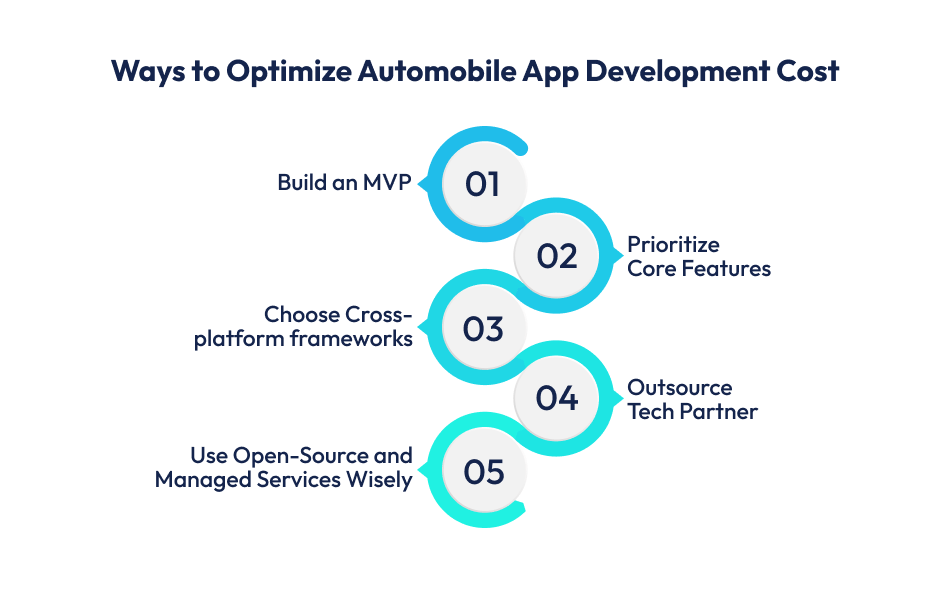
Launching with a Minimum Viable Product (MVP) remains one of the most effective cost-control strategies.
An MVP focuses only on the core problem your app solves nothing more.
By limiting scope early, teams reduce development time, QA cycles, and integration complexity.
In practice, an MVP-first approach can reduce initial development costs by 20–40%, while also accelerating time-to-market.
More importantly, it allows you to validate demand using real user data before investing in advanced features like AI modules, automation, or premium integrations.
Not all features deliver equal value.
Applying structured prioritization methods such as the 80/20 rule or MoSCoW analysis helps teams focus on features that directly impact engagement or revenue.
Every additional feature increases design time, backend logic, testing effort, and long-term maintenance.
By deferring low-impact features to later phases, businesses can significantly lower upfront costs and reduce ongoing technical debt.
Cross-platform frameworks such as Flutter or React Native allow developers to build iOS and Android apps using a shared codebase.
This approach typically reduces development and maintenance costs by 30–40% compared to building two separate native apps.
Beyond cost, cross-platform development simplifies updates, shortens release cycles, and ensures consistent user experience across devices critical for automobile apps that often rely on real-time data and frequent updates.
Outsourcing development to cost-efficient regions like India or Eastern Europe can dramatically lower labor expenses while maintaining strong technical quality.
Hourly rates in these regions are often 40–60% lower than in North America or Western Europe.
The key is selecting experienced teams with proven automotive or mobility-domain expertise, clear documentation Practices, and strong communication workflows.
Leveraging open-source frameworks, SDKs, and backend-as-a-service platforms like Firebase or AWS Amplify reduces the need for custom-built infrastructure.
These tools shorten development timelines, lower initial engineering effort, and shift costs toward predictable usage-based pricing.
This not only saves money early but also improves scalability as user demand grows.
In short, thoughtful planning, disciplined feature selection, and smart technology choices can significantly reduce automobile app development costs without compromising quality or future expansion.
Depending on the type of apps, different businesses use different business models to earn revenue.
Car wash apps convert fragmented, location-dependent services into predictable, scalable revenue streams.
Businesses benefit from on-demand bookings, prepaid packages, and recurring subscription plans that stabilize monthly cash flow.
Features such as scheduled washes, fleet packages, and add-on services (detailing, interior cleaning, eco-wash upgrades) increase average order value without adding operational complexity.
Automation of bookings, payments, and dispatch reduces manual coordination, allowing operators to serve more customers with leaner teams.
Over time, usage data helps optimize service routes, pricing, and demand forecasting, improving margins and operational efficiency.
Car rental and car-sharing apps help businesses maximize vehicle utilization and revenue per asset.
Digital bookings, real-time availability, and dynamic pricing enable operators to adjust rates based on demand, seasonality, and location.
Revenue is generated through daily rentals, hourly usage, insurance add-ons, late fees, and premium vehicle tiers.
For peer-to-peer or hybrid models, platforms earn commissions without owning vehicles, significantly reducing capital risk.
Data insights into usage patterns support smarter fleet expansion, maintenance planning, and location-based deployment.
Ride-hailing apps act as high-volume transaction platforms with multiple monetization layers.
Commission-based earnings from each ride are supplemented by surge pricing, subscription passes, in-app advertising, and partner integrations.
Businesses benefit from real-time GPS tracking, automated driver matching, and cashless payments, which reduce friction and improve service reliability.
AI-driven demand forecasting and route optimization increase trip efficiency and revenue during peak hours.
As networks grow, these platforms benefit from strong network effects that make them difficult for new competitors to displace.
Car auction and car marketplace apps digitize vehicle commerce, creating transparent and scalable sales channels.
Auction platforms earn through listing fees, bidding commissions, and premium dealer tools, while marketplaces generate revenue via featured listings, transaction commissions, and lead generation for dealers.
These apps reduce sales cycles, expand buyer reach, and eliminate many offline intermediaries.
Access to pricing trends, buyer demand data, and valuation insights allows businesses to refine inventory strategies and improve deal profitability.
Service and maintenance apps strengthen long-term customer relationships while creating recurring revenue.
Businesses monetize through service bookings, subscription plans, and referral commissions from workshops, insurers, or spare-part suppliers.
Automated reminders, service history tracking, and predictive maintenance features increase repeat usage and trust.
For workshops and fleet operators, centralized dashboards improve workload planning and reduce downtime.
Over time, data-driven insights help businesses anticipate demand, optimize staffing, and improve service quality, leading to higher retention and lifetime value.
To build a great automobile app in 2026, this is the comprehensive checklist you need to follow:

Choosing the right development partner is equally critical.
A reliable mobile app development company, whether an experienced automotive app development company in the USA, UAE, India, or elsewhere, can guide you through trade‑offs between cost, speed, and quality.
Expert teams help translate your business strategy into technology decisions that optimize cost without compromising on important features or scalability.
Start your project by defining clear goals and minimum feature sets, then expand in iterations.
With a structured plan and an expert partner, you can control your automobile app’s development cost while building a robust, future‑ready product that delivers real value in a competitive market.

The price to build an AI app? It's a big deal for startups and corporations alike. Creating these apps isn't your typical mobile dev thing. You've ..


AI dating apps aren't just about swiping anymore. They're now smart platforms that learn how people act, guess who'll get along, and make things safer..


Write Us
sales@techugo.comOr fill this form