


 SA
SA  KW
KW  IE
IE AU
AU UAE
UAE UK
UK USA
USA  CA
CA DE
DE  QA
QA ZA
ZA  BH
BH NL
NL  MU
MU FR
FR [ LET’S TALK AI ]
X
Discover AI-
Powered Solutions
Get ready to explore cutting-edge AI technologies that can transform your workflow!



Get ready to explore cutting-edge AI technologies that can transform your workflow!






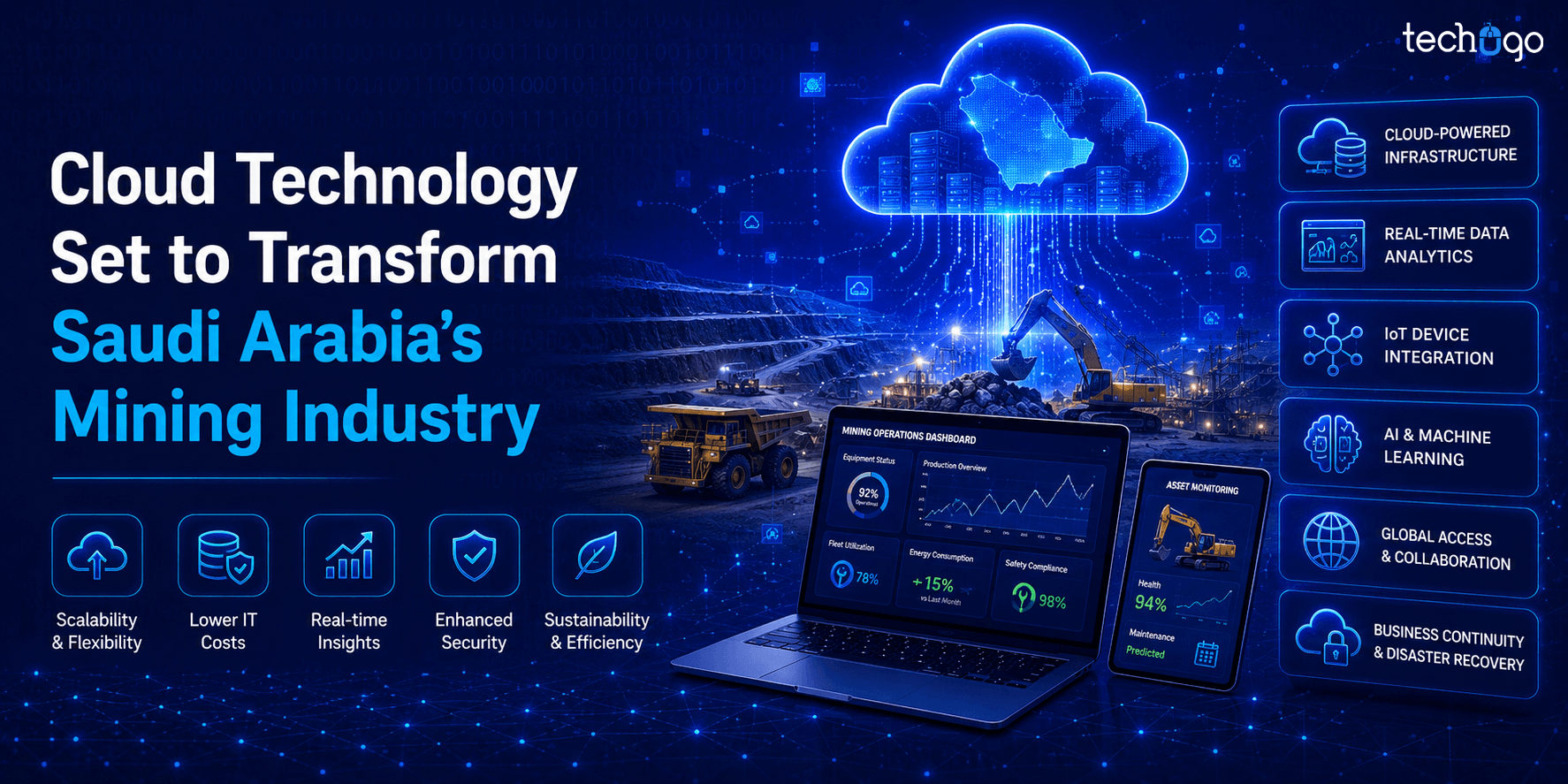
Cloud technology in mining industry is changing the way companies work in Saudi Arabia, and it is not just about speed but also about safety and efficiency because mining used to be slow, costly, and difficult also, especially in remote areas. But with cloud solutions, operations are becoming fast and safe, and you can see results in real time which was not possible before.
Saudi Arabia is accelerating cloud adoption in mining because the country wants to grow the sector quickly and Vision 2030 makes this a top priority. Real-time data, AI, and automation are helping mining companies so that they can explore, produce, and manage resources better to be able to make smarter decisions. As Al-Osaimi says, “If you don’t incorporate a cloud strategy, operating in such environments will be extremely difficult.”
Companies are able to reduce production timelines and improve safety due to cloud technology in mining industry in Saudi Arabia, and it is becoming the backbone of mining digital transformation.
Therefore, through this blog, we’ll look at the benefits, the challenges, and the future of cloud in Saudi mining because it is shaping the way the sector works today and tomorrow.
Cloud technology in mining industry is about using remote servers and internet platforms, instead of just relying on local systems, and it allows companies to store, manage, and analyze mining data, even in places that are remote and difficult to reach. Because mining operations can be spread across vast areas, and it was always a challenge to get real-time insights but with cloud, you can access information from exploration sites, production facilities, and processing plants, all at once.
For example, a mining company in Saudi Arabia can use cloud solutions to monitor multiple drilling sites and sensors on equipment that collect data on fuel usage, performance, and maintenance needs which is then sent to the cloud. Engineers at headquarters can review it and analyze it using real-time data analytics in mining and then optimize operations through mining automation and cloud technology, and apply AI tools, showing how AI and cloud in mining industry work together to make decisions faster and safer.
It also helps centralize operations, and manage resources better, and reduces costs, and improves safety so that companies can work smarter. Therefore, cloud technology has become a key part of mining digital transformation in Saudi Arabia because it is helping companies scale efficiently, and make better decisions and move faster than before.
Also Read – Cloud Computing in Pharma Industry Applications and Benefits
Saudi Arabia is not just moving toward cloud technology because it’s modern and it’s doing so for strategic, practical, and economic reasons that align with national goals and real business demands.
First, the Kingdom’s Vision 2030 is making a change to create a diversified economy to reduce the nation’s reliance on oil. Central to achieving this new economy is the deployment of technologies. Vision 2030 plan clearly identifies and emphasizes the importance of digital transformation and innovation as key pillars of economic development, hence, the plan encourages sectors like mining to adopt advanced technologies to enhance their ability to stay competitive and efficient.
The mining industry is subject to specific operational challenges. In general, mining takes place in remote areas with limited connectivity, making it difficult and expensive for companies to sustain traditional IT infrastructures. Leaders in the industry have indicated that, in order for these mining companies to continue to operate in these environments, they must have a cloud computing strategy.
Therefore, Saudi mining companies are accelerating cloud adoption because cloud‑based systems help to:
The motivation behind this drive is linked to other large movements within Saudi Arabia’s technology marketplace (in connection to the Cloud First Policy as a part of their national initiative), but there is additional governmental investment by building out their cloud infrastructure/data centers for all industries, including the mining industry, to improve the level of digital virtualization.
Saudi Arabia’s large investment in Artificial Intelligence (expected to provide billions of immediate economic value to the country by 2030) is also an incentive for businesses to utilize cloud platforms. This is due to the fact that the majority of AI applications are data-driven and reside on cloud platforms.
Therefore, because of the ability of cloud solutions to eliminate data bottlenecks, enhance operational efficiency, and be consistent with governmental policies, companies within the Saudi mining industry are adopting cloud-based solutions at an accelerated rate. This not only facilitates their ability to improve operations and be prepared for the digitized future (as they are the cost of doing business), but also aligns with the current level of government investment.
Mining operations are changing due to cloud computing; however, in Saudi Arabia, mining is evolving using cloud technology not just for the sake of using technology but rather to create actual business value through decreasing costs while at the same time increasing efficiency.
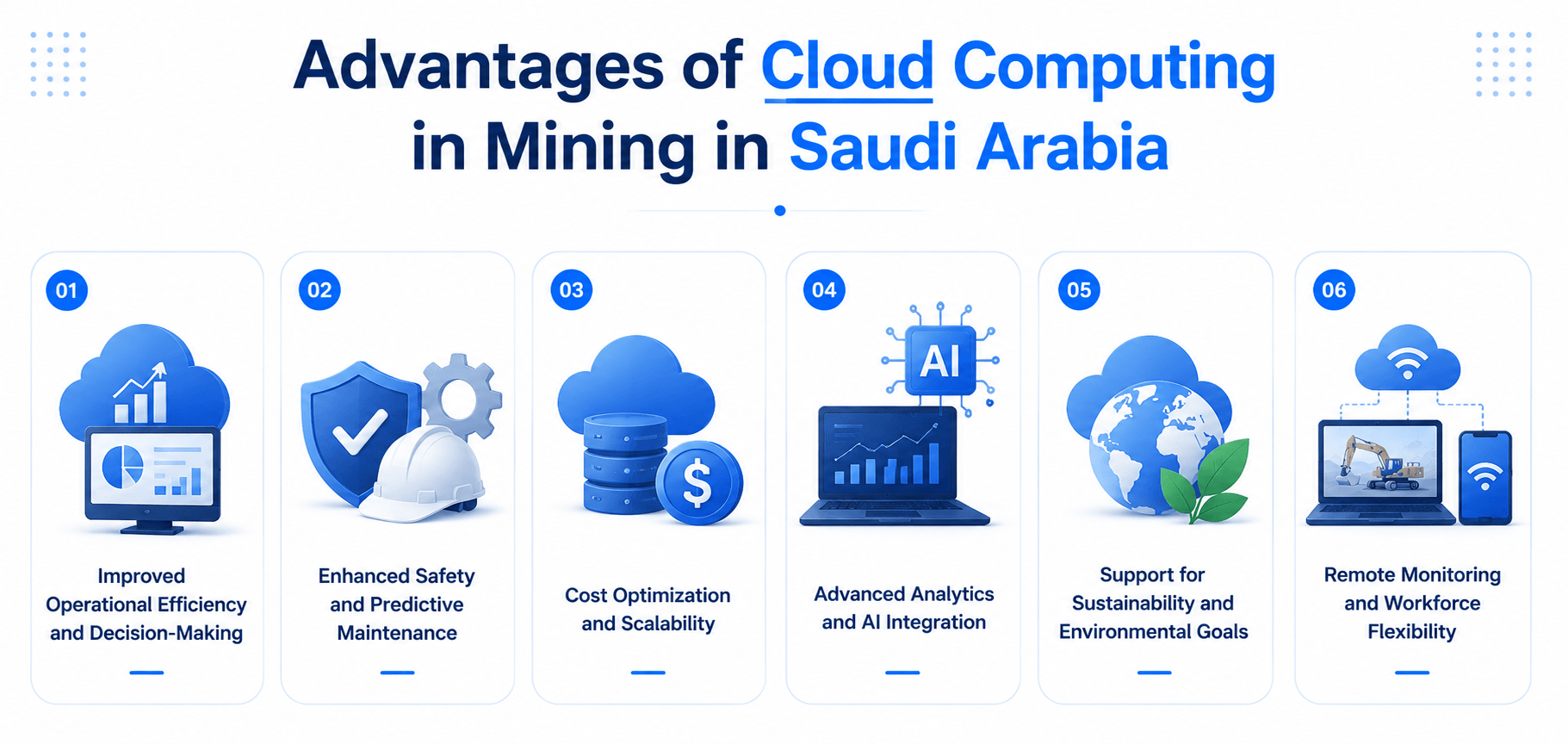
The most significant benefit of cloud computing in mining is the increased efficiency it provides. There are many different data sources to support mining operations, which include: drilling sensors; equipment performance logs; and production/management reports. On-premise systems have difficulty gathering and processing data quickly enough. Cloud platforms can automatically ingest data through different means and analyze that data in real time (in seconds). Thus, teams can quickly and accurately see irregularities, eliminate unnecessary steps in the execution process, and react promptly to operational emergency situations without delay. Cloud adoption increases the ability for companies worldwide to respond to operational emergencies quickly and automate many processes.
There are significant dangers in the mining sector due to the use of heavy equipment, geographical isolation, and various environmental challenges. Using cloud-based systems that offer real-time hazard detection and predictive maintenance allows the ongoing monitoring of equipment and environmental conditions, meaning that if a piece of equipment begins to fail, or if a safety threshold has been exceeded, the system will send out alerts before any unplanned downtime occurs and can assist in protecting workers. Research indicates that the use of cloud-based safety monitoring and the integration of environmental data can have a significant impact on incident response times and decrease the level of risk for employees.
Moreover, traditional data centres have very high initial investment costs (servers, cooling systems, support personnel) and do not provide an easy path for growth. In contrast, cloud computing employs a “pay-as-you-go” model, where users are only charged for the storage and compute services consumed. This reduces capital expenditure (CapEx) and shifts costs to operating expenditure (OpEx), which is much easier to manage and predict. Additionally, cloud services allow mining organisations to scale up or down their infrastructure as exploration efforts either expand or reduce without the need for massive investments in hardware.
Cloud infrastructure provides the computing power necessary for advanced analytics and AI‑driven insights. This is especially true for current mining companies who utilize machine learning techniques to find relationships within geological data and optimize ore blending and production bottlenecks. With the ability to run large number of AI models simultaneously on a cloud platform, organizations can rapidly analyse vast amounts of raw data and convert it to usable forms.
While digital transformation in Saudi mining is about producing more output, it also encompasses sustainability efforts. Through the use of cloud systems, mining companies can continually measure their environmental impacts such as emissions, water usage and energy consumption; and include this data when assembling compliance reports. By measuring these impacts on a real-time basis, mining companies can use this data to operate more efficiently and reach their environmental, governance goals, while also meeting the overall sustainability objectives of the Kingdom.
Because mining sites are often located in harsh or isolated environments, managing them remotely has traditionally been difficult. Cloud computing has provided mining engineers, analysts and managers access to dashboards, insights and control systems from any location, allowing continuous operations and collaboration across geographically dispersed teams. The result is improved collaboration, improved ability to supervise team members remotely, and improved capability to adapt to dynamic workforce requirements, all while continuing to maintain organizational oversight and control.
AI and automation in mining are not standalone; they rely heavily on cloud technology to function effectively, and in Saudi Arabia, this combination is driving a new era of operational efficiency, safety, and productivity.
Mining companies have always faced challenges with remote sites, unpredictable equipment failures, and massive amounts of exploration and production data but with cloud, AI can process this data quickly and automation can act on it almost immediately.
In Saudi Arabia, Ma’aden’s adoption of cloud-enabled AI and automation has allowed them to reduce downtime, increase precision in exploration, and accelerate production timelines. By combining real-time data analytics in mining, AI and cloud in mining industry, and cloud-based automation, companies are achieving outcomes that were previously impossible or would have taken years to reach.
Adoption of cloud technology in mining industry is growing fast but it’s not without challenges, and in Saudi Arabia, companies still face hurdles that slow down implementation.
Mining involves sensitive operational and geological data and companies must ensure it stays protected and meets local regulations so that operations remain safe and lawful.
Mining sites are often in harsh, isolated areas, and while cloud needs stable internet to function well, many locations struggle with network reliability. It was always difficult to manage real-time data from distant sites and cloud adoption can be delayed because of this.
Deploying cloud systems and integrating AI and cloud in mining industry requires investment and specialized skills which not every company has in-house. Employees need training, and systems need careful planning, otherwise benefits are limited.
Finally, legacy systems and resistance to change can slow things down. Many companies have long-standing IT infrastructure, and moving to cloud requires effort, time, and sometimes rethinking entire workflows but the payoff is efficiency, scalability, and smarter operations once it’s done.
Implementing cloud technology in mining industry in Saudi Arabia is not just about buying software or setting up servers, but about having the right partner by your side, because without guidance, it can get complex, slow, and costly. You need someone who understands mining operations, the local market, and how cloud, AI, and automation work together so that you can make the most of your investment.
A strong technology partner can help assess your existing systems, plan a phased migration to the cloud, and ensure real-time data analytics in mining and mining automation and cloud technology are fully integrated. They can train your workforce, address security concerns, and support you in scaling operations efficiently because adoption is not just technical, it’s also organizational.
For example, companies like Techugo, a leading mobile app development company in Saudi Arabia, also offer cloud consulting services, helping mining firms build cloud solutions tailored to their specific needs. Challenges like remote site connectivity, legacy systems, and regulatory compliance become manageable with the right partner and you can focus on improving productivity and sustainability.
In short, the right technology partner doesn’t just implement cloud, rather, it guides you, supports you, and ensures that your mining operations can truly benefit from digital transformation and that every step is efficient.
The adoption of cloud technology in mining industry is just beginning, and the future promises even more transformation, especially in Saudi Arabia. Companies are investing in technology not just to improve today’s operations but to prepare for smarter, safer, and more efficient mining in the years ahead.
Cloud platforms will continue to enable advanced AI models that can predict equipment failures, optimize production schedules, and analyze exploration data faster. This means downtime will be minimized, resources will be used efficiently, and decision-making will become more precise.
As cloud infrastructure becomes more robust, automation will expand beyond repetitive tasks. Remote-controlled machinery, automated drilling, and robotic material handling will rely on cloud connectivity, making operations faster and reducing human risk on-site.
Mining companies will increasingly use cloud systems to monitor energy consumption, emissions, and water usage in real-time. This helps meet environmental targets, comply with regulations, and promote sustainable operations.
Saudi Arabia is building more cloud regions and sovereign cloud services so that mining companies can keep sensitive data secure while benefiting from global cloud capabilities. This local expansion will accelerate adoption because companies won’t have to worry about compliance or latency issues.
Cloud adoption will make it easier for suppliers, contractors, and teams across multiple sites to collaborate seamlessly. Shared data, dashboards, and insights will enable integrated operations, faster problem-solving, and stronger overall performance.
Ankit Singh, COO at Techugo says,
“The future of cloud in mining is about AI, automation, security, and connected operations, and companies that adopt these trends will be able to operate smarter and stay competitive in Saudi Arabia’s mining sector.”
Cloud technology in mining industry in Saudi Arabia is reshaping the industry and will continue to transform as they evolve into more efficient, safe, and intelligent processes through the use of AI, automation, and real-time insights. The right technology partner will help ease the transition to cloud computing; however, the next wave of innovation, sustainability, and connected operations is on the horizon for the future. Companies that adopt cloud-based solutions today will be at the forefront of the transformation of the mining industry in the Kingdom.
Cloud computing allows mining companies to collect, process, and analyze huge amounts of data in real-time. This means equipment issues can be predicted before they happen, workflows can be optimized, and production schedules can be adjusted quickly. It also enables remote monitoring of operations in hazardous or isolated sites, reducing risks to workers and improving overall safety. By combining AI and cloud in mining industry, companies can make smarter, faster decisions that boost efficiency and protect employees.
Real-time data analytics lets mining companies track equipment performance, production progress, and environmental factors instantly. This helps prevent downtime, improve resource allocation, and make accurate operational decisions faster. By leveraging real-time data analytics in mining, companies can reduce costs, increase output, and ensure safer operations across all sites.
Despite its benefits, adopting cloud technology in mining industry in Saudi Arabia comes with challenges. Connectivity at remote sites can be unreliable, legacy systems may be hard to integrate, and companies must meet strict data security and regulatory requirements. Additionally, cloud solutions require skilled personnel and initial investment, which can slow down adoption if teams are not fully prepared.
A mobile app development company in Saudi Arabia can design and implement cloud-based apps and dashboards tailored for mining operations. These apps allow teams to monitor production, track equipment, and access insights remotely. They can also integrate Cloud Consulting Services to ensure secure, scalable, and efficient cloud adoption, helping mining companies leverage automation, AI, and real-time analytics effectively.
Not long ago, banking meant waiting (long queues, slow approvals, endless back-and-forth). Now? It’s instant. Just think about how things used to w..

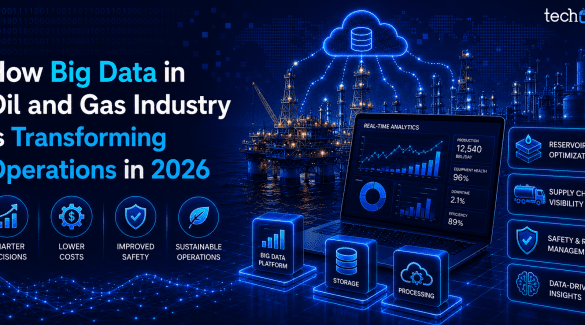
Oil and gas sector has always been at the heart of the global economy. Every minute, every day, companies are making decisions that rely on huge amoun..



Write Us
sales@techugo.comOr fill this form