

 SA
SA
 KW
KW
 IE
IE AU
AU UAE
UAE UK
UK USA
USA
 CA
CA DE
DE
 QA
QA ZA
ZA
 BH
BH NL
NL
 MU
MU FR
FR













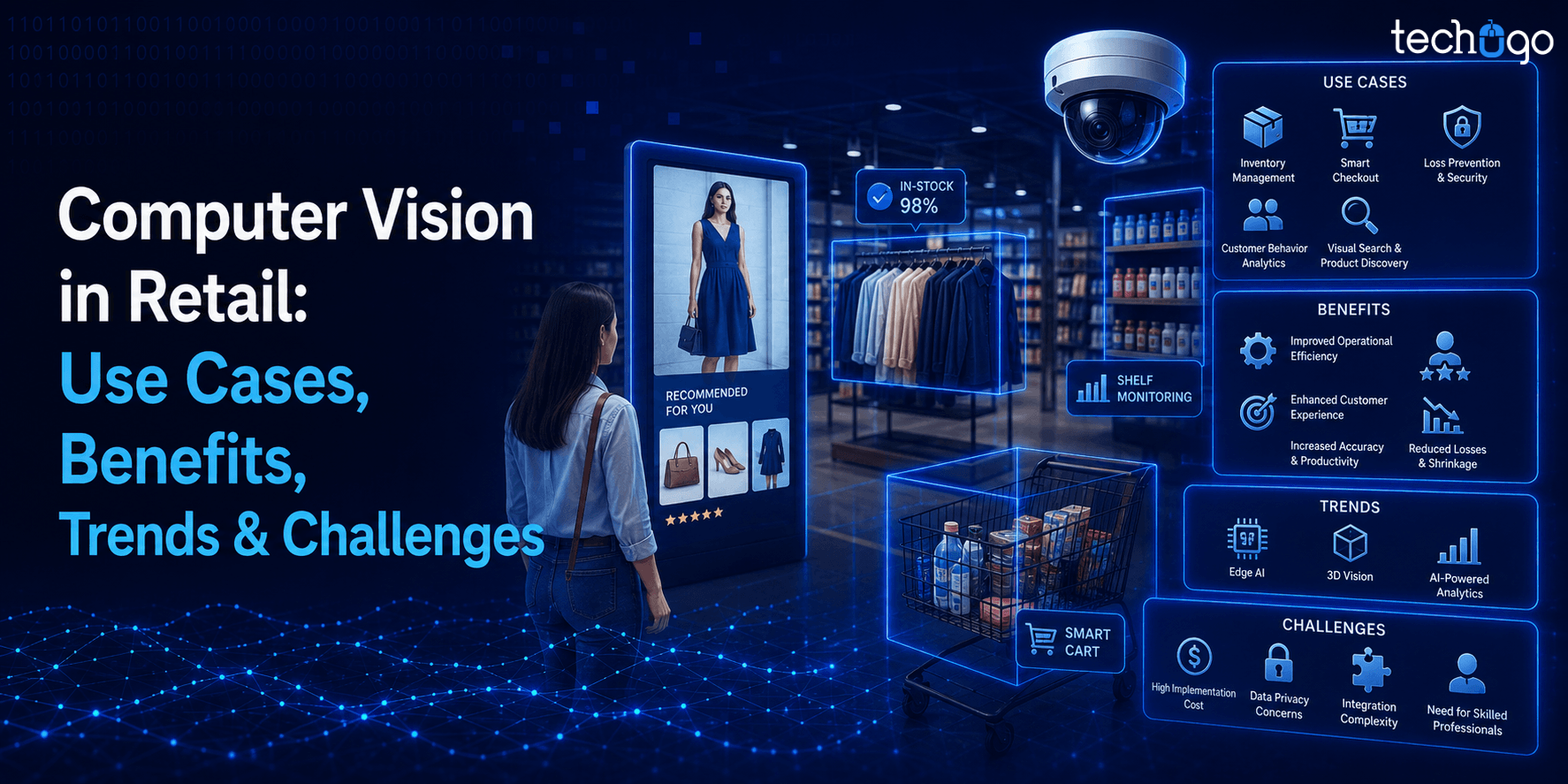


Ever wish shopping could be smarter, faster, and a little less chaotic?
And that’s precisely what computer vision in retail does.
Consider it your store’s omniscient helper: it monitors supply levels and notices empty shelves, helps protect against theft, and even assists with customization of the shopping experience. And the best part? All without replacing your staff… just freeing them up to do that which matters most: the customers.
Using AI-powered retail analytics, retailers can counter instant trends, troubleshoot prior to breakdowns, and make better decisions as they go. From mitigating theft to ensuring your shelves never run dry, the ways computer vision makes retail better are just impressive.
In this blog, we’ll simplify the top use cases, benefits, and real-world examples of computer vision in retail. No jargon, just the good stuff you can actually apply.
Let’s get started…
What is Computer Vision in Retail?
Before proceeding any further, we should define computer vision in retail.
In essence, computer vision (CV) is a branch of artificial intelligence that helps machines to see and perceive visual information. Consider cameras, sensors, and software that are able to sense objects, movement, and even read text (autonomously).
So why does that have anything to do with retail? Alright, imagine a store where cameras are available, but they are not just cameras that capture images. With such systems, customer behavior can be analyzed, the products picked up can be monitored, and even dwell time can be measured in various parts of the store. This is where AI-powered retail analytics will help: by turning the visual data into actionable information, retailers will be able to make wiser decisions in a shorter period of time.
Computer vision offers real-time insights as opposed to the time-consuming and manual-reporting-intensive nature of traditional analytics. To illustrate, it is able to identify stock shortages before they become an issue, or it is able to identify customer traffic patterns in order to optimize the store layout. And it is not confined to inventory or layout! CV may also be used to assist in retail store surveillance technology, and this keeps it safe and prevents any loss.
In other words, computer vision in retail is something like a brain to your store, which sees all, analyses it at once, and makes you do something before it is too late or you have missed an opportunity.
Computer Vision Use Cases in Retail You Should Know
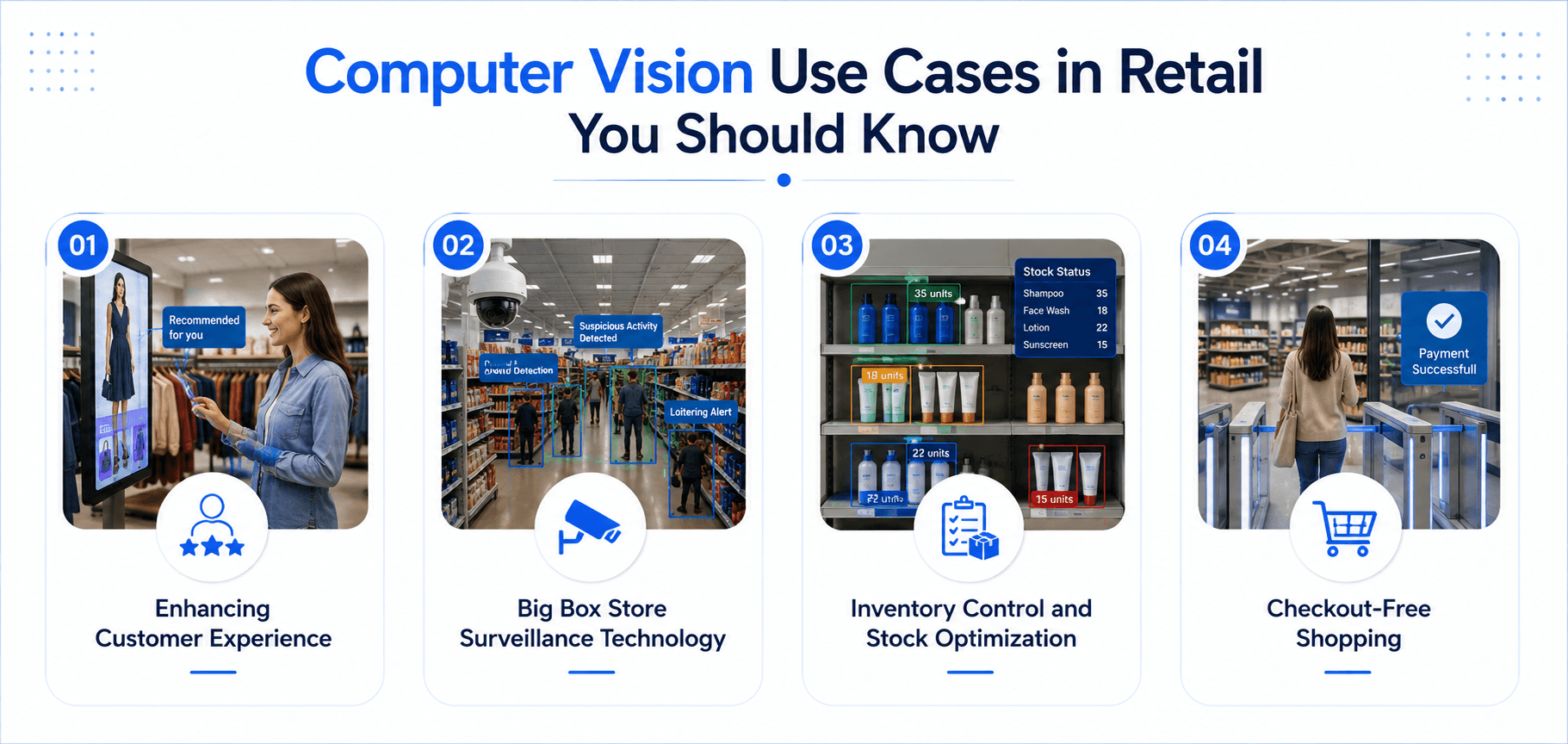
Stores are getting smarter, and computer vision is the reason why. From tracking products to understanding what shoppers actually want, these use cases are making retail work a whole lot smoother.
Let’s have a look at the most important use cases in retail.
1. Enhancing Customer Experience
Think about passing a smart mirror that proposes accessories to your outfit, or receiving personal offers on your phone as you shop. That’s CV at work. Shop owners are employing cameras and AI to monitor the movements of customers, patterns, and suggest products in real-time. It is a personal shopping assistant, but enhanced by technology.
CV opens new checkouts automatically with the help of queue management, tracks the foot traffic in crowded areas, so the shoppers do not feel overwhelmed. And that is only the beginning. Enhancing the customer experience is a big reason why how computer vision improves retail is becoming such a hot topic.
2. Big Box Store Surveillance Technology
Security is no longer about cameras capturing videos. Computer vision technology is being used to monitor suspicious activity in real time by retail store surveillance technology. It can be a shoplifter or some kind of safety threat, and these systems can notify the staff in real time, minimizing the losses and keeping everyone safer.
They can even monitor the performance of employees with some sophisticated CV systems to ensure that things like shelf restocking are performed effectively. A win-win situation: the customers would feel safer, and the operations would run with ease without the manual and continuous supervision.
3. Inventory Control and Stock Optimization
Ever walked into a store looking for a product, only to find it out of stock? With computer vision for inventory management, it is becoming less common. CV cameras scan shelves constantly, detecting low stock, misplaced items, or expired products.
Have you ever entered a shop searching a product and then realized that it is out of stock? That is becoming less so with computer vision of inventory management. CV cameras scan shelves in a continuous process, identifying low inventory, misplaced merchandise, or out-of-date items.
Retailers may incorporate such insights into automated systems that activate the restocking or update inventory in real-time. The result? Fewer stockouts, fewer losses, and satisfied customers. And, since CV is 24/7, it is much more efficient than checking shelves manually.
4. Checkout-Free Shopping
Have you ever had the frustration of long checkouts? Computer vision in retail is ensuring that it becomes a thing of the past. Stores now use CV to monitor what customers pick up and automatically add them to a digital cart as they go through the store. The shoppers make purchases, and the payment is done in the most convenient manner, either using their app or a credit card. No waiting, no scanning.
This system is based on sophisticated CV cameras and AI algorithms, as well as sensors to track products properly and identify errors. It is also cost-effective in terms of staffing and enhances overall efficiency beyond convenience. This is an ideal case of how computer vision improves retail and generates a seamless, future-like shopping experience.
Top Benefits of Computer Vision for Retailers in Today’s Smart Retail
Wondered why retailers are scurrying towards computer vision? Because of these advantages:
1. Operational Efficiency
Imagine computer vision is an invisible helper to your store. Avoid more employees going up and down checking shelves and aisles. CV tackles the routine, allowing your crew to concentrate on the people that are important, your shoppers.
2. Inventory Accuracy
There is no more disappointing thing to a customer than an empty shelf. Empty shelves? Not on CV’s watch. The solution to this is computer vision, where products are scanned in real-time, and staff are notified when the products are low or misplaced. Automated inventory tracking will minimize human error and will make sure that your shelves are always stocked, making your customers and your bottom line happy.
3. Enhanced Security
It is like having eyes everywhere without being creepy. Security is not just about wall cameras. From theft prevention to safety compliance, the way computer vision enhances retail has everything to do with real-time protection. The superior CV systems can alert to suspicious action in real time, track the activity of employees, and maintain the safety standards of the store without direct human observation. Contentment of management, improved security among customers.
4. Data-Driven Insights
Don’t guess what your customers want. CV knows it all. Information is strength, and a CV provides it in abundance. Through AI-powered retail analytics, retailers will obtain actionable information on customer behavior, the popularity of the products, and the store traffic patterns. Such insights enable smarter marketing, better layouts, and a clearer insight into what is selling, in real time.
5. Cost Reduction
Reduced workload, reduced stock mistakes, and enhanced security all create actual savings. There is more than enhancing operations when investing in computer vision.
In brief, your investment will pay itself back and make operations leaner and more efficient.
In a nutshell, your investment pays for itself while making operations leaner and more efficient.
Implementing Computer Vision in Retail
Considering taking a CV into your store? Here’s how.
- Collaborating with Experts: Collaborating with established developers will guarantee a seamless integration.
- Technology Choice: Select on-premise and cloud-based CV systems. Think about cameras, sensors, and AI software that best suit your store.
- System Integration: CV would integrate smoothly with your POS, inventory, and analytics systems.
- Training of employees: The employees should be aware of how to operate CV dashboards and how to react to alerts.
Smart Retail Technology Trends Worth Paying Attention To
To be honest, retail is not standing still. Neither is technology. Smart retail technology trends are now completely changing the shopping landscape, and computer vision sits right at the center.
Some notable trends:
- IoT Integration: CV systems are integrated with smart shelves and sensors to track stock in real-time.
- AR & VR Experiences: Visualize trying products virtually, as CV monitors your tastes.
- Cloud-Based Analytics: Real-time insights that can be accessed anywhere to enhance the speed of decision-making.
Monitoring these trends, retailers will be able to future-proof their operations and provide customers with the experience they will enjoy. And the best part? CV does not substitute employees; it enables them to perform work that is more substantial.
Real-World Examples & Case Studies
Here’s proof that computer vision use cases in retail aren’t just theory:
1. Loss Prevention: A major retail chain implemented CV-based cameras to detect suspicious behavior. Result? A 30% drop in theft incidents within six months.
2. Inventory Management: A supermarket deployed shelf-scanning CV cameras. Out-of-stock items decreased by 25%, boosting sales and reducing customer complaints.
3. Customer Engagement: A fashion retailer used CV with smart mirrors and personalized recommendations. Shopper satisfaction scores increased, and dwell time in stores rose by 15%.
These examples show that retail store surveillance technology and computer vision for inventory management are tangible investments, not just cool gadgets.
Challenges and Limitations: The Hidden Bottlenecks in Computer Vision
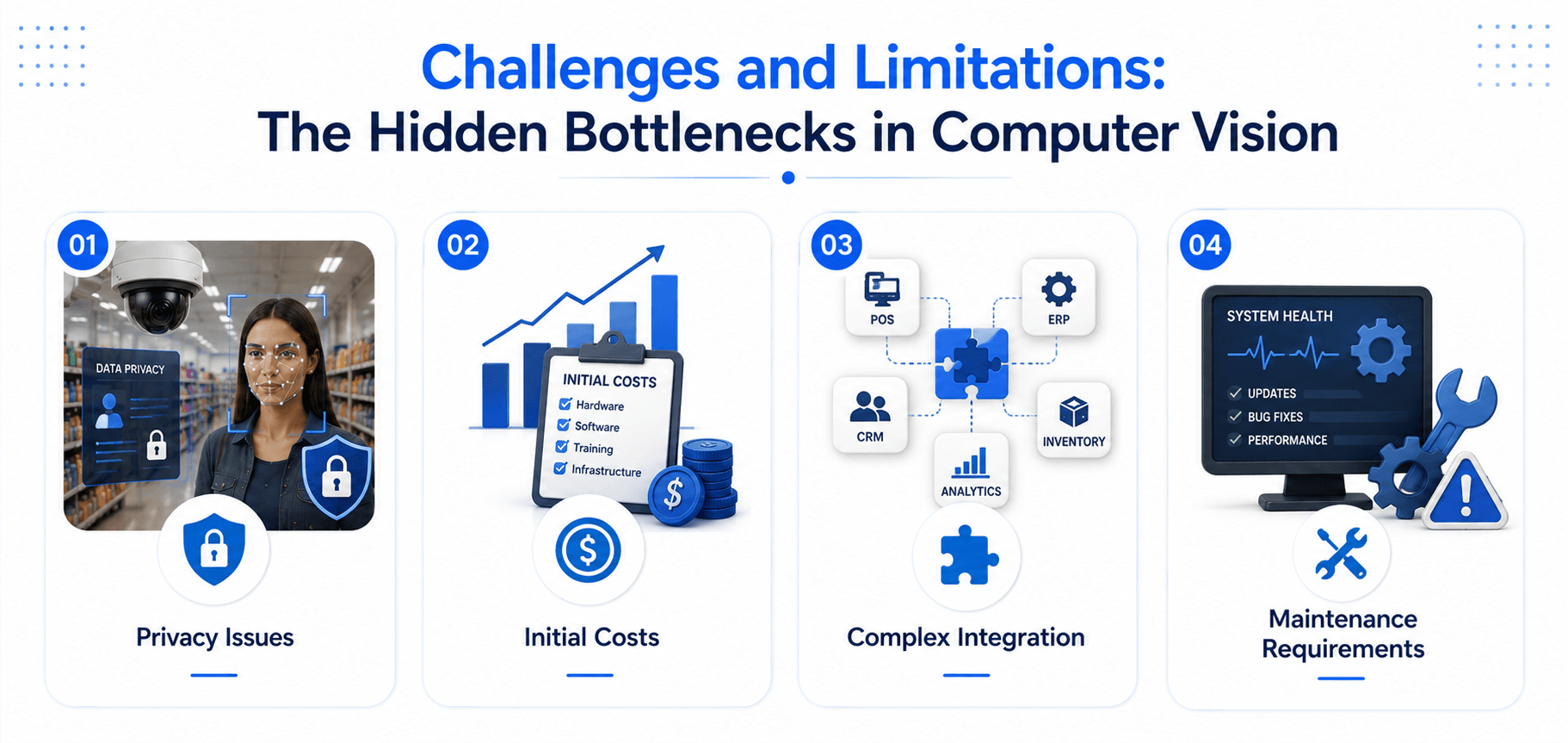
CV isn’t perfect. Some challenges include:
Privacy Issues: Customers might be concerned with being monitored all the time and how their information is being utilized. There should be clear privacy policies, clear communication, and practices that are GDPR-compliant, which will help to gain trust and adherence.
Initial Costs: Implementing computer vision may involve a considerable initial investment in hardware, software, and system integration. Such costs are, however, usually compensated for with time in terms of efficiency and enhanced customer experiences.
Complex Integration: The existing systems or retail software might not readily integrate with computer vision platforms. Professional integration, careful planning, and custom solutions would help to ensure that the operation is smooth.
Maintenance Requirements: AI models, cameras, and other hardware must be periodically updated and monitored to be accurate. The success in the retail software development with computer vision projects requires continuous support to ensure success.
With all these challenges, building an AI app can be a headache… but having an AI app development company like Techugo by your side can be a lifesaver.
How Techugo Brings Computer Vision to Retail Apps
Building tech is easy. Building tech that people actually use? That’s the hard part.
Meet Techugo. As a mobile app development company, we help businesses create mobile apps that reach real users and get results. Our team takes care of planning, design, and development, building apps that are simple, reliable, and ready for the real world.
Here’s how we can help:
- Apps that work: Smart, AI-powered, mobile, and everything in between (made to grow with your business).
- Our team has real-world experience: Successfully delivering high-performing, user-loved apps across fintech, logistics, retail, and more.
- We solve problems before they happen: From designing intuitive interfaces to integrating complex AI features, we make your app fast, reliable, and scalable.
- Proven results: Dozens of apps launched globally, helping startups and enterprises turn ideas into products users actually engage with.
- AI Innovation: We stay ahead of trends, integrating AI, machine learning, and computer vision seamlessly into mobile apps.
- User-first approach: Every decision we make is backed by experience, expertise, and measurable results.
Got a retail app idea but not sure how to start? Start with Techugo, and we’ll help you design it, add the AI magic, and launch it (and make it stand out).
FAQs
Q1: What is computer vision in retail?
A: Computer vision is, in simple terms, a technology on which computers can see and examine the physical world. Retail It is used to trace inventory, track customer patterns, deter theft, and even store layouts.
Q2: How does computer vision improve retail operations?
A: It automates repetitive tasks, reduces errors, enhances security, and provides data-driven insights. Basically, it frees your staff to focus on customers while keeping your store running efficiently.
Q3: What are the common use cases of computer vision in retail?
A: Inventory management, store surveillance, checkout-free shopping, and AI-powered analytics to learn customer behavior and increase sales are some of the key use cases.
Q4: Is computer vision expensive to implement in retail?
A: The prices differ based on the size of a store, level of tech, and functionality. With that being said, the investment is oftentimes more than the savings of labor reduction, fewer errors, and superior stock management.
Q5: How secure is computer vision in retail?
A: Contemporary systems value data privacy and security. Images and data are treated on high standards, and access is restricted; therefore, information of your customers and your business is secure.
Q6: Can small businesses benefit from computer vision too?
A: Absolutely! Smaller stores can save time, minimize waste, and make more intelligent business decisions using AI-based technology to monitor retail data and inventory management.
Q8: Will computer vision replace my staff in retail stores?
A: Not at all. Computer vision is intended to help your team, but not to substitute them. It manages the repetitive work such as scanning shelves, tracking stock or traffic patterns, allowing your employees to concentrate on assisting shoppers and on enhancing the shopping experience.

Get in touch
We'd love to hear from you.