

 SA
SA  KW
KW  IE
IE AU
AU UAE
UAE UK
UK USA
USA  CA
CA DE
DE  QA
QA ZA
ZA  BH
BH NL
NL  MU
MU FR
FR 














📌 Key Takeaways
- Global LIMS market is likely to grow from $2.1 billion in 2025 to over $3.5 billion by 2033.
- Healthcare LIMS software helps labs manage samples, reports, tests, and data in one system.
- Labs using LIMS can reduce processing time by 30–40%, according to ResearchAndMarkets.
- LIMS improves lab accuracy, reduces manual errors, and speeds up daily operations.
- Modern LIMS systems can integrate with EHR/EMR platforms and lab instruments for smooth data flow.
Healthcare is not short on data, but it is still struggling to manage it properly because every day, labs handle thousands of samples, reports, and patient records but the systems behind them are often disconnected or outdated. So delays happen, errors increase, and compliance becomes harder than it should be.
Therefore, more and more healthcare labs are investing in laboratory information management system (LIMS), that’s why the global LIMS market was around $2.1 billion in 2025 which is now likely to grow and cross $3.5 billion by 2033 (Source: Grand View Research).
Insights from Gartner say that LIMS has already become a standard across top pharmaceutical labs and is widely used in biobanks, genomics testing facilities, and drug research environments because it delivers consistency as well as control.
That’s why healthcare LIMS software development starts to matter because it connects workflows and organizes data so that everything is tracked, clearly. And therefore, LIMS software development is not just about systems anymore but about making lab operations reliable. When you think about laboratory management software development, it is really about building something that fits how labs actually work.
Through this blog, you will get to know about features, benefits, and the cost of LIMS software development. You’ll also understand how to build a LIMS software, step by step. So let’s get started…
What is healthcare LIMS software?
A healthcare LIMS software, or laboratory information management system (LIMS), is a system that helps laboratories manage samples, data, and testing workflows in one place. It is designed so that labs can handle large volumes of data, and still maintain accuracy, and speed.
Simply put, LIMS provides an electronic link between samples, testing, and reporting, preventing any loss or delay in the laboratory testing process. LIMS software for healthcare laboratories provides a structured, organized, and traceable method of managing sensitive/large-volume data generated from laboratory testing operations.
A custom LIMS software or LIMS application development is so much more than just building a piece of software; it’s about creating a system that complements a lab’s process, along with anticipating the continued growth of that lab over time.
Core components of healthcare LIMS software
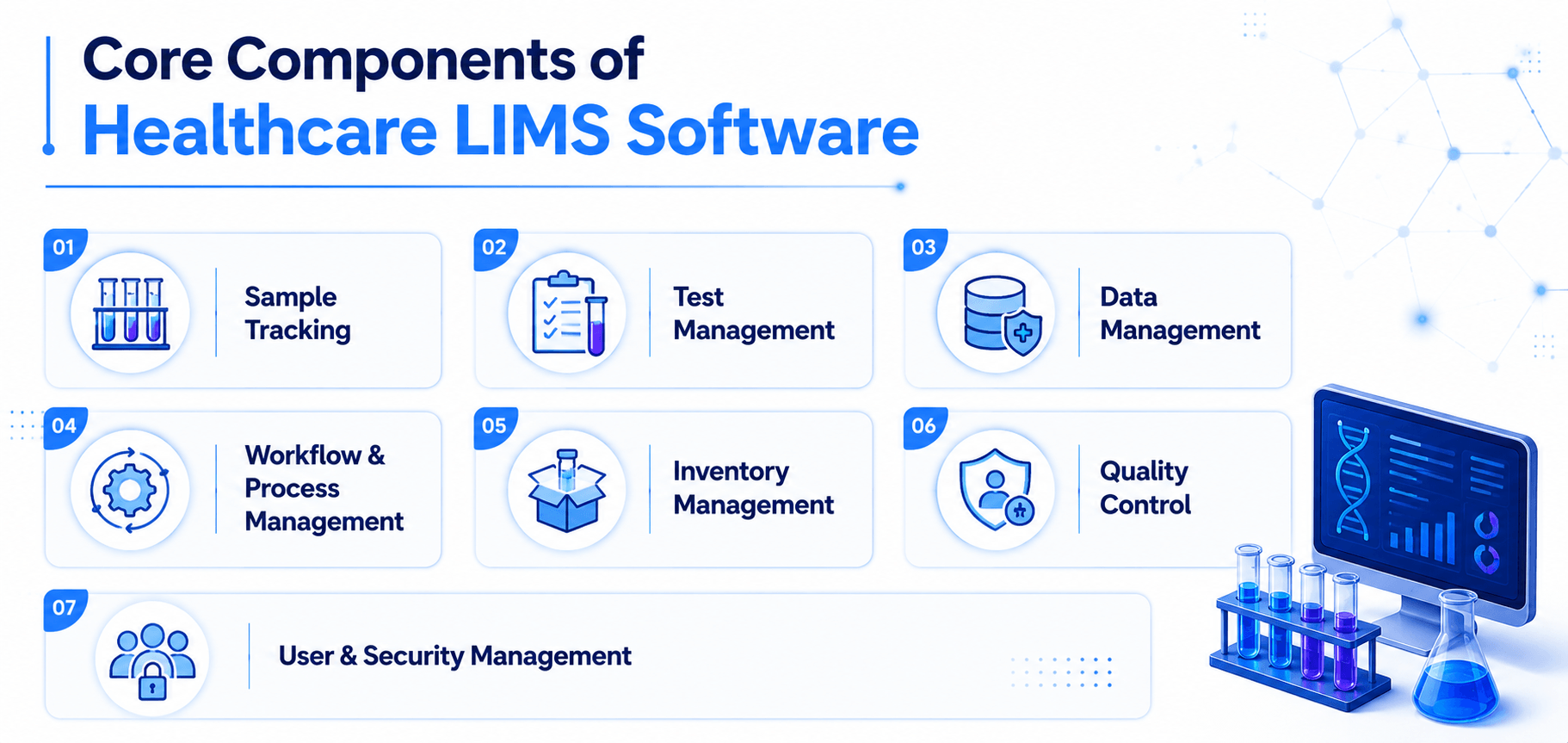
- Sample Tracking: Tracks every sample from collection to disposal, so its status and location are always clear.
- Test Management: Manages test workflows, protocols, and results to ensure consistency and accuracy.
- Data Management: Stores and organizes all lab data securely, making it easy to access and analyze.
- Workflow & Process Management: Automates lab processes so tasks follow a defined, error-free sequence.
- Inventory Management: Monitors lab supplies and reagents, preventing shortages and workflow disruptions.
- Quality Control: Ensures test accuracy by managing standards, calibrations, and validation processes.
- User & Security Management: Controls access and permissions so sensitive data stays protected.
At its core, a LIMS is used to make healthcare and pharmacy lab operations faster and more efficient by reducing manual work. Because when processes are handled manually, they take time, and they also increase the chances of errors. But with a LIMS in place, a lot of information gets captured automatically so there is no need to type everything or record it separately… and that saves both time and effort.
Now, what kind of data is captured, and how it flows into the system, and where it is stored – this is not fixed; it depends on how the system is designed, therefore, the approach taken during laboratory management software development matters a lot. Because different labs have different needs, not every system fits all.
Some LIMS solutions work really well for specific lab environments but they may not perform the same way in others. So choosing the right healthcare app development company becomes important because that decision directly impacts how efficient your lab operations will actually be.
Also Read: Generative AI in Healthcare: Top Applications and Use Cases
Why healthcare organizations need LIMS software
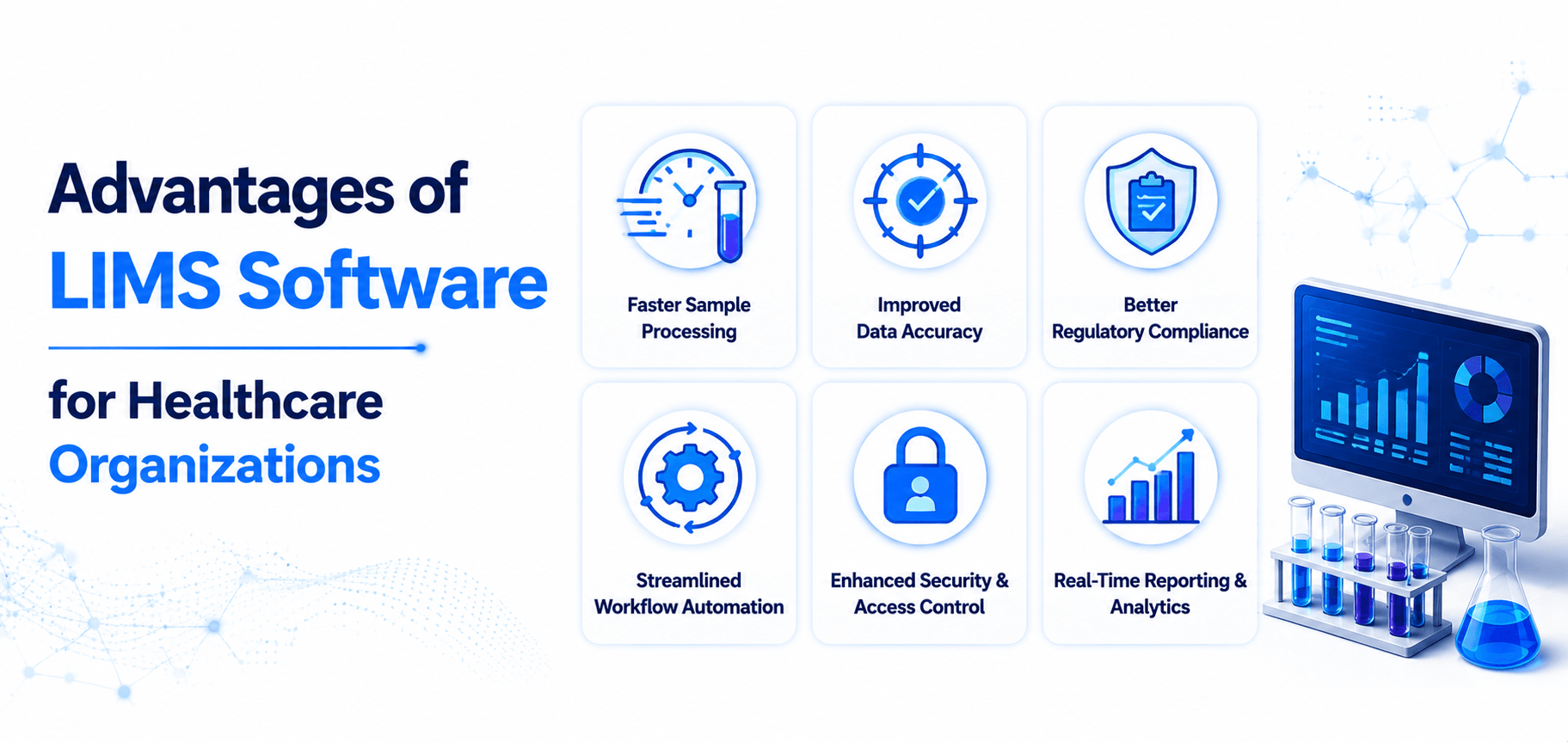
Healthcare laboratories are handling more samples and more data than ever before, and because managing this manually is not just slow – it was risky, so that you can see why automation matters. A healthcare LIMS software, therefore, solves these challenges, and it streamlines workflows, but it also improves accuracy and ensures compliance. Here are the reasons labs have been investing in LIMS:
Improved efficiency and faster turnaround
LIMS automates routine tasks like data entry, and sample tracking, and test scheduling. This means lab staff were spending less time on repetitive work, but more time on critical analysis. According to ResearchAndMarkets, labs that adopt LIMS can reduce processing time by up to 30–40%… which directly improves patient care.
Enhanced data accuracy and fewer mistakes
When a laboratory is using manual methods to enter and collect data from samples or tests, there is the potential for inaccuracy in terms of recorded information. The automatic capture of all data points in LIMS allows for greater accuracy and consistency across the laboratory resulting in fewer errors in testing processes and trustworthy results.
Compliance and readiness for audits
All healthcare labs must comply with numerous regulations such as HIPAA, CLIA, and FDA. With LIMS, the laboratory maintains secure records and audit trails, along with remaining compliant with data integrity, allowing the laboratory to demonstrate compliance during an audit and be ready at all times.
Improved management of samples and tests
From the initial log-in of the sample to tracking the sample through all stages of testing, LIMS keeps all data organized so that samples can be easily tracked back to their source; there are no lost samples, no missed tests, and test results can be followed and/or accessed.
Generation of reports and performance analyses is easier
LIMS centralizes all laboratory data; therefore, it is easier to create reports and perform analyses of the data in a timely manner. From an analysis point of view, LIMS provides laboratories with insights into process bottlenecks, optimizes workflows, and allows for faster and more confident decision-making based on laboratory data.
Flexibility and scalability for laboratories that are growing
The flexibility and scalability of a LIMS (Laboratory Information Management System) is essential for any hospital, research laboratory and pharmaceutical company planning on continuing to grow without disrupting their day-to-day operations or business processes. As laboratories expand or begin conducting complex testing, a LIMS allows for the ability to continue supporting their expansion, by easily and effectively accommodating the increased number of samples and/or users.
Suggested Read: What Role does Pharmaceutical Manufacturing Software play in the Pharmaceutical Industry?
Integration with Other Healthcare Systems
As laboratory operations have evolved, laboratories are frequently required to connect with EHR/EMR (Electronic Health Record/Electronic Medical Record) systems, diagnostic devices or cloud-based platforms. LIMS can ensure seamless integration between various systems, facilitating data transfer between multiple systems with less duplication of effort, creating a single, unified healthcare ecosystem.
Organizations implementing LIMS software for healthcare laboratories will benefit from time savings, reduced mistakes, enhanced data security and adherence to regulations, as well as improved decision-making. Most importantly, utilizing a LIMS System (for all laboratory testing and processes) transforms the previously complex lab operations into a simple and consistent process, resulting in improved patient outcomes, and increased organizational effectiveness, creating the foundation for continued progress and future growth.
Core functionalities of healthcare LIMS software
When it comes to healthcare LIMS software development, the right functionalities can make or break efficiency in your lab so here are the core functionalities that almost every lab needs:
- Lab Project Management: Create and manage lab project workflows for samples using assays, standardized methods, and procedures.
- Data Analysis: Perform QA/QC, graphing, curve-fitting, NCA, calculations, and other analytical tasks efficiently.
- Study Management: Design custom and reusable study plans, report results per study, and manage data validation.
- Specifications Management: Handle customer specifications and custom recipes while ensuring regulatory compliance.
- Lot, Batch, & Case Management: Track lots, batches, and cases; use grouped sample logins to improve operational efficiency.
- Environmental Monitoring: Keep tabs on lab and storage conditions and control waste generation and disposal.
- Security: Manage user access as well as track all changes that have been made to data, documents, and system records.
- Instrument Management: Monitor lab instruments, schedule work, and plan maintenance easily and effectively.
- Prioritization Queues & Worklist Management: Evaluate workload, adjust priorities per assay, and identify bottlenecks in projects as well.
- Workflow Management: Implement decision criteria so key samples are automatically queued and audit-ready data is captured for compliance.
- Lab Inventory & Storage Management: Track sample containers, locations, and storage durations as well as manage stock and reagents with automatic re-order alerts.
- Laboratory SOP Enforcement: Embed business rules in system to enforce standard procedures before sample registration or before screening.
- Customized Reporting: Generate custom reports automatically and export results to Word, PowerPoint, Excel, or PDF.
- Animal Facility Management: Manage cage cards, animal locations, and histories, and IACUC protocol compliance as well.
- Animal Study Management: Track study designs and workflows for PK, efficacy, behavioral, and toxicology studies.
- High Throughput Screening (HTS): Automate data collection and validation easily with alerts and in-vitro data management.
- Molecular Biology, Cell Culture & Bioinformatics: Integrate bioinformatics platforms with lab instrumentation for smart and most advanced functionality.
- Chemistry & Cheminformatics: Support compound registration, structure visualization, property calculations and searches.
- Automated Data Capture & Reduction: Integrate directly with instruments and parse files, and also reduce data automatically.
- Laboratory Automation & Integration: Control liquid handling and synthesis workstations; integrate with ERP, PIMS, and third-party systems.
- Electronic Document Management: Easily link electronic files (from raw data to final reports) into a unified repository for complete lab documentation.
All of these functionalities together make healthcare laboratory software a complete solution that can help improve speed, accuracy, as well as compliance and keep a lab ready for growth and modern challenges.
Types of LIMS software healthcare labs can invest in
Healthcare labs are not all the same, and so, the LIMS solutions they need aren’t either. Because every lab has its own size, workflows, and data requirements, the type of LIMS software for healthcare laboratories you pick really matters. And when it comes to healthcare LIMS software development, choosing the right system from the start can save you time, and headaches, and improve efficiency.
1. Enterprise LIMS
Enterprise software is for big labs, hospitals, or networks handling tons of samples. It integrates with multiple systems and manages complex workflows across departments, so that everything stays connected. It is scalable and flexible which is why it works well if your lab grows or you need centralized control over multiple locations.
2. Cloud-Based LIMS
Hosted on the cloud, this cloud-based LIMS lets you access data from anywhere and it reduces the need for heavy IT infrastructure. It is cost-effective and easy to scale, and also gives real-time access to information, which is perfect for labs that are spread out or labs that need field teams to report data remotely.
3. Open-Source LIMS
Open-source LIMS is customizable so if your lab has very specific workflows, you can tweak it to fit your processes. But, it does require technical expertise, or a partner skilled in laboratory management software development, because setup and maintenance can be tricky otherwise.
4. Laboratory Instrument Integration LIMS
Some labs rely heavily on automated instruments, and this type of LIMS works with them directly because it captures test results automatically and reduces manual entry, improving accuracy. Labs that do genomics, clinical chemistry, or pathology often need this type of LIMS.
5. Specialty LIMS
Certain labs like biobanks, genomic facilities, or pharma research labs need something very specific. Specialty LIMS is designed to manage sample storage, compliance, or drug development workflows – things that a general-purpose LIMS might not cover.
6. On-Premises LIMS
Installed locally on lab servers, this one gives full control over data and security. It is preferred when labs handle sensitive patient information or operate in regions with strict data privacy rules.
So the type of LIMS you pick matters because it affects how smoothly your lab runs, how fast tests are processed, and how efficient your operations are overall, therefore, understanding your lab’s needs and then planning your healthcare LIMS software development can save time, money, and future headaches.
How to Build a Healthcare LIMS Software: Step-by-Step Process
Building a healthcare LIMS software is not just about coding, it’s about understanding your lab, your workflow, and how the data moves. And if you want a system that actually works, then you need a clear process, because otherwise it gets messy fast. So, here’s a step-by-step approach you can follow.
Suggested Read: How to Build Software for Medical Devices: Process, Costs & Types
Step 1. Define your system needs
First, you need to figure out what your lab really requires, and why. Every lab is different, so the features in LIMS software development have to match the operations, and the kind of tests you do. Think about budget for setup and support, the number of users, and which processes must be automated.
Also, consider unusual workflows, because some labs have special needs like contract regulation tools or unique sample handling. Your IT stack might include Java, Python, Kubernetes, MySQL, or even AWS services, so that your custom LIMS software runs smoothly, and can scale as your lab grows.
Step 2. Choose a development partner
Unless you have a skilled IT team in-house, you will need to hire a healthcare mobile app development company in USA or any local vendor and then they will turn your requirements into a working system. They often provide demos, revisions, and regular updates also.
You need to give them clear technical requirements (functions, workflows, and expected outcomes) so that the team knows exactly what to build. This becomes the foundation for checking the final product, because without it, the LIMS could fail to meet your needs.
Step 3. Set the design and layout
Now think about how it should look and feel. Suppose you want an interface that is not just easy to navigate and intuitive but powerful also. Discuss the same with developers like screen layouts, menus, and user journeys because these small things matter a lot.
Security is crucial too. Limit public access, control IPs, and make sure there are no loopholes in your design. The goal is a laboratory management software development solution that is functional, safe, and ready for daily use.
Step 4. Test the software
Even with the best planning, problems will happen. Test every feature, every workflow, and how data moves, because errors can slow everything down. QA engineers from your vendor should check for bugs, compliance, and data accuracy.
And fix issues before going live, because once the system is in use, mistakes can affect lab operations and results.
Step 5. Prepare for launch
Before launch, train your staff, and set up hardware, networks, and access points. Plan how ongoing lab activities will transfer to the new system, and define timelines for implementation and post-deployment support.
By following these steps, your healthcare LIMS software development will be more efficient, reliable, and actually help your lab work faster, and smarter, because the system keeps everything organized.
How much does it cost to build healthcare LIMS software in 2026
Cost is always a big question, and it makes sense because before you start healthcare LIMS software development, you want to know what you are getting into. But the truth is, it really depends on your lab, the features you want, and how complex your workflows are.
| Type of LIMS | Target Users | Average Cost (2026) |
| Basic LIMS | Small labs, standalone facilities | $20,000–$40,000 |
| Mid-Range LIMS | Medium hospitals, diagnostic centers | $50,000–$100,000 |
| Enterprise/Advanced LIMS | Large labs, multi-location hospitals, research facilities | $150,000+ |
- A basic LIMS system with sample tracking, test management, and simple reporting can start from around $20,000–$40,000 for small labs. And that’s enough if you just need the essentials, but it might not cover extra workflows or integrations.
- Then, a mid-range solution with configurable workflows, document management, and some integrations, like for medium hospitals or diagnostic labs, usually costs $50,000–$100,000. And this is where labs get flexibility and efficiency, but yes, it costs more because there’s more work involved.
- For enterprise or advanced LIMS, serving large labs, multi-location hospitals, or research centers, with analytics, device integration, and cloud access, costs can go $150,000 and above. It’s an investment, but one that ensures everything runs smoothly and securely.
- On average, most custom healthcare LIMS software development projects in 2026 fall around $80,000–$100,000, depending on features, security, integrations, and whether you choose cloud or on-premise.
Factors affecting cost are things like:
- The number of features and workflows,
- Integration with instruments or other systems,
- Security and compliance needs,
- Customization and vendor rates, and
- Deployment choice – cloud or on-premise.
So, the price really varies, and therefore, knowing your lab’s exact needs before starting helps you avoid surprises, and makes sure your laboratory management software development delivers efficiency, accuracy, and real value.
Challenges in LIMS development (and how to overcome them)
Implementing a healthcare LIMS software can really transform a lab, but it’s not always simple, and things can get tricky. Because every lab is different, challenges often pop up, and if they’re not handled well, adoption slows down, or worse, it fails. So, let’s go through the main hurdles, and how you can tackle them.
Challenge 1. User resistance
Staff may hesitate, because the system is new, and it feels like more work. And when that happens, adoption drops, and efficiency suffers.
Solution
Involve the end-users early, and provide proper training, and ongoing support. Show them why the LIMS software development actually makes their work easier, so they see the value, and resistance decreases.
Challenge 2. Customization and integration issues
Labs have unique workflows, and integrating a new LIMS with existing software or instruments can be challenging. It was difficult, and sometimes frustrating, but it can be solved.
Solution
Pick a LIMS development partner with flexible customization and strong integration tools. Work closely with them so that the system matches your lab processes, and connects smoothly with other software you already use.
Challenge 3. High initial costs
Yes, implementing LIMS can be costly because of software, hardware, and training. And, smaller labs often worry about the upfront investment.
Solution
Consider modular, scalable LIMS that can be implemented in phases. Or cloud-based systems, because they reduce upfront hardware costs, and allow labs to pay as they grow.
Challenge 4. Data migration challenges
Moving old lab data into a new system can take time, because it often requires cleaning, formatting, and validation. And mistakes here can cause big problems later.
Solution
Plan a solid data migration strategy – clean, validate, and test before going live. Use migration tools, and seek expert help, so the transition is smooth, and nothing is lost.
So, even though these challenges exist, with careful planning, the right laboratory management software development partner, and phased implementation, you can make the adoption smooth, and ensure your lab fully benefits from a healthcare LIMS software system.
How Techugo Can Help Develop a Top-Notch LIMS App for Your Business?
When it comes to healthcare LIMS software development, having the right partner makes all the difference. And that’s where Techugo steps in as a trusted healthcare mobile app development company in India, USA, and UAE. Because developing a LIMS software for healthcare laboratories isn’t just about coding, it’s about understanding workflows, compliance, and efficiency.
Techugo has a proven track record in healthcare app development, and the best part? They don’t just deliver software; they understand your lab’s unique processes, so the laboratory management software development is fully tailored to your needs.
With Techugo, you can expect:
1. Custom Solutions – Every lab is different, and Techugo develops custom LIMS software that fits your workflows, from sample tracking to test management.
2. Seamless Integrations – Your LIMS app will connect smoothly with existing instruments, ERPs, or other healthcare software, reducing errors and improving efficiency.
3. Security & Compliance – Techugo prioritizes data security and regulatory compliance, ensuring sensitive patient and lab data is protected at all times.
4. User-Friendly Interface – A clean, intuitive interface so staff can adopt the system quickly, with minimal resistance.
5. Ongoing Support & Updates – The journey doesn’t end at deployment. Techugo provides continuous support, updates, and feature enhancements as your lab evolves.
So whether you are a small diagnostic lab or a large multi-location hospital, Techugo can help you create a top-notch LIMS app that boosts productivity, reduces errors, and makes lab management simpler than ever.
FAQs
Q. What is LIMS software used for in healthcare?
Healthcare LIMS software is primarily used to manage laboratory operations efficiently. It helps track samples, schedule tests, manage data, and ensure compliance, so labs can reduce manual work, avoid errors, and improve productivity. In short, it’s the backbone of smooth lab workflows.
Q. How much does it cost to develop a LIMS system?
The cost of healthcare LIMS software development varies depending on features, integrations, and customization. A basic system starts around $20,000–$40,000, mid-range solutions go up to $50,000–$100,000, and enterprise-level LIMS can exceed $150,000. On average, most labs spend $80,000–$100,000 for a custom solution in 2026.
Q. How long does it take to build a LIMS software?
Building a custom LIMS software for healthcare laboratories usually takes 3–9 months, depending on complexity, integrations, and testing. Simple systems are faster, but fully customized or cloud-integrated platforms require more time to ensure quality and compliance.
Q. Is cloud-based LIMS better than on-premise?
Both have benefits. Cloud-based LIMS software offers easy scalability, remote access, and lower upfront costs, while on-premise systems provide more control and localized data storage. Your choice depends on your lab’s infrastructure, budget, and security requirements.
Q. Can LIMS integrate with hospital systems like EHR?
Yes, modern laboratory management software development includes integration with hospital systems like EHR or ERP platforms. Seamless integration ensures real-time data flow, reduces duplicate work, and enhances patient care by connecting lab results directly to medical records.

Get in touch
We'd love to hear from you.