


 SA
SA
 KW
KW
 IE
IE AU
AU UAE
UAE UK
UK USA
USA
 CA
CA DE
DE
 QA
QA ZA
ZA
 BH
BH NL
NL
 MU
MU FR
FR



















📌 Key Takeaways
- 26 million EVs are expected on U.S. roads by 2030.
- Tesla Supercharger system development costs range from $60,000–$350,000 per station.
- DC fast chargers can charge EVs in 20–60 minutes – a preferred choice over slow chargers.
- EV charging costs vary by region, with India being cheaper and the USA/UAE more expensive.
- Slow chargers cost $1,000–$10,000 and fast chargers cost $30,000–$150,000+.
- Tesla Superchargers are costly because they combine ultra-fast charging with smart software and scalable infrastructure.
- Rising EV adoption and fuel uncertainty are creating long-term opportunities in EV charging infrastructure.
The demand for electric vehicles is growing fast, and it is not just because of sustainability anymore, but also because of rising uncertainty around fuel. According to PwC, there will be around 26 million EVs on US roads by 2030, and therefore the need for charging support is also increasing. Nearly 140,000 fast-charging ports will be required which is far more than what exists today.
The gap in electric vehicle charging infrastructure is extremely large, however, the size of that gap is becoming increasingly noticeable due to recent global events that have disrupted oil supply routes (e.g. Strait of Hormuz). This has caused fuel prices to spike and led to shortages in many countries. Because of this, more governments and consumers are beginning to consider alternative fuel sources such as smart electric vehicles.
The demand for electric vehicle charging is growing…
There is a growing demand for electric vehicle charging and EV software development but the current level of electric vehicle charging infrastructure has not kept pace with that demand, creating an opportunity for entrepreneurs and businesses to enter this growing market and build solutions. But traditional chargers, like L1 and L2, take time and they are not enough anymore. Users want faster charging, therefore solutions like Tesla Supercharger – a fast charging system for EVs, are becoming the preferred choice.
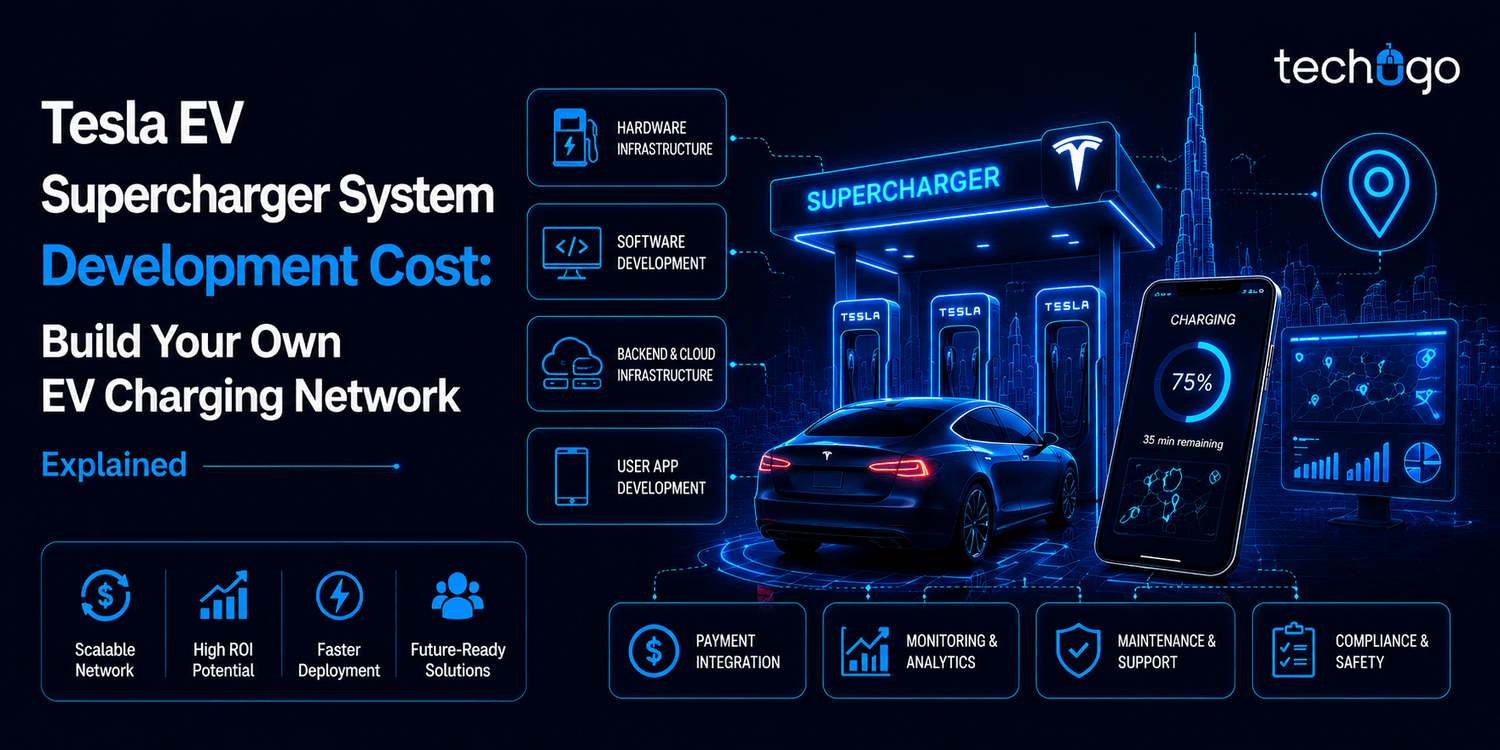
Now, before entering this space, one thing you would think about first is the Tesla EV Supercharger system development cost because it matters. The average cost to build Tesla EV Supercharger system is $60,000 – $350,000 per station. But it also depends on many factors and it can change based on hardware, installation, and system complexity.
Why Tesla Supercharger sets the standard in EV charging
Electric vehicles have been improving for years, and the charging systems have been evolving alongside them, but not always at the same speed. Because of this, different charging levels were introduced, and they are known as L1, L2, and L3, and each level defines how fast an EV can be charged. Let’s understand EV charging levels:
Level 1 (L1): Basic but slow
This is the simplest form of charging and it uses a standard household outlet. It is easy and accessible but it is also very slow, in fact, in most cases, it can take more than 40 hours to fully charge an EV so it works mainly for overnight use or limited daily travel.
Level 2 (L2): Faster and more practical
Level 2 charging uses higher voltage, therefore it is much faster than L1. It is commonly used in homes, workplaces, and public charging stations but still, it takes several hours, usually between 4 to 10 hours to fully charge a vehicle.
Level 3 (L3): Fast charging at scale
Then comes Level 3, also called DC fast charging. Fast charge systems (Level three DC Fast Charging) provide power directly to the battery and allow you to charge your electric vehicle (EV) in much less than an hour, and sometimes within a half an hour, depending on the system.
The Level 3 system is mainly what makes EV fast charging system like the Tesla Supercharger so successful; its fast charging capability allows EV owners to add hundreds of miles to their driving range in just a few minutes, rather than waiting for several hours.
Suggested Read: Generative AI in Automotive Industry: Use Cases, Benefits, Challenges, & Future Trends
Tesla has integrated high-power, high-speed charging hardware with smart software so that each of the stations has a very high level of comfort and performance, as well as manages the delivery of power, provides minimal wait times and allows the same level of performance regardless of the charging location.
So when businesses plan to build an EV charging system like Tesla Supercharger, the whole system is to be integrated into a larger intelligent network system to handle the demand of charging an increased amount of EVs. This is one of many reasons that Tesla has set the bar for others to follow in the EV charging industry.
So if you’re planning to build an EV charging system like Tesla Supercharger, it is important for you to understand the cost.
How much does it cost to build an EV charging system like the Tesla Supercharger
When you start thinking about entering this space, the first thing you look at is the cost, and it makes sense because the investment is not small. The Tesla EV Supercharger system development cost is not fixed, and it keeps changing, because there are many components involved, and each one adds to the final number.
On average, the cost to build Tesla EV Supercharger system can range between $60,000 and $350,000 per station, but this is just an estimate, and not the exact figure. The cost to develop Tesla EV Supercharger system depends on different factors, and therefore, it can go higher, or sometimes lower, based on your setup.
Estimated cost breakdown
| Cost Factor | Average Cost in USD |
| Hardware and Installation | $10,000 – $50,000 |
| Power Supply and Grid Upgrades | $20,000 – $100,000 |
| Software and System Development | $30,000 – $200,000 |
| Total Estimated Cost | $60,000 – $350,000 per station |
Key cost factors you should know
1) Hardware and installation
Most of the money goes into this, and it is expected because the hardware itself is expensive, and fast chargers, especially DC ones, are built for high power, that’s why they cost more. But it is not just the charger, it also includes installation, construction work, and electrical setup so the cost keeps adding up, step by step.
2) Power supply and grid upgrades
Now this part is often ignored, but it should not be, because it plays a big role. Fast charging systems need strong power support, and sometimes the existing grid is not enough, so upgrades are required. This may include transformers, new cabling, or even a substation, and therefore, it increases the overall Tesla Supercharger cost.
3) Software and network setup
It is not only about machines, and this is where things get interesting. A charging system also needs software, so that users can connect, pay, and track their usage. Features like monitoring, billing, and smart controls are part of it, and they have been becoming more important. This is why working with an experienced EV charging app development company helps, because it ensures the system runs smoothly.
4) Maintenance and operational costs
Even after setting up everything, the cost continues over time because maintenance, repairs, electricity usage, and regular checks are needed so that the system keeps working properly. Therefore when you think about the cost to build an EV charging system like the Tesla Supercharger, you also have to consider these ongoing expenses.
So if you are planning to build an EV charging system like Tesla Supercharger, you should understand that the cost is influenced by many things (such as location, technology, and scale) and the cost is not always predictable. The electric vehicle charging infrastructure is still changing and growing, that’s why these costs have been changing and will continue to change over time.
Region-wise Tesla Supercharger system development cost
The Tesla EV Supercharger system development cost is not the same everywhere, and it changes a lot because every region has different conditions and different challenges. The cost depends on land, labor, and power supply, but also on government rules, so you cannot just take one number and apply it everywhere. Therefore, if you are planning to build an EV charging system like Tesla Supercharger, you have to look at region-wise differences, because they matter.
Suggested Read: Why Solar Panel Monitoring Software Is Crucial for US Homeowners
| Region | Estimated Cost Range
(Per Station) |
Key Cost Factors |
| India | ₹10 lakh – ₹60 lakh+ | Lower labor cost, but grid limitations and hardware import costs |
| USA | $60,000 – $350,000 | High labor, strict regulations, grid upgrades, permits |
| Australia | $70,000 – $300,000 | Location-based variation, infrastructure gaps in remote areas |
| UAE | $80,000 – $350,000 | Premium infrastructure, high-performance systems, energy costs |
EV Charging system cost in India like Tesla Supercharger
In India, the cost is generally lower, and that is because labor and setup costs are comparatively affordable. But still, it is not always cheap because the hardware is expensive, and it has to be imported in many cases. The cost can range between ₹10 lakh to ₹60 lakh+, depending on the scale and location.
Also, the infrastructure is still developing, and because of that, grid issues can come up, so additional investment may be needed. But at the same time, government support and subsidies have been helping businesses, and therefore, the cost to build an EV charging system like the Tesla Supercharger becomes more manageable.
EV Charging system cost in USA like Tesla Supercharger
In the USA, the cost is higher, and it is expected because labor costs are high and regulations are strict. The cost to build Tesla EV Supercharger system can go anywhere between $60,000 and $350,000, but it also depends on location and power requirements.
There are also costs related to permits, and grid upgrades, and compliance, so the total investment increases. Because of this, the Tesla Supercharger cost in the USA has been on the higher side, but the infrastructure is strong and reliable.
EV Charging system cost in Australia like Tesla Supercharger
Australia is a bit different, and the cost varies depending on where you are building. In cities, the land and labor are expensive but in remote areas, the challenge is not the cost but the availability of power infrastructure.
So, while the base cost to develop Tesla EV Supercharger system may look similar, the additional expenses for connectivity and logistics can increase the total cost. Therefore, planning becomes very important, and it should be done carefully.
EV Charging system cost in UAE like Tesla Supercharger
In the UAE, the EV market is growing, and the infrastructure is also expanding, but the cost can be high. This is because the country focuses on premium infrastructure and high-performance systems, so naturally the investment increases.
Electricity pricing and charging tariffs also affect the overall setup and long-term cost. But the government has been supporting EV adoption and smart mobility initiatives, so businesses are encouraged to invest in electric vehicle charging infrastructure and grow in this space.
So the cost to build Tesla EV Supercharger system is not just about the technology but also about the location, and how the system is planned because every region is different and the costs are influenced by many factors, you need to evaluate carefully before investing.
And therefore, understanding how the Tesla EV Supercharger system development cost changes across regions helps you make better decisions and avoid unexpected expenses.
Fast Charging vs Slow Charging: What’s the cost difference
When you plan to build an EV charging system like Tesla Supercharger, you cannot ignore the difference between fast and slow charging because it directly affects the cost and also the user experience. Both options are used in the market but they serve different purposes and therefore, the investment also varies.
Slow Charging (L1 & L2): Lower cost, longer time
Slow charging includes Level 1 and Level 2 chargers, and they are easier to install and less expensive because they use AC power and simpler infrastructure, the setup cost is lower.
- Cost Range: $1,000 – $10,000 per unit
- Charging Time: 4 to 40+ hours
- Best For: Homes, offices, and low-traffic areas
But the drawback is that it takes time, and for users who are on the move, this is not always practical.
Fast Charging (L3 / DC Fast Charging): Higher cost, faster results
Fast charging, also known as DC fast charging, is what powers an EV fast charging system like the Tesla Supercharger. It delivers high power directly to the battery and because of that, charging happens much faster.
- Cost Range: $30,000 – $150,000+ per unit
- Charging Time: 20 to 60 minutes
- Best For: Highways, commercial hubs, public networks
However the cost is higher, and it is not just because of the charger; the setup requires strong grid support, advanced hardware, and proper installation so the total investment increases.
| Factor | Slow Charging (L1 & L2) | Fast Charging (L3) |
| Setup Cost | Low | High |
| Installation | Simple | Complex |
| Charging Speed | Slow | Very Fast |
| Power Requirement | Low | High |
| Use Case | Private / Semi-public | Public / Commercial |
What Should You Choose?
If your goal is affordability and limited usage, slow charging works. But if you are building a scalable business and targeting high demand, then fast charging is the better option.
Because in today’s market, users expect speed and convenience, and that is why the Tesla Supercharger cost is higher, but the value it delivers is also much greater.
Tesla Supercharger vs Other EV Chargers: Cost Comparison
When you compare the Tesla Supercharger with other EV chargers, the difference is not just about speed, but also about the cost, and the infrastructure, and how the system has been built over time. Tesla has been focusing on performance and scale, and therefore the investment is higher, but it also delivers a different level of experience.
Suggested Read: Understanding the Cost of Developing an AI-Powered Mobile App in 2026
| Charger Type | Cost Range (USD) | Speed Level | Use Case |
| Tesla Supercharger | $60,000 – $350,000 | Ultra Fast | Highways, large networks |
| Level 1 Charger | $500 – $2,000 | Very Slow | Home use |
| Level 2 Charger | $2,000 – $15,000 | Moderate | Homes, offices |
| DC Fast Charger (Non-Tesla) | $25,000 – $100,000+ | Fast | Public charging |
Tesla Supercharger: High Cost, But Built for Scale
The Tesla Supercharger is designed for fast charging and long-distance travel, and because of that, it uses high-power DC technology. It is not just a charger but a complete system, and that is why the Tesla Supercharger cost is higher.
- Cost Range: $60,000 – $350,000 per station
- Charging Speed: Up to 250 kW
- Includes: Hardware, grid setup, software, and network
- Use Case: Highways, large public networks
So yes, the cost is high but it is because the system is advanced, and scalable, and it has been designed to handle heavy usage.
Other EV Chargers: Lower cost, more flexible options
Now, other EV chargers are different because they are more flexible and also more affordable. But they do not always offer the same speed or the same level of integration.
Level 1 Chargers
These are the most basic, and they use standard outlets. The cost is low, but the charging speed is also very slow, so they are mostly used at home. Cost Range: $500 – $2,000
Level 2 Chargers
These are faster than Level 1, and they are commonly used in homes, offices, and public places. They offer a balance between cost and performance. Cost Range: $2,000 – $15,000
Third-Party DC Fast Chargers
These are closer to Tesla’s system but still different in terms of performance and ecosystem. They are fast, but may not be as optimized. Cost Range: $25,000 – $100,000+
How to develop an EV charging system like Tesla Supercharger?
Building an EV charging system like Tesla Supercharger is not just about installing the chargers, but also about creating a system where the software and the hardware work together, and because of that, the user experience becomes smooth. So here is how the process usually works, and what you need to focus on…
1. Define features and requirements
You start by deciding what the system should do and how the users will use it. This includes login, and payments, and station availability, but also reservations and real-time updates, because without these, the system feels incomplete and not very useful.
2. Design a simple user interface
The user interface should be simple and easy to understand so that users can find stations, and start charging, and track everything without confusion because if the design is complicated, users may stop using it, and that affects the whole system.
3. Build a strong backend system
This is the core part, where everything connects, and works together. The backend manages data, and users, and payments, and also communicates with the charging stations, so it needs to be strong and stable.
4. Integrate charging hardware
Now the system must connect with the actual chargers, and it should support different EV models, so that more users can use it because if compatibility is limited, then the system will not grow, and that becomes a problem.
5. Enable real-time monitoring
Users expect live updates and accurate data, so the system should show charging status, and time remaining, and availability. This helps users plan better, and therefore improves the experience.
6. Add secure payment systems
Payment integrations are important and they should be easy and secure because users trust the system with their money so multiple payment options and proper security are required, and they have been becoming standard now.
7. Focus on security and testing
The system must be tested and secured so that data is protected, and errors are reduced because if the system fails or gets attacked, it affects users directly, and that should be avoided.
8. Plan for scalability
As the number of users grows, and more stations are added, the system should handle it easily and without issues, therefore, scalability should be planned from the beginning, not later.
So when you build an EV fast charging system like the Tesla Supercharger, you build a full system that has to work together and grow over time, and that is what makes it successful.
Total investment required to develop a Tesla-like charging network
The total investment required to develop a Tesla-like charging network is high and it is because it includes the cost of the hardware-software, the infrastructure, and even the land so that system can work smoothly and without interruptions. It can range from $50,000 to $250,000 per station but the cost also changes depending on the location, and the scale, and the power capacity as well, therefore, if you plan to build a larger network, the overall investment has been, and will be, in the multi-million range.
How Techugo can help you build a smart EV charging software?
If you’ve decided to build a smart EV charging solution, then it’s not enough to have an idea. It is about how the system is planned, developed, and scaled because it needs to work in real-world conditions and not just in theory.
Being an experienced EV charging app development company, Techugo helps you design and build EV charging software where the users, the charging stations, and the data are connected so that everything works together.
Everything is handled carefully at Techugo because performance is important. The team also ensures that the platform is future-ready with AI and ML so that as your network grows, the system grows with it… therefore, you are not just getting an app, but a complete solution. Book your call with Techugo to discuss your ideas!
Is building a Tesla-like charging network worth it?
A huge investment is required to build a Tesla-like charging network and it requires the right planning and the right technology because the demand for EVs is growing and the infrastructure has been trying to catch up, and still is.
So for the businesses and the governments, it is not just about the cost but also about the long-term value and the opportunities it creates… and how you approach it.
Yes, the initial investment is high and the challenges are there but the returns, and the market demand, and the future potential are strong, therefore, it can be worth it if it is done strategically and carefully.
And this is where choosing the right electric vehicle mobile app development company becomes important because the success of the network depends on how well the system was built and how efficiently it has been performing over time.
FAQs
Q1. What are the main components required to develop an EV charging system?
An EV charging system includes the hardware, and the software, and the network infrastructure, because all of these work together so that the system runs smoothly. You need the charging stations, and the power supply setup, but also the mobile app, and the backend system, and payment integration, so that users can locate, use, and pay easily. It also includes real-time monitoring, and security systems, because reliability and safety are important.
Q2. How long does it take to develop EV charging software and infrastructure?
The development time depends on the complexity, and the scale, but usually, it can take 4 to 12 months, because both software and hardware are involved. A basic system can be developed faster, but a large network with advanced features, and integrations, and multiple locations, will take more time, and planning, therefore the timeline increases.
Q3. How do EV charging networks like Tesla Supercharger make money?
EV charging networks generate revenue through charging fees, and subscriptions, and partnerships, because users pay for the electricity, and the convenience. Some networks also earn through collaborations with businesses, and governments, and by offering premium services, so that revenue streams are diversified, and more stable.
Q4. What challenges do businesses face when building EV charging infrastructure?
Businesses face challenges like high initial costs, and land acquisition, and power availability, but also regulatory approvals, and maintenance, because setting up infrastructure is complex. There are also technical challenges, and scalability concerns, so that the system can handle growing demand, and therefore, proper planning becomes necessary.
Q5. How to choose the right EV charging app development company for your project?
You should choose a company that has experience, and the right technical expertise, because EV charging systems require both software and hardware integration. Look for a proven portfolio, and strong backend capabilities, and security practices, so that your system is reliable, and scalable. Working with an EV charging app development company ensures that your solution is built efficiently, and aligned with market needs.

Get in touch
We'd love to hear from you.