

 SA
SA
 KW
KW
 IE
IE AU
AU UAE
UAE UK
UK USA
USA
 CA
CA DE
DE
 QA
QA ZA
ZA
 BH
BH NL
NL
 MU
MU FR
FR







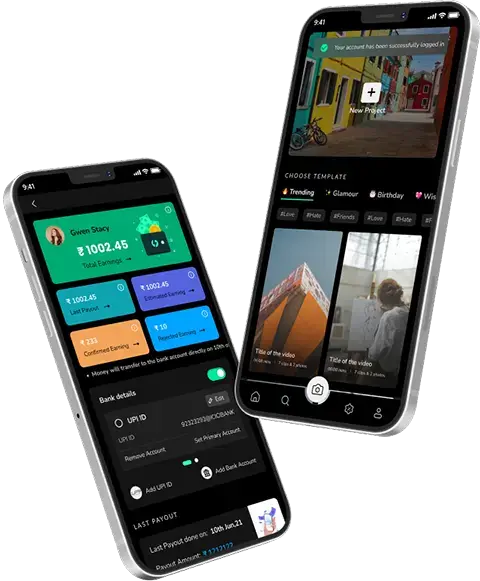






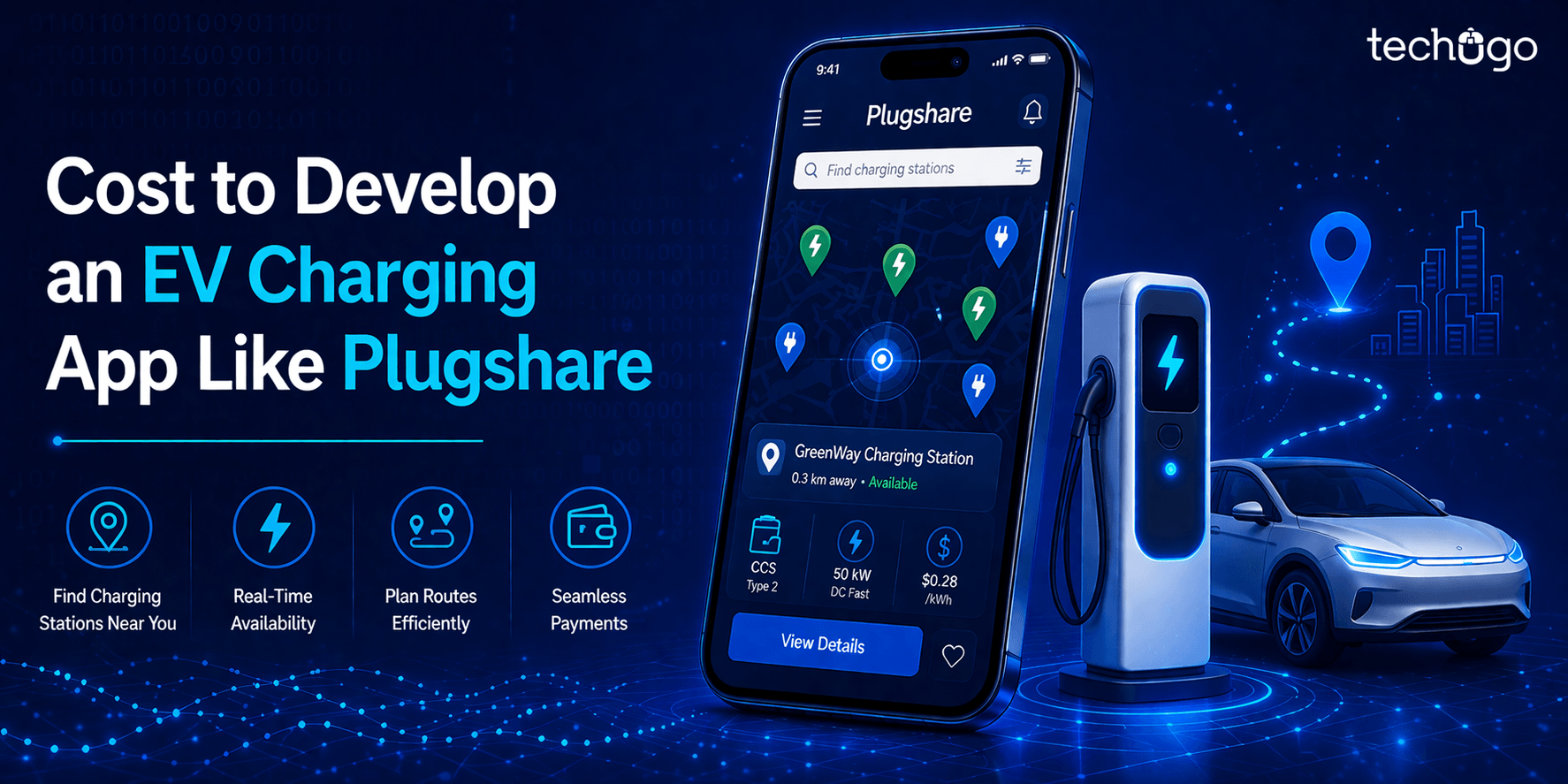


EV drivers are tired of playing hide-and-seek with charging stations. Let’s give them a cheat code.
This gap is a golden opportunity for businesses. A huge opportunity waiting to be claimed.
How? By investing in PlugShare-Like EV Charging App Development.
Apps like PlugShare simplify the process, connecting drivers to available charging stations and streamlining the EV experience. For companies, it’s a way to enter the market, build a digital presence, and create a platform users rely on daily.
The global EV market is on fire, growing over 40% year-on-year, and smart charging solutions are in huge demand.
Want to know how much it could cost you? Not too little, but not out of reach either. The cost of developing a PlugShare-like app can range from $25,000 to over $200,000, depending on features, design, and overall complexity.
In this blog, we’ll explore everything businesses need to know: key features, technology stack, development process, and a clear view of the cost breakdown.
What is a PlugShare-Like EV Charging App & How It Works
A PlugShare-Like EV Charging App is an app that helps electric vehicle drivers find charging stations quickly and easily. It shows where stations are, whether they’re available, what type of charger is there, and even ratings from other users. In short, it takes the stress out of charging your EV.
From a technical perspective, building this kind of app falls under EV charging app development. It involves integrating maps, real-time status updates, secure payments, user accounts, and notifications into a seamless, user-friendly experience.
But how does it work?
Here’s how it works. When the driver opens the app, it shows the various charging stations that are available in real time. This allows the driver to plan their trip to a gas station without guesswork (especially when it shows that there are no chargers available in the area). Many apps also allow users to reserve their charger and make a payment using the app, significantly reducing the time spent waiting for a charging station.
On top of that, drivers can leave ratings and reviews for stations, helping others pick the best spots and keeping the overall quality high.
But Why Build an EV Charging App in the First Place?
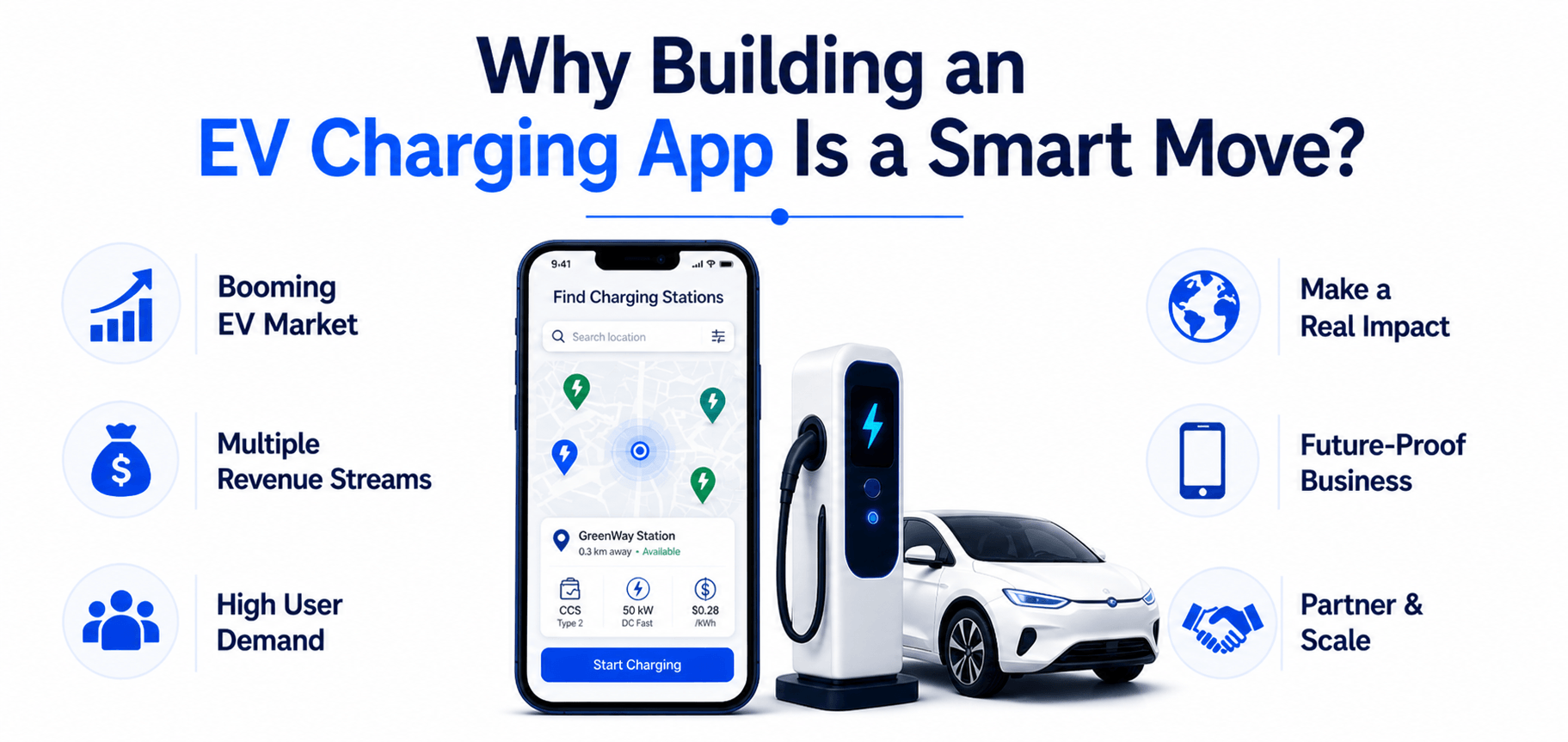
Think about the last time your phone ran out of battery. Frustrating, right? Now multiply that by driving an EV, except instead of finding a charger in your room, you’re looking for a station on the road, maybe miles away. That’s the daily struggle EV drivers face. And here’s where a PlugShare-like EV charging app steps in, turning panic into calm with a simple tap.
But why should you build one?
First, there is real demand. EV adoption is on track to exceed all expectations, given how fast millions of new drivers enter the EV market through new implementations every year. Users desire an easy way to access charging stations; therefore, the willingness & convenience of customers to use your app means that it will essentially serve as both a resource (charging ) and an assist (roaming).
Second, business potential. From a commercial perspective, charging station owners, fleet managers & municipalities are searching for tools to reach out to these new users of electric vehicles. With custom EV charging app development and smart features, your app can offer bookings, payments, and even reviews, opening multiple revenue streams.
In summary, building with the right EV charging app development services solves an existing problem and will provide the basis of the current growth (+ve trend) in EV usage, thus potentially becoming your organization’s primary revenue generator.
Most apps work. But not all apps make it past the install stage. As an EV charging app development company, Techugo builds apps that people actually use…. fast, simple, and built for real charging needs.
Top Features of an EV Charging App: Improve Every Charging Experience
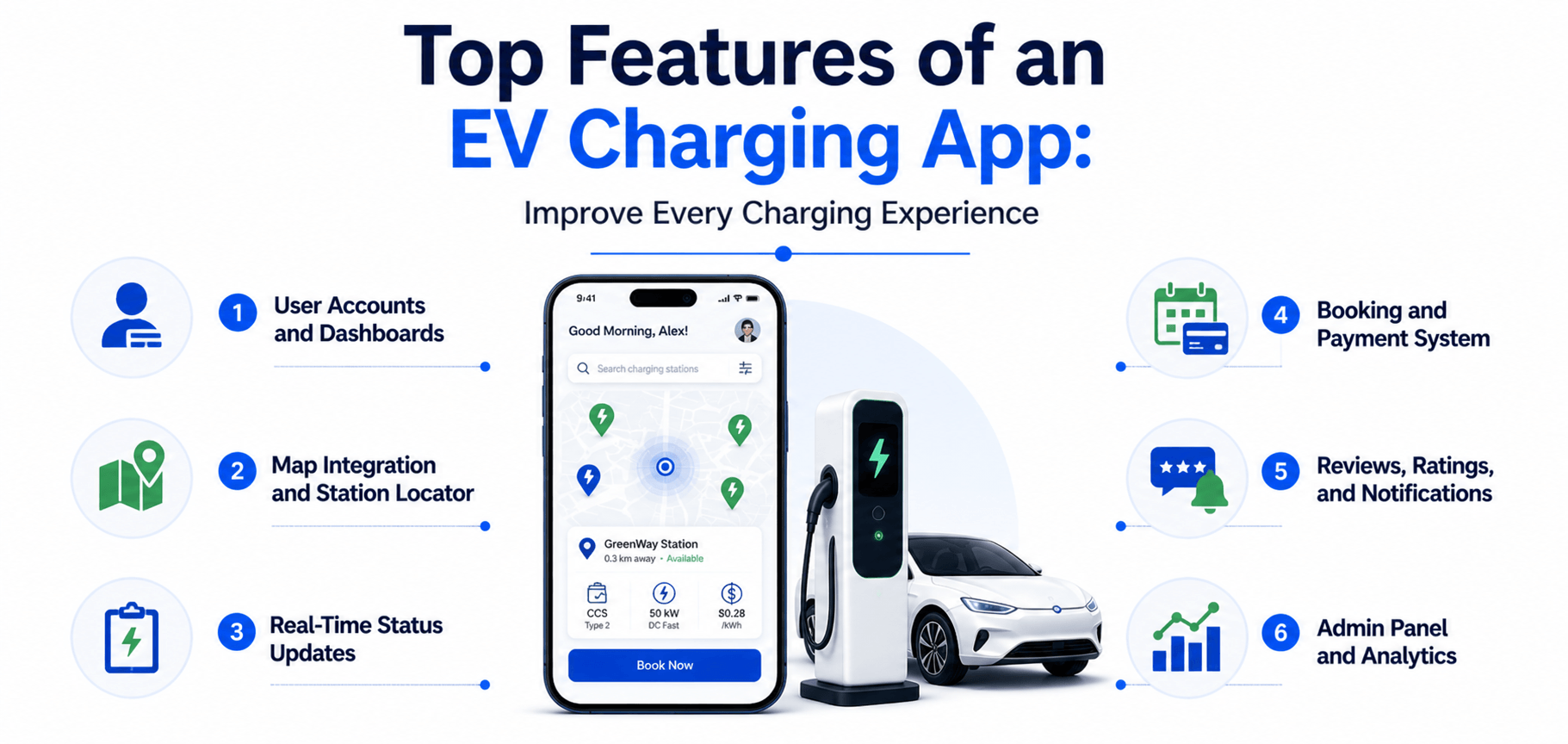
1. User Accounts and Dashboards
Every great EV charging app, developed for modern drivers, is among the most essential digital tools globally. Drivers should be able to sign up quickly using email, phone, or social logins.
The system involves a smooth sign-up for a user, and the personal dashboard of the driver reflects the developer’s idea of the connection between data and mobility. The functional and efficient charging application contains various features of utility, such as email, phone, and social logins, as well as structures, for instance, history and favorites.
2. Map Integration and Station Locator
The map is the heart of the app. Developers utilize numerous digital elements in the station locator, for instance, interactive icons to represent charger types, pricing, and availability. The map contains several navigation filters from the station lists and the GPS routes in the background.
Software engineers use integrated APIs, which create a smooth transition and slightly responsive surfaces; however, the data set contains slightly more complex backend structures. Numerous filters give the user control over outlining areas where the location turns to navigation and availability changes to a selection.
3. Real-Time Status Updates
Nothing kills trust faster than wasted trips to busy chargers. Real-time updates let users see instantly which stations are free and which are occupied. The interface emphasizes the charger’s availability since it is updated, and its status falls directly in the driver’s center of planning.
The live data and the accurate icons make a subtle impression, challenging to capture in most offline maps and lists. The less visually exciting areas are the archived and historical data since they seem secondary, lacking immediate features or information.
4. Booking and Payment System
Convenience is king. The ability to reserve a slot and pay directly through the app saves drivers time and effort. Secure payment integration also opens doors for monetization through in-app transactions, subscriptions, or premium services.
The booking module lies in a well-structured space and is developed to a reasonable scale. It is a full-length process from reservation to payment.
5. Reviews, Ratings, and Notifications
The significance of user opinion cannot be ignored. A user can rate their experience (with stars), create a review of a station, and find those stations that are most frequently used and highly recommended.
The combination of push notifications to keep users updated on each station’s availability, the addition of new stations, and added reservations will continually engage users and build trust in the shared-use vehicle network by ensuring users always receive timely and important information.
6. Admin Panel and Analytics
Every successful app has a corresponding back end that powers it. To provide continued service to its users, the operator will utilize an admin panel that provides the operator with tools to manage the use of their stations, evaluate the use of the distribution of their vehicles, and analyze how drivers are using their app.
By collecting data on where their drivers are using the vehicles most frequently and how they have interacted with the app, the administrator can identify opportunities for improvement, which in turn will continue to make the app smarter and improve the user experience.
Cost to Develop a PlugShare-Like App
If you’re thinking about building a PlugShare-like EV charging app, one of the first questions on your mind is probably: how much is this going to cost? The short answer is that it depends. But it’s not as intimidating as it might seem.
Depending on features, design, platform choice, and integration complexity, the PlugShare-like app development cost can range from $25,000 to over $200,000. Let’s break down what influences this range and why.
1. Core Features Drive the Base Cost
Every EV charging app, developed by various creators, is among the most essential digital tools globally. The functional and necessary app contains various essential features, such as payment processing and real-time station availability, as well as components, for instance, reviews and ratings. A simple version of the app with just these essentials can start at around $25,000–$50,000.
This kind of build is perfect for testing the market or launching in a single region. Users can locate chargers, see which ones are available, and make payments (essentially covering the basic “cheat code” for EV drivers). The lower cost reflects a simpler design, minimal backend integrations, and fewer advanced features.
2. Platform Choice Matters
Moreover, the choice of the platform contains diverse options such as iOS, Android, and both. The creator uses realistic frameworks like Flutter or React Native for development. A dual-platform app has a financial requirement, adding $20,000–$50,000 to the budget as the developer applies cross-platform frameworks to deliver an excellent product. The systems also contain a sense of depth since they are balanced in terms of cost and complexity.
3. Real-Time Updates and API Integrations
Live data on charger availability, expected by drivers, is among the most essential features globally. The system involves a backend integration of stations, and the real-time syncing of the data reflects the developer’s idea of the connection between technology and mobility. The expensive and functional charging application contains various elements of development, such as APIs, sync, and testing, as well as the principles. So, it can cost you around $10,000 to $30,000.
4. Advanced Features Increase Cost
Once you start adding advanced features like IoT integration, route optimization, or predictive analytics, costs rise. Skilled developers used numerous elements of technology in advanced features, for instance, route optimization to represent efficiency, analytics, and performance. Numerous features give the budget shape, outlining areas where the $50,000 turns to $200,000, and sophistication changes to a cost.
5. Design and User Experience
A clean and simple interface means users will enjoy using the app and be drawn back to it. Custom animations and maps cost a bit more, but bring added interaction and polish to the UI/UX design, which can cost $5,000–$20,000 or more depending on the desired level of customization and polish.
6. Admin Panel and Analytics
Having a proper admin panel to view all the stations, check for usage, view statistics and details is a huge aspect of the app’s overall functionality. This also would include any forms of analytics, reporting, and other features that can be utilized to manage all the individual stations within the app.
Cost range? It’s $10,000 to $30,000 (depending on the complexity and needs). Without having this in place, the app will have a tough time scaling, and can be problematic to maintain.
7. Testing and Launch
Testing is a crucial step for your app to be 100% functional on all devices and for the overall quality of the product. QA, bug fixes, and soft launch can cost anywhere from $5,000–$15,000. But not testing can cost you so much more in loss of customer trust!
Cost Breakdown Table
| Feature / Component | Description | Estimated Cost (USD) |
| Core Features | User accounts, dashboards, map integration, real-time availability, and payments | $25,000 – $50,000 |
| Platform Development | iOS, Android, or both; cross-platform vs native | $20,000 – $50,000 |
| Real-Time Updates & API Integrations | Live charger availability, data syncing with station networks | $10,000 – $30,000 |
| Advanced Features | IoT integration, route optimization, predictive analytics | $50,000 – $200,000+ |
| Design & User Experience | UI/UX design, animations, interactive maps | $5,000 – $20,000 |
| Admin Panel & Analytics | Station management, reporting, and performance tracking | $10,000 – $30,000 |
| Testing & Launch | Quality assurance, bug fixes, soft launch | $5,000 – $15,000 |
As you can see, the table gives a quick overview.
The final cost depends on the features, platform, design, and integrations you choose. Whether you go for a lean version or a fully-featured app, careful planning ensures your investment aligns with your goals and delivers real value to users.
Tech Stack for a PlugShare-Like EV Charging App
Frontend: Frontend is where users usually interact. The map, dashboards, and booking screens provide a simple and easy-to-understand interface through frontend frameworks such as Swift for iOS applications, Kotlin for Android applications, and React Native & Flutter for Cross-Platform Applications. Each framework should provide an intuitive and easy-to-use experience.
Backend: The backend is responsible for maintaining user accounts, providing real-time availability of charging stations, processing payments, and providing analytical data on how fast/slow the app is performing.
For a driver to have an experience that is predictable and reliable, it is crucial that the back-end be strong, so that all the data moves through the application without any bottlenecks and feels reliable each and every time that the driver opens it.
Database: The Database is where the user, charger station, payment history, and reviews have to be stored. They usually reside in the cloud and are usually one of the following: PostgreSQL, MySQL, or MongoDB. Databases provide a way for the application to store and access user data in real-time, in an organized manner.
Maps/Geolocation: This is basically the primary use case for the application. Map services such as Google Maps, MapBox, or OpenStreetMaps are used to allow users to locate and filter by station type or availability and navigate to them seamlessly.
Last but not least: push notifications and messaging. Staying connected is essential for users who value their social interactions. The app uses push notifications to inform drivers about station availability and booking confirmations and important updates, which keeps users engaged with the app.
Build Smarter EV Apps with Techugo by Your Side
Want to build the next big EV charging app? Partner with Techugo, a leading mobile app development company that turns ideas into fast, reliable, and user-loved apps.
At Techugo, we don’t just create apps, we create experiences. With 10+ years of expertise, we’ve successfully delivered high-performing apps across industries, including fintech, logistics, and EV mobility.
Our team combines deep technical knowledge with a user-first approach. We understand what drivers and businesses need, which allows us to design PlugShare-like EV charging apps that are intuitive.
Techugo’s accomplishments speak for themselves. We’ve launched apps with millions of downloads, seamless real-time integrations, and features that keep users coming back.
From designing intuitive dashboards and interactive maps to integrating real-time station data and secure payment gateways, we handle everything. Want to add advanced features like IoT-enabled chargers, AI-based route planning, or detailed analytics? Techugo integrates these seamlessly, ensuring your app stays ahead in the rapidly growing EV market.
Ready to launch your EV charging app? We’ll help you get there, launch with techugo and see it grow into a platform drivers actually rely on every day.
FAQs
1. What is a PlugShare-like EV charging app?
A PlugShare-like app helps EV drivers locate charging stations, check real-time availability, book slots, and pay directly through the app. It makes charging simpler, faster, and more convenient.
2. How much does it cost to develop an app like PlugShare?
Price shifts based on what it does, how it looks, one device or many. Usually building something similar to PlugShare runs between $25,000 to over $200,000.
3. Which features are essential for EV charging app development?
Signing up lets users create accounts, while a map tool shows nearby stations. What stands out is live data on which spots have bikes ready. Paying happens inside the app through secure gateways. Alerts pop up when reservations change or end. Down the line, sensors might link into the network for smarter updates.
4. What technologies are used in EV charging app development?
Key technologies include map APIs (Google Maps, Mapbox), backend frameworks (Node.js, Django), databases (PostgreSQL, MongoDB), payment gateways (Stripe, PayPal), and push notification services.
5. Can the app be scaled for multiple regions?
Yes! A well-planned tech stack and backend allow the app to scale across cities or even countries, handling more users and stations without slowing down.
6. How long does it take to build a PlugShare-like app?
Development time depends on complexity. A basic app can take a few months, while a fully-featured, multi-platform app with advanced integrations may take six months or more.

Get in touch
We'd love to hear from you.