

 SA
SA  KW
KW  IE
IE AU
AU UAE
UAE UK
UK USA
USA  CA
CA DE
DE  QA
QA ZA
ZA  BH
BH NL
NL  MU
MU FR
FR 













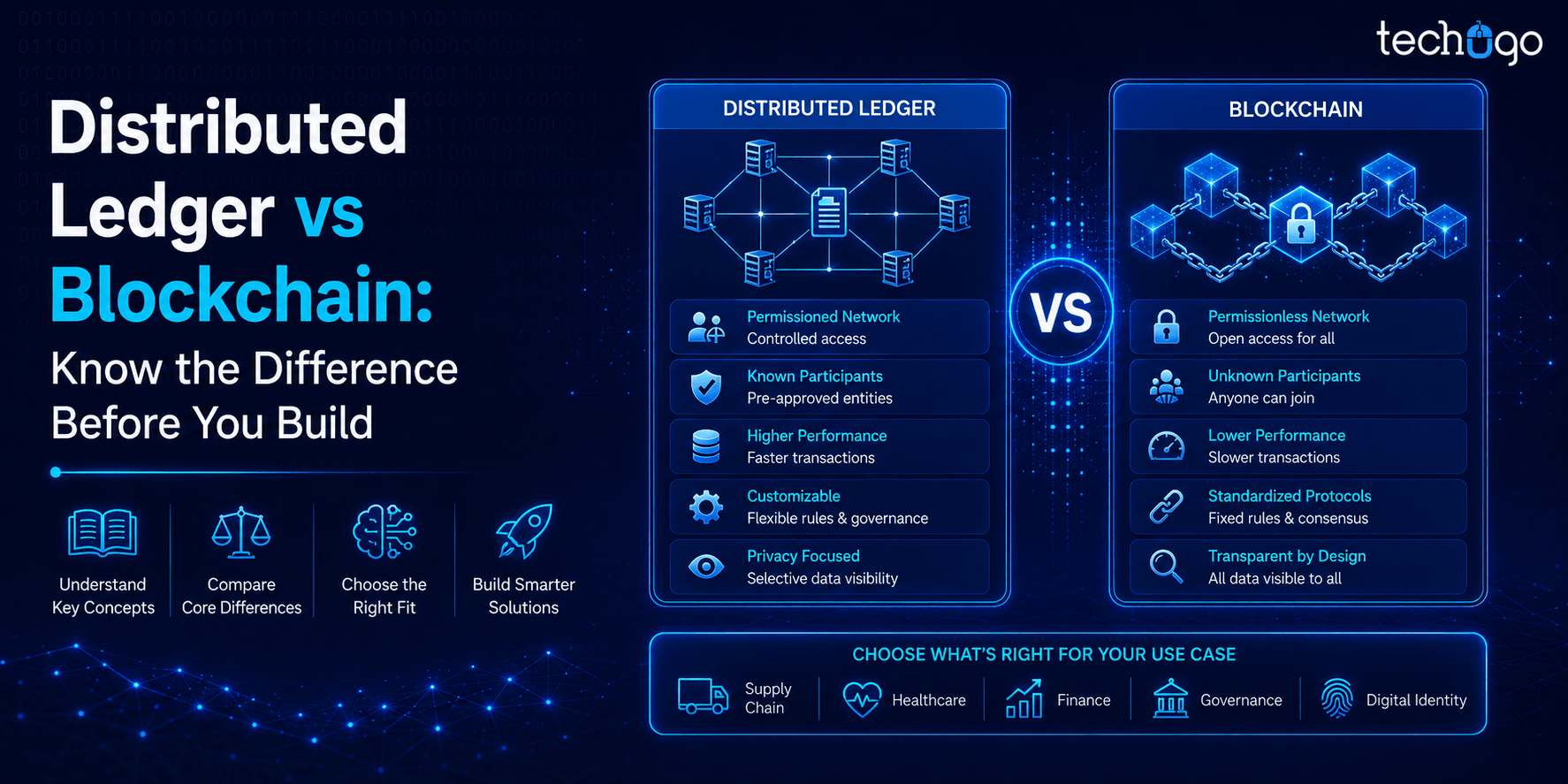


Most people use blockchain and DLT like they mean the same thing. They don’t.
Usually, blockchain and DLT get thrown around like they both are similar. It is like calling every streaming platform “Netflix.” Close, but not quite right.
But somewhere along the way, the two got bundled together, and now almost every conversation about decentralized tech starts (and ends) with blockchain.
Here’s the problem: when businesses treat them as identical, they often end up choosing the wrong solution. So before jumping into implementation, it’s worth asking: what is the real story behind distributed ledger vs blockchain? And more importantly, does the difference even matter?
As a matter of fact, it does. And not in a small way either. It can change how your system performs, how much it costs, and how easy it is to scale later on.
In 2026, building a blockchain or DLT solution can range from $25,000 for a simple MVP to $350,000+ for enterprise-grade platforms. Working with a reliable blockchain app development company like Techugo helps turn your idea into a secure, scalable, and real-world solution.
Let’s break it down in detail so that it actually makes sense.
What Is Blockchain & How Does it Work?
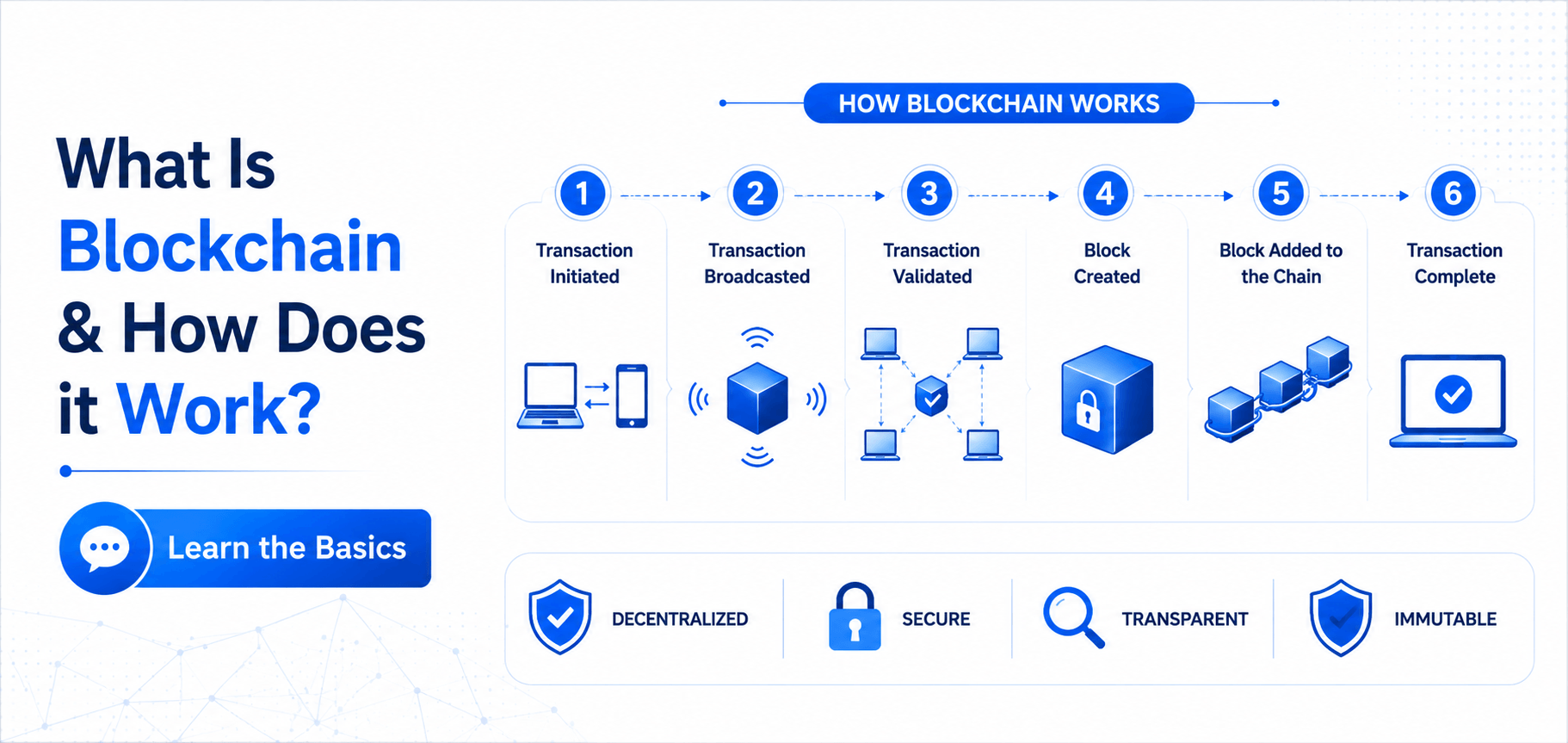
Blockchain is the most well-known type of DLT (and for good reason). It introduced a structure that makes decentralized systems more secure and transparent.
Here is how blockchain works:
- Data is stored in blocks
- Each block is linked to the previous one
- Once added, data is extremely hard to change
At its core, blockchain stores data in blocks, and each block is linked to the one before it. Once a block is added, it becomes extremely difficult to change. It is like a chain of records where every new entry depends on the previous one, so if someone tries to alter anything, the entire chain reflects that change. That’s what makes blockchain so reliable.
To simplify how it works, you can think of it like a flow:
Data is created → grouped into a block → linked to previous records → added to the chain → locked in place.
Once it’s in, it stays there. No edits, no hidden changes.
This structure is exactly why blockchain stands out. It brings a few clear advantages:
- High transparency, where data can be verified across the network
- Strong immutability, meaning records are extremely hard to alter
- Decentralized trust, so no single authority controls the system
But this is where things often get misunderstood. When discussing blockchain vs DLT, people presuppose that blockchain is a more developed and superior solution. The fact is that it is only one way of designing a distributed system. And like any design, it comes with trade-offs.
Blockchain can be slower because of how validation works. It can also require more resources, and in some cases, it’s less flexible than other DLT models. That is why it is not necessarily the default answer.
In other cases, more basic or flexible DLT methods may be able to accomplish the same (or even better) job.
Distributed Ledger Technology (DLT): The Bigger Picture
Distributed Ledger Technology (DLT) is a method of storing data in various systems rather than in a central database.
Imagine it in the following way: rather than having a single company holding and managing all the records, the same information is distributed among various participants. All people look at the same thing. Everyone verifies it.
DLT is not a technology in itself but a type of technology. It consists of several data-sharing and structuring techniques. One of them is blockchain.
And this is the reason why the term ‘blockchain distributed ledger technology’ frequently triggers misunderstandings. Individuals believe that blockchain is DLT, whereas it is actually only one of the methods of the larger concept.
DLT systems can:
- Be either public or private.
- Grant unrestricted or conditional access.
- Use other data structures (not only blocks).
This is enormous in terms of businesses. It implies that you are not bound to a single model. You are able to select which one suits you.
So, What’s the Real Difference Between DLT and Blockchain?
It’s true that both blockchain and DLT are about one thing: keeping records in a way that no single person controls.
The data is distributed among systems, as opposed to having a single central system (such as a bank database). Everyone has a copy. Everyone can verify it.
But this is where the similarity starts to fade. The way each system is structured, managed, and used can be very different.
Here are the key differences that set them apart:
Structure: How the Data Is Organized
Let’s start with structure, where the greatest difference is indicated.
Blockchain is in a very strict format. The information is stored in blocks, and the block is connected to the previous one, creating a chain. Each new bit of information is appended to this expanding sequence, and that form is predetermined. It is uniform, predictable, and made hard to tamper with.
DLT, on the other hand, does not tie you up in that format. It is not attached to blocks or chains. It is capable of utilizing various methods to arrange information (such as graphs, tables, or other models) based on the effectiveness of the system under construction.
Also Read – Building a Blockchain App in Saudi Arabia? Here’s Cost, Features Use Cases
Blockchain is only a structured technique, whereas in DLT, you have the flexibility to model the structure according to your application. And a large thing when you are constructing systems that cannot be fitted into a chain of blocks.
Flexibility: To what extent You can Adapt it?
This gives us the next directive of flexibility.
Blockchain is strong, yet it has a degree of inflexibility. The way it is made makes you frequently need to work within its limits. It is not always simple to modify or make something personalized without interference in the whole system.
DLT provides a wider breathing space. You are able to control the sharing of the data, access controls, validation, and even the structure of the system. You are able to tailor the technology to your needs rather than trying to squeeze your business requirements to fit the technology.
To businesses, this is more than it appears. In reality, systems in the real world are not always one-size-fits-all, and that freedom can make the implementation much easier and more feasible.
Speed & Scalability: How Fast It Can Grow
Now we can discuss performance, as this is where things get very realistic for businesses.
Blockchain networks, especially public ones, can be slower. Each transaction may require passing through several validation processes, and that is time-consuming. It is one of the reasons why blockchain is safe, yet it may make it slow in cases where high volumes are involved.
DLT systems, especially permissioned systems, are significantly faster. They do not necessarily require the same degree of validation by all participants since they operate in more controlled settings. That makes them more effective in systems where speed and scalability are important.
Consider such industries as logistics or finance, where thousands of operations are taking place every second. In such situations, even minor delays may accumulate. This is why performance is not a mere technical aspect; it is a business choice.
Control & Access: Who Gets In and Who Doesn’t
Another major difference is how control and access are handled.
Blockchain is typically linked to a decentralized system that is open and allows anyone to join it and contribute. That is very well in openness and confidence, particularly in the open networks. However, in the case of sensitive information, it is not necessarily the best.
With DLT, you have a better command of who is allowed to use the system. It may be private, permissioned, and restricted according to requirements or roles. This is why it is more appropriate in the industries where compliance and data privacy are a no-go zone.
For example, in healthcare or enterprise settings, not all people should be able to access all things. You require control levels, and that is where DLT models beyond blockchain tend to be more effective.
Use Case Fit: Where Each One Works Best
After all, it is the place where each one belongs at the end of the day.
Blockchain is effective in the context where trust is poor, and transparency is a paramount concern. In the event that various participants require communicating with each other without the use of a centralized force, blockchain may be a powerful option. It is particularly handy in such spheres as finances, digital belongings, or tracking of the supply chain.
Instead, DLT can be more appropriate in controlled settings, where the importance of performance, privacy, and efficiency surpasses the importance of complete decentralization. It is effective with enterprise systems, intra-organizational data exchange, and when the participants are well-known and trusted.
Still confused? Here is a quick side-by-side to make things clearer.
A Quick Side-by-Side Comparison
| Aspect | Blockchain | Distributed Ledger Technology (DLT) |
| Structure | Data stored in blocks linked in a chain | Can use various structures (graphs, tables, etc.) |
| Flexibility | More rigid due to fixed architecture | More adaptable to different business needs |
| Speed & Scalability | Can be slower due to validation processes | Often faster, especially in permissioned systems |
| Control & Access | Usually public and fully decentralized | Can be private, permissioned, and controlled |
| Transparency | High transparency across participants | Can be transparent or restricted based on setup |
| Use Case Fit | Best for trustless, open environments | Better for controlled, enterprise use cases |
Both have their place; it all depends on what you are trying to build.
The real value lies in choosing what works best for your system, not what’s more popular.
Blockchain vs DLT: Why the Difference Matters for Businesses
For businesses, the conversation around blockchain vs DLT isn’t just technical. it’s strategic.
Choosing the wrong architecture can lead to:
- Unnecessary complexity
- Higher costs
- Slower performance
- Poor scalability
Let’s say you are building a supply chain system. Do you need full public transparency? Maybe. Do you need fast, controlled data sharing between known partners? Probably.
In that case, a permissioned DLT system might work better than a traditional blockchain.
But the point is: not every problem needs a blockchain.
Sometimes, businesses jump into blockchain because it’s popular, not because it’s practical. And that’s where things go wrong.
The real value comes from understanding your requirements first. Before choosing between blockchain or any other DLT model, you need to get clear on what your system actually needs to do. Who needs access to the data? How fast should the system run? How much control do you need over who can see or modify information? And what level of transparency makes sense for your use case?
Once you answer those, the choice between blockchain and other DLT models becomes much clearer.
Real-World Use Cases of Blockchain & DLT: Where Each Fits Best
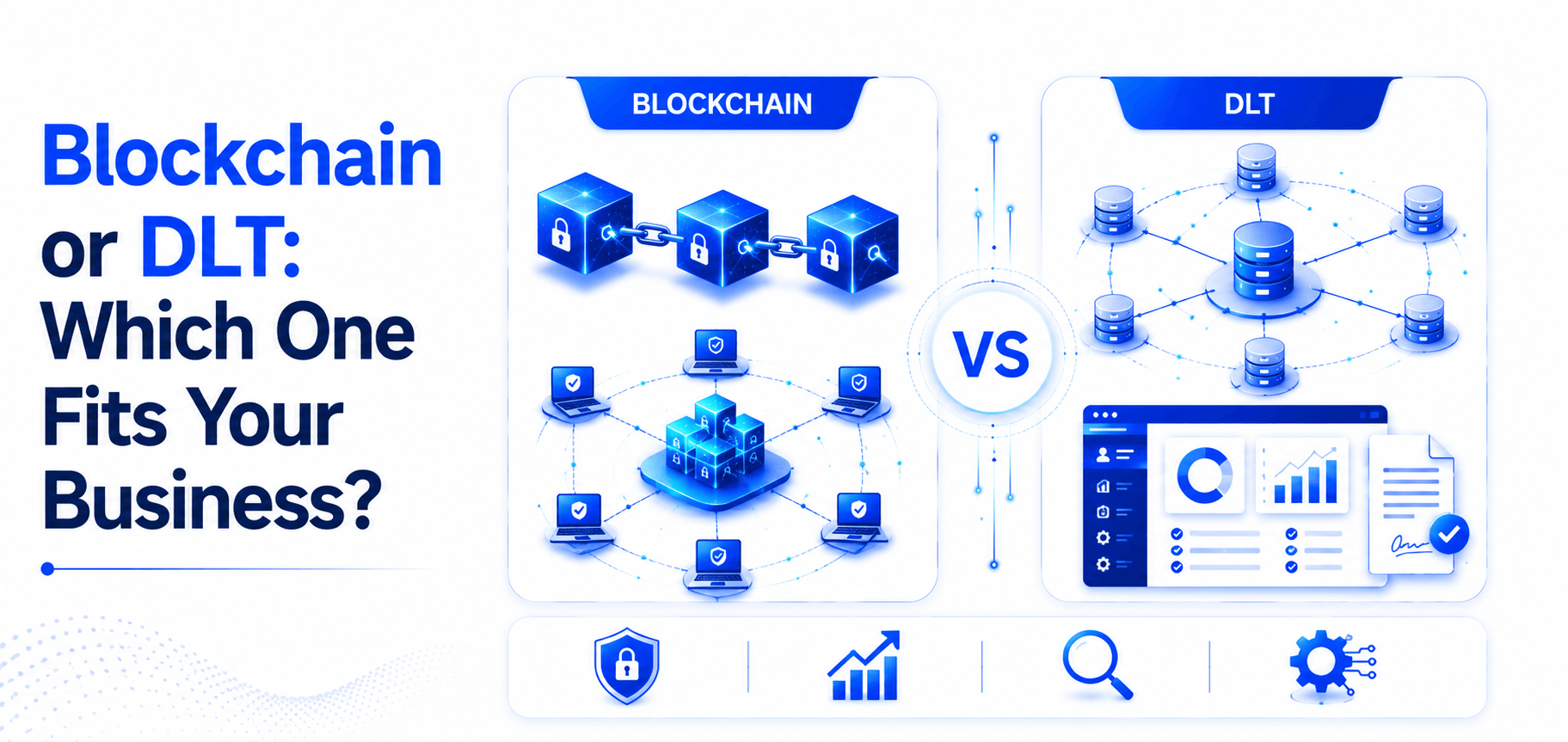
Now that we have broken down how blockchain and DLT work, it’s time to see them in action. Theory is great, but the real value comes from understanding where each technology actually fits. Some systems benefit from blockchain’s transparency and immutability, while others perform better with a more flexible DLT approach.
Let’s take a look at real-world use cases to see where each one shines.
Where Blockchain Works Best
Blockchain works best in environments where trust is low and transparency is critical. Its immutability and decentralized verification make it ideal for situations where no single party should have control.
Examples include:
- Financial transactions and cross-border payments
- Cryptocurrency networks like Bitcoin and Ethereum
- Supply chain tracking, ensuring every step is visible
- Digital identity verification for secure authentication
In these cases, blockchain’s transparency and tamper-resistant design provide real value, giving users confidence that the data hasn’t been altered.
Where DLT (Beyond Blockchain) Makes More Sense
Not every system needs a chain of blocks. Other forms of blockchain distributed ledger technology (DLT) can be more efficient in controlled, permissioned environments.
Examples include:
- Enterprise data sharing across departments or partners
- Healthcare record management where privacy is crucial
- Logistics coordination with high-speed updates
- Internal auditing systems need traceability without full decentralization
Here, speed, privacy, and control matter more than full decentralization. That’s where DLT (beyond blockchain) steps in, giving businesses the flexibility to tailor their system to real-world needs.
Techugo’s Expertise as a Blockchain App Development Company
Techugo is a global mobile app development company with over a decade of experience designing, building, and scaling apps across industries and technologies, including blockchain. Founded in 2015, we have delivered hundreds of digital solutions for startups, enterprises, and Fortune 500 brands, helping them raise significant funding and create real business impact.
When it comes to DLT or blockchain app development, our expertise spans a wide range of services that go beyond just building apps:
- ICO & token development: launching and structuring initial token ecosystems
- Smart contract development: secure, automated business logic on blockchain
- Private blockchain solutions: for enterprise use
- Cryptocurrency & secure wallet development: safe transaction systems
- Hyperledger & multi‑chain implementations: flexible architecture for different network types
- POC & prototype development: testing viability before full rollout
So, have you picked between blockchain and DLT? Let’s build it with Techugo.
FAQs
Q1: Are blockchain and DLT the same thing?
A: Not exactly. Blockchain is a type of distributed ledger technology (DLT), but not all DLTs use a blockchain structure. Think of blockchain as one way to organize data within the broader DLT category.
Q2: What is the difference between blockchain and DLT?
A: Blockchain is a specific type of distributed ledger technology (DLT). While all blockchains are DLTs, not all DLTs use a blockchain structure. Blockchain organizes data in linked blocks for immutability and transparency, whereas other DLTs may use different structures (graphs, tables, etc.) to suit speed, control, and privacy needs.
Q3: When should I choose blockchain over other DLTs?
A: Blockchain works best in environments where transparency, immutability, and trustless verification are critical, like cryptocurrency, supply chain tracking, or digital identity systems.
Q4: When is a non-blockchain DLT better?
A: If your system needs speed, privacy, and controlled access rather than full decentralization, other DLT approaches are often more efficient. Examples include enterprise data sharing, healthcare records, and internal auditing systems.
Q5: Can DLT be private?
A: Yes. Unlike many blockchain networks that are public, DLT can be designed as a private or permissioned network, giving you more control over who can view and modify data.
Q6: What are the main use cases for blockchain and DLT?
A: Blockchain works best for crypto, finance, supply chain, and identity verification. DLT (beyond blockchain) fits enterprise data sharing, healthcare, logistics, and internal audits.
Q7: Is blockchain always the best choice for businesses?
A: Not necessarily. While blockchain is popular, it comes with trade-offs like slower processing and higher resource use. The best choice depends on your business needs, system performance requirements, and level of decentralization required.

Get in touch
We'd love to hear from you.