

 SA
SA  KW
KW  IE
IE AU
AU UAE
UAE UK
UK USA
USA  CA
CA DE
DE  QA
QA ZA
ZA  BH
BH NL
NL  MU
MU FR
FR [ LET’S TALK AI ]
X
Discover AI-
Powered Solutions
Get ready to explore cutting-edge AI technologies that can transform your workflow!



Get ready to explore cutting-edge AI technologies that can transform your workflow!







The idea of pharmacy app development in the UAE can feel overwhelming at first.
From planning the features to understanding regulations and preparing for launch, there’s a lot to figure out.
But you’re in the right place if you’re planning to launch an app like LIFE Pharmacy but unsure how to get started.
The good news is you don’t need to figure everything out on your own. In this guide, we’ll cover everything – from how to build a pharmacy app in the UAE and the cost to develop a pharmacy app in the UAE to the features you actually need and what it really takes to launch successfully.
Pharmacy App Development in the UAE is gaining real attention as more people turn to digital options for everyday healthcare needs.
Across Dubai, Abu Dhabi and the wider MENA region, most customers would rather order their medicines online than wait in long queues or make multiple phone calls just to refill a prescription.
They expect to order medicines, upload prescriptions, track deliveries and even consult a doctor – all from their phones, in just a few taps. That’s exactly why apps like LIFE Pharmacy have raised the bar for digital healthcare convenience.
And naturally, it makes business owners wonder: What is the cost to develop a pharmacy app in the UAE?
On average, building a pharmacy app in the UAE can cost anywhere from AED 120,000 to AED 450,000+, depending on the features, compliance needs and whether you launch on iOS, Android, or both.
Building an app like LIFE Pharmacy in the UAE isn’t just about adding a “Buy Now” button and calling it a day. You’re dealing with prescriptions, patient trust, government regulations, delivery timelines and zero room for mistakes.
It’s healthcare on a smartphone.
In this guide, we’ll cover the features you’ll need, the tech behind it and what it really costs. So that you can decide your next move.
Also Read: Understanding AI in Healthcare App Development in UAE
Building an app like LIFE Pharmacy isn’t just a tech decision. In the UAE, it’s a market shift. Digital healthcare adoption is accelerating and customer expectations are rising just as fast.
If you’re planning pharmacy app development, understanding the local landscape isn’t optional, it’s strategic.
The United Arab Emirates is one of the most digitally connected countries in the world. Smartphone penetration is extremely high and mobile commerce continues to grow year after year.
In cities like Dubai and Abu Dhabi, people are already used to ordering groceries, booking appointments and managing their finances through apps. So it’s no surprise that healthcare is moving in the same direction and that’s exactly why healthcare mobile app development is seeing steady growth across the UAE.
Always remember, if you’re not digital, you’re invisible to a growing segment of customers.
Today’s users don’t want to stand in queues. They want fast search, quick checkout, real-time delivery tracking and zero friction.
More importantly, they expect trust.
When someone orders medicine through a pharmacy app, they want:
In the wider MENA region, convenience isn’t something that impresses customers anymore, it’s something they expect.
So pharmacy app development isn’t about innovation for the sake of it; it’s about staying relevant in a market that has already moved online. That’s what keeps you in the competition.
Healthcare is regulated and for good reason. People aren’t ordering clothes or gadgets, they’re ordering medicine.
That changes everything.
In the UAE, digital pharmacy platforms must follow strict healthcare authority guidelines, data privacy laws and licensed pharmacist verification processes. Prescription handling isn’t casual. Patient data isn’t just another database. It’s sensitive, protected and treated seriously.
That’s why building an app like LIFE Pharmacy isn’t only about clean design or smooth checkout flows. It’s about building a system that respects medical rules from day one.
Compliance isn’t something you “add later.” It has to be part of the foundation.
(When done right, compliance doesn’t slow your growth, it builds trust. It reassures users and tells them their health and their data are in safe hands.)
Life Pharmacy App is a mobile shopping app made by Life Pharmacy that lets people order medicines and health products from their phone instead of going to a physical store. It’s basically the digital version of their pharmacy stores.
Now, let’s understand the revenue model of the LIFE Pharmacy app!
Apps like Life Pharmacy don’t usually make money directly from selling the app itself, they make money through other business methods:
| How the app makes money | Explanation |
| Product sales | You buy medicines/products → company earns profit. |
| Delivery fees | Extra charges for home delivery sometimes. |
| Rewards | Discounts encourage you to buy again (more long-term revenue). |
| Ads & brand promotions | Brands pay to be featured. |
| Additional services | Optional consults, subscription refills, etc. |
A pharmacy app today carries more than products, it carries responsibility. When someone orders medicine, they’re choosing trust, speed, and reliability in one tap.
That’s why partnering with the right mobile app development company in UAE matters from day one. Here are the features that your app must have if you’re developing an app like LIFE Pharmacy:
Also Read: Generative AI in Healthcare: Top Applications and Use Cases
Native apps are built separately for iOS and Android. That means Swift for iPhones and Kotlin (or Java) for Android devices.
But why does that matter? Because native apps usually perform the best. They’re faster, smoother and more stable. And when you’re dealing with prescriptions, payments and sensitive health data, that extra reliability really counts.
The downside? You’re building two versions instead of one, so it takes more time and budget.
Hybrid apps use frameworks like Flutter or React Native to run on both iOS and Android from a single codebase.
Basically, you build once and deploy everywhere.
This saves time and reduces development costs, which is why many startups building an app like LIFE Pharmacy prefer this route. Performance today is also much better than it used to be, especially for well-optimized healthcare apps.
It’s often the practical middle ground.
Web apps run inside a browser. No App Store download. No Play Store installation.
They’re cheaper and faster to launch, but here’s the trade-off: limited offline access, weaker hardware integration and not the same smooth experience users expect from a full pharmacy app.
For something as sensitive as digital healthcare, web apps alone usually aren’t enough.
In the UAE and wider MENA region, both platforms matter.
So what’s the smart move?
In the UAE, both matter.
iOS has a strong presence in cities like Dubai and Abu Dhabi, especially among premium users and enterprise customers. If your target audience includes higher-income segments, professionals, or corporate clients, iOS is important.
Android, on the other hand, has the larger overall user base. It gives you wider market reach across different demographics and income levels throughout the UAE and the broader MENA region.
If you’re serious about your pharmacy app development, launching on both platforms is usually the right decision.
It’s not one big task. It’s a series of strategic phases – each one building on the last.
When you’re developing an app like LIFE Pharmacy in the UAE, every step matters because you’re dealing with healthcare, compliance and real customer trust.
Also Read: Building a Next-Gen Healthcare App Like Bupa Arabia
Before you design anything, you think.
Who are you building this for? A single pharmacy branch? A multi-store chain across the UAE? Are you planning prescription uploads? Doctor consultations? Express delivery?
You study the UAE healthcare market. You check competitors. You understand local compliance rules. You define your revenue model – commission, direct sales, subscription?
This phase shapes everything. Skip it and you’ll fix expensive mistakes later.
Now you turn the idea into structure.
This is where you map the user journey:
Browse medicine → Add to cart → Upload prescription → Checkout → Track delivery.
Sounds simple. But in pharmacy app development, simplicity takes effort.
Healthcare apps must feel clean, calm and easy. Also, users shouldn’t struggle to upload prescriptions or find critical medicines. In the UAE market especially, expectations are high. If the experience feels confusing, users uninstall.
Design here isn’t decoration. It’s clear.
Also Read: AI in UX/UI Design: 10 Ways to Transform User Experience (With Real Examples)
This is where the real build begins.
You decide the approach:
But development isn’t just the front end. The backend is the real engine.
You’re building – inventory synchronization across stores, a secure prescription verification workflow, payment gateway integration, an order management dashboard and a delivery tracking system. All of this in a single connected platform!
In LIFE Pharmacy app development, security and compliance architecture are baked into the system, not added later.
This is where your digital pharmacy becomes real.
Now you break it before users do.
Testing checks:
In healthcare, small bugs become big trust issues.
Pharmacy app development in the UAE requires serious QA. Not just visual testing, but performance, security and compliance validation.
You don’t launch “almost ready.” You launch stably.
Once everything is tested, the app goes live on the App Store and Google Play.
But launch isn’t the finish line. After deployment, you’ll need:
An app like LIFE Pharmacy is not a one-time build. It’s a living system.
And, if you want long-term growth, maintenance is part of the strategy, not an afterthought.
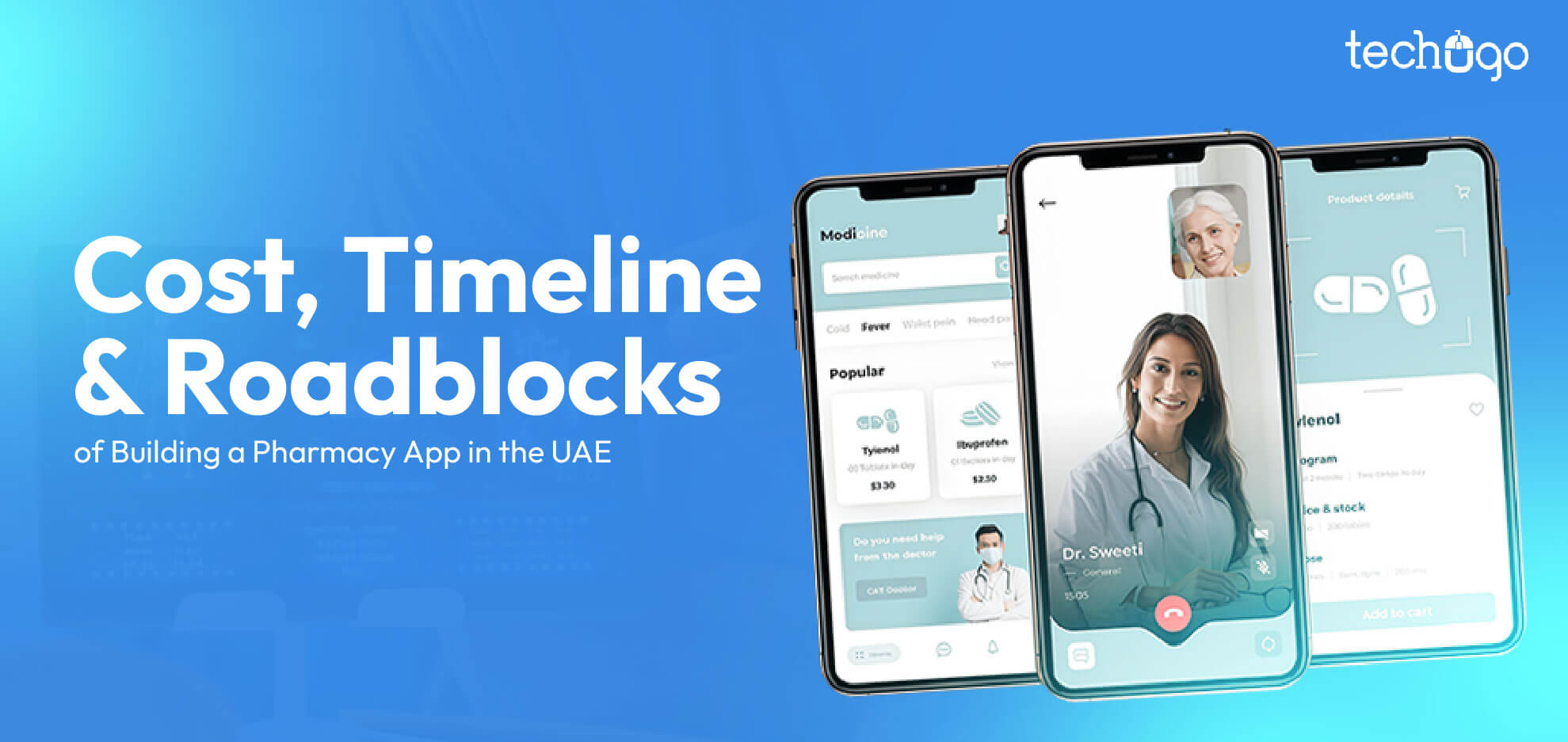
of Building a Pharmacy App in the UAE
Building a pharmacy app in the UAE typically takes 3 to 8 months. A simple medicine ordering app can be ready in about 3-4 months.
But if you’re building a complete digital pharmacy platform with inventory sync, delivery tracking, pharmacist verification and compliance built in, expect closer to 5–8 months.
And because this is healthcare, approvals and workflow checks can stretch timelines a bit.
When it comes to pharmacy app development in the UAE, the average cost typically ranges between AED 120,000 to AED 450,000+.
Here’s how the costs usually stack up:
| App Level | Estimated Cost (UAE) | What’s Included |
| Basic App | AED 120,000 – 180,000 | User registration, medicine catalog, search & filters, basic cart, secure payment gateway |
| Mid-Level App | AED 180,000 – 300,000 | Everything in Basic + prescription upload, real-time order tracking, push notifications, admin dashboard |
| Advanced App | AED 300,000 – 450,000+ | Everything in Mid-Level + AI recommendations, multi-store management, ERP/CRM integrations, high-end security compliance, scalability architecture |
Yes, that’s a wide range.
But that range depends on what kind of pharmacy app you’re building.
It’s not just “app development.” It’s everything behind it.
And in the UAE, compliance is non-negotiable.
More complexity means more time and more time means higher cost.
Also Read: Cost To Develop a Healthcare App Like Patient Access
This is where most businesses underestimate things. In the UAE, delays don’t usually happen because of coding, they happen because of the process.
A lot goes on behind the scenes before a pharmacy app can fully operate:
Then come the ongoing costs – hosting, security updates, maintenance and feature upgrades. So the real question isn’t just, “How much does it cost to build a pharmacy app?” It’s, “How much does it cost to build it properly and sustain it?”
That’s the smarter way to look at pharmacy app development in the UAE.
When it comes to building a pharmacy app, you need more than just developers. You need a team that understands how sensitive and important healthcare solutions really are. That’s why partnering with a reliable healthcare app development company makes all the difference.
Techugo delivers that level of reliability. Not as just another development team, but as a partner that understands what’s actually at stake.
Techugo builds apps that survive the real world, not just the app store. When you’re building an app like LIFE Pharmacy, you’re dealing with urgency, compliance, sensitive data, and zero room for glitches. This is where Techugo stands apart.
Techugo have worked across complex healthcare ecosystems, built platforms ready for high user traffic, and developed apps engineered for consistency and trust. And that’s exactly the kind of foundation a pharmacy app needs to succeed.
Usually between AED 120,000 to AED 450,000+, depending on features, platforms and compliance needs.
Most projects take 3 to 8 months, depending on complexity and approvals.
The cost to develop a pharmacy app in the UAE usually ranges between AED 120,000 and AED 450,000+ (depending on the platform you choose to launch on.)
Healthcare app development usually includes features like booking, prescriptions, payments and secure data handling. It needs to be easy to use and safe for patients.
Yes. In most cases, prescription medicines must go through proper pharmacist review before approval. This is a critical part of healthcare compliance.
If you are planning to build an app like Rover, the first thing you need to think about is not features… but budget. A pet care platform is not just a..

Suppose you bring a new dog home. You've named them, you pampered them, and now can’t wait to spend endless hours snuggled up together but the very ne..



Write Us
sales@techugo.comOr fill this form