

 SA
SA  KW
KW  IE
IE AU
AU UAE
UAE UK
UK USA
USA  CA
CA DE
DE  QA
QA ZA
ZA  BH
BH NL
NL  MU
MU FR
FR [ LET’S TALK AI ]
X
Discover AI-
Powered Solutions
Get ready to explore cutting-edge AI technologies that can transform your workflow!



Get ready to explore cutting-edge AI technologies that can transform your workflow!






The market for on-demand apps has been gaining massive traction over the past few years; however, it acquired immense limelight only after the pandemic. Initially, it all started with the encounter of tech into e-commerce, and gradually the food and restaurant industry was also caught in the technology web for good.
Businesses, startups, and even small restaurant owners today are planning to develop their own restaurant app or food delivery app to grow their business but many still hesitate to enter the market because of rising competition and the cost to develop a food delivery app.
Several questions usually come to mind…
How much does it cost to develop a food delivery app in 2026?
What if my app doesn’t stand out in the market?
What if my app doesn’t get enough downloads?
Still, there’s no denying that on-demand food delivery apps have built a massive user base in a very short time, and the trend is clearly here to stay.
So in this blog, we will explore the market opportunities in on-demand food delivery app development and whether it is worth investing in. Along with that, we will break down the cost to develop a food delivery app in 2026, including the key factors that influence the overall development cost.
So, let’s get started…
One of the top advantages of on-demand app development is the online presence that helps businesses reach a global audience.
The food delivery industry has been expanding rapidly in recent years. In fact, the global online food delivery market was valued at around $303.24 billion in 2025 and is expected to continue growing significantly over the next decade.
Moreover, the user base for online food delivery platforms has crossed 1.9 billion users worldwide, showing how strongly consumers rely on these services for everyday meals.
With such massive adoption, investing in a food delivery platform can be a profitable opportunity despite the cost to develop a food delivery app.
So, what is your idea about building a food delivery app?
One of the most evident advantages of using a food delivery platform is the convenience of ordering any food cuisine using a single platform.
A user needs to look for their favorite restaurant, add a lip-smacking dish to the cart, and order right away with a single click.
What’s a burger without a side of fries? Luckily, you can get all of it in one place.
Today, almost every restaurant is registered with a food delivery app, and thus, it is another great reason for customers to order via these applications. Food delivery apps provide detailed information such as opening hours, menu items, best-selling dishes, ratings, and location details.
According to industry reports, more than 62% of restaurants now partner with third-party food delivery platforms to reach online customers and increase visibility.
The icing on the cake is that people can review and provide feedback on their experience for others to learn about the same before ordering big. These features add value to the platform and influence the overall cost to develop a food delivery app.
Trust us, food delivery apps like Swiggy offer really cool discounts, and so should your app!
Of course, giving discounts is a strategy to attract more customers and retain them by intriguing, which, not to deny, is a smart move.
Additionally, other apps like UberEats offer membership options that come along with more advantages like no shipping charges, more discounts, etc.
Such monetization strategies help businesses recover the food delivery app development cost faster.
Before planning and implementing an app model idea, are you aware that there are multiple types of food delivery apps that you can develop?
Understanding these models is important because the cost to develop a food delivery app varies depending on the type of platform you choose.
Since many people are unfamiliar with the same, there are three primary types of app models as discussed below:
It is a suitable business model if you’re new to the industry and digitization. An order-only business model is one where a platform connects multiple restaurants to its end-users. In simple words, restaurants can sign-up with the app to offer their services to their customers.
Since it is an order-only application, restaurants or food chains are responsible for delivering the orders to their customer’s places either via their own delivery service or a third-party provider.
Note: Logistics is not managed by the app owner!
For entrepreneurs looking forward to adopting this model for the development of a food delivery service, the capital investment is minimal.
The manner of operation of these apps is quite simple:
– Customers can visit the app and browse the menu.
– They can place their order, and the restaurant directs a confirmation message after the order is placed.
– The food gets prepared, and a driver delivers the package to its destination.
– The driver can directly connect with the customers for any assistance if required.
But how do app owners earn via the same?
Notably, there’s a flat fee charged from the restaurant for each order placed from them.
As mentioned earlier, app owners have no interference regarding the quality of food and delivery services. Thus, in case of customer dissatisfaction, it can be challenging to retain them!
The aggregator’s app model closely functions the same as the order-only food delivery model; however, this one’s also responsible for the entire logistics management.
Some of the most popular food delivery apps using the aggregators model are UberEats, Grubhub, Swiggy, etc.
Here’s how:
– Customers can visit the app and browse the menu.
– They can place their order, and a confirmation message is directed by the restaurant after the order is placed.
– A delivery executive nearby the restaurant is notified and assigned the pickup.
– The executive then picks up the food order to get it delivered to the customer’s doorstep.
This app model charges a shipping fee to the customers depending on the distance between their location and the restaurant.
One of the biggest challenges faced upon adopting this business model is to build an efficient and accelerated transport fleet.
Thus, the executives associated with the delivery service have to be properly trained for timely deliveries and a satisfactory system.
In this model, the cost to develop a food delivery app increases because the platform must manage delivery partners, tracking systems, and logistics operations.
As the name suggests, the app owner is responsible for all the activities, from taking orders to food preparation to delivery. Thus, adopting this model means investing big. One of the popular examples of this business model is Dominos Pizza.
Here’s how the app model works:
– Customers can visit the app and browse through the menu.
– After the restaurant receives an order, a confirmation message is sent.
– After the order is prepared, the restaurant’s delivery executive collects the same and delivers it to the customer’s address.
A primary issue posed by this app model is the high cost. Investment is high and needs to be met to develop a business that manages the entire food preparation and delivery system.
Because it involves restaurant operations, logistics, and technology together, the cost to develop a food delivery app under this model is significantly higher than other types.
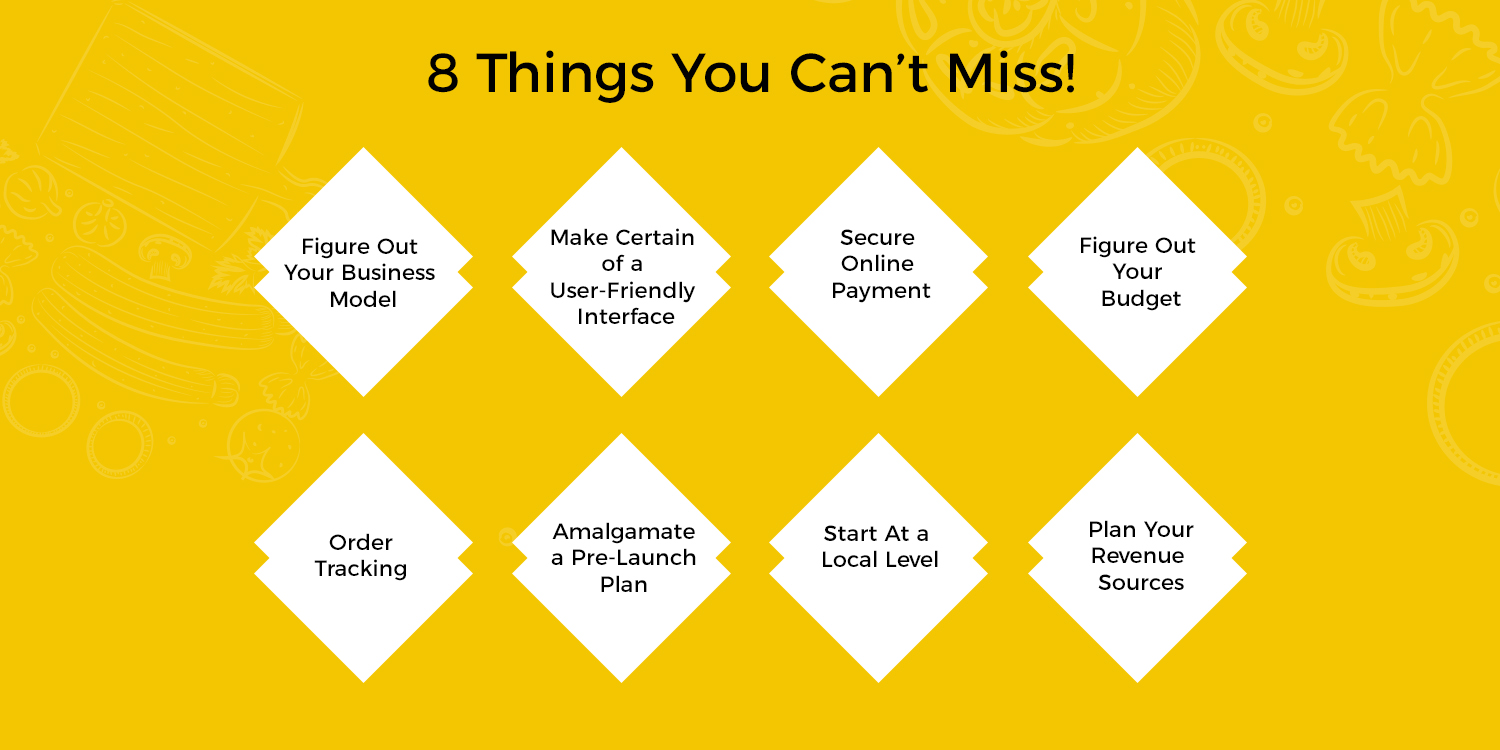
There are numerous factors that are unfamiliar to app owners and must be considered during a food delivery app development. For instance, the development structure and the cost to develop a food delivery app is something that they don’t know. Therefore, before getting in touch with a food delivery app development company, continue reading to learn more:
As mentioned earlier, there are multiple kinds of food delivery apps, and before beginning to develop one, it is crucial to figure out a business model that suits your requirement the most.
Once you decide on the same, you can identify the cost structure for food delivery app, and connect with the professionals to further discuss your app idea and strategies. Remember, your chosen model directly impacts the cost to develop a food delivery app, development timeline, and operational strategy as well.
For any mobile app to be successful, it is significant to emphasize a user-friendly interface to keep customers from uninstalling the app. In many cases, complicated apps might require users to invest some time and figure out their functionality.
However, it is precisely the opposite of how applications should be. Consumers should be able to perform activities within the app hassle-free and should be able to navigate and use any feature seamlessly. And a well-designed UI improves user engagement but may also increase the cost to develop a food delivery app because of additional design efforts.
Since many people are still adapting to purchasing things online, paying via digital mode is worrisome for many.
Why?
Because security is a rapidly growing concern and a trustworthy mechanism must be built for the customers. Additionally, if an app is utilizing consumers’ data, their consent is incredibly crucial for building trust and comforting them about their information. Integrating secure payment gateways and data protection mechanisms is crucial but it also contributes to the food delivery app development cost.
From the moment a flawless app idea makes its space in your mind, it’s time to start thinking about the budget. It is imperative to get an estimated cost to develop a food delivery app. No matter what, it is something that may vary as per the changes or things you introduce to the project. Furthermore, the budget slab also relies on factors like the developer’s cost, choice of the framework, etc.
What do you want your customers to do while waiting for their order?
– DIE WITH CURIOSITY?
Well, of course not! This is why most food delivery apps leverage an order tracking feature for consumers to view the map and trace the course of their food.
What’s important is to ensure that the feature is also available for restaurant and delivery executive portals too!
Wouldn’t you want your target audience to know about your platform before it is launched?
It’s time to rock and roll; thus, hire a team of top-notch marketing experts who can build strategies that will help you stay running in this competitive world. Because the team plays an important role in deciding the cost of building a food delivery app.
Utilize the maximum social media platforms you can, including Facebook, Instagram, LinkedIn, and more, to create a buzz.
Targeting the global audience is a big step if you’re not sure if your app has the potential to attract a solid consumer base. Thus, start at a local level for satisfaction and boost confidence. You may also consider better testing to start.
You can collect feedback and reviews to get to know what people think about your app and make alterations if necessary. Then, once a pleasing app version is in front of you, you may start expanding. This approach allows businesses to validate the idea before investing heavily in the food delivery app development for global markets.
Take a look at the top-notch food delivery solution Techugo has created.
If you think about how much it will cost you to develop a food delivery mobile app, don’t bother about it. There are multiple methods for revenue generation; therefore, think of the best possible sources and plan your business model accordingly. For instance, you can run third-party restaurant ads on your app in exchange for revenue!
When it comes to knowing the cost to develop a food delivery app what are some of the essential features, you ask?
Here’s a list and keep in mind that all these features influence the overall cost to develop a food delivery app.
Don’t make the on boarding process too complicated for your app users; instead, enable them to sign up in a single click and generate an OTP for authentication and a seamless profile creation process.
Time and distance are the two factors that play a significant role in the delivery business and food delivery app development cost. Thus, if you are developing an only-delivery app model, enable customers to browse through restaurants of their choice for food ordering using the GPS feature.
Once the order is placed, the GPS feature can present the estimated delivery time to help them determine the incoming order.
Having a cluttered menu is no good in today’s times. In fact, customers want to seek a well-organized menu that segregates cuisine categories, enables customization, and has unlimited food items to choose from. Additionally, apps must include pictures of the dishes since most people decide on their meals based on the same.
The icing on the cake would be to enable customers to choose between ‘veg’ and ‘non-veg’ food items!
Strategies like offering perks to your customers play a crucial role in retaining them. Therefore, you can provide promo codes, discounts, etc., for app users to claim a reduction in food prices.
Notably, these offers encourage sales and keep customers from uninstalling the app!
The world is going cashless, and nobody likes carrying around their wallet when they can access the convenience of digital wallets.
How about the idea of integrating digital wallets into your app for online payment?
Sounds great, right?
Offer the flexibility of online payments via multiple modes like wallets, debit/credit cards, etc., to add value to the consumers’ experience.
Not only the food delivery app but any on-demand app must enable customers to provide their feedback and reviews to work on the improvement of the app if need be.
Evidently, who would be better to rate the functioning of your app than its users?

One of the prominent challenges food app developers are facing is the rising competition. And believe it or not, the cost to develop food delivery applications has somehow been affected by the cutting edge competition. You can find numerous flawless food delivery applications like UberEats, Swiggy, etc., and customer expectations are rising.
Therefore, to become a leader in the domain, it’s best to think out of the box and offer what your competitors are not doing.
For people who have recently stepped into the restaurant digitization mechanism, partnering with restaurants can come as a hurdle.
Restaurants may hesitate to partner with you; therefore, the best solution is to reach out to places that are seeking promotion. It is vital to get more restaurants on board than emphasizing the popularity of that place.
You must be familiar that MVP is the app model that offers basic app functionality to test the depth of the ocean before diving in. Launching an MVP can reduce the initial cost to develop a food delivery app.
Building MVP is a preferred choice since it enables acquiring user feedback to introduce alterations accordingly. However, it might be difficult to decide the MVP features that are to be added or not to be added. In addition, it can help you identify the cost of making an app like GrubHub and UberEats.
Finding an organization that turns your vision into reality can be a difficult decision to make. Who wouldn’t want to partner with a team that listens to the app idea and contributes their suggestions to bring out a better version of the same? Moreover, an efficient food delivery app development company is the one that follows you through the post-app development journey to be there if a situation arrives.

There is no single number that can define the cost to develop a food delivery app in 2026 and beyond. Every app project is different and therefore the final price is different too. Some apps are simple and small while others are complex and built for large scale operations.
Because of this, the cost to develop a food delivery app depends on many things. It depends on the features you want, the technologies that are used and also the development team that builds the platform. So before you plan the investment, you need to understand what type of app you want to create.
In most cases, the cost to develop a food delivery app usually falls somewhere between $25000 and $120000 or even more. It depends on the level of complexity and the features included inside the platform.
Let us understand this a little better.
The cost to develop a food delivery app changes depending on how advanced the application is. A basic platform will obviously require less time and effort. But if you plan to build something similar to large platforms, then the development work increases and so does the cost.
| App Type | Estimated Timeline | Estimated Cost |
| Basic App MVP | 2 – 3 months | $25000 – $40000 |
| Standard App | 3 – 5 months | $40000 – $80000 |
| Advanced App | 5 – 8 months | $80000 – $120000+ |
A basic app usually includes simple functionality. Users can sign up, search restaurants, browse menus, place an order and make payments.
Because the features are limited the cost to develop a food delivery app in this category usually ranges between $25000 and $40000. Many startups prefer this model because it allows them to test the market first.
A mid level application includes more advanced features. For example, real time order tracking, push notifications, customer reviews and multiple payment options.
As the functionality increases, the development effort also increases. Therefore the food delivery app development cost at this stage normally ranges between $40000 and $80000.
An advanced platform includes complex features and scalable infrastructure. These apps may include AI recommendations, delivery partner management, advanced analytics and real time logistics systems.
Because these systems require deeper development and stronger architecture the cost for advanced platforms can go between $80000 and $120000 or even higher.
Many companies begin with a smaller version of the app and then scale it later. This helps them manage the cost to develop a food delivery app while also validating their business idea.
Several elements directly influence the cost to develop a food delivery app. These factors shape the development process and therefore the final budget.
When you develop for multiple platforms, the work increases and therefore the cost to develop a food delivery app becomes higher.
Building a food delivery app does not always mean that you must start with a very large budget and invest everything at once. Many businesses think it is necessary to build a full platform immediately but that is not always the case. With careful planning and the right development choices, you can control spending and still build a useful and competitive product. Therefore the cost to develop a food delivery app can be managed better when the approach is practical and step by step.
One common approach that many startups have been following is starting with a smaller version of the product. Instead of building every feature in the beginning, you focus on the essential parts such as user signup, restaurant listing, ordering and payment. It was seen that when companies begin with this approach, they are able to test the idea in the real market. And because the feature set is limited, the cost to develop a food delivery app in the early stage becomes more manageable.
Another thing that often affects development spending is the platform choice.
When you build separate applications for Android and iOS the development effort increases, and the time also becomes longer. But if you use cross platform technologies, then the same codebase can run on multiple platforms. So the work is reduced and it becomes easier for you to manage the cost to develop a food delivery app during the development cycle.
It is also important that you think carefully about which features are truly necessary in the beginning. Many founders want to include advanced tools like AI recommendations, analytics dashboards and loyalty systems from the start. These features are useful but they also increase the complexity of the project. Because of this, the food delivery app development cost may grow quickly. A better approach is to launch with the core functionality and then add new features later when the product starts growing.
Another area where businesses can save effort is through existing integrations. Today, many services already provide ready tools for payment location services, notifications and analytics. When you integrate these systems, it reduces the amount of development work that has to be done from scratch. And therefore the cost to develop an online food delivery app can remain within a reasonable range.
Planning the architecture carefully is also something that many companies overlook. When the system is designed with scalability in mind, it becomes easier to expand the platform later. This means the product can handle more users and more features without needing a complete rebuild. Because of that, the long term cost of online food delivery apps stays more controlled.
Finally the development team that you choose plays a very important role. Experienced teams understand the process, and they have been building similar platforms for years. They know what works and what often fails in large projects. So while the upfront investment may look higher, the process becomes smoother and fewer mistakes happen. And in the long run it helps businesses manage the online food delivery app development cost much more efficiently.
Indeed, app development is a costly affair; therefore, you must ensure that the time, money, sweat, and blood you invest goes in the right direction. Before entering the market, carefully evaluate the cost to develop a food delivery app and choose the right development strategy.
Undoubtedly, platforms like UberEats have taken the market by storm; however, there are numerous other opportunities for budding businesses to bag and make the most out of it. And worrying about the food delivery application development cost won’t help you.
So, are you thinking of going for a food delivery app development…or grocery delivery app development?
Trust Techugo, as our team has been working in the food delivery app development industry for years and has delivered solutions for startups and enterprises across different markets. Milkbun is one of our most successful apps.
Give a quick read to our case study: MilkBun: A Tempting Dine-In and Delivery Experience
Our team works closely with businesses to understand their goals and therefore builds solutions that match the exact requirements of the project. Plus, we follow a structured development process and provide continuous support even after the launch.
Schedule a consultation with us, a top mobile app development company, and we’ll make your dream come true.
Have a great day.
Building a food delivery application depends on various factors. You must identify your requirement first, then start investing your money to create an app. Above all, contacting an app development company to develop a food delivery app is the best way to save money. Moreover, on average, the cost ranges from $35k to $70k for a simple app.
If you want to develop an app like GrubHub or DoorDash, it may cost you $10k to $100k. Also, the charges may vary depending upon several factors like app design, quality, features, and business requirements.
Starting an online food delivery app business is the most efficient way to grow. You can develop a top-notch application that costs you around $50k to $70k. However, you must do a research prior to kickstarting your app development project.
When someone decides to build an app in France the question everybody asks is never related to design, user experience, or the functionality of the ap..


For entrepreneurs, startups, and established companies looking to break into the largest digital market in Europe, launching a mobile app in Germany p..


Write Us
sales@techugo.comOr fill this form