

 SA
SA  KW
KW  IE
IE AU
AU UAE
UAE UK
UK USA
USA  CA
CA DE
DE  QA
QA ZA
ZA  BH
BH NL
NL  MU
MU FR
FR [ LET’S TALK AI ]
X
Discover AI-
Powered Solutions
Get ready to explore cutting-edge AI technologies that can transform your workflow!



Get ready to explore cutting-edge AI technologies that can transform your workflow!






Today, the world is highly competitive, and it has become necessary to keep up with the rising competitiveness to acquire the advantage you deserve. Therefore, it is vital to be updated with advanced skills and modern technology like AI in education & learning industry that are changing how people learn, work, and grow.
To acquire knowledge and understand the same, people are turning to e-learning apps and platforms that allow them to virtually learn and train themselves efficiently about anything and everything.
As a result, e-learning and education apps have received immense popularity amongst people of all age groups since it is a fun-learning method that intrigues their audience to stick to the app.
Entrepreneurs, startups, and even small coaching institutes and colleges are therefore investing in their own education or e-learning app development in 2026 so that education and learning are unstoppable even in uncertain situations.
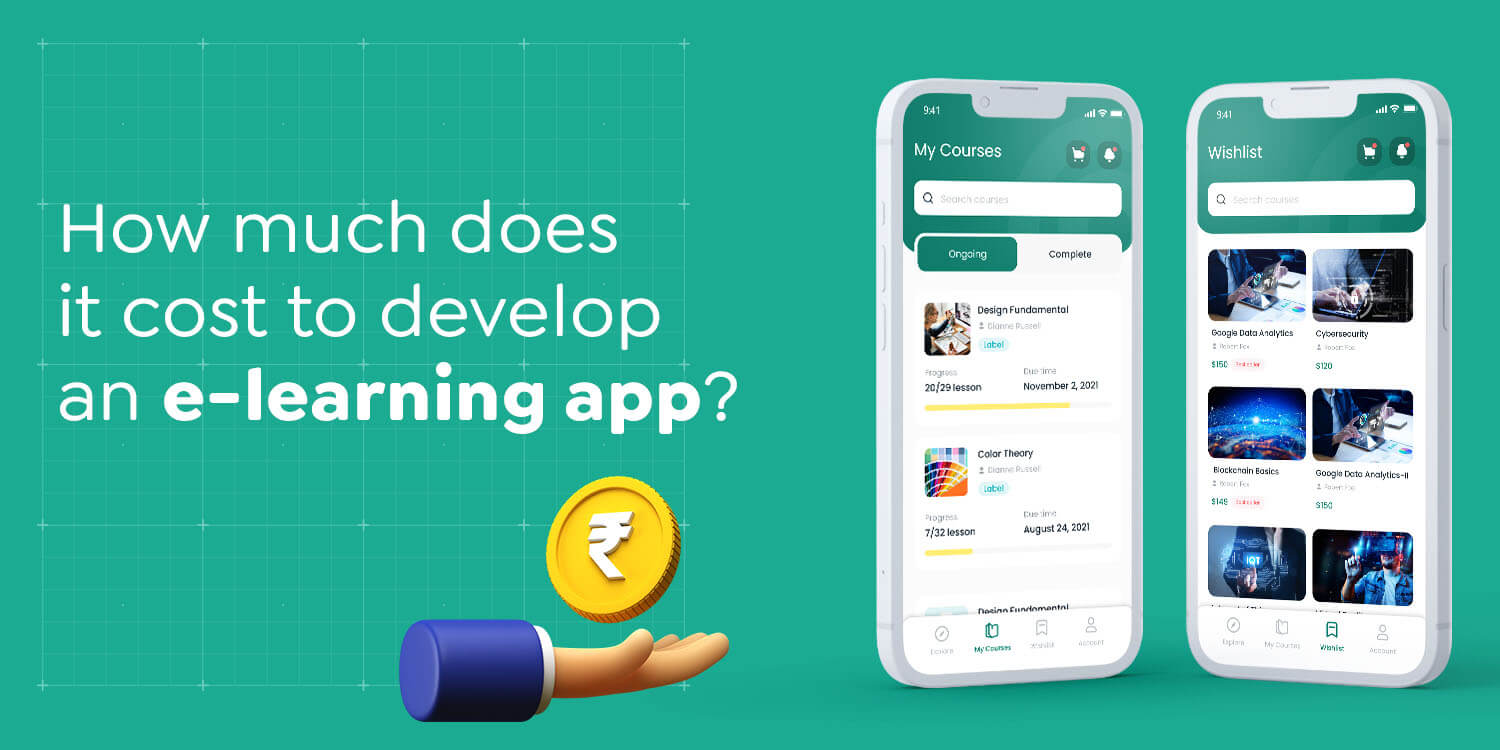
One thing that is stuck in their mind is the e-learning app development cost in 2026. Well, the cost to build an e-learning app in 2026 ranges anywhere between $30,000 to $500,000+ but it totally depends on the app’s features and functionalities.
2026 might be the right time to build a digital learning platform for your audience. Fortunately, this article will talk about everything you need to know about the same, especially the factors that affect e-learning app development cost.
So, let’s get started.
The pandemic posed a huge challenge in front of educational institutions built for learners to attend school for learning. However, the challenge was soon transformed into opportunity when schools began designing new learning patterns, one of which is e-learning that efficiently connects teachers with students digitally to bridge the gap.
The icing on the cake is that since classes can be taken from the comfort of one’s place, learning can easily reach millions of people worldwide. In fact, the demand for digital education has been rising rapidly. Recent industry reports suggest that the global edtech market was valued at around $279.8 billion in 2025 and is expected to grow to nearly $760 billion by 2034, driven by the increasing adoption of mobile learning apps, AI-powered education tools, and online learning platforms.
This rapid expansion shows that e-learning is no longer just a temporary solution introduced during the pandemic, rather, it has become a long-term transformation in the education ecosystem.
Impressive, isn’t it?
Mainly, there are three kinds of e-learning apps that can be built depending on the purpose and the target audience of the business. The app type you choose can also influence the overall e-learning app development cost. Take a look at the following to figure out the business model that will work best for you:
The personal learning apps are the most convenient ones as the students straightaway register with an account and begin taking courses. Moreover, the online courses are pre-developed and uploaded on the platform; thus, students can learn at their own pace and conditions.
Learning apps are not only adopted by institutions and their students, but it has become a buzzword in the corporate world as well. These apps are now leveraged in corporate training to train the employees internally. Some of the most popular examples are Moodle and Yammer.
Undoubtedly, virtual learning applications are ideal for teachers to teach their students digitally. The interface is simpler than ever, and teachers can easily share their notes, study material, lesson plans, etc.
Corporate training is highly adopted by businesses, especially in countries like the USA and Europe. Therefore, the amalgamation of these platforms is likely to enhance employees’ skills and quality performance at its best, and there’s no looking back.
Unlike having to wait for school and college intakes, students can register anytime for the online courses. Additionally, these courses can be conveniently taken at any time with the help of a smartphone and a stable internet connection.
The best part about using an e-Learning platform is that it does not support any age barrier. Kids and even adults register on the same and continue their education whenever however they like.
Traditional learning is long gone, and not to overlook mentioning, it was a slow process. Students had to commute to the school; moreover, textbook learning isn’t as fun as online learning integrated with videos, images, activities, and whatnot.
The e-learning mechanism is brimming with success and is intriguing students to take part in projects and activities that otherwise would not have added much value to their learning.
There are students or learners who can not afford expensive tuition fees. In other cases, many regions do not have the availability of schools for students’ education. Thus, e-learning apps are a perfect affordable alternative for people going through the same.
The Internet is a real blessing for people with disabilities as it has made their lives easier by providing trouble-free access to education and food delivery, e-banking, healthcare, and much more.
Are you now convinced to develop an e-learning app?
Connecting with the best e-learning app development company is an incredible shot if we are on the same page as their team can help you understand the custom e-learning app development cost and the best approach to build your product.
Don’t forget that industries are investing their sweat, blood, and money in creating their space in the digital world. Therefore, you must not step into the ecosystem without prior research on what your competitors are pursuing.
Additionally, you need to think of strategies that’ll differentiate your presence from the rest of your competitors. The key is to keep faith in your app idea and execute them with the help of your best resources.
Are you aware of the audience you’re going to serve?
For example, are you catering to kids or adults?
It is vital to acquire answers to these questions to build an app that’ll solve the purpose of your target audience. Understanding your audience helps define features and directly impacts the e-learning app development cost.
Pleasing aesthetics is a gamechanger in the mobile app ecosystem, and it is precisely what you must serve to your app users. A user should be able to navigate through the app seamlessly, which is why you must hand over the project to the UI experts.
Minimum Viable Product is a concept of developing a product with the basic features to roll out for the early testers. Users provide their feedback on the app, and thus, developers further make amendments based on the same.
Apart from what you have in mind that you want to bring to the real world, making profits is another important reason behind the creation of an exceptional app. Therefore, figure out the best monetization model as per your business plan and work on the same.
To develop a terrific e-learning app, the first step is to design an app that efficiently caters to your customer’s needs. Therefore, it is essential to leverage features for students, teachers, and guardians that would intrigue them to opt to download your app than your competitors. The features you include for students, teachers, and guardians can also significantly influence the overall e-learning app development cost.
What kind of features, you ask?
Take a look.
The community of e-learning app users is likely to be students; therefore, you need to ensure that the application is engaging enough. Also, keep in mind that these features improve engagement but may also increase the e-learning app development cost depending on their complexity.
Let’s look at some of the top-notch features to obtain the desired results:
Content delivery of an education app is an integral element. These apps have a database incorporated that holds the entire data to be delivered. Thus, all the lessons, courses, etc., provided on a virtual education app are only because its database is structured properly.
An e-learning app must also emphasize activities, tests, and more along with the delivery of courses. For example, teachers can interact with the students, take their queries, etc., before presenting them with the tests to gain insights into their course knowledge.
For starters, gamification is the integration of games into e-learning apps to foster engagement, and some of the popular elements include:
– Reward Loops: These are the rewards, virtual currency, etc., offered to students on their good performance.
– Badges and Points: These are the indicators or progress marked within the app.
Personalization in apps is the idea of tweaking the app experience for learners for comfort and an enhanced learning ecosystem. Thus, personalized learning is not only about delivering videos, study material, etc. It is about delivering solutions in context to students’ requirements and thinking.
The in-app messaging feature makes it simpler for teachers and students to interact via messages and helps enhance learners’ retention.
While students can type and send their queries, teachers can answer the same, send rewards and reminders, etc, with the help of the feature.
Push notifications encourage students to visit the app more often and engage with the same. These notifications are triggered by the developer on the user’s smartphone. For instance, a push notification can ask for users’ feedback on the last lesson.
You may adopt any monetization model for your app, considering the strategy and requirements. For instance, in-app purchases would want customers to pay for the additional features; therefore, you must leverage an in-app payments system for direct settlement by the user.
Most elearning apps enable downloading study material for offline use. Therefore, users can consume the downloaded content without an internet connection.
Convenient, right?
To start with, the interface built for the teacher’s panel should be simple yet elegant. Furthermore, the features listed below will do a perfect job, but again, we are mentioning that these features are core for teachers but may also increase the e-learning app development cost depending on their complexity.
To start using the application, it is vital for users to register with an account. Once they enter their information and hit the ‘Register’ button, a confirmation email will be forwarded. After completing the steps, app users will be able to set a password to access their account and monitor their dashboard.
The app must enable teachers to schedule classes and upload recordings of the same for those who were not able to attend.
After teachers deliver their lessons, feedback can be initiated to learn more about the improvements students want to seek in the lessons. Therefore, teachers can work on the same to enhance the experience.
One of the most crucial features to add in an e-learning app for teachers is to provide them the ability to take student queries. Sure, attending a course is great, but what’s the advantage if students are not able to ask questions and clear their doubts?
As mentioned earlier, posting assignments for students to check on their clarity of the concept is vital. Therefore, integrate a feature that enables teachers to do the same and also nudge with deadlines.
Guardians and parents must check on their children’s curricular performance; thus, there must be features for them to easily access the information on kids’ behavior, habits, grades, and more. Here are a few must-have features:
This feature requires guardians to register their child and add other caretakers’ profiles if any.
The cherry on top is the student progress feature that not only enables guardians to track their kid’s performance but what they are doing in real-time.
The feature will enable students to keep a check on their course clarity. Additionally, the feature also keeps track of their attendance, exam schedule, etc.
Do you remember tagging along with your parents on PTM days? While it’s no longer the system, e-learning apps can enable guardians to connect with teachers for queries, reports, and overall effective communication.
The leaderboard is a scoreboard where students are ranked, and their progress can be tracked by the guardian. In addition, many apps allow sending encouraging messages to the students for their motivation.
So, as we mentioned, these features are crucial and in fact, non-negotiable if you want to develop a successful e-learning mobile app, but remember, depending on their complexity, these features can also increase the e-learning app development cost but are worth investing in.
Here comes one of the most awaited sections of the blog- e-learning app development cost in 2026.
Now that you have come this far, the idea must be to develop an efficient e-learning app for your target audience. So start by thinking about what element would let your customers stick to the app. Once the solution is constructed, emphasize the cost of app development.
But before starting the development journey, it is important to understand how much budget you might need. In reality, the e-learning app development cost varies significantly depending on app complexity, features, platform, and development team.
Let’s first understand the estimated cost based on different app complexity levels.
The overall e-learning app development cost can vary widely depending on the scope and functionality of your app. A basic MVP will cost far less than a fully featured AI-powered learning platform. Below is an estimated cost breakdown.
| App Complexity | Key Features | Development Timeline | Estimated Cost |
| Basic E-learning App | User registration, course listing, video streaming, basic quizzes, push notifications | 3 – 4 months | $30,000 – $80,000 |
| Mid-Level E-learning App | Live classes, payment gateways, course management, student progress tracking, gamification | 4 – 7 months | $80,000 – $200,000 |
| Advanced E-learning App | AI-powered recommendations, adaptive learning, analytics dashboards, multi-language support, AR/VR learning | 7 – 12+ months | $200,000 – $500,000+ |
For startups, many companies begin with an MVP to test the market. Later, they gradually add advanced features to scale the platform. This approach helps control the e-learning app development cost while validating the product idea.
While the complexity level provides a rough estimate, several technical and strategic factors influence the final e-learning app development cost.
Have you decided on the platform you’ll build your app for? Notably, it is one of the primary steps before starting the app development process since you’ll have to make a choice between Android, iOS, both, or other platforms.
App developers can choose between two approaches: Native or Hybrid. While native apps are specifically built for different platforms, hybrid apps use a single codebase to develop apps for multiple platforms. Thus, the hybrid approach costs less than the native approach.
Undoubtedly, e-learning apps comprise video and audio content, interactive exercises, etc., which lead to higher app development costs. Additionally, developers choose to integrate technologies like Chatbots that can take student queries automatically.
The idea is simple: the more the features and technologies, the higher will be the e-learning app development cost.
Globally, the app development software market is expected to grow from roughly $138 billion in 2025 to over $800 billion by 2034. Notably, factors like business type, potential customers, and services enable framing the app budget. In the case of a customer service model, app development also demands external APIs that contribute to additional costs.
Each e-learning mobile app varies due to its design and functionality. Most app developers emphasize integrating advanced app features for smooth functioning of the same and enhanced user experience. However, advanced UI/UX design, animations, and interactive elements can increase the overall e-learning app development cost.
No wonder apps hold truckloads of data for functioning seamlessly. Therefore, the data might be confidential, employee data, etc., that has to be kept safe from vulnerabilities.
To achieve the same, a robust hosting provider and cutting edge security measures have to be adopted that’ll add to the app development cost. Furthermore, the adoption of security measures also depends on the business size!
Educational mobile apps demand maintenance in the form of app updates that need to be rolled out from time to time. Thus, developers must deliver efficient technical assistance to revamp the app integrations, which leads to increased expense. Therefore, businesses must allocate a portion of their budget for ongoing maintenance, which contributes to the long-term e-learning app development cost.
The purpose of app development is resolved only when it has an exceptional developer or team behind the same. Teaming up with an e-learning app development company bags the support of the best domain experts and other creative resources. Thus, they deliver excellent product development services.
Artificial Intelligence is no longer a futuristic concept in digital education. In 2026, AI is actively reshaping how students learn, how teachers deliver content, and how platforms personalize the entire learning experience.
From adaptive learning paths to AI tutors, modern platforms are becoming smarter and more intuitive. However, integrating these technologies also increases the overall e-learning app development cost due to the additional infrastructure, data models, and machine learning integrations required.
Let’s explore how AI is transforming e-learning apps and how it impacts the e-learning app development cost.
One of the biggest advantages of AI in e-learning platforms is personalized learning experiences.
AI algorithms analyze student behavior, course progress, quiz performance, and learning patterns to recommend content tailored specifically for each learner. This ensures that students receive the right material at the right time.
For example, if a student struggles with a particular topic, the system can automatically recommend additional videos, exercises, or practice tests.
However, implementing such adaptive learning algorithms requires machine learning models and advanced data analytics, which increases the e-learning app development cost.
AI chatbots are becoming a common feature in modern education platforms. These intelligent assistants can answer student queries instantly, provide course guidance, and even help learners navigate the platform.
Virtual tutors powered by AI can also assist students with problem-solving and provide explanations in real time.
While these features greatly improve engagement and support, integrating natural language processing (NLP) models and chatbot frameworks can raise the e-learning app development cost, depending on the level of automation required.
AI can also assist educators in creating and organizing course content.
For instance, AI tools can automatically generate quizzes, summarize lessons, and recommend relevant study material based on the curriculum.
This not only saves time for educators but also enhances the learning experience for students.
However, implementing AI-driven recommendation engines and content automation tools requires additional backend development and AI infrastructure, which can increase the e-learning app development cost.
Modern e-learning platforms are also using AI for learning analytics.
These systems analyze student engagement, course completion rates, and assessment performance to generate detailed reports for teachers, institutions, and administrators.
Such insights help educators identify weak areas in the curriculum and improve learning outcomes.
But building advanced analytics dashboards and predictive models adds complexity to the platform, which may raise the e-learning app development cost.
Adding AI capabilities can significantly enhance an e-learning platform, but it also affects development budgets.
Here’s a rough estimate of how AI integrations may influence the e-learning app development cost:
| AI Feature | Additional Cost Impact |
| AI Chatbots / Virtual Assistants | $10,000 – $40,000 |
| Personalized Learning Algorithms | $30,000 – $80,000 |
| AI Recommendation Systems | $25,000 – $70,000 |
| AI Learning Analytics & Reports | $20,000 – $60,000 |
The final e-learning app development cost will depend on the complexity of the AI models, the volume of user data, and the level of automation required.
Choosing the right technology partner matters a lot when you plan to build an education platform. The idea is not just to launch an app, but to make sure it scales well, performs smoothly, and stays relevant for years. And because of that, the partner you choose can directly influence the e-learning app development cost as well as the quality of the final product.
Over the years, Techugo has been working closely with several global edtech innovators, and the focus has always been on building platforms that are reliable, scalable, and easy to use. These platforms are not just apps sitting in the store; they are digital learning ecosystems that students, parents, and educators actively rely on. Therefore, experience with real-world edtech products plays a huge role when managing the e-learning app development cost and development strategy.
One of the most recognized names in the global edtech space is BYJU’S, and the platform has transformed how digital learning is consumed today. The collaboration involved improving the mobile learning experience so that students could easily explore courses, purchase programs, and navigate lessons without friction.
The focus was on optimizing user journeys, refining APIs, and making the experience smoother across the application. Because when millions of students are using a platform, every small improvement matters. It was about making the learning process simpler and more intuitive but also scalable at the same time.
Another interesting project is Lifology, a platform designed to help students and parents make better career decisions. The idea behind the platform was simple, yet powerful – to connect learners with global mentors, career experts, and structured guidance so that they can plan their future more effectively.
The platform integrates mentorship systems, career assessment tools, and AI-powered recommendations, and therefore it creates a complete career guidance ecosystem. Over time, Lifology expanded significantly, reaching more than 100,000 users across 52 countries. It shows how a thoughtfully designed platform can scale globally when the technology foundation is strong.
Projects like these demonstrate how the right mix of product strategy, design thinking, and technology execution can create meaningful digital education platforms. And because every project has different requirements, managing the e-learning app development cost becomes a process of balancing features, scalability, and long-term product vision.
The e-learning app market is booming, and with its rise being at its apex, if you want to set your foot in the domain, now 2026 is the perfect time to enter the market.
However, before starting development, it is important to understand the e-learning app development cost, required features, and the right development strategy.
Have a flawless app idea in mind, and are looking forward to collaborating with the best educational app development company?
Then, reach out to us at Techugo- a trusted e-learning mobile app development company in India, to turn your vision into reality.
Still have doubts? Get in touch with us today.

A healthcare team decides to build an AI app; the goal is to detect a rare disease early because patient data already exists inside the Electronic Hea..

The idea of pharmacy app development in the UAE can feel overwhelming at first. From planning the features to understanding regulations and prepar..



Write Us
sales@techugo.comOr fill this form