

 SA
SA
 KW
KW
 IE
IE AU
AU UAE
UAE UK
UK USA
USA
 CA
CA DE
DE
 QA
QA ZA
ZA
 BH
BH NL
NL
 MU
MU FR
FR














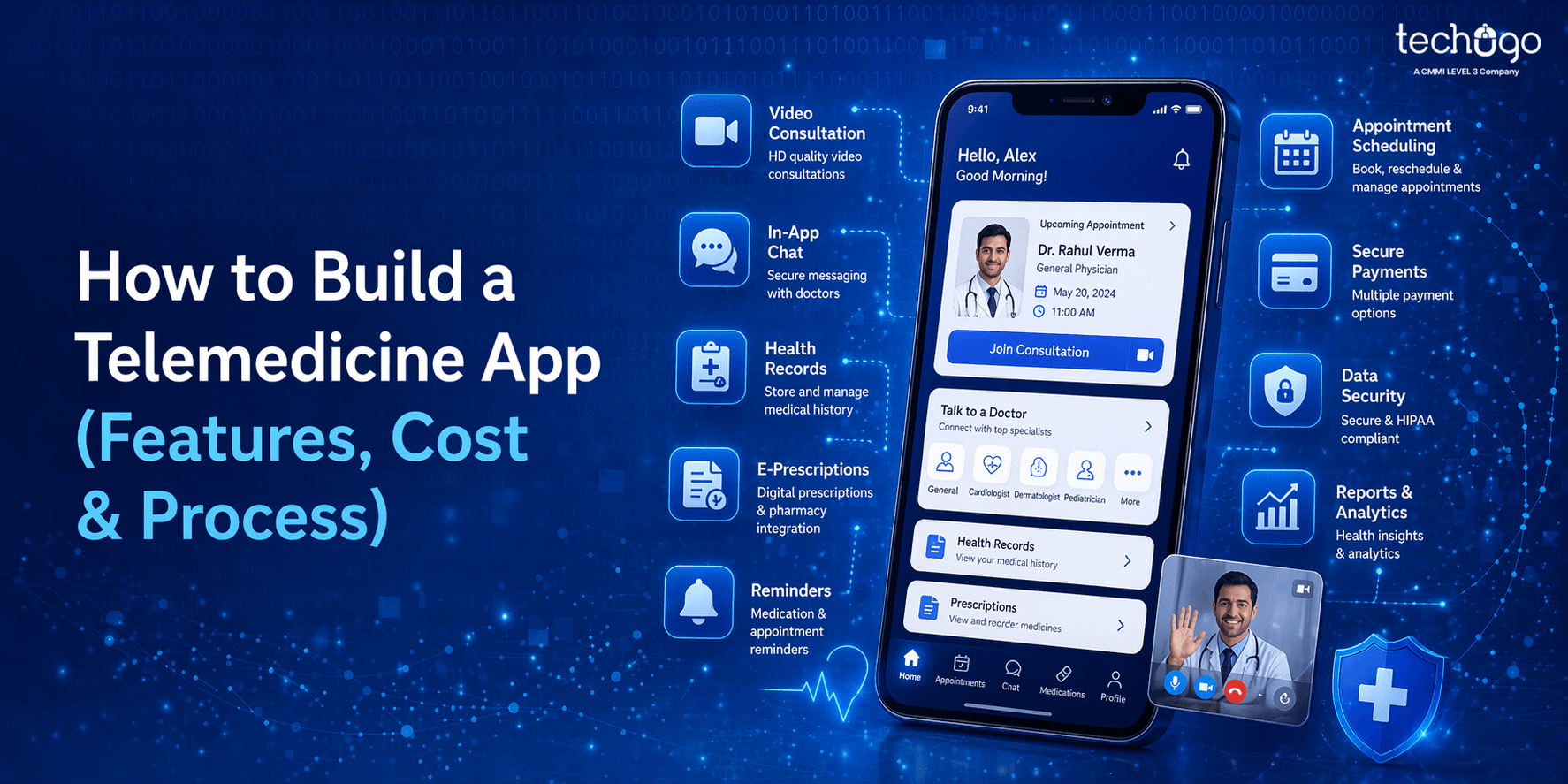


📌 Key Takeaways
- Telemedicine is growing fast, making it a great time to invest.
- A reliable telemedicine app needs the right features, security, and compliance.
- AI and remote patient monitoring are changing how virtual care works.
- Your development cost depends on the app’s features and complexity.
- Working with the right development team helps you build faster and smarter.
Healthcare is one of the most conservative industries and is not open to new ideas. Over the past few years, however, we all have reimagined how care is delivered and jumped headfirst into technology-enabled services.
Digital healthcare was made possible by the widespread adoption of tools and technologies that allow the virtual delivery of healthcare services. As a result, telemedicine app development has seen a rise in acceptance. However, this concept was previously not well received by providers and consumers.
But now telemedicine is no longer an alternative and in fact, it is becoming a core part of healthcare delivery. And in 2026, the growth is not based on assumptions but backed by strong, verifiable data:
- The global telemedicine market was valued at $141.19 billion in 2024 and is likely to reach $380.33 billion by 2030. (Source: Grand View Research).
- The broader telehealth market reached $123.26 billion in 2024 and is likely to grow to $455.27 billion by 2030 at a 24.68% CAGR. (Source: Grand View Research).
- Another 2026 report estimates telehealth will grow from $219.31 billion in 2026 to $1.27 trillion by 2034, showing long-term acceleration. (Source: Fortune Business Insights).
This isn’t just market expansion. It reflects a deeper shift:
- Healthcare is becoming digitally accessible.
- Patients are increasingly choosing remote-first care models.
- Providers are investing in scalable, tech-enabled systems.
Telemedicine startups: why are they the best choice right now?
Telemedicine startup founders in America are in great shape right now. As a result, the market trends offer a great opportunity to invest. If you’re also entering the telemedicine space today, you’re stepping into a market that is validated, funded, and still expanding.
Not early-stage. Not saturated.
Just… strategically open.
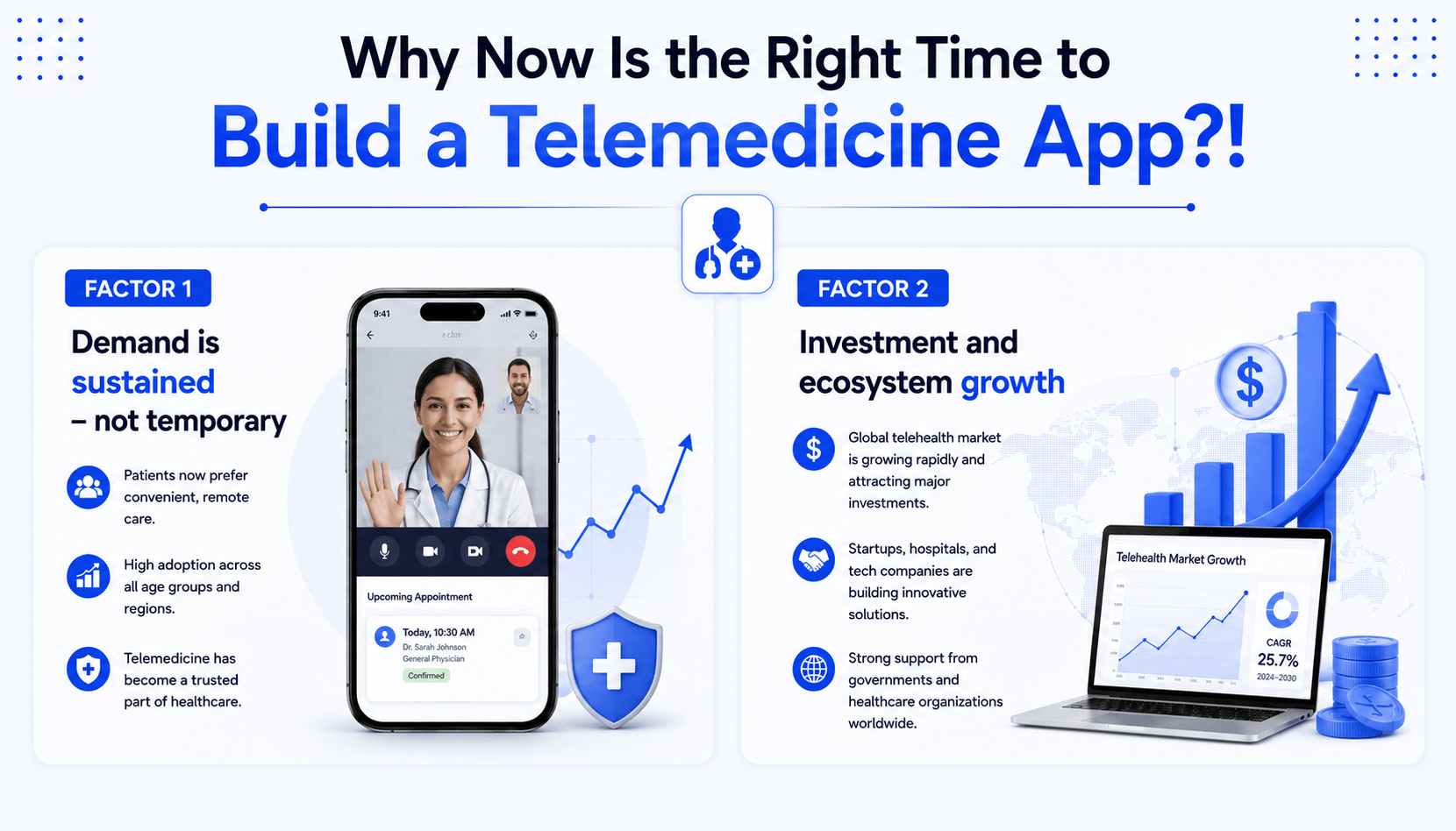
Factor 1: Demand is sustained – not temporary
The pandemic accelerated adoption, but the growth didn’t drop after; instead, it stabilized into long-term demand for telemedicine app development.
Telehealth continues to grow due to patient preference for accessible and convenient care
Remote consultations, monitoring, and digital-first care models are now integrated into healthcare systems globally. This means one thing:
- You’re not building for a spike.
- You’re building for a behavior that has already changed.
Factor 2: Investment and ecosystem growth
The telemedicine ecosystem is expanding through strategic partnerships, healthcare digitization initiatives, and increasing enterprise and government investments.
In fact the market growth is being driven by rising investments, digital health adoption, and infrastructure improvements. Healthcare organizations are actively investing in telehealth to expand reach and improve efficiency. By this year 2026, telemedicine research shows that 83% of healthcare organizations plan to invest in Telehealth.
We hope that you will agree with the statistics and not just trust your instincts. This is where partnering with an experienced mobile app development company becomes critical, as building a scalable and compliant telemedicine platform requires both technical expertise and a deep understanding of healthcare workflows.
Types of telemedicine apps you can build
1. Virtual consultation apps – let patients talk to doctors over video, voice, or chat.
2. Remote patient monitoring apps – give doctors a live look at how their patients are doing which makes a real difference for people managing chronic conditions day to day.
3. Mental health apps – bring therapy, counseling, and wellness support straight to your phone, so getting help doesn’t have to feel like a whole ordeal.
4. E-prescription apps – let doctors send prescriptions digitally, cutting out the paperwork and making the whole medication process a lot smoother for everyone involved.
5. Specialist consultation apps mean you no longer have to travel hours just to see an expert… you can get specialist advice from wherever you are.
Key features that define modern telemedicine app development
A well-built telemedicine platform is not just about connecting doctors and patients through video calls. In reality, telemedicine app development today focuses on building a complete digital healthcare ecosystem, and it is more about structure and usability and security, all together, so that everything works in real situations and not just on paper.
Below are the most important features of telemedicine app that make these platforms effective in real-world healthcare environments:
1. User registration and role-based profiles
Every telemedicine app starts with a simple onboarding system, but then it becomes more layered and structured because patients, doctors, and administrators are all different users and they were never meant to use the same access level, therefore roles must be managed clearly and securely… and it matters more than people think.
2. Appointment scheduling and reminders
A smooth scheduling system helps patients book consultations easily, and the reminders are automated so that no one forgets.
3. EHR/EMR integration
Modern healthcare app development often includes EMR software development to enable seamless integration with telemedicine platforms. This basically allows doctors to access patient history, prescriptions, lab reports, and clinical records from a single platform.
4. ePrescription and digital reports
Doctors can issue prescriptions instantly and it is all digital now, and patients can access lab reports and medical documents directly within the app so that everything stays connected and nothing is lost between systems.
5. Chat and in-app messaging
Secure messaging allows patients to ask follow-up questions and stay connected with healthcare providers, but not always in a formal way, sometimes it is quick and simple which is enough.
6. Payment gateway integration
Most platforms include secure payment options for consultations, subscriptions, or additional healthcare services, because without payments – the system does not really run, so it becomes an important layer of the development.
7. Remote patient monitoring (RPM)
One of the fastest-growing areas in digital healthcare is remote patient monitoring, where apps track patient health data in real time using wearable devices or IoT-enabled tools, and it was earlier considered complex but now it is becoming normal. This allows doctors to monitor conditions like blood pressure, glucose levels, or heart rate without requiring physical visits, therefore making care more continuous.
8. Notifications and alerts
Automated alerts for appointments, medication reminders, or abnormal health readings help keep both patients and doctors informed at all times, but sometimes users ignore them too, which is also reality.
9. Admin dashboard and analytics
A powerful backend dashboard helps healthcare providers manage users, monitor app performance, and gain insights into patient behavior and system usage, and it is essential because without it the whole system becomes hard to control.
Together, these features of telemedicine apps ensure that the platform is not just functional but also reliable, scalable, ready for real-world healthcare demands. And it all connects back to how telemedicine app development is shaping modern healthcare systems today.
Telemedicine apps: monetization models that actually work
In 2026, monetization in telemedicine is more layered and strategic. These monetization models are most effective for telemedicine apps:
1. Subscription model (still strong, but smarter)
The app is available for monthly or annual app purchases. Subscriptions are an excellent way to attract users because they allow you to pay once in a while rather than every week. In addition, investors are more likely to prefer products that have a subscription model, as it gives them a better understanding of the ROI.
2. Pay-per-consultation
Still one of the most common models. Users pay per session which is ideal for specialist consultations, second opinions, and on-demand healthcare
3. Freemium model
Basic features are free, but advanced services are paid:
- AI health insights
- Detailed reports
- Personalized care plans
This helps in user acquisition at scale.
4. B2B & enterprise partnerships (high revenue potential)
This is where serious money comes in. Partner with hospitals, clinics, insurance companies, and corporations (employee health programs). You’re not just selling to users – you’re selling infrastructure.
5. In-app services & add-ons
In-app advertising is a very popular monetizing strategy for free telemedicine apps, but in the context of telemedicine software development, this partnership approach is generally low-profit and also requires a lot of attention from the business you are partnering with.
They must be relevant to your audience, trustworthy, and reliable, because in healthcare – trust matters more than anything else and even a small mismatch can affect user confidence.
Inside the telemedicine app development process
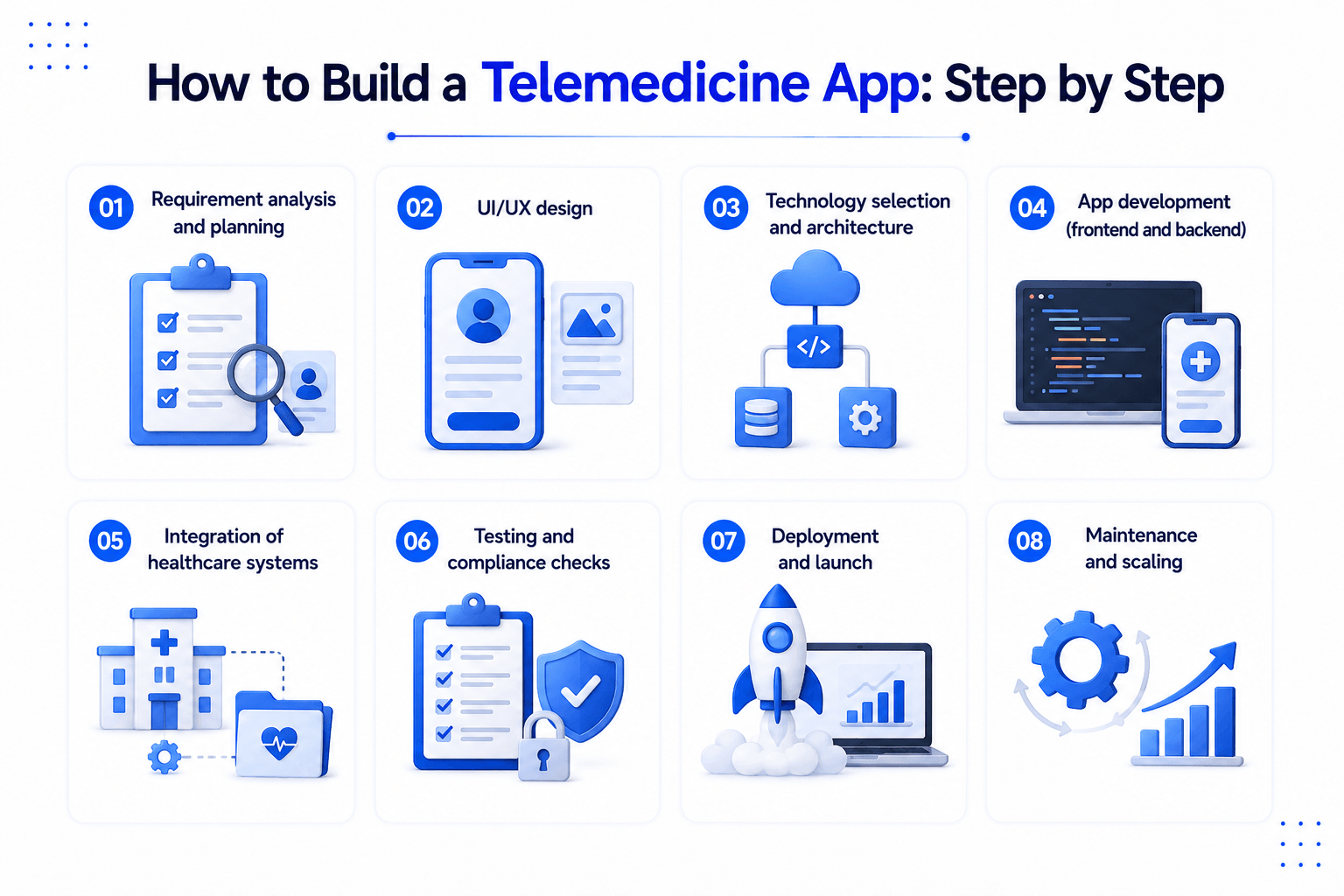
Building a healthcare platform is not just about writing code, it is actually a structured journey where planning, design, development and compliance – all come together. The telemedicine app development process is designed in such a way that every stage contributes, and it helps in creating a secure, scalable, and user-friendly solution.
Let’s take a look at the steps involved:
-
Requirement analysis and planning
Every successful project begins with understanding what you actually want to build and why. At this stage business goals, target users, features and compliance requirements are defined clearly, and this is where you decide how you want to develop a telemedicine app that fits both clinical needs and business needs… because if this step is weak then everything later can be affected.
-
UI/UX design
Once the idea is clear then the focus shifts to design, and in healthcare simplicity matters a lot because users are patients, doctors, and administrators all mixed. Good design ensures the app is easy to navigate, so that users are not confused, and it reduces friction during consultations and bookings… but also it must still look modern.
-
Technology selection and architecture
In this step the technical foundation is planned, and the stack, database structure, system architecture are defined so that the platform can handle real-time communication & data security. This is where strong mobile app development practices become essential for long-term stability, because without this -the system would not be able to scale properly.
-
App development (frontend and backend)
This is the core stage where the actual product is built, and developers work on both user-facing interfaces and backend systems together. Features like video consultations, chat, scheduling, and payments are integrated during the development phase… and everything must connect properly so that users get a smooth experience.
-
Integration of healthcare systems
Modern telemedicine platforms often require integrations such as EHR/EMR systems, payment gateways, and wearable devices, and these integrations ensure smooth data flow and better healthcare experience. It is important because without integration, the system feels isolated and data does not move properly.
-
Testing and compliance checks
Before launch, the app goes through strict testing to ensure performance and security, and compliance with healthcare standards like HIPAA or GDPR. This step is critical because healthcare applications cannot afford errors or data risks, so that everything is safe and reliable.
-
Deployment and launch
After testing, the application is deployed on app stores or web platforms, and a smooth launch ensures users can start accessing services without technical issues – but sometimes minor bugs still come and then fixes are pushed quickly.
-
Maintenance and scaling
The process does not end at launch, because continuous updates, bug fixes, and feature improvements are always part of maintaining a successful healthcare product. As usage grows, scaling becomes important, and therefore it is usually handled with a reliable telemedicine app development company so that the system stays stable and performs well over time.
Telemedicine app compliance & regulatory requirements
-
Compliance & data privacy
Okay so building a telemedicine app is not limited to the features… there’s actually a ton of legal stuff you have to deal with. In the US, HIPAA is basically the big one, it makes sure patient data doesn’t end up in the wrong hands. And if you’re targeting Europe too, GDPR is a whole other thing you need to worry about. Every country has its own rules so going global means doing a lot more homework than you’d expect.
-
Medical licensing & prescriptions
This part trips a lot of people up. Doctors actually can’t just hop on a call with patients in different states or countries without having the right licenses. Like it’s not as simple as just downloading an app and consulting anyone anywhere. Prescription rules are also very different depending on the region which means you can’t ignore that part for sure.
-
Data storage & security
And then there’s the whole data storage situation it’s not just about keeping things safe. There are actual laws about where patient data has to be stored. Most places want it kept within their own borders which is kind of a big deal. To be honest it’s a lot to figure out but sorting this stuff out early is way better than dealing with legal drama later.
Telemedicine app development challenges & solutions
-
Patient data security
Challenge: People are sharing really personal stuff, but one breach and trust will be completely gone.
Solution: You have to lock that down from day one and the data will stay protected.
-
Video call quality
Challenge: Nobody would wish for their doctor’s call freezing mid-sentence. The challenge here is that it can still happen if you build on weak infrastructure.
Solution: If you invest in solid technology you will get calls that actually work when it matters most.
-
Connecting with hospital systems
Challenge: Hospitals already have their own software, but getting everything to work together can be problematic.
Solution: You can use APIs and integrations and everything will start talking to each other smoothly.
-
Getting people to actually use it
Challenge: You could build the most advanced app ever but it will mean nothing if people find it confusing.
Solution: Keep it simple, make onboarding easy, and you will create something both patients and doctors actually want to use.
The role of AI in telemedicine apps as a clinical support system
When you develop a telemedicine app, AI slowly stops feeling like a “feature” and starts behaving more like a quiet assistant sitting next to the doctor, just observing, analyzing, and helping when needed. In modern telemedicine app development, this is exactly what AI is becoming – a clinical support layer that doesn’t interrupt, but gently improves decisions in the background.
Instead of replacing doctors, AI basically takes over the heavy lifting that nobody really talks about, like sorting data, spotting patterns, and flagging what might matter.
Here’s how it actually shows up in real use:
It scans patient symptoms and history in seconds and highlights what looks “off”
- It gives doctors possible condition suggestions, not final answers.
- It quietly raises red flags when something looks risky or urgent.
- It helps prioritize patients so critical cases don’t get lost in queues.
- It reduces repetitive work like basic data review and documentation support.
- It supports faster decision-making during live consultations.
And the interesting part is this AI layer doesn’t feel flashy or loud, it just makes everything smoother.
Doctors still make the final call, but they’re no longer working blind or slow.
At the same time, in telemedicine software development, this system has to be built carefully because healthcare is not a place for “almost correct” answers. So accuracy, privacy, and compliance become non-negotiable, otherwise the entire support system loses trust.
In short, AI in telemedicine apps is less about replacing intelligence and more about quietly amplifying it – like a second set of eyes that never gets tired.
Telemedicine app development market trends in 2026
-
AI-powered healthcare
AI is handling the boring admin work so doctors can actually focus on patients and give faster, more accurate care.
-
Remote patient monitoring
Doctors can now keep an eye on patients from a distance which means fewer unnecessary clinic visits.
-
Wearable Integration
Your smartwatch is doing more than counting steps now. It is sending real health data straight to your doctor in real time.
-
Personalized virtual care
People want care that actually fits them. And telemedicine apps are catching up with custom treatment plans and follow-ups.
-
Better accessibility
Quality healthcare is finally reaching people in remote and underserved areas who honestly needed it the most.
Telemedicine app development cost in 2026
The cost of developing a telemedicine app in 2026 is not fixed – it varies a lot because of features, complexity, and compliance requirements, and also the development team you choose.
On average:
- A basic telemedicine MVP can cost between $60,000 to $120,000.
- A mid-level app with advanced features may range from $120,000 to $450,000, but it also depends sometimes on how you build it and what you include.
- A fully integrated enterprise platform can go beyond $500,000 to $1M+, and yes it is seen in many large systems already.
In general, most telemedicine applications are within the $60,000 to $280,000 range, but again it changes because scope and integrations are not fixed, and it depends on what you are trying to achieve, which is why healthcare app development cost can vary significantly from project to project.
What actually impacts the cost?
The variation in cost comes down to a few critical factors, and these are important because they decide almost everything:
- Feature complexity (video consultations, AI diagnosis, remote monitoring) and it can change the cost heavily because more features always mean more work.
- Platform choice (iOS App Development, Android App Development, web, or cross-platform). Each one is different so it adds or reduces effort.
- Third-party integrations (EHR/EMR systems, payment gateways, APIs) because when you connect systems it becomes more complex and sometimes slow.
- Security & compliance (HIPAA, GDPR, data encryption) so that everything stays safe and legal (it is required everywhere now).
- UI/UX design quality and overall user experience.
- Scope of telemedicine app development, therefore bigger scope means more cost and more time
- Approach to MVP app development for initial launch and scaling strategy, because if you plan it wrong then later it becomes expensive.
For example, adding EHR integration or advanced compliance layers alone can significantly increase the overall budget due to technical and regulatory requirements, and this becomes even more complex when features like EMR integration in telemedicine apps are included.
Building a telemedicine app is about creating a secure healthcare ecosystem. That’s why many businesses rely on healthcare app development services that combine technical expertise with a clear understanding of healthcare compliance from day one.
Summary
Telemedicine isn’t really something we can call “the future” anymore. It’s already changing how healthcare is delivered in real time, and the pace at which it’s evolving is honestly hard to ignore. Anyone looking to enter this space needs to be prepared for how fast expectations are shifting.
Having a strong idea is just the starting point. What actually matters is how that idea is shaped into something real – through the right technology choices, simple and thoughtful design, and a clear understanding of what patients and doctors actually need day to day.
Because at this stage, success isn’t just about launching an app. It’s about building something that people don’t struggle with – something that feels natural to use, reliable when it matters, and useful enough that it becomes part of their routine rather than something they avoid.
As a healthcare app development company, Techugo approaches healthcare app development with that mindset. The focus isn’t on stacking features, but on building telemedicine platforms that can actually stand up in real-world conditions – stable architecture, clean user experience, and the ability to scale without becoming complicated over time.
If you’re thinking about building a telemedicine app, the timing really does matter. The best results usually come when the idea is still flexible enough to shape properly. That’s where the right conversations early on can make all the difference.
FAQs
1. What is telemedicine app development?
Telemedicine app development is the process of building digital healthcare platforms that allow patients and doctors to connect remotely through video calls, chat, appointment booking, e-prescriptions, and more.
2. How much does it cost to develop a telemedicine app?
The cost typically ranges from $25,000 to $250,000+ depending on the features, complexity, integrations, compliance requirements, and whether you’re building an MVP or a full-scale healthcare platform.
3. How long does it take to build a telemedicine app?
A basic telemedicine app can take around 3–6 months, while a more advanced platform with custom features and integrations may take 6–12 months or longer.
4. What features are essential in a telemedicine app?
Most telemedicine apps include these features:
- Video and audio consultations
- Appointment scheduling
- Secure messaging
- Electronic prescriptions
- Patient profiles
- Payment integration
- EHR/EMR integration
- Notifications and reminders
5. What is the role of EMR integration in telemedicine apps?
EMR integration gives doctors instant access to patient records during virtual visits. This helps deliver faster, more informed care while reducing paperwork and manual data entry.

Get in touch
We'd love to hear from you.