

 SA
SA  KW
KW  IE
IE AU
AU UAE
UAE UK
UK USA
USA  CA
CA DE
DE  QA
QA ZA
ZA  BH
BH NL
NL  MU
MU FR
FR [ LET’S TALK AI ]
X
Discover AI-
Powered Solutions
Get ready to explore cutting-edge AI technologies that can transform your workflow!



Get ready to explore cutting-edge AI technologies that can transform your workflow!



For entrepreneurs, startups, and established companies looking to break into the largest digital market in Europe, launching a mobile app in Germany presents numerous significant opportunities. The strong economy, high level of smartphone use and tech-savvy population can help you achieve a successful launch in fintech, e-commerce, healthcare, and mobility. But launching an app in Germany involves more than just having a great idea. You may need the help of a mobile app development company in Germany, which will assist you during each step of the process.
The market for mobile applications in the German market is growing every year.
It was $12.1B in 2023 and will gradually grow at a rate of 2.02% per year until 2029, with the potential to surpass $30B by 2029. This includes in-app purchase, paid apps, subscriptions, and advertising across Android and iOS.
Some detailed insights suggest that iOS was the largest growing segment, but Android offered lucrative aspects.
The mobile app market in Germany is driven by a range of factors that provide considerable tailwinds. Some reasons point towards the monetary benefits, others to the regional demographics. Overall, the tide is in favour of entrepreneurs, which includes:
Mobile applications are common in all industries in Germany, such as health care, financial technology (fintech), e-commerce, logistics and education. All of the companies in these industries continue to implement mobile solutions to enhance customer engagement and to make operations seamless.
Germany has an excellent internet infrastructure and has large amounts of internet access through both 4G and 5G systems. The availability of a reliable internet connection is beneficial to mobile apps, which improves the user’s experience and subsequently creates an incentive for users to frequently utilise mobile applications.
Germany has high consumer purchasing power and an overall quality of life. Therefore, users have the ability and willingness to pay for quality mobile applications, premium services and in-app purchases, which provides companies greater potential for revenue generation through mobile applications.
Some of the major startup hubs in Europe are located in Berlin and Munich. Providing help to businesses with a robust set of products and services in the mobile application era, thousands of new tech startups are being born. Therefore, collaboration and invention are the result of functioning in such an environment.
Germany’s robust economy, combined with a fast-paced change to digital processes, is attracting more companies every day that are using technology as a way to be more productive or provide enhanced services to their customers. One way in which many businesses are transforming themselves digitally is through the use of mobile apps. These are a major component of this digital transformation and make the market appealing for both investors and developers.
Germany has one of Europe’s largest populations, and smartphone adoption is nearly universal. Consumers use smartphones to access a variety of application-based services, such as shopping, banking, transportation and entertainment. As such, there is an ongoing strong demand for newly developed and innovative applications, representing a significant opportunity for companies to introduce their brand to a broad range of consumers.
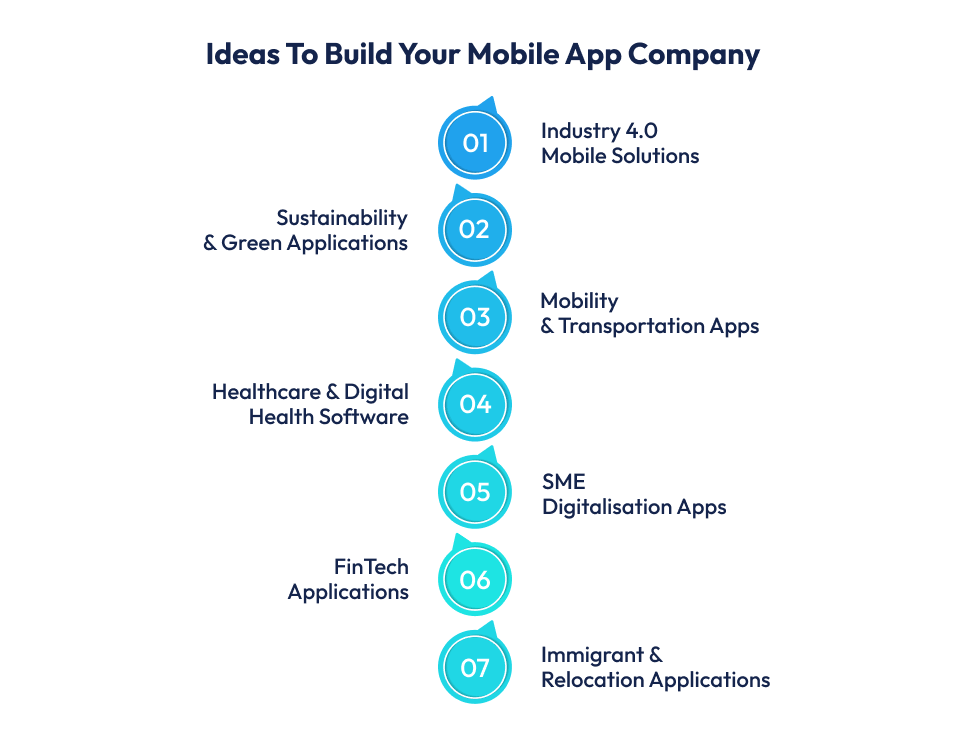
Driving innovation and leading the tech segment, building a mobile application from scratch or refining an existing one is crucial. With plenty of ideas or themes for a mobile application already, finding new ones can be a difficult task. Hence, based on the lucrative opportunities, we have curated a list for you:
Germany is known as a leader in advanced manufacturing and automation, with a majority of its businesses being based on the Industry 4.0 strategy. In this space, you can expand on ideas like:
Germany has made a significant commitment to renewable energy and environmental sustainability through initiatives such as the Energiewende. To leverage this, a mobile app development company in Germany will help you with:
Germany’s transportation infrastructure is one of the most complete in Europe, including services provided by Deutsche Bahn. So, if you are looking to hire mobile app developers in Germany, you can build upon:
Germany’s healthcare system is becoming increasingly reliant on digital transformation as a result of the Digital Healthcare Act. According to some estimates, the digital health market in Germany was $32.69 Billion and is moving towards $48.1 Billion. These estimates are for the period 2024 to 2030. So, to align yourself with public policy and reap benefits, consider these ideas:
The backbone of the German economy is small to medium-sized enterprises (SMEs), otherwise known as the Mittelstand (middle class). Many of these SMEs are still going through digital transformation, which paves the way for these ideas:
The FinTech domain in Germany is expanding rapidly due to the adoption of digital financing services. Estimates suggest that the FinTech industry is growing at the pace of 14.71% CAGR, which is projected to reach $33.16 Billion from $14.57 Billion. This is from the period 2025 to 2031. Hence, it is worthwhile to take a look at some ideas which include:
Germany continues to attract qualified, skilled workers, students and entrepreneurs from all over the world. Moreover, the tense situation around the world does make Germany an appealing nation for immigration. Thus, you can grab opportunities in this space through app development services in Germany, which include:
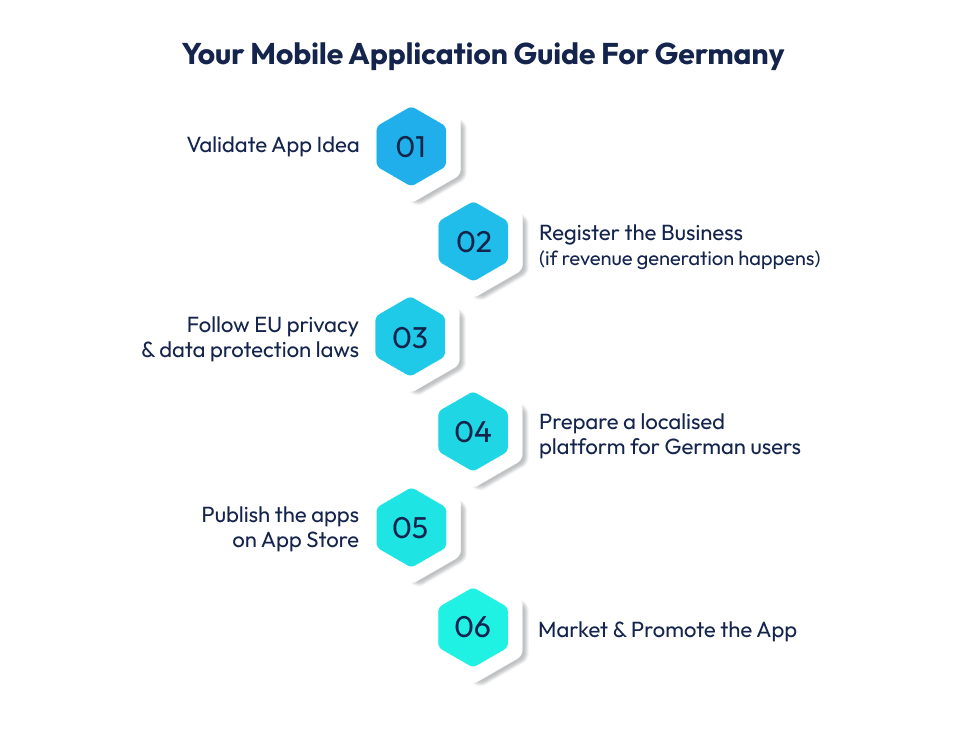
When you have an idea and want to earn revenue, it becomes critical that you know about the app launch process in Germany.
It is essential to conduct market research and analyse competition before creating or launching a mobile app in Germany. The mobile app market in Germany is well-established and extremely competitive. Therefore, knowing user needs and existing products or services is vital to success.
Before conducting any research, the first thing you should do is check to see if any similar apps exist and their respective success rates. For this, you can take the help of Google Play and App Store, that displays competing apps, ratings, and user reviews. Furthermore, in Germany, transparency, functionality over flashy design, and prioritising security are what the population wants.
If you monetise your app (through subscriptions, ads or in-app purchases), you must register your company before engaging in business activities. There are many different types of businesses that can exist in Germany. However, the most common type of business structure for startups in Germany is a ‘GmbH’, which is a Limited Liability Company. Once the business is registered, you will get a tax number from the German authorities.
The GDPR compliance for mobile apps in Germany is a must to follow and applies to all member countries within the EU. The GDPR (General Data Protection Regulation) requires mobile applications to refrain from collecting personal data unless required, provide notice of usage of the collected data, and exceed their requirements for notifying users.
However, if you have a mobile application generating large volumes of personal data, then appointing a Data Protection Officer is necessary.
Most Germans understand English, but using an app with a German-language interface will give users a better experience and build trust. This means that you should translate the user interface, help relationship, and all customer care communications. Furthermore, the prices should also reflect euros (€), and all payment methods must be available to users in Europe.
Once the application is built, it is now time to make the application live and publish it in the Google Play Store and App Store. Creating a developer account requires you to pay one time fee, or you can seek a mobile app development agency in Germany to do it for you. Now, the step is to upload screenshots, add app packages, write descriptions, and configure distribution settings. As complex as all of these steps sound, it is a piece of cake for the best mobile app company in Germany.
In the world of digital revolution, you can take the help of Instagram, TikTok, YouTube, and other social media platforms to reach the masses. It will take time for the audience to accept and use your application, which is why paid ads work best. Moreover, as a part of app store regulations in Germany and generating visibility for your platform in respective digital stores, you can perform App Store Optimisation (ASO).
At different stages, it is important to know the cost to develop an app in Germany. Basically, this is dependent on factors like UI/UX design, the use of cutting-edge technology, and other custom needs that are required by the user.
| Stage | Cost |
| Planning & Research | €5,000 – €15,000 |
| UI/UX Design | €8,000 – €30,000 |
| Development | €20,000 – €80,000+ |
| Testing & QA | €5,000 – €20,000 |
| Deployment & Maintenance | €5,000 – €10,000 |
However, the cost to build a mobile app in Germany may also differ due to the industry you are targeting. This is driven by the level of complexity and features that are demanded within each industry.
To build under this, some essential features like:
Usually, the cost range for such an app is €80,000 to €500,000, and the development time can be between 6 and 12 months.
Under the healthcare applications segment, you can focus on certain features like:
This generally begins and ends in approximately 6 to 12 months, and it might cost you between €50,000 to €400,000.
To build a FinTech application from scratch, you will need to include aspects like:
The cost to develop an app in the FinTech domain is usually between €40,000 to €500,000. The overall time it will take to do this is 6 to 18 months.
Building a social media application from scratch requires you to integrate:
To do all this, it might cost you between €40,000 to €350,000, and the time it will take to do this will be approximately 6 to 12 months. So, it is beneficial for startups to seek custom mobile app development in Germany.
On-demand platforms have made a significant surge in the app development segment in Germany. So, to capitalise on this, your app must focus on:
Development time for such an application ranges from 3 to 9 months, and the cost will fall between €40,000 to €150,000.
If you are looking to develop an application in the e-commerce space, you might want to consider:
To make this idea a success, it will cost you around €30,000 to €150,000, and the timeline will be between 3 and 8 months.
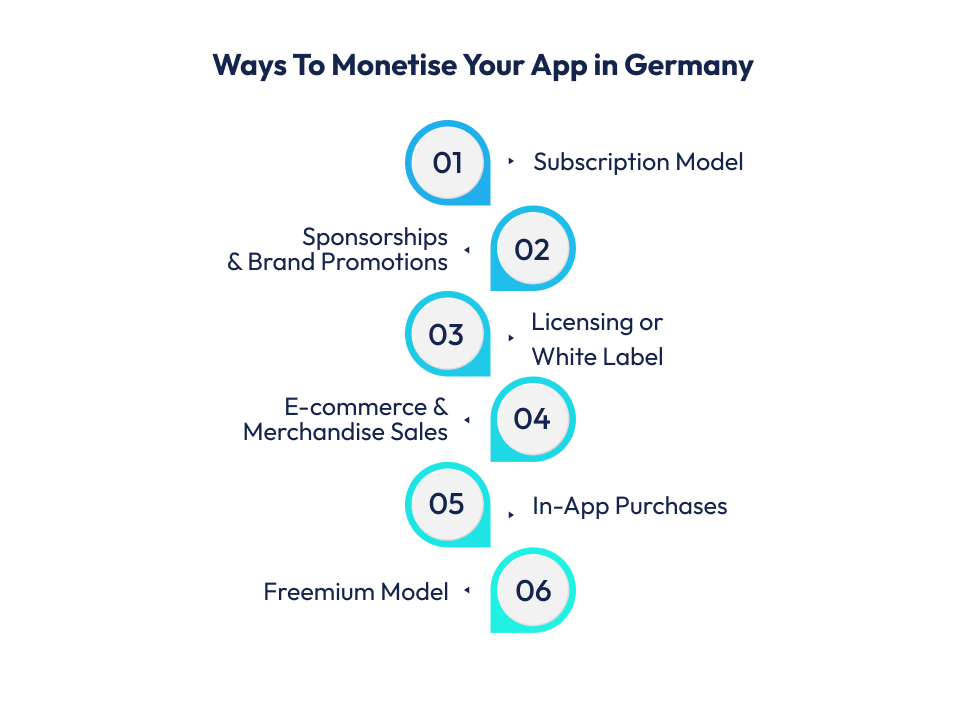
Gaining ground with your mobile application in Germany is not enough. It must generate the necessary revenue, and for that, you need to opt for the right monetisation strategy. Take a look at some ways to monetise your mobile app company in Germany:
The revenue model for an application using a subscription model charges the end-user a consistent fee, either monthly or annually, to maintain use of certain premium features or services. By doing this, application owners establish a more reliable income stream as compared to selling physical items. Applications that have used subscription models are those that use streaming media, fitness, meditation, cloud storage and productivity.
Brands can partner with successful apps to create sponsorship agreements that allow brands to pay app developers in return for advertising or promoting their products or services through various advertising vehicles, including but not limited to:
Apps can also monetise their operations by licensing their technology to other businesses. The developer allows other businesses to utilise the app as a white-label product, meaning the developing company will provide the business with an app built on the original technology but marketed under the business’s name. This type of model provides significant revenue generation opportunity for apps to generate revenue for apps with technologies that are easily scalable.
Some apps generate revenue by utilising e-commerce capabilities. In addition to selling products within the app’s core functionality, many successful apps generate additional revenue by selling merchandise (e.g., branded clothing, accessories) and/or digital products (e.g., online courses, templates, downloadable digital content). Successful apps with strong brands or communities will use e-commerce as an additional source of revenue, in addition to the core functionality of the app.
Purchases made inside an app are called in-app purchases because they are purchased internally, while add-ons or services added to an app usually come from outside sources. Most of the time, people make in-app purchases while playing video games, by purchasing things like virtual money, items, extensive lives, levels, etc. This is seriously considered by startup app development in Germany.
Under the freemium model, users can access and download the basic features of the software for free. However, to access advanced features, users must pay the service fee. This is one of the most sought after method because people can try the application before going on to buy the advanced features. Gaining additional functionality, access to exclusive content, unlocking advanced tools, and removal of ads are some of the perks.
When you seek the best mobile app development company Germany, you will come across Techugo for multiple reasons, which include:
So, why wait even for a second when you can collaborate with an effective and efficient startup app development company in Germany?
Companies looking to launch a mobile app in the German market can take advantage of the positive economic climate, the robust digital infrastructure found throughout the country, and the increasingly tech-savvy citizenry of Germany. All of these factors contribute to a rapidly expanding marketplace and an abundance of discretionary income. Companies will have the ability to effectively market new and innovative types of solutions to many different industries, such as financial services, healthcare, and transportation. So, if you have an idea on the same, you must definitely consider the cost to build a mobile app in Germany.
Ans) A German mobile app developer guarantees you high-quality software, the ability to comply with all EU regulations, such as GDPR, and a talented local development team that knows the market well and how to best serve it.
Ans) The average cost of having an app created in Germany ranges from €30,000 to €500,000. However, prices will depend on the complexity, features and graphics of your app, as well as the time required for development.
Ans) Most mobile apps take 3 to 12 months to develop. Complex apps like finance or gaming may take up to 18 months.
Ans) Some of the industries that will benefit significantly from using a mobile application include fintech, health care, e-commerce, transportation, logistics and digital services.
Ans) In the German market, you can always rely on Techugo to refine or build your mobile application. Due to our 10+ years of experience in this domain, our marketers, software developers, and testers have been catering to custom needs.
When someone decides to build an app in France the question everybody asks is never related to design, user experience, or the functionality of the ap..
As the rate of energy consumption in mature and emerging markets drives the new phase, it has become evident to understand the benefits that IoT is br..

Write Us
sales@techugo.comOr fill this form