

 SA
SA  KW
KW  IE
IE AU
AU UAE
UAE UK
UK USA
USA  CA
CA DE
DE  QA
QA ZA
ZA  BH
BH NL
NL  MU
MU FR
FR 


















📌 Key Takeaways
- Offshore development has shifted from a cost-saving tactic to a strategic way to scale faster and access global talent.
- Companies use offshore software development services to overcome local talent shortages and speed up product delivery.
- AI is improving offshore workflows by enabling faster coding, smarter planning, better collaboration, and more efficient testing.
- Cost efficiency remains a major advantage compared to in-house hiring, which involves high recruitment and operational expenses.
- Technologies like machine learning, generative AI, IoT, blockchain, and predictive analytics are becoming core components of modern UAE mobile applications.
- Success in offshore models depends on choosing the right partner, clear communication, and structured processes.
“Why hire locally when the best talent could be anywhere in the world?”
Honestly, that question is being asked in boardrooms more and more these days – and for good reason.
As businesses scramble to innovate faster, cut costs, and actually scale their dev capabilities without losing their minds, offshore software development has gone from being a “nice backup option” to a genuinely smart strategic move. And the numbers back that up – according to Grand View Research, the U.S. IT services outsourcing market pulled in nearly $212 billion in 2024 and is on track to hit $291 billion by 2030. That is not a trend. That’s a shift.
But here’s what’s changed: companies aren’t just hunting for cheaper developers anymore. They’re looking for something smarter. They want smart software development – the kind that blends global expertise, cutting-edge tech, and real operational efficiency into something that actually moves the needle.
And that’s exactly what great offshore software development delivers. Think access to specialized talent you probably can’t find (or afford) locally, teams that scale up or down based on what you actually need, and development happening around the clock – so while your team sleeps, progress doesn’t stop.
The result? Products ship faster. Quality holds up. And your business stays competitive without burning through runway.
So in this guide, we’re going to break it all down – the real benefits, the challenges, what it actually costs, and everything else you need to know to figure out whether this approach is the right fit for where your business is headed.
Why businesses are investing in offshore software development services
Let’s be real – the main reason businesses are pouring money into offshore software development services isn’t some grand strategy they mapped out in a conference room. It’s simpler than that: they just can’t hire fast enough.
Local talent pools are stretched thin. Recruitment cycles drag on for months. And by the time you’ve finally onboarded someone, your competitor has already shipped. Sound familiar?
That’s exactly why more and more companies are ditching the “hire locally or bust” mindset and turning to offshore models instead. More flexibility. Faster execution. Less waiting around.
Here’s what’s actually pushing businesses to make the switch:
- Local talent shortages make finding skilled developers feel like searching for a needle in a haystack
- U.S. developer salaries have climbed so high they’re eating entire development budgets alive
- Slow hiring cycles mean products sit in limbo while the market moves on without you
- Growing teams too fast internally creates its own chaos — offshore scaling avoids that
- Specialized skills that simply don’t exist in your local market are suddenly within reach
So what do companies actually do?
They bring in offshore software developers who don’t just take orders – they plug directly into existing teams, keep things moving, kill the bottlenecks, and make sure development never has to pause just because it’s 6 PM in San Francisco.
And for most U.S. companies, this stopped being a “cut costs” conversation a long time ago. It’s now a “stay competitive or fall behind” conversation. Speed matters. Execution matters. And having reliable engineering capacity on demand? That’s not outsourcing anymore – that’s just smart business.
Key offshore software development benefits
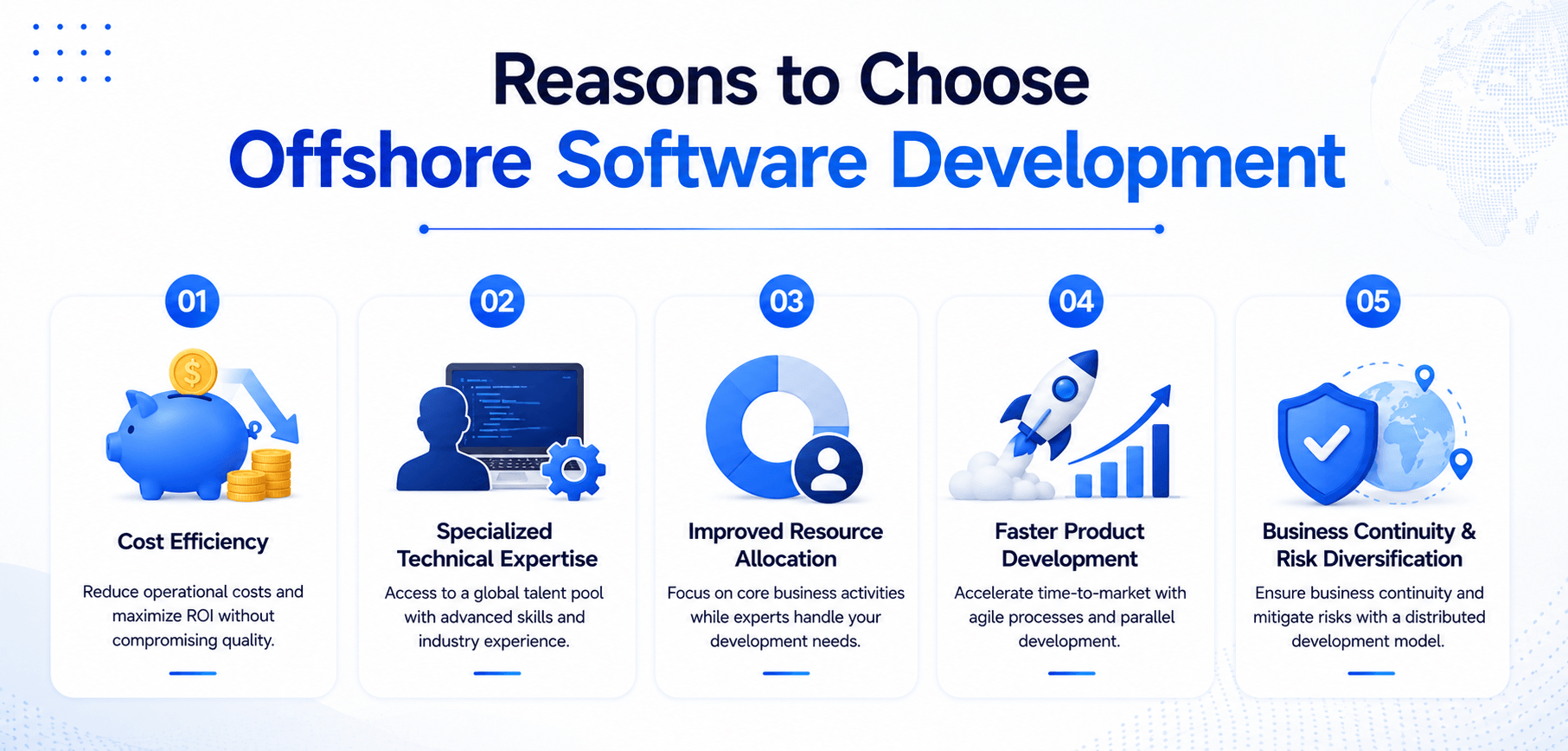
Look, businesses today are under a lot of pressure. Like, a lot. Get the product out faster. Keep costs under control. Find skilled people without spending half the year just trying to hire them. It’s genuinely exhausting – and most companies are feeling that strain right now.
That’s honestly why so many are waking up to offshore software development benefits. Not because it’s some trendy buzzword, but because it actually solves real problems that are slowing businesses down every single day.
Here’s what it actually looks like in practice:
Cost efficiency
Nobody wants to overspend. And one of the biggest wins here is real cost efficiency in software development – lower hiring costs, less infrastructure overhead, leaner budgets without cutting quality. You’re not being cheap. You’re just being smart about where the money goes.
Specialized technical expertise
Sometimes you just need someone who knows their stuff – cloud, AI, enterprise systems, you name it. And finding that locally? Easier said than done. Skilled offshore software developers bring that expertise to the table without the six-month hiring saga. They’ve done it before. They can hit the ground running.
Improved resource allocation
When your offshore team handles the heavy development work, your internal team can finally breathe. They stop firefighting and start focusing on what actually matters. Everything just runs smoother.
Faster product development
Here’s something people don’t always realize – different time zones are actually a good thing. Your offshore team keeps building while your local team sleeps. Development never really stops. Products ship faster. That’s a real competitive edge.
Business continuity and risk diversification
Things go wrong sometimes. Teams face disruptions. Situations change. Having distributed teams means work keeps moving no matter what. That kind of backup isn’t a luxury anymore – it’s just good planning.
How to hire offshore software developers?
Hiring the right offshore talent is not just about filling roles – it’s about building a reliable extension of your engineering capability. Businesses that take a strategic approach can scale faster, improve delivery speed, and strengthen overall development capacity through a well-structured offshore software development team.
But to get these benefits, here’s what you actually need to think about before hiring:
Define your project requirements clearly
Know what you need before you start talking to anyone. Your technical needs, project scope, timelines, the expertise you’re looking for – get all of that down first. The clearer you are, the easier it is to find an offshore team that actually fits what you’re building.
Choose the right engagement model
Dedicated teams, fixed-price projects, time-and-material – vendors offer all kinds of setups. But if you’re in this for the long haul, going with an offshore software product development model and a dedicated team just makes more sense. You get consistency, and room to grow without starting over every time.
Evaluate technical expertise and experience
Look at what they’ve actually built. Their past projects, the tech stacks they’ve worked with, the industries they’ve served. A real offshore development partner won’t just talk a good game – they’ll show you work that’s scalable, secure, and built to perform.
Assess communication and collaboration process
Time zones are tricky. So before you commit, make sure your offshore software development team has real structure around how they communicate – regular reporting, agile workflows, clear channels. If that’s not already there, it becomes your headache.
Prioritize security and quality standards
Ask the hard questions about how they handle data security, code quality, and compliance. For long-term product work especially, you can’t afford to find out the hard way that corners were cut.
Start with a small pilot project
Don’t go all in from day one. Run something small first. See how they deliver, how they collaborate, how the whole thing feels in practice – then scale from there.
Major offshore software development challenges & how to handle them
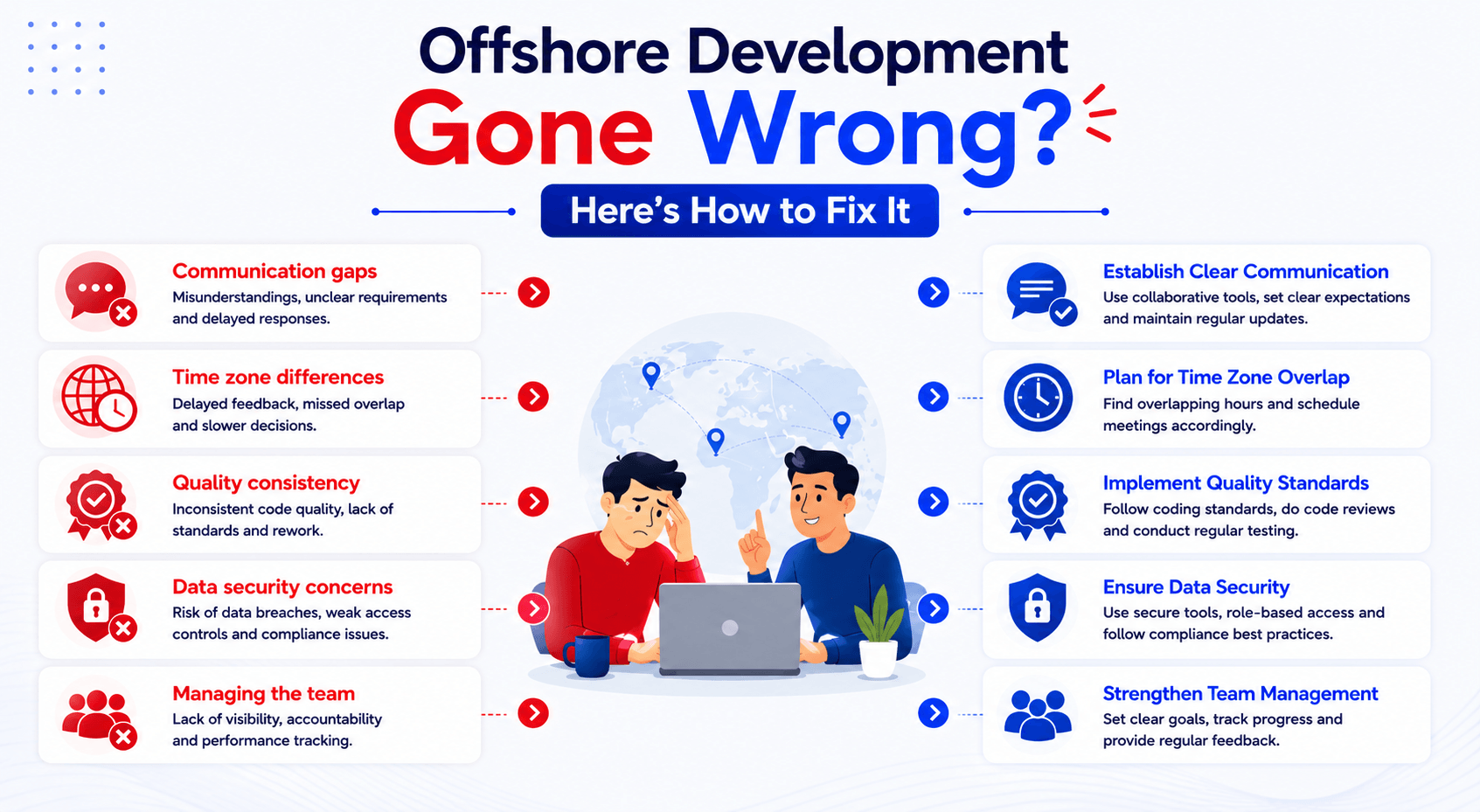
Offshore teams can be a great way to save time, cut costs, and access better talent. But like anything, it’s not perfect. There are some offshore software development challenges that businesses usually run into when working with remote teams.
Communication gaps
Look, when you’re working with people across different countries, miscommunication is just going to happen. Different languages, different working styles, different response times — it creates gaps that can snowball if you’re not careful.
How to handle it: Set up clear communication channels early, use structured reporting, and schedule regular check-ins so nothing falls through the cracks.
Time zone differences
This one frustrates a lot of teams. When half your team is signing off just as the other half is logging on, real-time collaboration becomes really hard and decisions that should take an hour end up taking a day.
How to handle it: Find overlapping working hours where you can – even just a couple – and lean on async tools to keep the work moving regardless of who’s online.
Quality consistency
Just because someone is talented doesn’t mean they’ll automatically work the way you expect. Coding standards, review processes, quality benchmarks – if these aren’t clearly defined and enforced, the output starts varying in ways that are really hard to fix down the line.
How to handle it: Define clear coding standards upfront, make code reviews a regular part of the process, and implement quality assurance that actually has teeth.
Data security concerns
Sharing sensitive data with an external team is always going to come with some risk. This isn’t something you can afford to figure out as you go.
How to handle it: Get NDAs signed, set up secure access controls, use proper encryption, and make sure everyone is compliant with the relevant industry regulations – before you share anything critical, not after something goes wrong.
Managing the team
Without the right coordination structure, managing a distributed team can get chaotic fast. Priorities get blurry, progress becomes hard to track, and things start slipping.
How to handle it: Use project management tools like Jira or Trello to keep things visible, define clear workflows, and make sure there’s a dedicated project manager whose actual job is keeping everything on track.
Offshore vs Onshore vs Nearshore Development
Okay so if you’re trying to figure out whether to go nearshore or offshore for software development, the honest answer is – it offshore software development depends on what actually matters to you.
Here’s a quick side-by-side view:
| Factor | Onshore Software Development | Nearshore Software Development | Offshore Software Development |
| Time Zone | Same time zone | Similar or overlapping | Significant time difference |
| Communication | Seamless and instant | Easier and faster | Can have delays |
| Collaboration | Fully real-time | More real-time interaction | More asynchronous work style |
| Software Development Cost | Highest | Moderately high | More cost-efficient |
| Project Control | Maximum visibility and control | Higher visibility and control | Relies more on structured reporting |
| Talent Access | Local talent pool | Limited but nearby talent pool | Large global talent pool |
If software development cost is your biggest concern, offshore software development is going to win almost every time – it’s just cheaper, plain and simple and if you’re trying to scale fast without burning through your budget, that matters a lot.
But here’s the thing – nearshore software development has its own serious advantages. When your teams are working in similar time zones, you get real conversations happening in real time. Feedback doesn’t sit in someone’s inbox overnight. You’re not playing calendar Tetris just to get on a call.
And then there’s onshore software development. While it’s usually the most expensive option… It offers the easiest communication.
So which one’s right for you? It genuinely depends on what you’re optimizing for. Need to cut costs and tap into a massive global talent pool? Go offshore. Need tighter collaboration, faster feedback loops, and more day-to-day control? Nearshore software development is probably your better bet. Most teams end up prioritizing one over the other based on where they are in their growth and honestly… there’s no universally wrong answer here.
The real cost of offshore software development in 2026
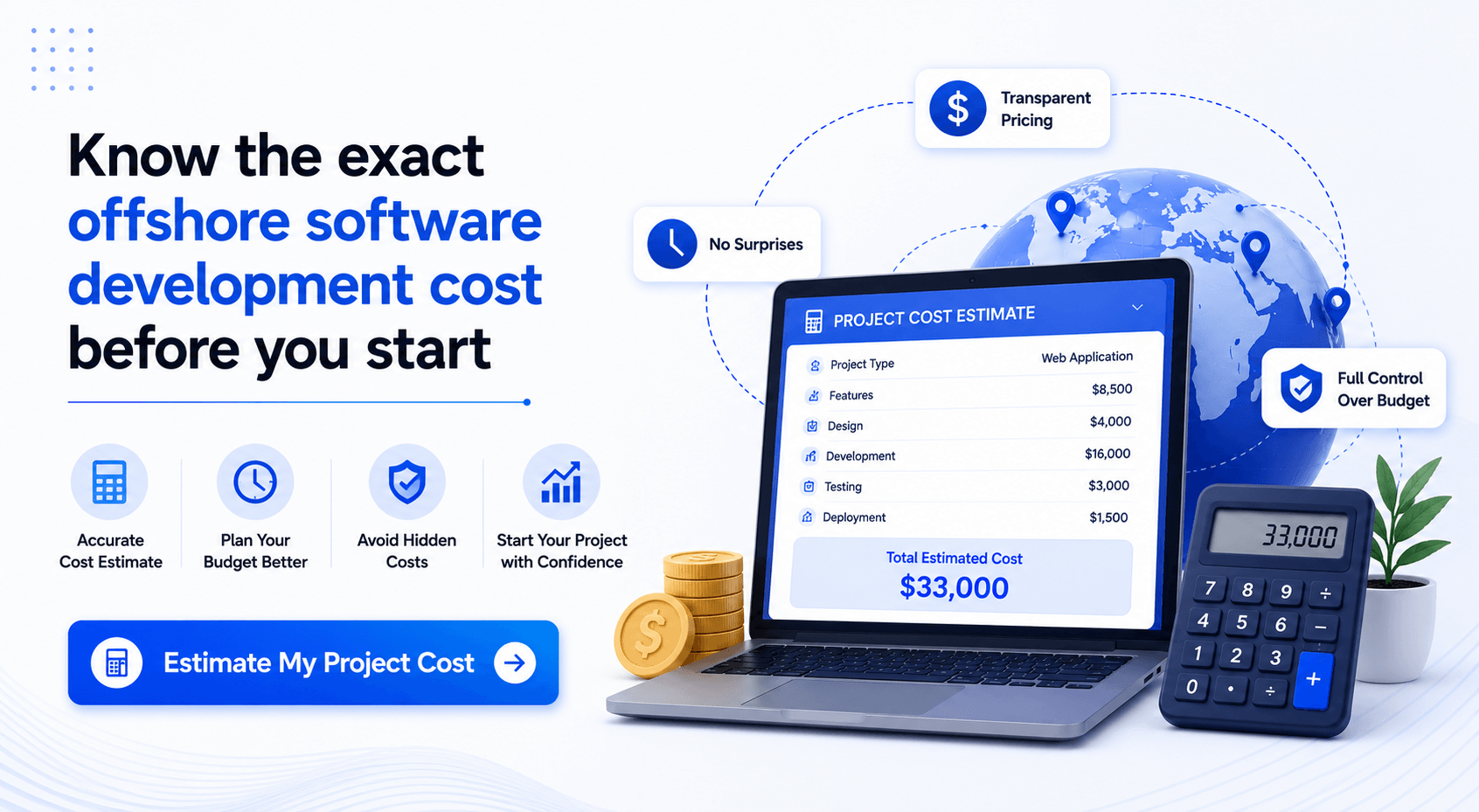
If you’re budgeting for a serious project, understanding the cost of offshore software development upfront can save you from a lot of painful surprises later.
For mid-to-large scale projects – especially anything involving robust enterprise software development – you’re typically looking at somewhere between $250,000 and $380,000 in total. That number moves around depending on how complex the project is, how big your team is, and which engagement model you go with.
Here’s roughly where that money goes:
| Cost Component | Percentage of Total Cost | Estimated Cost Range |
| Development & Engineering | 45% – 55% | $112,500 – $209,000 |
| UI/UX Design | 10% – 15% | $25,000 – $57,000 |
| Project Management | 8% – 12% | $20,000 – $45,000 |
| Quality Assurance & Testing | 10% – 15% | $25,000 – $57,000 |
| DevOps & Deployment | 5% – 10% | $12,500 – $38,000 |
| Maintenance & Support | 5% – 10% | $12,500 – $38,000 |
Basically the biggest chunk goes straight into development and engineering. The rest gets spread across design, testing, management, and keeping things running after launch.
What this really does is give you a clearer picture of where your money is actually going, so you’re not just staring at a final invoice wondering how it got that high. When you break it down like this, it’s a lot easier to spot where you can optimize and where you really shouldn’t cut corners.
Offshore software development use cases across different industries
Healthcare
Healthcare software is some of the most complex work out there. Whether it is a patient portal, a telemedicine app or a full-blown EHR system… these projects are expensive to build. That’s why so many NHS trusts and health-tech startups choose to work with a healthcare app development company. You get the same expertise, without the London price tag.
FinTech
Banks and fintech startups deal with some of the most demanding software requirements –
- fraud detection
- real-time payments
- lending platforms
Offshore teams have become a go-to solution because you can tap into specialists who’ve built this stuff before, and you’re not paying Silicon Valley rates to do it. Scalability becomes a lot less scary when you have the right people (the kind you’d find at a good fintech app development company, wherever in the world they happen to be based).
E-commerce
If you’re running a retail business today, your tech stack is EVERYTHING. Offshore developers help build the storefronts, the shopping apps, the inventory tools. And they’re also pretty good at stitching everything together with payment providers, CRMs and logistics platforms.
Whether you hire in-house or work with an e-commerce app development company abroad, the goal is a stack that actually holds together under real-world pressure.
Manufacturing
Manufacturers aren’t usually the first industry people think of when it comes to software. But the need is very real.
The need for:
- ERP systems
- supply chain tools
- IoT monitoring
- and predictive maintenance
Offshore teams bring the technical know-how to build these solutions & manufacturers get to modernize their operations without the overhead of a massive in-house dev team.
Education
EdTech has grown a lot over the last few years. You see it everywhere now.
And offshore development played a big part in making that happen. Schools and online learning platforms needed LMS tools, virtual classrooms and student portals. The sort of work any experienced elearning app development company will tell you is deceptively complex to get right.
Offshore teams helped them get there within a reasonable budget (which matters a lot in an industry that’s notoriously underfunded).
How AI is transforming offshore software development workflows
Offshore software development is changing fast – and AI is a big reason why. It’s no longer just about finding cheaper talent in another country. AI is now baked into the actual engineering process, from the moment you start planning all the way through to delivery.
And for anyone working with an offshore outsourcing software development company, that shift is pretty significant. AI is making it a lot easier to keep distributed teams aligned, spot issues before they spiral, and keep work moving even across time zones.
Smarter development planning
Good planning used to rely heavily on experience and gut feel. Now AI tools can take complex requirements and break them down into structured, manageable tasks automatically. For something like HMI software development – where you’re dealing with precision and system-level coordination – that kind of accuracy at the planning stage makes a real difference.
Faster coding and debugging
AI-assisted dev tools are genuinely speeding things up. Engineers are writing cleaner code faster and catching bugs earlier, which means fewer delays and less time spent going back and fixing things that should’ve worked the first time. That alone saves teams a ton of back and forth.
Improved collaboration across teams
One of the harder parts of working with an offshore outsourcing software development company is keeping everyone on the same page. AI helps by automating updates, keeping documentation current, and tracking project status without someone having to manually chase it down.
Better quality and reliability
AI-driven testing catches bugs and performance issues way earlier in the process. For something as detail-sensitive as HMI software development, where a reliability issue isn’t just annoying but potentially critical, that early detection really matters.
More efficient project delivery
Better estimation, smarter resource allocation, earlier risk flags – AI helps distributed teams deliver more consistently and with fewer last-minute surprises.
Security & compliance considerations in offshore software development
Security isn’t an afterthought. So you have to treat it like a priority from day one
When you’re sharing code, customer data, and business ideas with a team in another country, you need to know it’s protected. This is one of those things people think about too late. Don’t be that person.
Here’s what to actually look out for.
Data protection practices
Before you sign anything, ask how they actually handle your data. How is it encrypted? Who has access? Where is it stored? A solid partner will have real answers. If they’re vague or defensive, that tells you everything.
Compliance requirements
Depending on your industry, there are rules you have to follow: GDPR, HIPAA, PCI DSS. Your offshore team needs to understand these from the start, not figure them out halfway through the project.
Intellectual property protection
Your code and your ideas should belong to you. Get an NDA signed, make sure IP ownership is written into the contract, and don’t skip this step just because everything feels friendly and collaborative right now.
Regular security audits
Security isn’t something you check off before launch and forget about. The best teams build it into the whole process – regular code reviews, vulnerability checks, ongoing testing. If they don’t do this, that’s a red flag.
Common mistakes to avoid when outsourcing software development offshore
Nobody really talks about what goes wrong. But they should.
Outsourcing offshore sounds amazing at first. Lower costs, access to great talent, faster turnaround. But honestly? A lot of companies get burned because they walk in unprepared and figure it out the hard way.
Here are the most common mistakes to avoid:
Going with whoever’s cheapest
Look, I get it. The budget is tight and the low quote looks attractive. But nine times out of ten, cheap upfront means expensive later – rewrites, missed deadlines, hours wasted on back and forth. It’s just not worth it.
Not being clear about what you actually want
If you go in vague, you’ll get vague back. Scope creep is real, and it starts the moment expectations aren’t locked down. Write it all out. Timelines, features, deliverables – all of it.
Underestimating the time zone thing
A 10 hour difference feels fine until you’re sitting on a blocker all day waiting for someone to wake up. Make sure there’s actual overlap in working hours, not just an email chain going back and forth for days.
Thinking you can just hand it off and walk away
This is a big one. The teams that get the best results stay involved. Regular check-ins, quick feedback, actual collaboration. Outsourcing isn’t a magic wand.
Skipping the legal stuff because it feels like overkill
It’s not overkill. No NDA, no IP agreement, no clear contract – and suddenly your product belongs to nobody, or worse, somebody else. Get it all in writing before anything starts.
Key offshore software development trends to watch
The way businesses work with offshore software development companies is shifting.
What used to be a straightforward cost-cutting move has turned into something a lot more strategic – and if you’re planning to outsource anytime soon, these are the trends actually worth paying attention to:
- AI is becoming part of the actual workflow
It’s not just a buzzword anymore. Teams are using AI to plan smarter, write code faster, catch bugs earlier, and keep projects on track with less manual effort. The companies that are weaving AI into their day-to-day process are simply delivering better results.
- Security is getting more attention – finally
As more sensitive work moves to distributed teams, security practices are tightening up across the board. Compliance, data protection, and secure development pipelines are no longer afterthoughts – they’re part of the conversation from day one.
- Niche expertise is in higher demand
Businesses aren’t just looking for general developers anymore. There’s a growing push for teams with specific domain knowledge – whether that’s fintech, healthtech, embedded systems, or complex enterprise platforms. Specialization is becoming a real differentiator.
- Flexible engagement models are the new normal
Dedicated teams, project-based work, staff augmentation – companies want options. The rigid contracts of the past are giving way to models that actually fit how modern product teams operate.
- Communication and culture fit matter more than ever
This one’s been creeping up for a while. Beyond just time zones, businesses are paying closer attention to how well remote teams actually collaborate – how fast they respond, how they handle feedback, and whether they feel like an extension of the in-house team rather than a vendor.
Keeping an eye on offshore software development trends like these helps businesses make smarter outsourcing decisions (not just cheaper ones).
How to choose the right offshore software development company
Review their past work
We are not talking about the logos depicted on a homepage. Find real projects! Did they build something similar to what you need? That matters way more than how pretty their pitch deck is.
If they’re slow to respond now, run
If they take 48 hours to reply during the sales process, imagine how that’ll feel mid-project. You want a team that’s responsive, speaks clear English, and keeps you in the loop without you having to chase them down.
Ask how they actually work day to day
Do they work in sprints? Give you regular demos? Or do they disappear for weeks and resurface with something completely off? Process matters more than people think.
Your code should belong to you (make sure of it)
Security is non-negotiable. Get an NDA signed, confirm IP ownership is yours, and check they follow proper data security standards.
Reviews and references are your best friend
Check Clutch or GoodFirms. Then go a step further and ask for references. A quick 10-minute call with a past client tells you more than any proposal ever will.
If the price looks too good, it probably is
Dirt-cheap rates are tempting. But they almost always come with a catch – missed deadlines, poor quality, or constant back-and-forth. Pay for quality, and you’ll save money in the long run.
Why choose Techugo for offshore software development?
Techugo stands out in offshore software development by offering a structured approach to building scalable digital products.
The team works as an extension of your in-house setup, focusing on faster delivery, better collaboration, and reliable execution. Using AI-powered tools and workflows, Techugo improves planning, accelerates development, and ensures smoother coordination across every stage – from requirement gathering to deployment. This helps reduce delays, minimize errors, and improve overall product quality.
Unlike a typical mobile app development company that focuses only on execution, Techugo takes a product-focused approach that emphasizes long-term success, scalability, and continuous improvement.
For businesses looking to scale efficiently without expanding internal teams too quickly, Techugo provides a dependable offshore model supported by AI-driven efficiency and strong delivery processes.
So if you’re planning to build something new or scale an existing product, reach out to us and we’ll help you move faster with the right approach and support.
FAQs
1. What are the benefits of offshore software development?
Some key benefits include cost savings, access to skilled developers, faster time-to-market, improved scalability, and the ability to focus on core business operations while development is handled externally.
2. How much does offshore software development cost?
The cost depends on project complexity, team size, and technology stack. On average, mid-to-large scale projects can range between $250,000–$380,000, but smaller projects may cost significantly less.
3. Are offshore software development services cost-effective?
Yes. They are generally more cost-effective compared to in-house hiring as they reduce recruitment, infrastructure and operational expenses.
4. What industries use offshore software development?
Offshore software development is used across industries like healthcare, fintech, e-commerce, education and so on. Basically… any industry that needs custom software can benefit from offshore teams.
5. What are the risks of offshore software development?
One of the most common risks include communication gaps, time zone differences and quality control issues. However these can be managed effectively with clear requirements, proper project management tools and working with a reliable offshore development partner.

Get in touch
We'd love to hear from you.