

 SA
SA
 KW
KW
 IE
IE AU
AU UAE
UAE UK
UK USA
USA
 CA
CA DE
DE
 QA
QA ZA
ZA
 BH
BH NL
NL
 MU
MU FR
FR




















📌 Key Takeaways
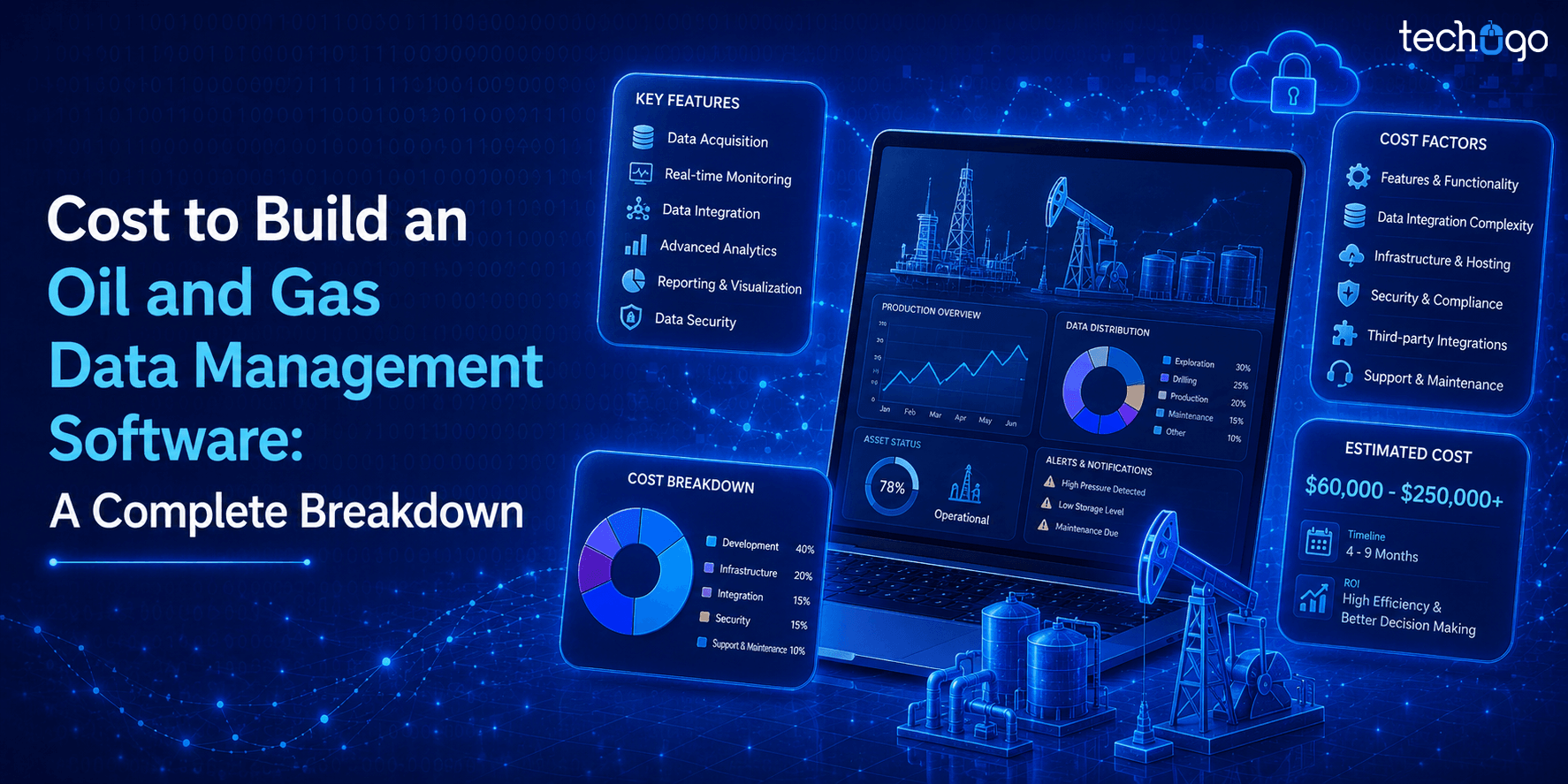
- The oil & gas data management software market is expected to reach $136 billion by 2035.
- Oil and gas data management software helps improve efficiency, safety, compliance, and decision-making.
- Its development costs can range from $40K to $150K+.
- Real-time monitoring, predictive analytics, AI, and IoT are key features driving software demand.
- Custom software offers better scalability and ROI compared to off-the-shelf solutions.
In the oil and gas industry, downtime can cost millions in a single day, and it’s not just about money, it’s about decisions, because if your data is scattered, then your team is always a step behind. You might have sensors collecting information, spreadsheets piling up, and yet, the insights you need were never really there, so companies have been struggling to keep up.
That’s why the cost to build an oil and gas data management software is more than just numbers on a page, it’s about efficiency, and accuracy, and being able to act fast when something goes wrong. Traditional tools and software were never designed for this volume, variety, and speed of data. They break, they lag, or they just don’t talk to each other properly which means, yes, mistakes happen, and yes, decisions are delayed.
Because of this, understanding oil and gas data management software cost becomes crucial, and it’s not simple, because the price depends on features, integrations, analytics, and all the things that make it possible to turn raw data into actions.
And, if you are looking into oil and gas data management software development, you also need to consider what features of oil and gas data management software matter most, how the oil and gas software development process works, and why data management solutions for oil and gas industry are now being prioritized.
Also, don’t forget areas like oil and gas analytics software development and upstream data management systems, because these are the ones that really impact performance, and yes, cost too.
The oil & gas data management software market has been growing by 17.4% annually since 2025, and it is likely to reach $136.0 billion by 2035.
Why oil and gas companies need data management software
In the oil and gas industry, data isn’t just something that exists, it is central, because it drives decisions, and it affects how risks are managed, and yes, even profits. Fields generate enormous volumes of data every hour (drilling logs, seismic surveys, sensor feeds from hundreds of assets, production reports, maintenance logs, supply inventories, regulatory filings) and all of it comes in different systems, different formats, so that without a way to manage it, companies are literally flying blind.
On paper, having all this data might sound like a good thing, but in reality, when it is scattered across spreadsheets, legacy systems, and isolated databases, it becomes a real problem. Different teams end up working with different versions of “truth,” engineers can’t quickly compare seismic logs with production data, and executives – they can’t make confident decisions because they don’t trust what they see. Issues like inconsistent formats, duplicated records, and disconnected tools slow down workflows, introduce errors, and yes, they increase operational risk.
That is why many companies are turning to oil and gas data management software development — and it isn’t just a trend, because the need is real. About two-thirds of firms are investing in real-time analytics specifically because traditional methods were never able to keep up with modern field operations, especially with IoT sensors and remote monitoring systems.
Real-time software allows continuous visibility into production, safety alerts, and performance anomalies that manual systems just cannot handle.
But it’s not only about storing data… modern platforms help companies do 3 critical things better.
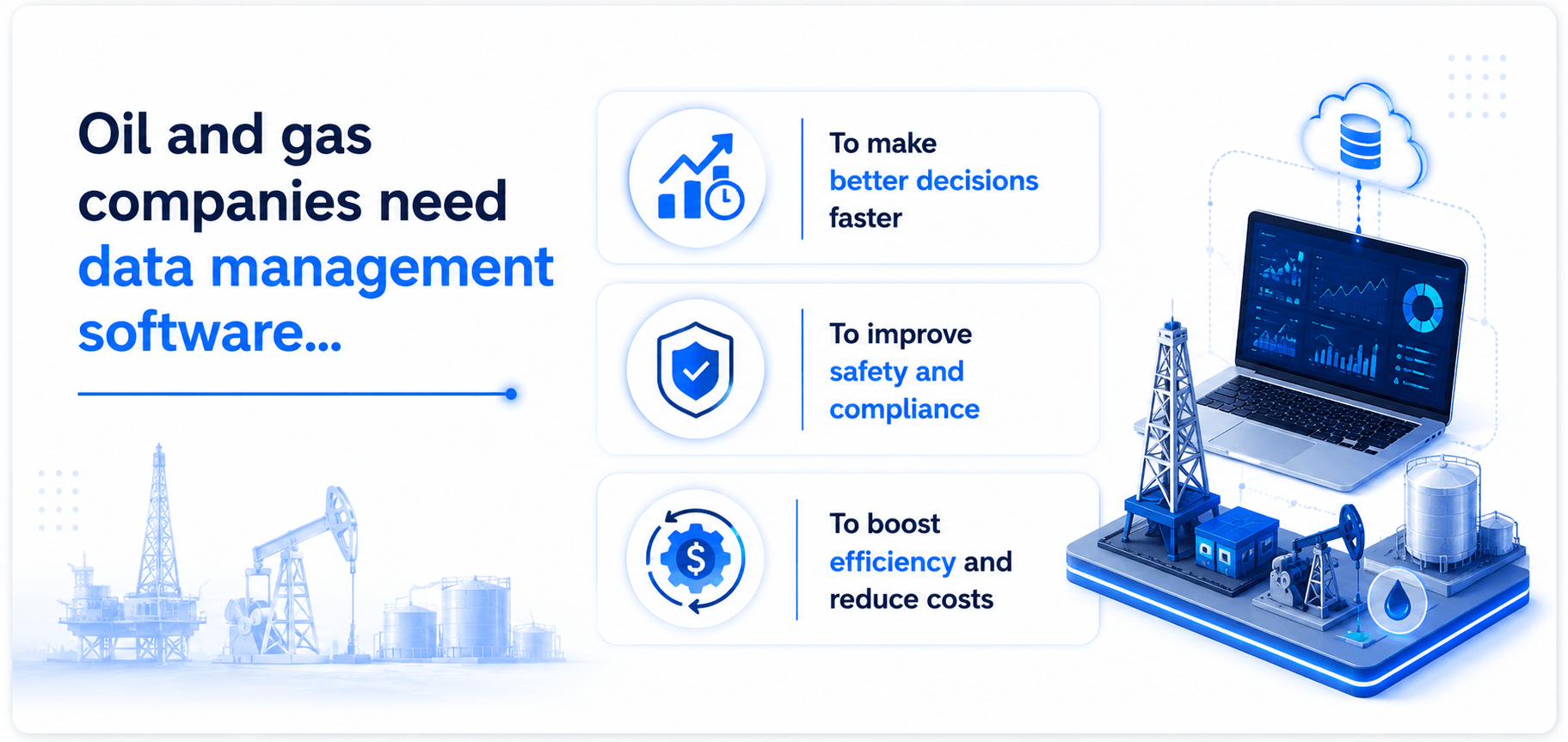
First, make better decisions faster
Because when data is cleaned, integrated, and in one place, engineers and planners can analyze it in context, not in isolation, which means faster drilling plans, more accurate output forecasts, and better reservoir insights.
Second, improve safety and compliance
The industry operates in hazardous environments, so early detection of issues through real-time monitoring is crucial, and proper data management also ensures regulatory reporting is handled correctly, reducing fines and stoppages.
Third, boost efficiency and reduce costs
Fragmented data leads to duplicated work, missed insights, and reactive maintenance. A good system reduces non-productive time, improves planning, and therefore directly affects the bottom line.
In short, oil and gas companies need robust data management software, because the scale and complexity of operations today are too much for traditional tools. Without it, decisions are slower, risks are higher, and efficiency is lower – all of which affects profitability and competitiveness.
What is oil and gas data management software?
So, what exactly is oil and gas data management software? Well, in simple terms, it is a system that collects, organizes, and analyzes all the different types of data that oil and gas companies generate every day such as drilling logs, production metrics, pipeline monitoring, sensor data, maintenance reports, and even regulatory records. And without a tool to handle it all, you are basically trying to swim in an ocean with a teaspoon.
This software was designed to solve that problem, because traditional methods (spreadsheets, isolated databases, paper logs) just weren’t enough. And it’s not only about storage, it’s also about making sense of the data so that engineers, managers, and executives can make timely, accurate decisions.
Now, there are different types of systems depending on where you are in the value chain like –
- Upstream operations rely on upstream data management systems for exploration and drilling efficiency.
- Midstream and downstream operations might focus more on pipeline monitoring, refinery data, or logistics. tracking. But ultimately, the goal is to centralize data, make it accessible, and turn it into insights.
Some of the key things these platforms do include real-time monitoring, predictive analytics in oil and gas, automated reporting, and integration of IoT and SCADA systems, because all of this data only has value when it can be analyzed together and not just sitting in silos. And, of course, modern solutions often include cloud storage, so that your team can access the information securely from anywhere, anytime, without worrying about system crashes or data loss.
So yes, in essence, oil and gas data management software development is about building a backbone for the entire organization’s data operations to make complex data simple, usable, and actionable, and this is exactly why data management software for oil and gas industry operations has become critical in today’s competitive and high-risk environment.
Must-have features for oil and gas data management software development
1. Geological surveys
2. Seismic data
3. Well logs
4. Production volumes
5. Equipment status
6. Sensor data
7. Financial records
8. Predictive Analytics
9. Compliance Management
10. Data Integration
11. Real-Time Monitoring
Must Read: Drilling into the Future With Artificial Intelligence in Oil and Gas Industry
Cost to build oil and gas data management software (With detailed cost breakdown)
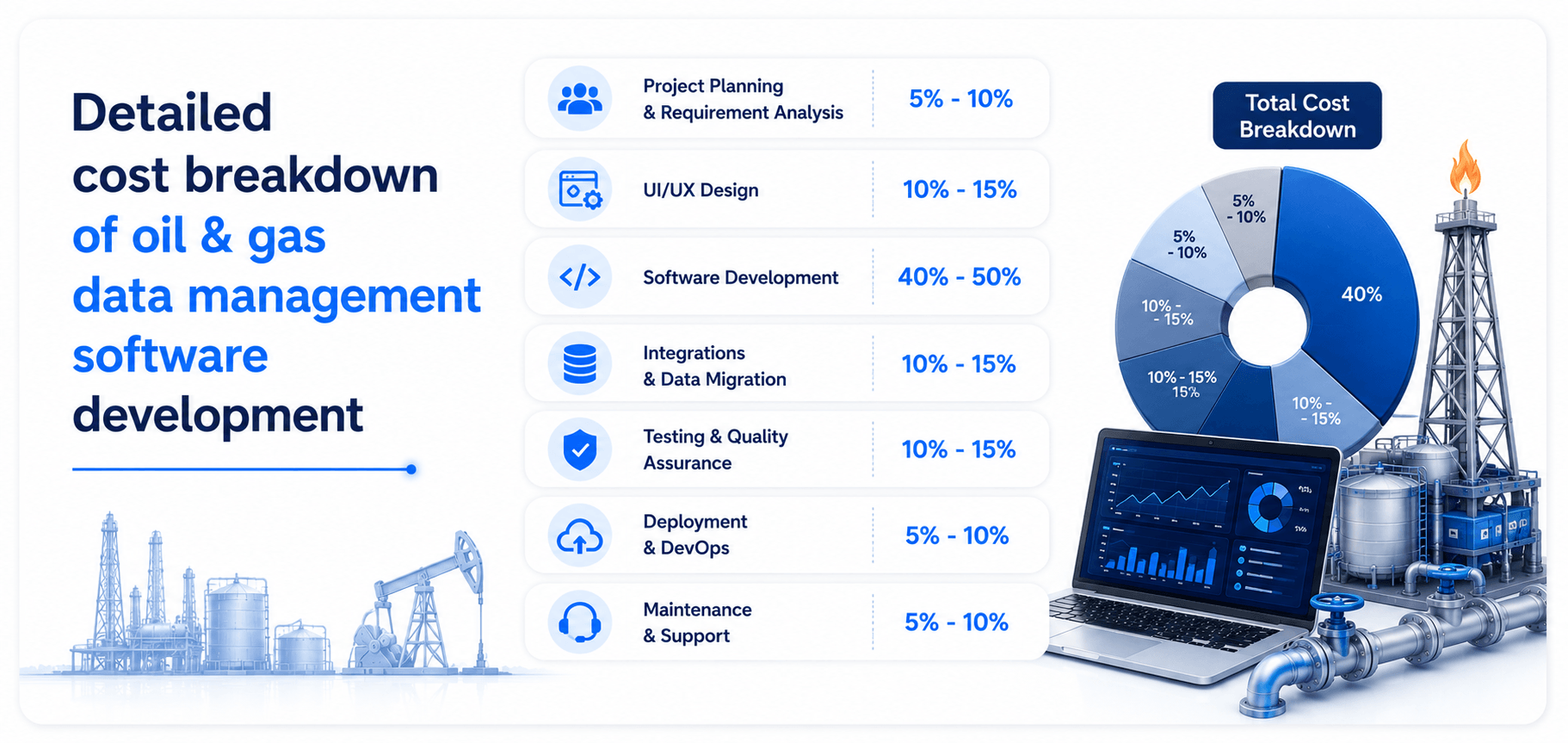
When you think about the cost to build oil and gas data management software, it’s not simple, because every project is different, and it’s not just coding – it’s also about integration, analytics, security, scalability, and compliance. So, the final cost depends on how complex your system is, and the type of data you want to handle, and the features you need, because all of these matter.
| System Type | Estimated Cost | Description |
| Basic System | $40,000 – $80,000 | Simple data storage, minimal integrations, core dashboards |
| Mid-Level System | $80,000 – $150,000 | Real-time analytics, reporting dashboards, moderate integrations |
| Enterprise/Advanced System | $150,000+ | Predictive analytics, cloud infrastructure, upstream systems, mobile apps |
And it’s important to remember that the price isn’t just coding, because there are multiple components, and each one affects the final oil and gas software development cost differently.
Detailed cost breakdown
| Component | Estimated Cost Range |
| UI/UX Design | $5,000 – $15,000 |
| Frontend Development | $10,000 – $25,000 |
| Backend Development | $20,000 – $50,000+ |
| Data Infrastructure & Cloud Setup | $10,000 – $30,000 |
| API Integrations | $5,000 – $20,000 |
| Testing & Quality Assurance | $5,000 – $15,000 |
| Deployment & Maintenance | $5,000 – $15,000/year |
-
UI/UX Design
Designing dashboards, visualizing drilling or production data, and creating user-friendly workflows. Good design reduces errors, so it saves money in the long run, and yes, it was often overlooked before.
-
Frontend Development
Everything the user interacts with such as dashboards, alerts, mobile interfaces. If you want real-time updates, interactive charts, or mobile compatibility, costs go up naturally.
-
Backend Development
The core of the software – databases, data processing, analytics engine, APIs. Complexity depends on how many data sources you integrate, IoT feeds, cloud setup, and all the other moving parts.
-
Data Infrastructure & Cloud Setup
Everything is critical like cloud servers, storage, streaming pipelines, backups, security because oil and gas operations generate huge volumes of data, and without proper infrastructure, nothing works.
-
API Integrations
Connecting existing tools, SCADA systems, IoT devices, ERP, or third-party analytics platforms, so that the system actually talks to everything else.
-
Testing & Quality Assurance
All these things like functional testing, security audits, performance optimization, user acceptance are necessary, because you don’t want surprises later.
-
Deployment & Maintenance
Deploying the software, continuous updates, bug fixes, patches, and scaling, without this, the system isn’t really usable over time.
Factors that drive cost higher or lower
Number of features… more dashboards, predictive analytics, mobile access, AI modules, all add up.
- Data Sources & Volume – more sources, more complexity, more cost.
- Compliance & Security – meeting industry standards adds time and money, but it’s essential.
- Development Team Location – offshore might save money, but sometimes you trade off communication or time zones.
- Project Timeline – rush it, and costs go up, because resources need to be allocated faster.
So, in short, the oil and gas data management software cost is not just a number but it reflects how much value, efficiency, and accuracy you want. Understanding the breakdown helps companies decide where to invest, and how to prioritize features, so that the software pays for itself by reducing downtime, improving safety, and boosting operational efficiency.
Connecting with an experienced team of developers from a top mobile app development company in USA can help optimize development costs especially for cloud-based and mobile-enabled oil and gas systems.
Factors affecting oil and gas software development cost
When you look at the oil and gas software development cost, it’s not a single number that just appears magically. It is a sum of many moving parts, and each part pushes the needle up or down. So, before you start budgeting, you have to understand what actually pushes the cost, and why it happens.
Here are the main factors that have been driving development costs… and yes, they are the real reasons teams spend more than they expected:
1. The type of system you want
This is the first thing that changes the cost because not all systems are equal. If you want a basic dashboard that collects data, that’s one thing, but if you want real‑time analytics, predictive maintenance work, and cross‑asset drill data comparisons, then that’s another level because it takes more code, more logic, and more testing. Different modules and different purposes mean different costs.
2. UI/UX and design complexity
You might think design is just “how it looks” but it’s not. A good user interface makes sense of messy data, and oil and gas teams really need that, because if the interface is confusing, engineers and operators won’t use it properly. Designing workflows, icons, dashboards, drill maps, and responsive screens adds time, and therefore adds cost.
3. Development team expertise and size
Cost is not only about what you build, but who builds it. A small team with limited experience might take longer and introduce bugs, and that actually ends up costing more in revisions later. On the other hand, a highly skilled backend engineer knows how to handle complex storage, analytics pipelines, and security which speeds things up, but usually costs more per hour.
So the team size, the mix of specialists (backend, frontend, database, cloud experts) impacts the final price. It’s not just headcount, it’s skills; because experts solve tricky problems faster, but you’re paying for that expertise.
4. Data volume, integration & complexity
Oil and gas systems don’t sit in a single place – they connect to sensors, historical databases, SCADA systems, ERP tools, compliance records, and sometimes satellite feeds. Integrating all these data sources, so that they talk to each other without breaking, is a major cost driver.
More sources, more variety, more formats – means more integration code, more testing, and more time. And time is money.
5. Real‑time data requirements
If your solution needs real‑time data processing which means data is ingested, analyzed, and alerts are sent instantly, then costs go up because real‑time systems need faster infrastructure, stronger streaming engines, and smart buffering logic so that nothing gets lost or delayed.
Batch processing is cheaper; real‑time processing is more expensive – simply because it’s harder.
6. Cloud vs on‑premise choices
Some companies want their system in the cloud so that everyone can access data from anywhere, and the infrastructure scales with demand. Others want it on‑premise for tight control and extra compliance.
Cloud setups often have ongoing costs tied to usage (storage, bandwidth, compute) but less upfront hardware cost. On‑premise systems need servers, networking gear, maintenance, power – all paid upfront. So your choice here directly impacts the final bottom line.
7. Security and compliance requirements
Oil and gas companies deal with sensitive operational data, so security isn’t optional, rather mandatory. If you want the system to comply with industry standards and regulations (especially if you operate globally), then encryption, audit trails, access control, and compliance checks all add development overhead which pushes cost up.
Good security protocols take time to build, test, and validate, and that reflects in the price.
8. Testing, QA, and bug fixing
Even the best code needs thorough testing before it goes live, and in oil and gas, mistakes can be costly -financially and operationally. So strong testing (automated tests, manual checks, performance stress tests) ensures reliability, but it also adds hours, and therefore cost.
9. Advanced features and future expansion
If you plan to include advanced analytics, AI modules, predictive insights, or mobile monitoring later, all of that requires additional planning, additional modules, and additional development effort. Complexity exponentially increases cost because every module has dependencies, and each dependency needs validation.
In reality, understanding these factors helps you see that oil and gas data management software cost isn’t a fixed figure, it’s a reflection of what you want, how complex it is, how many systems it ties into, and how robust and future‑ready the final product needs to be.
Custom vs off-the-shelf oil and gas software: Cost comparison
When it comes to oil and gas data management, one of the first decisions you face is whether to go custom or pick an off-the-shelf solution. And, honestly, this choice can make a huge difference in cost, flexibility, and long-term value so it’s not something to decide lightly.
| Feature | Off-the-Shelf | Custom-Built |
| Upfront Cost | Low ($20K – $60K) | High ($80K – $200K+) |
| Implementation Time | Weeks | Months |
| Customization | Limited | Fully Tailored |
| Scalability | Moderate | High |
| Integration with Existing Systems | Moderate | Seamless |
| Maintenance | Vendor-managed (subscription) | Requires team/partner |
| Future Expansion | Limited | Easy to add new modules or AI features |
-
Off-the-shelf software
Off-the-shelf software is pre-built, ready to deploy, and often cheaper upfront. You can start using it quickly, and some platforms offer cloud hosting, dashboards, and basic analytics out of the box.
-
- Cost Range: $20,000 – $60,000 (depending on modules and licensing fees)
- Pros:
-
-
- Faster implementation – you don’t wait months for development
- Lower initial cost – because development is already done
- Proven reliability – widely tested and used across the industry
-
- Cons:
-
- Limited customization – you get what the software provides
- May not integrate seamlessly with your existing systems
- Can incur recurring subscription costs or add-on fees for advanced modules
Off-the-shelf solutions are fine if your operations are fairly standard and don’t need complex real-time analytics or upstream-specific modules. But if you want full control over workflows, dashboards, or unique reporting, it may feel restrictive.
-
Custom-built software
Custom software is designed specifically for your organization, so it can handle exactly the data sources, workflows, and analytics your teams need. You choose the features, the integrations, the UI, and the security standards.
-
- Cost Range: $80,000 – $200,000+ (depending on complexity, integrations, and features)
- Pros:
-
-
- Tailored to your business processes – no compromises
- Scalable and future-proof – you can add modules, AI, or mobile apps later
- Better integration with upstream, midstream, and downstream operations
-
- Cons:
-
- Higher upfront cost – because everything is built from scratch
- Longer development timeline – several months, sometimes up to a year
- Requires ongoing maintenance and updates – you need a dedicated team or partner
Custom solutions make the most sense if you deal with large volumes of data, need predictive analytics, or want full control over operations and reporting. Over time, the ROI can outweigh off-the-shelf costs because it improves decision-making, efficiency, and safety.
How to reduce oil and gas software development costs
Developing oil and gas data management software can be expensive, but costs can be controlled with smart planning and strategic choices.
-
Define Requirements Clearly
List must-have features and prioritize them. Clear scope prevents unnecessary work and reduces costs.
-
Choose the Right Approach
Decide between custom or off-the-shelf software. Off-the-shelf is cheaper upfront; custom gives flexibility and avoids hidden expenses.
-
Start with an MVP
Build a Minimum Viable Product first to test essential features, gather feedback, and avoid overbuilding.
-
Use Cloud Infrastructure
Cloud reduces upfront hardware costs and scales with your needs, lowering maintenance expenses.
-
Focus on Core Features
Include only features that impact efficiency, safety, and decision-making. Add advanced modules later.
-
Outsource Strategically
Hire the right oil & gas software and mobile app development company. Cost-effective regions help, but expertise matters.
-
Automate Testing
Automated QA reduces errors, saves time, and lowers long-term costs.
-
Plan for Maintenance
Well-structured code and modular design prevent high future maintenance costs.
ROI of oil and gas data management software
The investment in oil and gas data management software was, and still is, often high, but the returns are visible because it helps you manage operations better, and reduces downtime, and improves decision-making. When you have real-time data, you can spot issues faster, optimize production, and lower costs, so that your resources are used efficiently.
It was also found that companies see savings in maintenance, compliance, and resource management, and at the same time, better insights help plan long-term and reduce risks. So, even though the upfront costs may feel high, the efficiency gains, the improved safety, and the data-driven decisions usually pay off within months, or sometimes a couple of years, therefore, it’s worth considering seriously.
Why choose Techugo for oil and gas data management software development
The oil and gas industry generates huge volumes of data every day, and managing it efficiently is not easy but that’s exactly where Techugo steps in. We, being a pre-eminent oil and gas software development company, build oil and gas data management software that helps you streamline operations, improve decision-making, and increase efficiency, so that your teams spend less time juggling data and more time acting on insights.
We combine state-of-the-art technologies like artificial intelligence, machine learning, and IoT, deep industry knowledge, and proven development practices to deliver solutions that are tailored to your unique workflows. Our software helps businesses confidently handle the complexities of the energy sector.
You get a dedicated team that understands both the technology and the business challenges of oil and gas. We make sure your software is not only functional but also ready for future growth. And, because we focus on results, our solutions directly impact efficiency, safety, and profitability.
So, if you want to develop highly effective oil and gas data management software that drives tangible results for your business, Techugo is the partner to trust. Contact us today!
FAQs
Q. What is oil and gas data management software and why is it important?
It’s software that organizes and analyzes oil and gas data, helping companies optimize operations, reduce downtime, and make better decisions with real-time insights.
Q. Should I choose custom or off-the-shelf oil and gas software?
Off-the-shelf is faster and cheaper upfront but less flexible. Custom is tailored to your workflows, scalable, and offers better long-term ROI.
Q. How can oil and gas companies reduce software development costs?
Focus on core features, start with an MVP, use cloud infrastructure, automate testing, and outsource strategically to an experienced mobile app development company in USA.
Q. What are the key features of oil and gas data management software?
Real-time monitoring, predictive analytics, reservoir management, supply chain tracking, compliance reporting, and mobile access for field teams.
Q. Can mobile apps be integrated with oil and gas data management systems?
Yes, mobile apps connect to your system and gives real-time access and updates to the field teams.

Get in touch
We'd love to hear from you.