

 SA
SA  KW
KW  IE
IE AU
AU UAE
UAE UK
UK USA
USA  CA
CA DE
DE  QA
QA ZA
ZA  BH
BH NL
NL  MU
MU FR
FR 














📌 Key Takeaways
- SaaS application development is reshaping how modern software is built, shifting from traditional installations to flexible cloud-based systems.
- SaaS products are generally faster to build and more cost-efficient than traditional software models.
- The global SaaS market is booming, set to hit hundreds of billions as businesses rapidly shift to cloud-based solutions.
- Core features like multi-tenancy, subscription billing, and cloud storage are key to building successful SaaS platforms.
- AI is playing a major role in SaaS, improving automation, decision-making, and overall user experience.
A decade ago, buying software meant buying a disc. Today, it means opening a browser tab and that shift has changed everything.
SaaS application development has quietly become the backbone of how modern businesses operate. CRMs, project tools, finance platforms – if a team is using it daily, there’s a good chance it lives in the cloud. No installations. No IT headaches. Just software that works, scales & stays out of the way.
And the numbers don’t lie: the global SaaS market is on track to hit $389.8 billion in 2026 (Market Data Forecast). That’s not a trend. That’s a structural shift in how the world buys and builds software.
What’s making this space genuinely exciting right now is AI. Not the buzzword kind – the kind that actually cuts a workflow in half or surfaces an insight a human would’ve missed at 2 AM. The smartest players in enterprise SaaS development aren’t just moving to the cloud anymore; they’re rebuilding what software is supposed to do.
Whether you’re a founder stress-testing a napkin idea or an enterprise team mapping out a five-year transformation – understanding how SaaS gets built isn’t optional anymore. It’s table stakes.
So in this guide we will understand the features that define great SaaS products, the development process, the cost, the AI trends reshaping what is possible and also the real-world benefits that make it all worth the investment.
Why invest in SaaS application development?
Simple — because it’s the smartest way to build software that actually keeps up with your business. No bloated infrastructure, no painful update cycles, just a product that works from day one and grows from there.
Here’s what you’re really getting:
- Lower costs upfront – no hardware, no heavy IT setup, just cloud-based infrastructure that scales as you grow
- Faster time to market – ship updates in real time, respond to customers quickly, and never wait on a lengthy release cycle again
- Access from anywhere – your team, your clients, your global users: everyone’s in, on any device, at any time
- Built-in scalability – as demand grows, your product grows with it. No rebuilding from scratch.
And with AI and automation now baked into modern SaaS application development, your platform doesn’t just function (it gets smarter over time). Predictive analytics, automated workflows, intelligent decision-making – all running quietly under the hood.
Investing in SaaS application development means investing in a product that’s ready for today and built for whatever comes next.
Saas application development vs traditional software development
When businesses look at different ways of building software, they usually compare SaaS application development with traditional software development. While both of them aim to deliver working applications, the way they are built, deployed, and maintained is not really the same, and yes it changes the whole experience.
Traditional software development is mostly based on installing applications directly on local machines or company servers, and because of that it usually requires manual setup, hardware dependency, and ongoing maintenance from the user or IT team. Updates are also pushed manually, so it could get slow… and honestly a bit messy sometimes.
On the other hand, SaaS app development follows a cloud-based model where software is hosted centrally and accessed through the internet. You don’t install anything, you just log in and use it. Everything from updates to maintenance is handled by the provider, and this is often supported through SaaS application development services that make sure the system runs smoothly, is secure, and of course, scalable.
Key differences
| Aspect | SaaS Application Development | Traditional Software Development |
| Deployment | Hosted on cloud and accessed via internet | Installed on local systems or servers |
| Maintenance | Managed centrally by the provider | Managed manually by users or IT teams |
| Updates | Automatic and real-time | Manual installation required |
| Scalability | Easily scalable based on demand | Limited by physical infrastructure |
| Accessibility | Accessible anytime, anywhere | Restricted to installed devices or networks |
| Cost Structure | Subscription-based model | High upfront licensing and setup cost |
Which one should businesses choose?
In most cases, businesses today prefer to develop SaaS applications because it offers better flexibility, lower upfront costs, and easier scalability. It removes a lot of the maintenance burden so teams can focus more on actually using the software instead of managing it which frankly makes a lot of sense.
This is also why enterprise SaaS development has been growing so fast in recent years, because large organizations need systems that can handle complex workflows, high traffic, and long-term digital transformation needs, and SaaS just fits that better.
However, traditional software development is still used in some cases where offline access is required, or where companies need strict internal control, or highly customized systems that don’t really depend on the cloud.
In the end, most modern businesses are shifting toward SaaS because it fits how software is actually used today – fast, remote, always changing… and yeah, more flexible overall.
Must-have features of a successful SaaS application
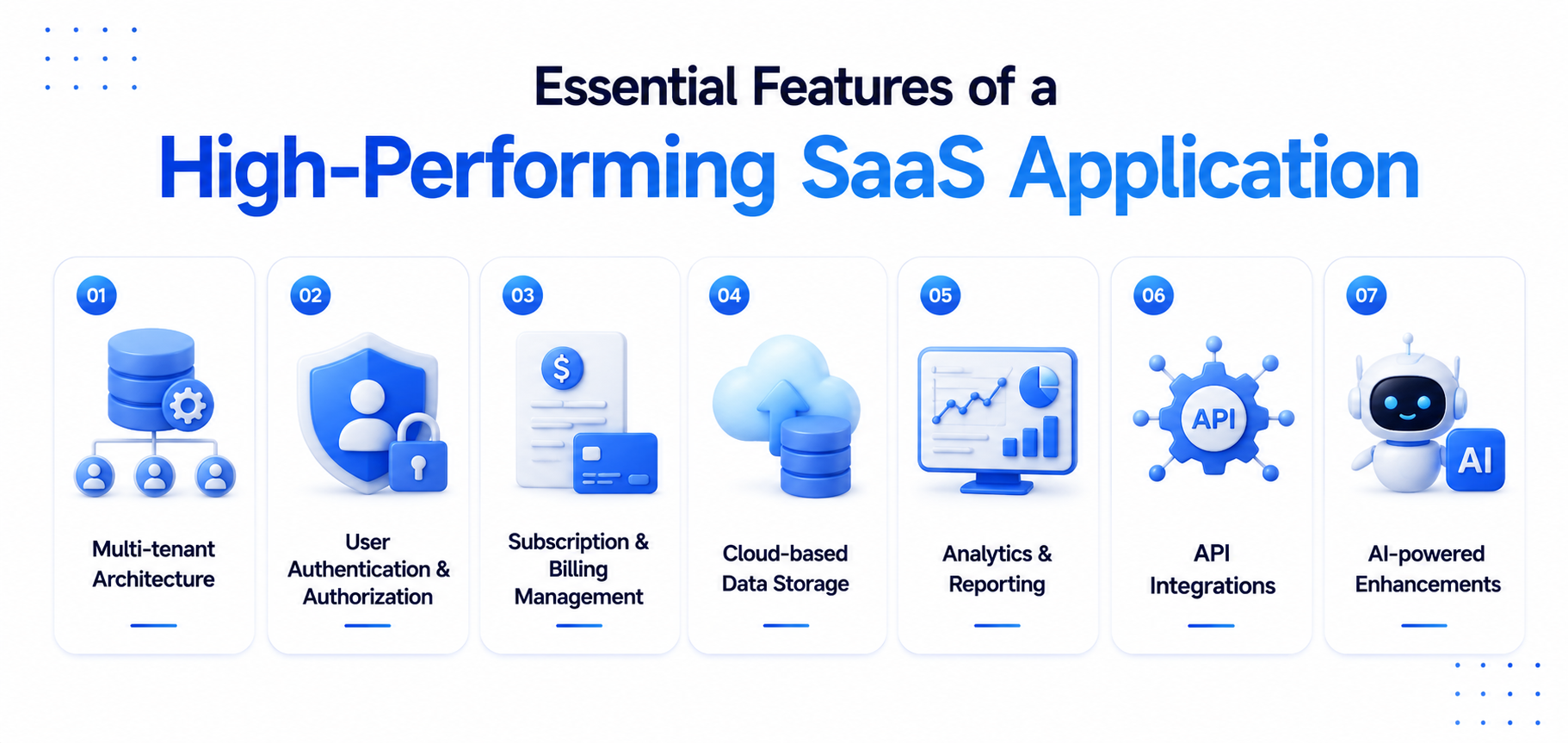
The features you include can directly impact user adoption and business growth. Some of the most important capabilities include:
1. Multi-tenant architecture
At the core of SaaS application development, there is multi-tenant architecture, and basically it allows a single platform to serve multiple customers without mixing their data, but still keeping everything on one shared system. It works this way because SaaS platforms are built for scale so that multiple users can exist on the same infrastructure, and yet everything remains isolated, secure and organized.
2. User authentication & authorization
Every SaaS platform needs strong login systems and access control, and this is what makes sure the right users get the right access, and not the wrong ones. Because if authentication is weak, then data security breaks down, and that is something no system can really afford.
3. Subscription & billing management
Most SaaS products run on subscriptions, so billing becomes the core of the system, not just a side feature. In SaaS software development, these systems handle payments, renewals, upgrades, cancellations… and they do it automatically so that users don’t have to think about it every time.
4. Cloud-based data storage
Data in modern SaaS platforms doesn’t sit on local machines anymore, it is stored in the cloud because cloud-based software development allows access from anywhere, anytime. And it also makes scaling easier, so that when traffic grows, the system doesn’t really break or slow down.
5. Analytics & reporting
If you can’t measure it, you can’t improve it… and that’s exactly why analytics is important in SaaS application development. It helps businesses understand user behavior, what is working, what is not, and therefore they can make better decisions, faster.
6. API integrations
No SaaS product really works alone. APIs allow systems to connect with other tools and platforms – this is what makes everything feel connected. It’s like the software is talking to other software, and everything just flows together.
7. Security & compliance
Security is not optional. In SaaS software development, you are always dealing with user data, so compliance rules, encryption, and security layers are built in from the start – not added later after problems happen.
8. AI-powered enhancements
And now things are moving towards leveraging AI and ML in SaaS products, because companies want smarter systems. So instead of just static features, you get automation, chatbots, predictions, recommendations – things that learn over time and keep improving even while you are using them.
Businesses looking to incorporate AI App Development capabilities can also integrate predictive analytics, intelligent automation, AI chatbots, and recommendation engines to enhance functionality.
Best technology stack for SaaS application development
Honestly, this is one of the first things you need to nail before writing a single line of code. The stack you choose will affect everything – how fast you can build, how well your product holds up as users grow and how much of a headache maintenance becomes down the road.
So let’s break it down:
Frontend
- React or Next.js: most SaaS teams swear by these for a reason. They’re fast, flexible, and great for building interfaces that actually feel good to use. Plus, the community support alone makes them worth it
- Tailwind CSS: and on the styling side, Tailwind makes things way less painful. It keeps everything consistent as your UI grows without bloating your codebase
Backend
- Node.js or Python (Django/FastAPI): both are solid choices, but it really comes down to your team. Go with Node if you want speed and a JavaScript-heavy workflow, or Python if you’re leaning into data or AI features down the line
- GraphQL or REST APIs: either works – but the key is picking one and staying consistent. Switching midway through is a nightmare you don’t want
Database
- PostgreSQL: the go-to for most SaaS software development projects that need structured, reliable data storage. It’s battle-tested and scales well
- Redis: pair it with Postgres, though, because Redis handles caching and keeps things snappy even when traffic spikes unexpectedly
Cloud & Infrastructure
- AWS, Google Cloud, or Azure: you’ll need one of these. They handle the heavy lifting so you’re not managing physical servers, and therefore can focus entirely on building your product
- Docker + Kubernetes: sounds intimidating at first but once you’re set up, deployments become so much cleaner and more predictable
Security & Auth
- Auth0 or Firebase Auth: don’t build authentication from scratch. Seriously, just don’t. These tools exist for a reason and will save you weeks of work
- SSL, role-based access, data encryption: these aren’t optional either, especially the moment real users start trusting your product with their data
At the end of the day there’s no single perfect stack but getting these decisions right early means you’re not scrambling to fix architectural mistakes when you’re trying to scale. Therefore think of your stack not just as a technical choice, but as the foundation everything else is built on.
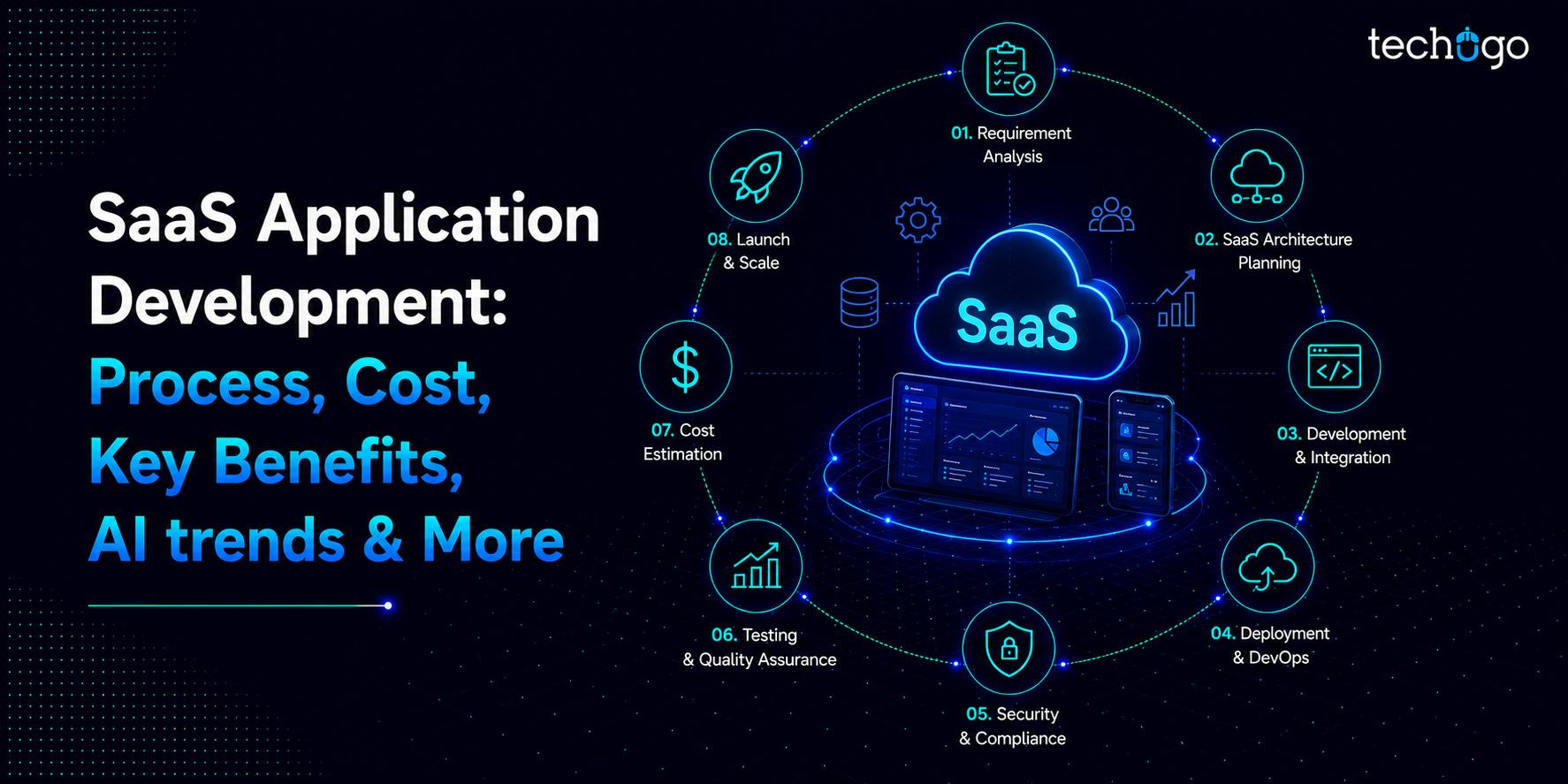
How SaaS application development works: step-by-step process
Step 1. Market research & idea validation
Every successful SaaS product starts the same way – not with code, but with understanding people. Before you even think about building anything, you need to figure out who you’re building for, what they actually struggle with, and whether your idea is even worth turning into a product.
This is where you naturally start shaping the saas application development process in real terms – not theory. You look at real problems, study competitors, and try to find that gap everyone else is ignoring. That’s basically where a solid strategy to develop SaaS application begins, even if it doesn’t feel technical yet.
Also Read – Finding the Secrets of SaaS Marketing
Step 2. Define product requirements
Once the idea starts making sense, the next step is getting brutally clear about what you’re actually building. Features, user types, subscriptions, technical needs – everything has to be mapped properly, otherwise things get messy later.
This is also where the direction for saas web application development starts forming, because now you’re not just imagining a product, you’re actually shaping how it will work in real life.
Step 3. UI/UX Design
This is the part where things start feeling real. Design is not just about making something “look good” – it’s about making sure users don’t feel lost the moment they open the product.
If the experience feels confusing, people leave. It’s that simple. So every click, every screen, every flow has to feel natural and effortless.
Step 4. SaaS architecture planning
Now comes the part most people don’t think about, but it decides whether your product survives or collapses later.
You need a proper foundation – tech stack, database structure, security layers, everything. And almost every modern system today leans on cloud-based software development, because without it, scaling just becomes painful and expensive very quickly.
Step 5. MVP development
Instead of trying to build everything at once, smart teams start small. An MVP is basically your “real-world test version” – just enough features to see if people actually care about what you’ve built.
It saves time, money, and a lot of guesswork.
Step 6. Step testing & quality assurance
Before anything goes live, you break it… on purpose. You test how it behaves, where it fails, what slows down, and what might frustrate users. Because once real users come in, you don’t get second chances.
Step 7. Deployment & launch
This is the moment everything goes live. The product is pushed into production, and suddenly it’s not just “your idea” anymore – it’s something real people are using.
Step 8. Continuous maintenance & scaling
But the work doesn’t stop at launch. In fact, that’s just the beginning. You keep fixing, improving, scaling, and adapting based on how people actually use the product.
Because in SaaS, the product is never really “finished”. It just keeps evolving.
When you develop saas application, it rarely works out well if you treat it like a straight checklist. The difference comes from how the small decisions add up into something users actually want to stick with. That’s also why many businesses lean on a SaaS application development company – not because they can’t build it, but because it helps avoid the usual trial-and-error loop where everything looks fine on paper but falls apart in real usage.
SaaS application development timeline
Timelines vary depending on complexity and team size, but here’s a realistic phase-by-phase breakdown of what to expect:
| Phase | Duration | What Happens |
| Discovery & Planning | 2 – 4 weeks | Defining scope, user flows, tech stack, and roadmap |
| UI/UX Design | 3 – 6 weeks | Wireframes, prototypes, and overall look and feel |
| MVP Development | 8 – 16 weeks | Core features, backend setup, integrations, and basic security |
| Testing & QA | 3 – 5 weeks | Load testing, bug fixes, cross-device and security checks |
| Launch & Deployment | 1 – 2 weeks | Cloud setup, CI/CD pipeline, monitoring systems go live |
| Post-Launch Iteration | Ongoing | User feedback, improvements, and continuous updates |
Total: roughly 4 to 9 months from kickoff to launch – and that’s for most standard SaaS builds. The more complex the product, the more breathing room you’ll want in each phase.
Cost to build a SaaS application in 2026: complete breakdown
If you’re planning SaaS application development, the first question that usually comes up is pretty simple – how much is this actually going to cost?
And the honest answer is: it depends. The cost to build a SaaS application changes a lot based on what you’re building, how advanced it is, and who you’re building it with.
In 2026, things have also gotten a bit more layered. SaaS products aren’t just web apps anymore – they often stretch into mobile experiences, smarter automation, and even AI features.
Basic SaaS application ($15,000 – $40,000)
At the basic level, you’re usually looking at something simple – user login, a dashboard, maybe a few core features, and a basic subscription setup.
This is often handled by an app development company or small product team building an MVP. It’s mostly web-focused, but sometimes businesses also add light iOS app development or Android app development support if they want early mobile access.
Mid-level SaaS application ($40,000 – $120,000)
This is where things start getting more serious. You’re not just building “a product” anymore – you’re building something people will actually rely on.
At this stage, you’ll typically see things like integrations, dashboards with real data, automation, and more refined UI/UX. A lot of teams also expand into full mobile application development so the product works smoothly across devices.
Enterprise SaaS application ($120,000 – $300,000+)
Now we’re in heavy territory. Enterprise SaaS platforms are built for scale – lots of users, complex systems, high security, and long-term stability.
Everything here is more advanced: SaaS architecture, infrastructure, performance, security layers (all of it).
What actually affects the cost?
If you strip it down, the cost to build a SaaS application usually depends on:
- how complex your features are
- whether you need mobile apps or just web
- how much AI or automation you’re adding
- the design and user experience expectations
- and who you hire – like a mobile app development company or an in-house team
At the end of the day, SaaS development in 2026 isn’t just about building software anymore. It’s about building something that scales, feels smooth to use, and can grow with your users. That’s why budgets vary so widely – because no two SaaS products are ever really the same.
Benefits of SaaS application development
1. Lower development and infrastructure costs
One of the biggest advantages of SaaS application development is that it helps cut down heavy upfront infrastructure costs. Instead of investing in servers and hardware from the start, businesses can scale using cloud resources as they grow.
That is also why SaaS cloud solutions are becoming the default choice for many companies today – especially in modern saas web application development where everything is expected to run smoothly on the web without friction.
2. Faster time-to-market
SaaS products can be built & launched much faster compared to traditional software. With cloud-based systems and agile workflows, teams do not get stuck in long setup or deployment cycles. And honestly in a market where timing matters, this speed can make or break an idea.
3. Scalability on demand
As user demand grows, SaaS platforms can scale without needing a complete system overhaul. This is especially important for startups and enterprise SaaS development, where growth isn’t optional (it’s expected). In most cases teams rely on saas application development solutions so scaling doesn’t turn into a technical bottleneck later.
4. Accessibility across devices and locations
Since SaaS applications are cloud-based, users can access them from anywhere as long as there’s an internet connection. Whether it’s a laptop, tablet, or phone, everything stays synced and available in real time, which naturally supports remote teams and global users.
5. Simplified maintenance and updates
Unlike traditional software, SaaS platforms don’t require users to install updates manually. Everything is handled in the background – new features, bug fixes, security patches – all rolled out without disrupting the experience.
6. Enhanced security and data protection
Modern SaaS systems come with strong built-in security like encryption, authentication layers, and continuous monitoring. Because everything runs in a controlled cloud environment, it’s easier to manage security at scale without constant manual intervention.
Also Read – Must-Have SaaS Security Best Practices to Win Over Enterprise Clients
7. Seamless third-party integrations
Most SaaS products today don’t operate in isolation. They connect with CRMs, payment gateways, analytics tools, and other platforms to create a connected ecosystem – and that actually makes the product more useful in real workflows.
8. AI-powered automation and insights
There’s also a clear shift toward using AI and ML in SaaS products. From automation to predictive insights and smart recommendations, AI is slowly making these platforms more adaptive and less dependent on manual input over time.
SaaS application development challenges and how to overcome them
Security and data privacy
This one is probably the scariest (and for good reason). When multiple customers are sharing the same infrastructure, keeping everyone’s data separate and secure is genuinely tricky. One misconfiguration and you’ve got a situation that’s not just technical – it’s a trust problem.
The fix: Don’t bolt security on at the end. Build it in from the very beginning – think role-based access, end-to-end encryption, regular audits, and making sure you’re compliant with things like GDPR or SOC 2. It’s so much easier to do it right the first time than to patch holes while customers are already in your product.
Scalability
Everything works fine at 100 users. But what about 10,000? This is where a lot of teams get caught off guard because they built for right now instead of for growth. And by the time the bottlenecks show up… fixing them is expensive and disruptive.
The fix: Think about scale before you need to. Use cloud infrastructure that grows with you, consider microservices where they actually make sense, and make load testing a regular habit (not just a pre-launch checkbox).
Multi-tenancy complexity
Serving multiple clients on one platform sounds efficient, and it is – but it’s also way more complex than it looks on the surface. Custom configurations per client, data isolation, performance between tenants: all of that needs to be thought through carefully, otherwise it becomes a mess fast.
The fix: Nail down your tenancy model early. Shared database, separate schemas, fully isolated environments – whatever you choose, commit to it. Switching later is a painful, expensive process that nobody wants to go through mid-growth.
Downtime and reliability
Users don’t care why your product is down. They just know it’s down, and that frustration sticks. Therefore, reliability isn’t just an engineering problem… it directly affects how much your customers trust you and whether they stick around.
The fix: Get your monitoring and alerting set up before something breaks, not after. Have a clear incident response plan, build in redundancy, and treat uptime as a product feature – because to your customers, it absolutely is.
Keeping up with continuous updates
The ability to ship updates constantly is one of the best things about SaaS. But it’s also one of the easiest ways to accidentally break things for your users. Push too fast without the right guardrails and you’re gambling with stability. Move too slow and competitors catch up.
The fix: A solid CI/CD pipeline is non-negotiable here. Pair that with automated testing, staged rollouts, and feature flags – and suddenly shipping fast doesn’t feel so risky. It’s not about slowing down, it’s about building the confidence to move quickly without the chaos.
Customer retention and churn
This one’s a bit different because it’s not purely a technical challenge – but it’s deeply connected to how well your product is built. Clunky UX, slow load times, features that don’t evolve: all of that adds up, and in SaaS, churn compounds quietly until it’s suddenly a very loud problem.
The fix: Stay close to your users. Like, genuinely close. Use analytics, run feedback loops, talk to customers directly. The products that retain users aren’t necessarily the flashiest ones – they’re the ones that actually listen and improve based on what people need.
AI-powered SaaS trends in 2026: what businesses should know
AI is no longer something “extra” in SaaS products – it’s slowly becoming the default expectation. In 2026, most SaaS application development projects are being shaped by AI from the ground up, not just added as a feature later.
What’s interesting is how quickly things are shifting. Businesses are no longer asking “should we use AI?” but rather “how do we actually make it useful inside our product?”
1. AI is becoming a core part of SaaS, not a feature add-on
Earlier, AI was treated like an upgrade. Now, in modern SaaS platforms, it’s being built directly into workflows. Whether it’s automation, predictions, or smart recommendations, AI is starting to define how the product behaves instead of just supporting it.
This shift is pushing companies to rethink how they approach SaaS software development, because the architecture itself now needs to support intelligent systems from day one, often running on scalable SaaS cloud solutions.
2. Smarter automation is replacing repetitive workflows
One of the biggest trends is simple: less manual work. Businesses are using AI to automate repetitive tasks like data entry, customer responses, reporting, and even decision-making in some cases.
This is where AI-powered SaaS applications are really changing the game – they don’t just store data, they actually act on it.
3. Personalization is getting more advanced
Users don’t want generic dashboards anymore. They expect systems that understand their behavior and adjust accordingly.
AI is making SaaS products feel more “personal,” whether it’s customized dashboards, tailored recommendations, or adaptive user experiences that improve over time.
4. AI is improving product decision-making
Another big shift is how companies are using AI inside SaaS platforms to understand patterns and predict outcomes. Instead of relying only on historical reports, businesses can now forecast trends and make faster decisions.
This is becoming a major part of AI-powered SaaS applications, especially for data-heavy industries.
5. Businesses are rethinking how they build SaaS products
Because AI is now so deeply integrated, companies are reworking how they approach development itself. From architecture to user experience, everything is being designed with intelligence in mind.
This is why many teams now prefer working with a SaaS application development company that understands both traditional SaaS systems and modern AI-driven capabilities.
Also Read – Top 10 SAAS Trends to Watch
How to choose the right SaaS application development company
Well, this decision can make or break your product – so don’t rush it.
Here’s what actually matters:
1. SaaS-specific experience – have they built multi-tenant, cloud-based products before? Ask for real case studies, not just a portfolio page
2. Their tech stack – a good team can explain what they use and why. If they can’t, keep looking
3. Communication style – you’ll be working with these people for months. Do they ask smart questions or just nod along? Big difference
4. Post-launch support – a lot of companies disappear after delivery. But in SaaS, that’s when things get real. Make sure they’re sticking around
5. Reviews beyond the testimonials – check Clutch or G2 and look at how they handled problems, not just the wins
6. Price vs value – cheapest isn’t best, but expensive doesn’t mean quality either. Look at what you’re actually getting
But above everything else – find a team that understands your business, not just your brief. The right partner won’t just build what you ask for, they’ll tell you when something could be done better.
Future of SaaS application development beyond 2026
SaaS isn’t slowing down. If anything, it’s just getting started.
The products being built today are going to look pretty different from what’s coming, and honestly, it’s an exciting time to be paying attention.
Here’s where things are headed:
1. AI stops being a feature and becomes the backbone — right now teams are bolting AI onto products and calling it innovation. But beyond 2026, the best SaaS products will be built around AI from the ground up. It’ll think, adapt, and respond in ways that feel less like software and more like a really good teammate.
2. Everything gets hyper-personalized — generic dashboards and one-size-fits-all workflows are on their way out. Users are going to expect their tools to actually feel like they were made for them specifically. And the products that deliver that will win
3. Vertical SaaS keeps having its moment — broad platforms that try to serve everyone are slowly losing ground to tools built for very specific industries. Healthcare, legal, logistics, construction — these niches are getting their own dedicated SaaS ecosystems and honestly it makes total sense.
4. No-code and low-code become expected — users don’t want to file a ticket every time they need a small change. More platforms are going to hand that power directly to the user, and the ones that don’t will feel outdated fast.
5. Security becomes a selling point, not just a requirement — as SaaS scales globally, the companies that take compliance and data protection seriously are going to stand out. Because users are getting smarter about where their data lives.
6. Edge computing quietly changes everything — processing data closer to the user means faster load times, better reliability, and SaaS products that actually work well everywhere in the world (not just in regions with great infrastructure).
Honestly? The next wave of SaaS application development isn’t just about building better software. It’s about building products that feel smarter, more personal, and way more intentional than what most people are used to. The teams thinking about this stuff now are the ones who’ll be ahead of the curve when it actually hits.
Why Techugo is a good fit for SaaS application development
When businesses look for a development partner for SaaS application development, it usually comes down to one thing – whether the team can actually turn an idea into a stable, scalable product that works in the real world.
With over 10 years of experience, Techugo has worked across a wide range of digital products, helping businesses move from early concepts to fully functional, scalable platforms. The focus is not just on development, but on building products that can grow without breaking under pressure which is exactly what businesses expect when working with the best mobile app development company for long-term digital products.
The team works with modern technologies including cloud-native architectures, scalable backend systems, cross-platform frameworks like Flutter for mobile-first SaaS extensions when needed, and AI-driven solutions for building smarter, more automated digital products.
Why businesses choose Techugo?
- Strong experience in building scalable SaaS products
- End-to-end development support from idea to deployment
- Focus on performance, security, and long-term scalability
- Ability to build user-friendly and future-ready digital products
- Proven track record across multiple industries and use cases
At the core, it’s not just about building software – it’s about building something that lasts, adapts, and performs when it matters most.
Your SaaS product deserves better execution – let’s build it right together. Reach out to us.
FAQs
1. How to develop a SaaS application?
To develop a SaaS application, businesses usually start with market research, define product requirements, design the UI/UX, plan the architecture, build an MVP, and then move through testing, deployment, and scaling.
2. How much does SaaS application development cost?
The cost to build a SaaS application depends on complexity, features, design, and infrastructure. A basic SaaS product may start from a lower range, while enterprise-level platforms with advanced features and integrations can cost significantly more.
3. Why is SaaS better than traditional software?
SaaS is generally more flexible because it doesn’t require manual installation, offers automatic updates, and can scale easily based on demand. It also reduces upfront infrastructure costs for businesses.
4. Do SaaS applications support AI features?
Yes, many modern SaaS platforms now go beyond basic functionality and include AI capabilities. AI-powered SaaS applications are increasingly being used to automate tasks, analyze data in real time, and deliver smarter user experiences
5. What technologies are used in SaaS web application development?
SaaS web application development usually involves cloud platforms, backend frameworks, databases, APIs, and frontend technologies that ensure scalability, performance, and security.

Get in touch
We'd love to hear from you.