

 SA
SA  KW
KW  IE
IE AU
AU UAE
UAE UK
UK USA
USA  CA
CA DE
DE  QA
QA ZA
ZA  BH
BH NL
NL  MU
MU FR
FR 














Have you ever lost a potential enterprise deal because your SaaS platform didn’t meet their security requirements?
If yes, you are on the right page to ease your worry!
As more enterprises shift their operations to the cloud, their top concern isn’t just functionality, it’s security. They need assurance that the SaaS solutions they adopt can protect sensitive data. Also, meet compliance mandates and defend against ever-evolving cyber threats. If your product doesn’t deliver on these fronts, chances are it will be cut from their shortlist.
Integrating SaaS security best practices throughout the SaaS software development lifecycle is crucial to meet the rigorous expectations of enterprise clients. From architecture planning to deployment and ongoing updates, security must be embedded at every stage to prevent breaches and maintain customer trust.
Aiming to land your first big client or a growing SaaS provider refining your security posture? These must-have features will strengthen your offering and help win over security-conscious enterprises.
We’ll be walking you through a comprehensive SaaS security checklist. Designed to help you build secure SaaS applications that align with enterprise SaaS security standards.
Why Enterprise Clients Care Deeply About SaaS Security?
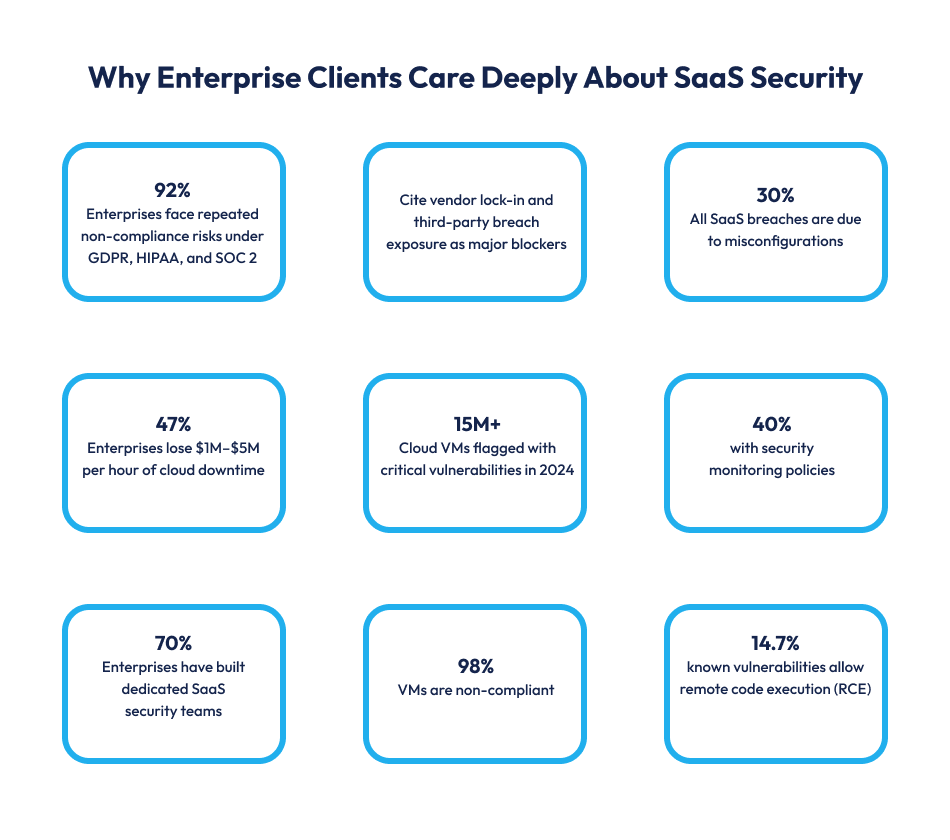
Enterprise clients demand robust enterprise SaaS security. Get engaged in why they care, often at a deeply personal and costly level.
Enterprises operate under regulations like GDPR, HIPAA, and SOC 2, where non-compliance can mean hefty fines and legal action. 92% of companies report repeated intrusion attempts within a year. This is due to the failure to safeguard sensitive data, which can lead to cascading liability. These regulatory burdens place compliance squarely at the heart of SaaS security best practices.
Vendor lock‑in is a major concern. 47% cite it as a top SaaS pain point. If one vendor misconfigures access or suffers a breach, entire enterprise stacks are at risk. A recent CISA alert flagged Commvault’s breach of client secrets, raising alarm on how deeply a third-party failure can impact downstream customers.
Complex SaaS environments lead to misconfigurations, the most common cause of breaches at 30%. One hour of downtime can cost enterprises over $100,000. With 40% reporting losses between $1–5 million per hour. Identity compromises drive 82% of SaaS breaches. MFA reduces unauthorized access risk by 99%. 70% of enterprises have created dedicated SaaS security teams, with budgets rising 39% and staff headcount up 56%. Demonstrating mature, secure SaaS application security credentials is a key differentiator for winning large deals.
Another mandate is real‑time threat visibility. Alarmingly, 98% of VMs fail to meet basic controls for monitoring changes within AWS environments. Leaving enterprises blind to malicious activity. Meanwhile, 14.7% of known vulnerabilities allow remote code execution (RCE), letting buyers assess exploitability risk before onboarding new SaaS.
On the flip side, investing in security pays off. Around 70% of enterprises have created dedicated SaaS security teams, with budgets rising by 39% and staffing up by 56%. Vendors showcasing a mature secure posture gain a clear competitive advantage and greater trust across enterprise buying cycles.
SaaS Security Features Enterprises Expect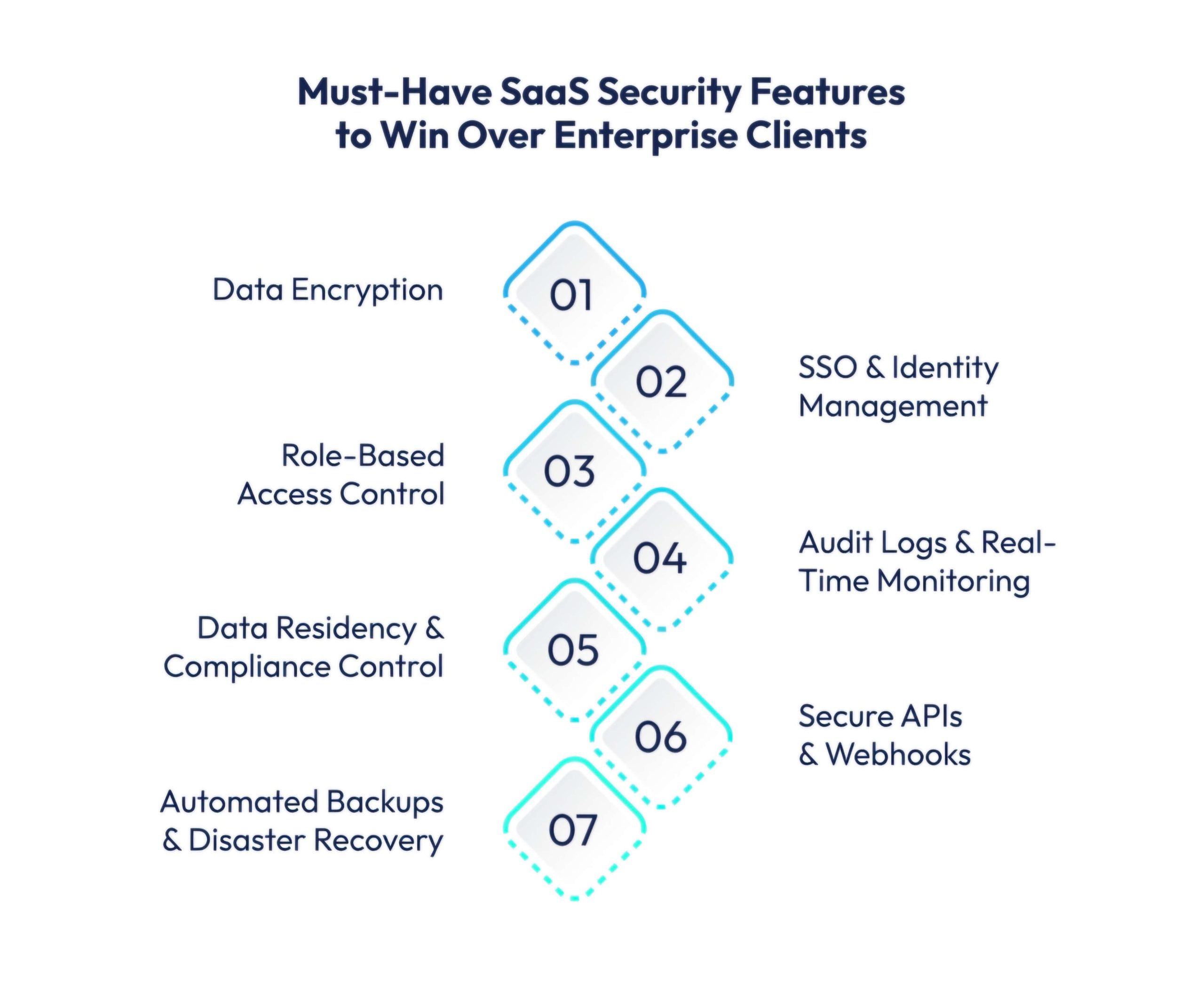
| Feature | Description | Enterprise Benefit | Real-World Example |
| Data Encryption (at Rest & in Transit) | – TLS 1.2+ for transit – AES-256 for stored data – Secure key management via KMS | – Blocks unauthorized access – Critical for finance, healthcare – Builds compliance readiness | – Zoom added AES-256 GCM – Helped recover trust post-privacy backlash |
| SSO & Identity Management (OAuth 2.0, SAML, SCIM) | – Connects to Okta, Azure AD – Enables SSO and MFA – Syncs user roles via SCIM | – Streamlines user access – Reduces shadow IT – Speeds up onboarding/offboarding | – Slack scaled enterprise growth – Rolled out SSO, SCIM, granular role access |
| Role-Based Access Control (RBAC) | – Defines access by roles – Fine-grained permissions – Contextual conditions (e.g. IP, time) | – Limits privilege escalation – Prevents insider misuse – Aligns with least privilege model | – Notion lets teams set view/edit rights – Enables document-level security |
| Audit Logs & Real-Time Monitoring | – Tracks user actions, API calls – Alerts on anomalies – Integrates with SIEM tools | – Helps with audit trails – Enables incident forensics – Supports SOC 2, HIPAA | – Salesforce Shield offers field-level logs – Sends real-time alerts for unusual behavior |
| Data Residency & Compliance Control | – Let users select region – Supports GDPR, CCPA, etc. – Multi-region infrastructure | – Meets legal obligations – Supports regional governance – Appeals to regulated sectors | – Azure enables country-specific hosting – Popular in finance and healthcare |
| Secure APIs & Webhooks | – Uses OAuth tokens – Applies rate-limits & schema checks – Enforces webhook signing | – Prevents API abuse & injection – Secures third-party integrations | – Stripe uses versioned APIs – Requires webhook signatures to block tampering |
| Automated Backups & Disaster Recovery | – Daily encrypted backups – Point-in-time restore (PITR) – Geo-redundancy for failover | – Prevents data loss – Ensures availability (SLA-grade) – Defends against ransomware | – Dropbox Enterprise offers auto-backups – Restores critical files with minimal downtime |
SaaS Security Best Practices
Design for Security from Day One
- Embed security early in SaaS application development
- Follow DevSecOps best practices across environments
- Conduct threat modeling before new feature rollouts
- Perform regular secure architecture reviews
Encrypt Everything
- Use AES-256 encryption for data at rest
- Apply TLS 1.2+ or above for data in transit
- Encrypt logs, backups, and temp files
- Secure configuration files and environment secrets
Implement Strong Authentication & Access Controls
- Enforce Multi-Factor Authentication (MFA)
- Apply Role-Based Access Control (RBAC)
- Use Just-in-Time (JIT) access provisioning
- Define least privilege policies for all roles
Secure APIs & Integrations
- Validate all input and output payloads
- Use rate limiting to prevent API abuse
- Protect endpoints with API gateways
- Sign and verify all webhooks
- Regularly rotate API keys and secrets
Continuously Monitor SaaS Environments
- Deploy SSPM (SaaS Security Posture Management) tools
- Track user behavior and access anomalies
- Monitor third-party integrations for suspicious activity
Conduct Regular Security Testing
- Run vulnerability scans monthly or per release
- Perform static and dynamic code reviews
- Hire vendors for external penetration tests
- Prioritize fixes using CVSS severity scores
Maintain Audit Trails & Compliance Logs
- Log all user access and permission changes
- Record configuration and infrastructure modifications
- Document incident responses and resolutions
- Align with SOC 2, GDPR, HIPAA, and other regulations
Prepare for Incidents & Recovery
- Create and update an incident response playbook
- Run disaster recovery (DR) and business continuity tests
- Automate daily or hourly encrypted backups
- Test and verify backup restoration integrity
Educate & Train Teams Continuously
- Train developers, DevOps, and customer support
- Conduct quarterly security awareness sessions
- Refresh internal security policies regularly
- Simulate phishing and social engineering tests
Ensure Vendor & Third-Party Risk Management
- Assess vendors’ security certifications and audit reports
- Continuously monitor third-party SaaS tools
- Identify and remove inactive integrations
- Mitigate shadow IT risks with policy enforcement
Integrating Security into the SaaS Architecture & Development Lifecycle
To meet compliance mandates and avoid breaches, SaaS providers must embed security throughout both SaaS architecture and the software development lifecycle (SDLC).
Here’s how to do it effectively:
Design a Security-First SaaS Architecture
Your SaaS architecture is the foundation of your application, and it needs to be secure by design. This means:
- Ensuring tenant isolation in multi-tenant models
- Using zero-trust design principles for authentication and access
- Segmenting services with microservice security patterns
- Managing secrets through tools like AWS Secrets Manager or Azure Key Vault
- Performing threat modeling during the design phase
Embrace DevSecOps in the Development Pipeline
By integrating security into your CI/CD pipeline, you reduce risk before release. This shift-left approach ensures security flaws are caught while they’re cheapest to fix.
- Use SAST (Static Application Security Testing) for code analysis
- Use DAST (Dynamic Analysis) for runtime vulnerability scanning
- Scan for secrets, known CVEs in dependencies, and insecure configurations
- Automate security gates at each build stage
- Enforce secure code commits with Git pre-hooks and auto-scan tools
Strengthen Identity and Access Management
Most SaaS breaches stem from poor access controls. These measures enforce least-privilege access and reduce the blast radius of insider threats:
- SSO (OAuth/SAML) with providers like Okta or Azure AD
- Multi-Factor Authentication (MFA) for privileged users
- Role-Based Access Control (RBAC) and optionally ABAC (Attribute-Based)
- Session timeout policies and auditable login tracking
Secure APIs and Integrations
APIs are the lifeblood of SaaS, but they’re also the most exploited.
- Authenticate all endpoints using OAuth tokens
- Rate-limit and throttle APIs to prevent abuse
- Validate all payloads using strict schemas
- Sign and verify incoming webhooks
- Segregate public and internal APIs with gateways
Secure the Infrastructure Layer
Security at the infrastructure level reduces exposure and protects the app from lateral movement during attacks. Beyond the app layer, your infrastructure must be locked down.
- Use network segmentation (e.g., VPCs, service meshes with mTLS)
- Enable Web Application Firewalls (WAFs)
- Monitor configurations with CSPM tools like Wiz or Prisma Cloud
- Scan container images and apply the principle of least access in cloud roles
Implement Real-Time Monitoring and Incident Readiness
Detection is as critical as prevention. Being proactive here boosts your enterprise readiness posture. Integrate tools to monitor and respond:
- Centralize logs from services, users, and system events
- Use anomaly detection and SIEM tools (e.g., Splunk, Datadog)
- Establish incident response plans with defined escalation paths
- Conduct regular tabletop exercises or red team simulations
Protect Data and Ensure Resilience
Enterprises expect their data to be secure and recoverable at all times. This builds resilience and earns client trust through transparency and preparedness.
- Encrypt data in transit and at rest (TLS 1.2+, AES-256)
- Mask or obfuscate sensitive data in test environments
- Enable automated backups, geo-redundant storage, and PITR (Point-in-Time Recovery)
- Apply compliance-as-code for GDPR, HIPAA, etc.
Foster a Security-First Developer Culture
Even the most secure architecture fails without human alignment. Encourage:
- Regular secure coding workshops
- Gamified security awareness programs
- Peer code reviews for risky commits
- Threat modeling sessions as part of sprint planning
Common Pitfalls to Avoid When Building Secure SaaS Applications
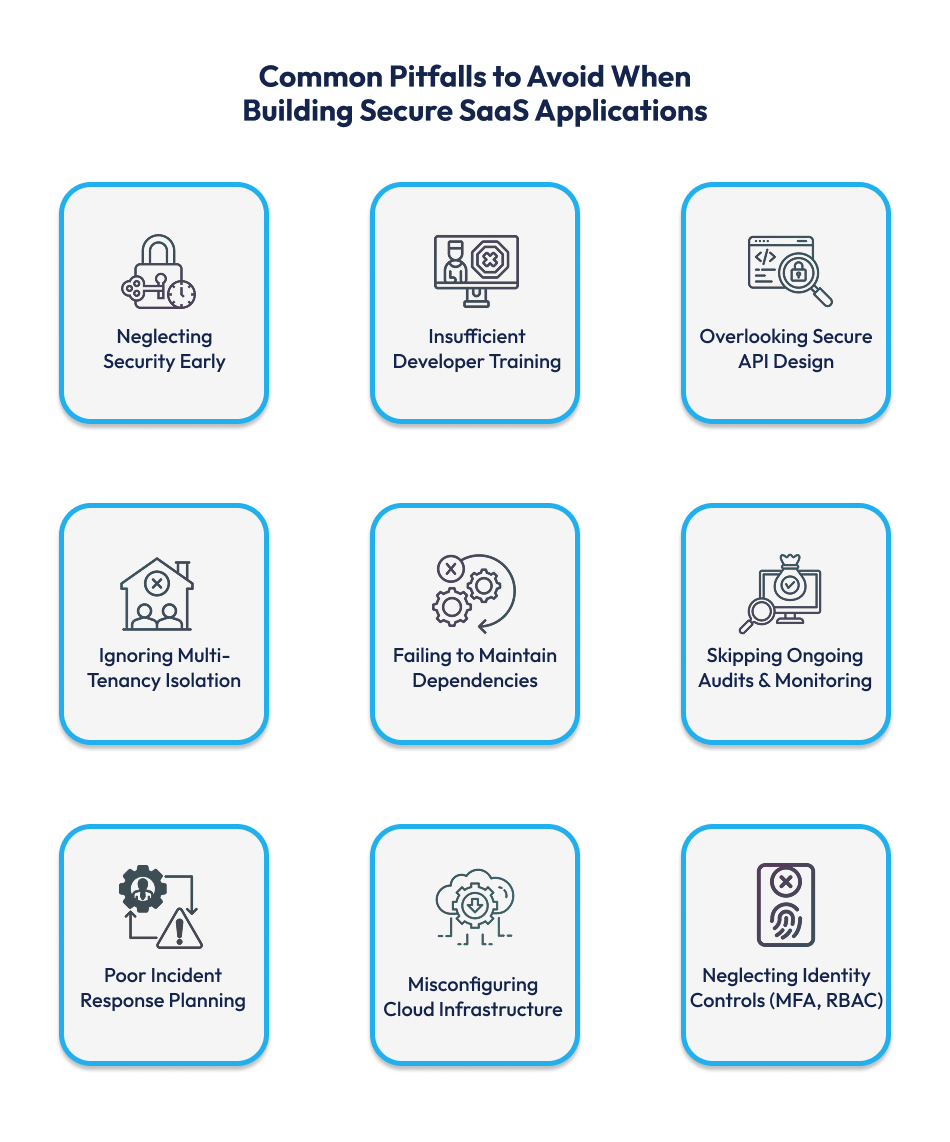
For a SaaS contract management solution, understanding the common mistakes in secure SaaS application development services can save time, budget, and customer trust. Avoiding these traps mitigates risk and strengthens your value proposition:
| Pitfall | Why It Matters in SaaS | How to Avoid It | Key Benefit |
| Neglecting Security Early | Delaying security integration leads to expensive retrofits, compliance gaps, and vulnerabilities | Embed threat modeling, secure design, and DevSecOps from the MVP stage | Lowers risk and cost; builds stronger SaaS architecture |
| Insufficient Developer Training | Lack of secure coding knowledge introduces OWASP-level issues into SaaS workflows | Provide ongoing secure coding education and appoint security champions | Fosters a secure dev culture and reduces bugs |
| Overlooking Secure API Design | Insecure APIs/webhooks are high-risk vectors in contract management tools | Enforce token auth, rate limits, schemas, signed webhooks, and frequent testing | Prevents data leaks and integration abuse |
| Ignoring Multi-Tenancy Isolation | Poor isolation in contract data stores can lead to cross-customer leaks | Implement strict tenant boundaries, segmented data stores, and access controls | Ensures data confidentiality and compliance in shared environments |
| Failing to Maintain Dependencies | Outdated libraries expose contract systems to known attacks | Use automated dependency scanners and CI/CD pipelines for patching | Keeps SaaS secure and compliant with minimal effort |
| Skipping Ongoing Audits & Monitoring | Relying on initial security without continuous monitoring risks hidden breaches | Schedule regular penetration tests, audits, and real-time logging | Detects threats early, supports forensic investigations |
| Poor Incident Response Planning | No defined breach plan causes delays and damages trust in contracts | Create and rehearse a response plan: detect, contain, recover, improve | Accelerates recovery and maintains client confidence |
| Misconfiguring Cloud Infrastructure | Misunderstanding shared responsibility leads to oversights in cloud setups | Use CSPM tools, infra-as-code, regular config reviews | Prevents misconfigurations and audit failures |
| Neglecting Identity Controls (MFA, RBAC) | Weak access control is a major entry point for contract data breaches | Require MFA, enforce RBAC, and conduct permission audits | Protects sensitive workflows and reduces insider risk |
Security as a Differentiator in SaaS Marketing
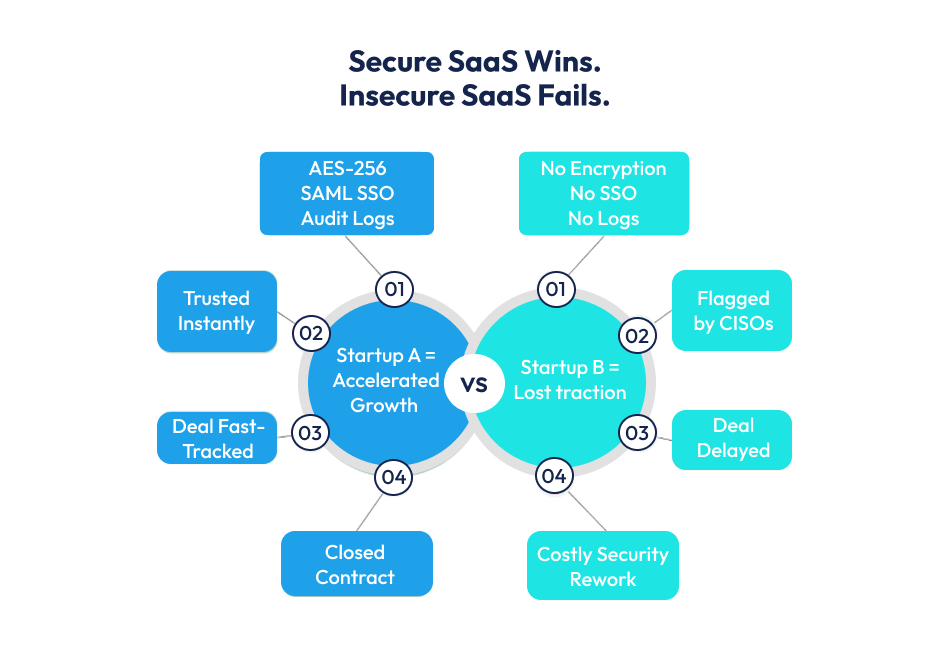
When it comes to B2B SaaS MVP development, the line between triumph and disaster can be as thin as a secure encryption key.
A startup launches a contract management SaaS MVP without security features, including encryption, SSO, or audit logs. As they pitch to an enterprise, CISOs flag vulnerabilities in a quick review. The deal stalls. Weeks spent courting the client are lost, pivoting to retrofit security costs months and thousands in rework.
The outcome? Fail.
A competing MVP is built with DevSecOps, embedded SAML-based SSO, AES-256 encryption, tenant isolation, and audit logging from day one. During demos, the startup highlights these features, CISOs immediately see reduced risk, procurement fast-tracks, and the contract closes.
The outcome? Win.
That early investment in security transforms it from a perceived cost to a deal catalyst. Amplifying SaaS marketing success and accelerating traction in enterprise pipelines.
AI-powered custom SaaS solutions often handle sensitive workflows, from predictive analytics to automated contract review. Buyers evaluate not just model quality but also data governance, API security, and run-time monitoring. Vendors who demonstrate AI-driven security features, like automated anomaly detection or predictive threat blocking. Additionally, they also showcase continuous monitoring and adaptive controls to gain enterprise confidence. AI-based security tools (e.g., Reco) have recently raised $55M, underscoring buyer demand for secure AI-first SaaS
A shift in buyer preferences is underway. According to B2BDaily, enterprises now view security as a core differentiator in SaaS selection, especially given the average cost of $4.45M for data breaches. Vendors who lead with security in their marketing often outperform competitors:
- Faster procurement cycles
- Higher willingness to pay
- Broader adoption across regulated industries
How to Embed Security into SaaS Marketing?
| Tactic | Why It Matters | Example |
| Security-focused onboarding | Position security as a value-add from day one | Our MVP includes SSO, encryption, and PCI logging |
| Marketing collateral | Builds trust with details on encryption, compliance, and auditability | Feature sheets, case studies, and datasheets |
| Live demos of security controls | Impresses technical buyers by demonstrating team readiness | Show real-time logs, RBAC, and response workflows |
| Certifications & 3rd-party audits | Validates claims and eases internal procurement risk | SOC 2, ISO 27001, penetration-test reports |
| AI in security messaging | Appeals to tech-savvy buyers in AI SaaS | Our engine flags anomalies in seconds using AI |
For B2B SaaS MVPs and AI-driven platforms, early security builds credibility, accelerates enterprise adoption, and unlocks growth. Leading with this in your SaaS marketing narrative helps you stand out, transforming security from a risk at the finish line into a competitive advantage from the first line of code. To get it right from the start, partner with the best AI app development company that embeds security and compliance into every layer of your product.
Enterprise-Ready SaaS Security Checklist
Key Strategies for Enhancing Cybersecurity SaaS Security & a Resilient Digital Infrastructure
- Encryption (TLS / AES‑256)
- Multi‑Factor Authentication (MFA)
- SSO / SAML / OAuth integration
- Role‑Based Access Control (RBAC)
- Signed Webhooks & API Throttling
- Vulnerability Scanning (SAST/DAST)
- Dependency/Library Updates
- Misconfiguration Management (CSPM/SSPM)
- Audit Logging & SIEM Integration
- Real‑Time Monitoring & Alerts
- Data Residency / Regional Hosting
- Secure Key & Secrets Management
- Automated Encrypted Backups
- Disaster Recovery Plans
- Incident Response Playbooks
- Tenant Isolation & Segmentation
- Cloud Infrastructure Hardening
- Secure Defaults & Infrastructure-as-Code
- Third‑Party Risk Assessment
- Vendor SLA & Compliance Checks
- Penetration Testing & Red Teaming
- DevSecOps in CI/CD Pipelines
- Secure Onboarding / De-Provisioning
- Security Awareness Training
Conclusion
Building secure SaaS applications is about trust, growth, and long-term enterprise success. From encryption and access controls to audit trails and secure DevOps, every layer of your SaaS architecture must reflect maturity and readiness.
So what did you learn today?
- Security drives enterprise buying decisions
- Early security integration reduces future costs and risks
- A strong SaaS security posture builds a competitive advantage
- Enterprise clients expect full-stack protection, from code to cloud
Invest in secure SaaS applications with the help of trusted experts. Partner with Techugo, a leading provider of end-to-end SaaS enterprise application development services.
Who’s Techugo?
Techugo is a global enterprise AI development company delivering scalable, secure, and enterprise-grade SaaS software development services. Whether you’re launching a B2B MVP or scaling an AI-powered platform, Techugo brings deep expertise in SaaS architecture. And expert compliance readiness, and cloud-native security. Our experts are your go-to partner for fast-growing startups and global enterprises alike.
Let’s build something secure, together with one of the best AI saas companies.

Get in touch
We'd love to hear from you.