

 SA
SA  KW
KW  IE
IE AU
AU UAE
UAE UK
UK USA
USA  CA
CA DE
DE  QA
QA ZA
ZA  BH
BH NL
NL  MU
MU FR
FR 














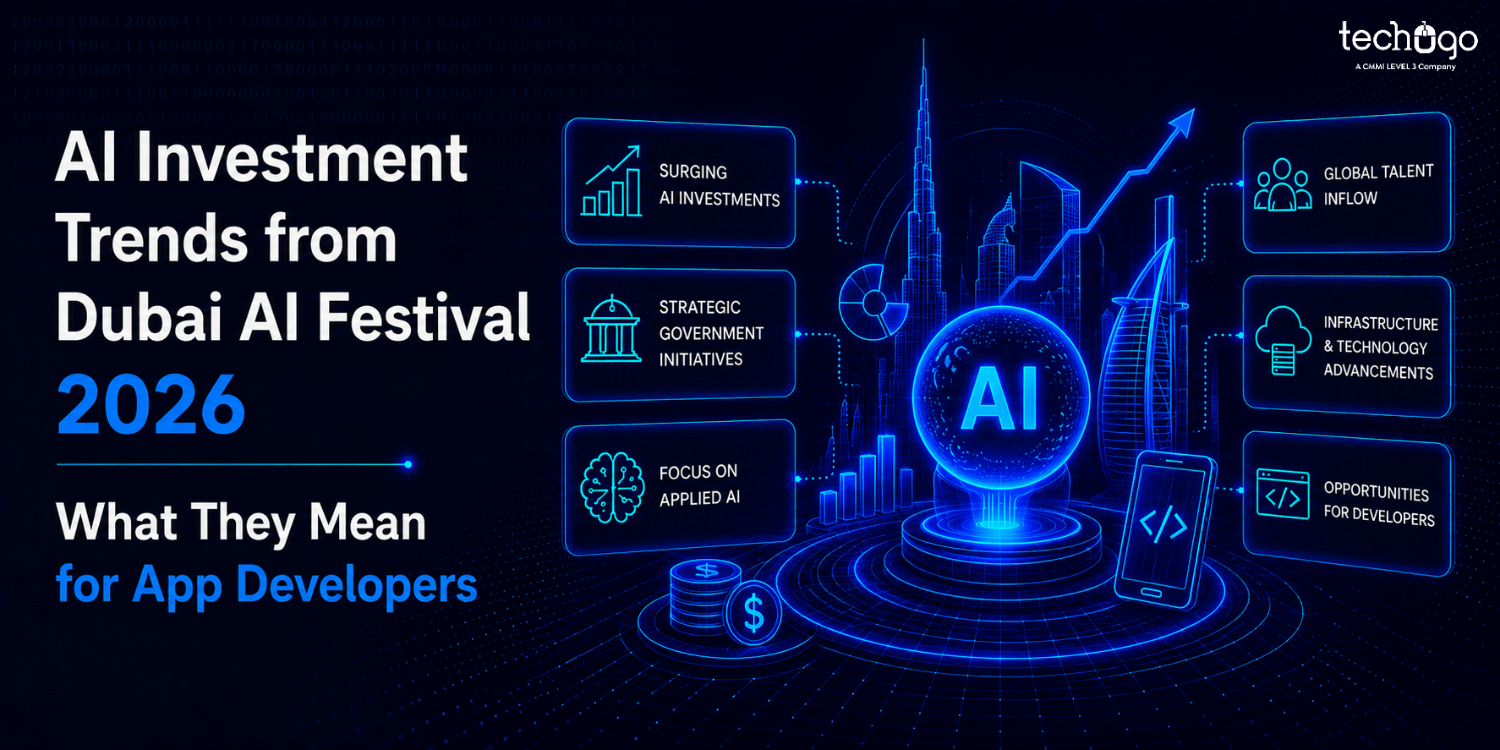


Artificial intelligence is a trend where serious money is going. Agree?
At Dubai AI Festival 2026, one thing became clear: investors are now focusing on AI that delivers real business value, not just ideas and this is already visible in the numbers.
According to PwC, AI could contribute up to $15.7 trillion to the global economy by 2030, while McKinsey & Company reports that companies are rapidly increasing spending on AI-driven solutions with clear ROI. But what does this mean for app developers?
It means expectations are changing. Investors are backing practical and industry-specific AI applications.
In this blog, we’ll break down the latest AI investment trends in 2026 and explain what they really mean for developers building the next generation of apps.
How AI investment trends in 2026 are shifting
AI investment trends in 2026 are changing direction. They’re moving from hype-driven spending to value-driven investment.
A few years ago, companies invested in AI to “try it out.” In 2026, that phase is ending. According to McKinsey, round 88% of companies are already using AI in at least one function. Now, the focus is on scaling what works. Even more telling, top-performing companies are seeing up to 3x returns on AI investments.
AI is becoming a core business investment. Companies are expected to double AI spending as a share of revenue in 2026. And global AI investment is projected to cross $300 billion+
Despite heavy spending, many companies are still struggling to see returns. Only 12% of companies report both cost and revenue benefits from AI. This is forcing investors to be more selective which means less funding for “cool ideas” and more funding for proven, revenue-generating AI use cases.
Massive capital is moving into AI infrastructure. Big Tech alone is expected to invest $700 billion in AI infrastructure in 2026. And data centers and computers are becoming critical assets.
Generic AI tools are losing appeal. Investors now prefer – healthcare AI, fintech AI, and logistics & govtech AI because these solve real, measurable problems.
A small group of companies is capturing most value. Around 20% of companies capture the majority of AI-driven gains. This shows a growing gap between companies that implement AI strategically and those that don’t.
AI is no longer concentrated in just the US or China. The Middle East, especially Dubai, is emerging as a strong AI investment hub. Governments are actively funding AI innovation and infrastructure.
What does this really mean?
AI investment in 2026 is no more about who is building AI but about who is building AI that actually works and makes money.
Key AI investment trends highlighted at Dubai AI Festival 2026
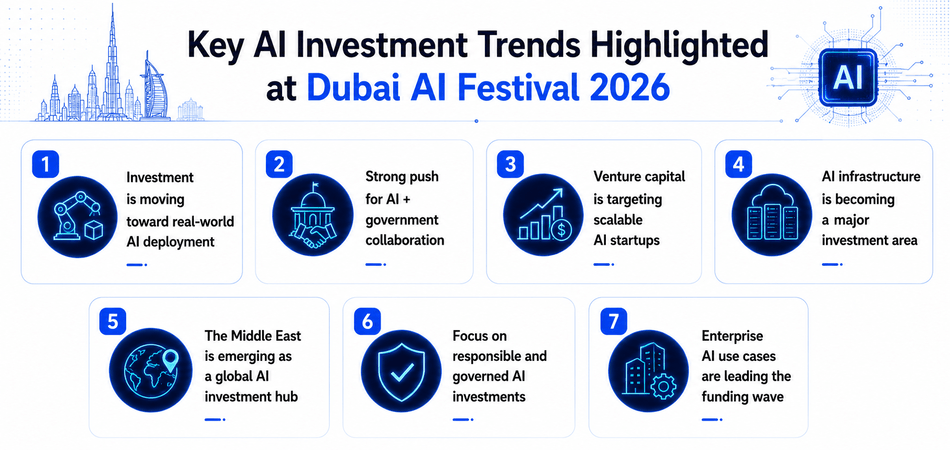
The conversations at Dubai AI Festival 2026 made one thing very clear – AI investment in 2026 is becoming more structured, strategic, and outcome-focused. It is no longer about experimenting with AI, but about scaling it across industries.
Here are the key trends that stood out:
1) Investment is moving toward real-world AI deployment
Investors are prioritizing AI solutions that are already being used in real business environments. The focus has shifted to deployment, adoption, and governance, rather than just innovation. This means funding is going to automation platforms, decision intelligence tools, and AI systems embedded into workflows.
2) Strong push for AI + government collaboration
One of the biggest highlights was the involvement of government bodies alongside private investors. 20+ government agencies participated to drive AI adoption. Public-private partnerships are accelerating AI funding.
This shows that AI investment is now backed not just by venture capital, but also by national strategies, especially in the Middle East.
3) Venture capital is targeting scalable AI startups
With top global venture capitalists actively participating, the focus is on startups that can scale quickly and solve specific problems. Investors are looking for:
- Industry-specific AI (healthcare, fintech, logistics)
- Clear monetization models
- Faster path to market
4) AI infrastructure is becoming a major investment area
A significant portion of discussions revolved around building the backbone of AI, not just applications. This includes AI platforms, data infrastructure, and computer ecosystems. The festival highlighted how AI infrastructure is becoming a core economic driver, not just a technical layer.
5) The Middle East is emerging as a global AI investment hub
Dubai is positioning itself as a bridge between global capital and innovation. AI is expected to contribute $320 billion to the Middle East economy by 2030. The region is attracting global investors, startups, and enterprises. This signals a clear shift in global AI market trends, from concentrated hubs to more distributed innovation ecosystems.
6) Focus on responsible and governed AI investments
Another important theme was AI governance and ethical deployment. Investors are now evaluating:
- Compliance readiness
- Data privacy frameworks
- Long-term sustainability
This is becoming a key factor in funding decisions, not just a regulatory checkbox.
7) Enterprise AI use cases are leading the funding wave
Large enterprises are driving demand for AI solutions that improve operational efficiency, customer experience, and cost optimization. With 20+ global enterprises showcasing AI solutions, it’s clear that enterprise AI is where most capital is flowing.
The biggest takeaway from Dubai AI Festival 2026 is that AI investment is about practicality, scalability, and measurable impact.
What these AI investment trends mean for app developers
The insights from Dubai AI Festival 2026 clearly show that AI investment trends in 2026 are becoming more focused and outcome-driven. Investors are no longer funding ideas alone. They are backing applications that deliver real business value. For app developers, this means building solutions that are practical and aligned with current AI funding trends.
One major shift is that AI is now a baseline feature. Simply calling an app “AI-powered” is not enough. Developers need to show how AI improves performance, reduces cost, or enhances user experience. This is where strong alignment with global AI market trends becomes important.
There is also a growing demand for industry-specific solutions. Current AI startup investment trends show that investors prefer apps built for sectors like healthcare, fintech, and logistics. These targeted solutions are easier to scale and attract funding faster.
At the same time, expectations around quality have increased. Apps must be secure and ready for real-world use.
In simple terms, the focus has shifted from experimenting with AI to building AI products that actually work and generate results.
Opportunities for startups & businesses in 2026
The current AI investment trends in 2026 are creating clear opportunities for startups and businesses that are willing to build practical, scalable solutions. Insights from Dubai AI Festival 2026 show that funding is moving toward applications that solve real problems and deliver measurable results.
- One of the biggest opportunities lies in building industry-specific AI solutions. As seen in AI startup investment trends, sectors like healthcare, fintech, logistics, and retail are attracting strong investor interest. Startups that focus on a single domain and solve a clear pain point have a higher chance of securing funding.
- Another growing area is AI-powered SaaS platforms. Businesses are increasingly adopting tools that automate workflows, improve decision-making, and enhance productivity. This aligns with broader AI funding trends, where investors prefer products with recurring revenue models and long-term scalability.
- There is also strong potential in AI-powered mobile apps. From personalized user experiences to predictive analytics, integrating AI into mobile products is becoming a standard expectation. This creates demand for reliable mobile app development companies that can build and scale such solutions effectively.
- In addition, the Middle East is emerging as a key growth region. With rising AI innovation in the Middle East (especially UAE) and government-backed initiatives, startups have new opportunities to expand, localize, and enter less saturated markets.
Overall, the opportunity in 2026 is not just to build with AI, but to build solutions that are focused, scalable, and aligned with real market needs.
Challenges developers must prepare for
As AI investment trends in 2026 evolve, developers must navigate rising complexity, costs, and expectations to stay competitive.
Rising competition
With rapid growth in AI investment trends in 2026, more startups and enterprises are entering the space. Standing out is becoming harder, especially when many apps offer similar AI capabilities.
High development costs
Building AI-driven applications requires investment in data, infrastructure, and skilled talent. These rising costs are a direct result of evolving AI funding trends and the demand for high-quality solutions.
Data privacy & compliance
As AI adoption grows, so do concerns around data security. Developers must ensure compliance with regulations and build systems that handle user data responsibly.
Scalability issues
Many apps fail when moving from MVP (minimum viable product) to large-scale deployment. Current AI startup investment trends show that investors prefer solutions that are ready to scale without major rework.
Talent gap in AI
There is still a shortage of skilled AI engineers and specialists. This makes it difficult for startups to build strong teams and deliver complex AI solutions efficiently.
Changing user expectations
Users now expect smarter, faster, and more personalized experiences. Keeping up with these expectations requires continuous improvement and alignment with global AI market trends.
Infrastructure complexity
Modern AI apps depend on APIs, cloud systems, and data pipelines. Managing this complexity is becoming a key challenge for developers building advanced solutions.
How to align your app strategy with AI investment trends
To stay aligned with AI investment trends in 2026, developers need a focused, practical, and outcome-driven approach.
1st Step: Problem-first approach
Start with real user problems, not just AI capabilities. This aligns with current AI funding trends, where solutions with clear business value attract more investment.
2nd Step: Partner strategically
Work with an experienced AI mobile app development company in UAE to ensure quality and faster execution.
3rd Step: Focus on niche markets
Build industry-specific apps for sectors like healthcare, fintech, or logistics. As seen in AI startup investment trends, targeted solutions are easier to scale and fund.
4th Step: Build for scalability
Design apps with strong architecture, security, and integrations from day one. According to global AI market trends, scalable products are more attractive to investors.
5th Step: Validate early
Launch quickly, but focus on real user feedback and traction. Investors now expect proof of value, not just speed.
6th Step: Strengthen AI integration
Make AI a core part of your app, not an add-on, and for this, leverage reliable AI integration services. AI integration should directly improve functionality and user experience.
Why the Middle East (especially Dubai) is becoming an AI investment hub
The rise of Dubai as an AI investment hub is driven by a clear vision and strong alignment with AI investment trends in 2026. Governments in the region are supporting AI and most importantly, are actively leading AI’s adoption. Initiatives like UAE National Strategy for Artificial Intelligence 2031 are creating a structured roadmap for AI growth across industries
At the same time, the region is attracting significant global capital. Investors, venture capital firms, and tech leaders are increasingly focusing on the Middle East as a high-growth market. Events like Dubai AI Festival 2026 are further strengthening its position within global AI funding trends.
Dubai’s business-friendly environment is another key factor. With easy company setup, strong infrastructure, and supportive regulations, startups find it easier to launch and scale. This directly supports rising AI startup investment trends, where speed and scalability are critical.
There is also a strong push toward innovation through smart city projects, fintech growth, and digital transformation initiatives. This is accelerating AI innovation in the Middle East and creating real, large-scale use cases for AI applications.
Overall, Dubai is not just attracting investment. It is creating an ecosystem where AI solutions can be built, tested, and scaled efficiently, making it a key global hub in the evolving AI landscape.
Follow the money, build the future
The direction of AI investment trends in 2026 is clear. Funding is flowing toward solutions that are practical, scalable, and built for real-world impact. For businesses and startups, this is not just a trend to watch, but a signal to act. Those who align their app strategy with these evolving AI funding trends in 2026 will be the ones shaping the next wave of digital products.
But building such AI-driven applications requires more than just an idea. It demands the right technology, strong execution, and a deep understanding of market needs. This is where partnering with an experienced Techugo, a top and trusted AI app development company, becomes crucial.
At Techugo, the focus is on turning ideas into scalable, high-performance AI products. With expertise in delivering end-to-end mobile app development services in Dubai, Techugo helps businesses design, build, as well as launch applications that are aligned with current global AI market trends.
In a space that is growing this fast, the smartest move is simple – follow where the investment is going, and build solutions that truly matter.
So, get in touch today and consult AI experts.
FAQs
1.What are the top AI investment trends in 2026?
AI investment trends in 2026 focus on enterprise AI, industry-specific solutions, AI infrastructure, and applications with clear ROI.
2.What is the Dubai AI Festival 2026?
Dubai AI Festival 2026 is a global event where investors, startups, and enterprises discuss AI innovation, funding trends, and future technologies.
3.Which industries are attracting the most AI investment in 2026?
Healthcare, fintech, logistics, retail, and government technology are attracting the highest AI funding.
4.How are AI startup investment trends changing?
AI startup investment trends are shifting toward niche, scalable solutions with strong business use cases and faster time-to-market.
5.What do investors look for in AI-powered apps today?
Investors look for scalability, real-world application, measurable ROI, strong architecture, and clear monetization strategies.
6.How can startups benefit from AI funding trends in 2026?
Startups can benefit by building industry-specific AI solutions, focusing on real problems, and validating their products early.

Get in touch
We'd love to hear from you.