

 SA
SA  KW
KW  IE
IE AU
AU UAE
UAE UK
UK USA
USA  CA
CA DE
DE  QA
QA ZA
ZA  BH
BH NL
NL  MU
MU FR
FR 














The onset of COVID‑19 was not just a global health crisis, but it was also a period that changed how the world thinks about healthcare, and how we access it. During the time when everything was disrupted, our only hope was some applications that bridged the space between a doctor and a patient, and we realized, you know, that booking an appointment on your smartphone was suddenly the most convenient thing because visiting the hospital was not always possible.
The digitalization of healthcare has made all this possible, and it was not only about convenience, but about safety too. Also the global mHealth apps market was valued at USD 36.68 billion in 2024 and is projected to nearly double by 2032. With the help of a healthcare app development company, solutions like pillCam and EHR (Electronic Health Records) were created that let doctors see everything inside the human body, and that also help healthcare professionals manage patient information digitally.
But, of course, storing all this data digitally comes with responsibilities because without proper protection, patient information can be at risk, that’s why the Health Insurance Portability and Accountability Act or HIPAA compliance is so important. Every entrepreneur who wants to develop their own healthcare app has to understand this act clearly, because it defines how you can collect, share, and protect sensitive patient data.
So, make sure you read through this post carefully, because understanding HIPAA is not just a legal requirement, it is essential if you want your app to be trusted, secure, and successful in the market otherwise, you could face penalties, fines, or worse, and nobody wants that.
Also Read: Generative AI in Healthcare: Top Applications and Use Cases
About HIPAA Compliance
HIPAA compliance represents such laws that restrict unauthorized access to a patient’s stored information. It favors that no one without the consent of the patient can access his/her information. Anyone doing it has to face several penalties and fines of around $25K.
As the leading market favors investing in mhealth apps, such measures are important so that no one can access, misinterpret, and amend the information inside. The penalties will be at your doorstep if you do not follow the HIPAA essentials below.
- Persons with their names having a hold of patients’ data and their medical history
- Every healthcare contributor, such as doctors, insurers, and clinics, has access to PHI (Protected Health Information)
- Contractors that let the healthcare professionals disclose the PHI.
These essentials are vital; however, not all apps fall under HIPAA compliance. The section below covered which app categories can eliminate these HIPAA essentials, therefore, ensure to read further.
Which Healthcare Apps Fall Under the HIPAA Compliance?
As per the survey, it is estimated that 88% of healthcare apps have codes that provide no security against threatful access, and one can easily get hold of patients’ data.
Neglecting such a crucial feature when security is the most critical concern can bring you much more trouble with your digital solution.
That’s why you have to learn the factors that can help you identify if your app falls under HIPAA compliance or not.
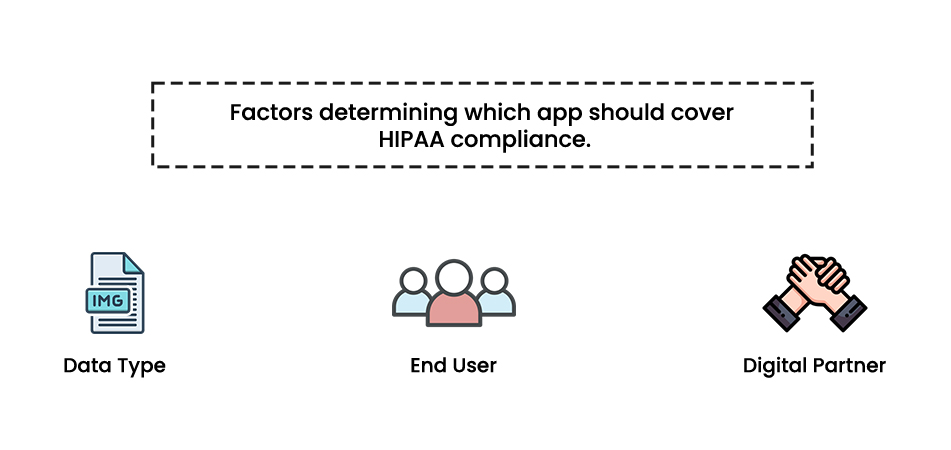
Data Type
If the data type concerns collecting, processing, and sharing of information from one digital platform to another, it signals that you must follow the PHI protection covered under the law.
However, you are in luck if the data ensures allowable uses. That means you can share the information with healthcare professionals for treatment, not for any other purposes.
Thus, you are safe if your app is used appropriately.
End Users
It also depends on the end-users whether your app follows the HIPAA rules & regulations or not.
For example, if the mhealth app is created for telemedicine, hospitals, or clinics, where anyone can make amendments to the information, you must follow the regulations correctly. As different third-party groups can access, alter, or edit sensitive data, it is essential to have this.
Digital Partner
If you go to the on-demand app development company to build an app that favors the laws and regulations covered inside PHI, ensure that the developer follows the act properly.
HIPAA Compliant Patient Data: What You Need to Cover?
Until now, we have learned about the healthcare apps that must be created with HIPAA compliance; it’s time to move further and resolve your queries on which patient’s information must abide by the regulation.
PHI covers any of the 18 identifiers of a patient given below:
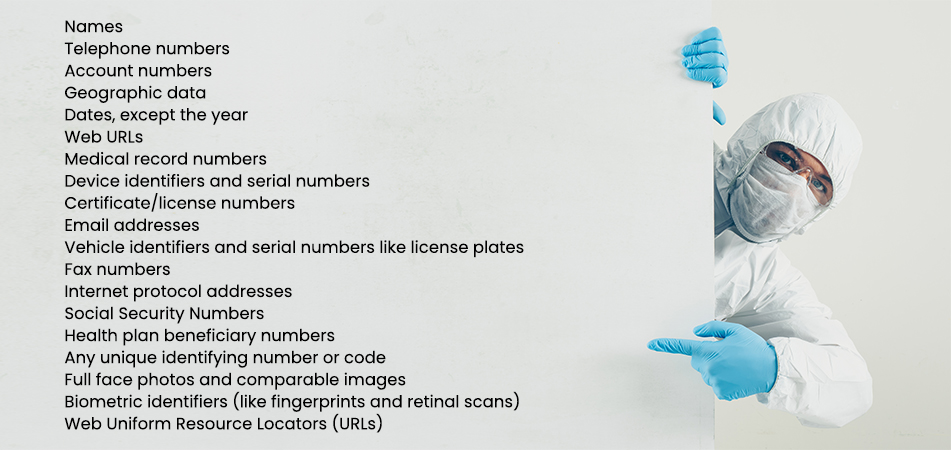
However, removing any of this information means de-identified PHI, which means your app is not restricted from following the rules of HIPAA.
Other Core Components of HIPAA
Core components of HIPAA that signify the collection, sharing, saving, and accessing of PHI are provided below. Ensure to take a deep insight.
Security Law
Security block plays a major role in protecting health information against all kinds of threats, leaking, and unauthorized access to the data. It includes every technical and non-technical measure for maintaining the integrity and confidentiality of the information.
The right technological partner will surely help you build an application that defines the best security. You must present your healthcare app ideas to your team of developers so that they can create a significant product out of it.
Enforcement Law
While somehow, the PHI is breached, this rule takes shape and prepares such provisions that make the providers chargeable for the following threatful access. The victim only has to file a complaint against the investigation, and everything gets sorted out thereafter.
If we look at the statistics, more than 256,086 out of 259K issues have been resolved since 2003, indicating the powerful impact this rule has been making upon several lives.
Privacy Law
Another important block responsible for safeguarding and transmitting information is the Privacy Rule. It is applied to every form in which we usually store information, like paper, oral, or electronic.
Below are the applications’ requirements that let you save, secure, and regulate the information:
- Data access should be limited
- Users can only access their own PHI
- Asking users for permissions before initiating any operations with PHI.
- Right to users for disclosing PHI.
- Restriction to full disclosure of information.
- Notifying users about the use method, cases, and disclosure of data.
- Patient Safety Law
According to this rule, healthcare professionals can share the patients’ information with Patient Safety Organizations. It is generally used for collecting and analyzing information while neglecting all kinds of errors and issues.
Breach Notification Law
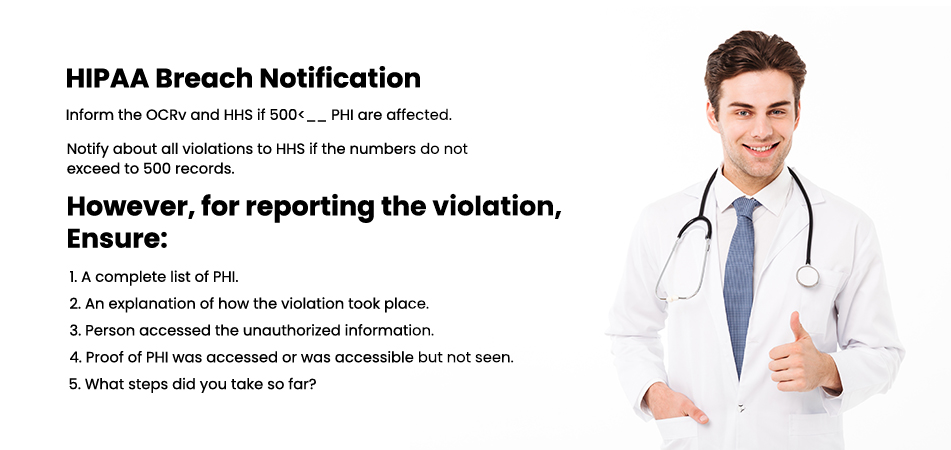
The law articulates that organizations need to notify individuals if any data breach leads to a threat to information. Within 60 days, the organization has to notify the patient. However, if the rule is violated, the violator must go through any of the protocols according to the people affected.
How to Build a HIPAA-Compliant App
The requirements to create a full-fledged HIPAA-compliant app may leave you all breathtaking. However, top-notch developers who are perfectly trained in building such quality applications can make you relieve your stress.
But that does not mean your healthcare app will be secured against penalties. You must gain a full insight into everything to avoid a deep pitfall.
Therefore, try to differentiate between the technical and non-technical requirements. The former one requires several rules, so ensure to move on to learn about this.
Access Controls
It restricts access to information to network participants. This safeguard standard will decrease the danger of data breaches and threatful access to information.
Let us explain it with an example of a doctor who is restricted from sharing the data with other associates if they do not have any authorization rights. It falls under the Minimum Necessary Standard that depicts patients will not be allowed to see more than the required data.
Pointers below will help you figure out how Access Control Standard works:
- Emergency access
- Encryption and decryption of data
- Unique user identification system with smart keys, passwords, biometrics, and PIN.
- Automatic logoff.
- Data Backup
Data backup is vital to fight against any kind of loss and unauthorized access. The world today favors cloud backup that lets the user recover the data anytime, anywhere, with just the requirement of an internet connection.
Also, you can research the cost to develop a healthcare app with a hybrid backup solution and connect to the best team of developers who can create a significant product that will add more to your growth.
Data Encryption
Data encryption ensures a shield against all unauthorized access by making the data unreadable. The patient’s data will not be turned into useful information or cannot be read or viewed if some unauthorized person tries accessing it.
A perfect way to provide safety to a patient’s data. This law requires encoding the data once it moves into other networks.
Security Audits
Security audits is responsible for vulnerability assessment, risk assessment, compliance checks, and penetration verifications. It also ensures regular security evaluation to provide proper protection to data.
Disposal Methods
This evolves into a concern of making electronic patient information unreadable. So, for that, the law covers the clearing method as the final disposal of electronic records.
Also Read: Understanding AI in Healthcare App Development in UAE
Cost to Build HIPAA-Compliant App
Features matter a lot when it comes to HIPAA-compliant healthcare app development because patient data is sensitive, and mistakes can be really costly so you have to be careful. The cost to build a healthcare app that is HIPPA compliant depends on many things and it was observed that the type of app, the platforms, and the features all play a role but let’s break it down, so you get an idea.
If you go for a basic appointment booking or patient info app (with login, profile, and simple notifications), the cost usually ranges from $20K–$35K. But if your app includes telemedicine, chat features, or video consultations, the cost increases…somewhere around $35K – $60K because more integrations and stricter compliance checks are needed and the timeline gets a bit longer.
And then if you want to integrate EHR, or advanced security, or even AI-assisted diagnostics, the cost can go much higher around $50K–$150K. And timelines can stretch from 6 months up to a year, depending on the team, technology and how careful you are about compliance.
Here’s a quick table, so you can see it more clearly:
| App Type | Average Development Cost (INR) | Average Cost (USD) | Estimated Timeline |
| Basic Appointment & Patient Info | ₹15 L – ₹25 L | $20K – $35K | 3 – 4 months |
| Telemedicine & Chat Features | ₹25 L – ₹45 L | $35K – $60K | 4 – 6 months |
| EHR Integration & Advanced Security | ₹40 L – ₹90 L | $50K – $120K | 6 – 9 months |
| AI Diagnostics & Complex Workflows | ₹80 L – ₹1.2 Cr | $100K – $150K | 8 – 12 months |
Now these are averages and your actual cost can vary because of the platforms and the features, and also the team you choose. For example, iOS apps need device-specific encryption, web apps need server-level security, and cross-platform apps have their own challenges. So timelines can stretch and the budget can go up because it’s not only development but also testing, audits and ensuring compliance, and making sure your data is secure.
Other factors that affect cost are:
- Cloud vs on-premises data storage & encryption,
- Regular security audits & testing,
- Third-party integrations like labs, pharmacies, EHR systems, and
- Ongoing maintenance & updates, because HIPAA rules keep changing, and you have to stay compliant, so that you don’t face fines.
So yes, building a HIPAA-compliant healthcare app is not cheap, but it’s worth it because it protects patients, it protects your brand, and it protects you from penalties that can go up to $50,000 per violation, and nobody wants that, right?
Also Read: Generative AI in Healthcare: Top Applications and Use Cases
HIPAA Compliance for Mobile vs Web Apps
So when you are thinking about building a HIPAA-compliant healthcare app, you might wonder – should it be mobile, web, or maybe both? Well, it’s not that simple because each platform has its own challenges and it was noticed that compliance rules, development complexity, and user convenience all vary and sometimes it can get confusing.
Mobile apps (iOS or Android) are usually very convenient for patients because they can check records, book appointments, and even chat with doctors anywhere, anytime, but they also bring their own risks because smartphones can be lost, stolen, or hacked, and therefore encryption, secure logins, and remote wipe capabilities are essential. And updates…they need to happen regularly so that HIPAA compliance is always met, otherwise you could run into problems.
Web apps, on the other hand, are easier to manage from the server side, because they run on browsers, and you can implement centralized security, backups, and cloud storage more easily. But, they can be less convenient for users on the go, and you have to make sure that session timeouts, access control, and secure logins are strictly enforced, because patient data is sensitive, and one mistake can cost a lot.
Here’s a simple table so you can see the comparison clearly:
| Feature / Factor | Mobile App (iOS/Android) | Web App | Cross-Platform / Hybrid |
| Ease of Access | High – patients can use anytime, anywhere | Moderate – browser required, less convenient | High – single codebase works across platforms |
| Security Requirements | Device encryption, biometric login, remote wipe | Server encryption, session timeouts, centralized control | Both mobile & web security combined |
| Development Complexity | Medium – separate builds for iOS & Android | Low – single codebase | Medium – some platform-specific tweaks |
| Timeline | 4 – 6 months (basic) | 3 – 5 months (basic) | 5 – 7 months (basic) |
| Cost Estimate | $35K – $60K | $25K – $45K | $40K – $65K |
| Maintenance | Frequent updates for OS changes | Server maintenance, patching, backups | Both maintenance types combined |
So you see, whether mobile, web, or hybrid, HIPAA rules are the same and you cannot skip encryption, access control, audits, or backups, but the way you implement them changes depending on the platform, and because of these differences, your healthcare app development company has to carefully plan everything from day one, so that you don’t face penalties later.
In short, mobile apps are better for engagement, web apps are easier to maintain, and hybrid tries to combine the best of both worlds, but remember, all require strict HIPAA compliance otherwise your patient data, your brand, and your business could be at risk and nobody wants that, right?
To Sum it Up!
No one would deny the fact that healthcare applications prove to be game-changing elements for the industry. The best use of technology is deriving such solutions that bridge the gap between doctors and patients.
However, this arriving technology can prove to be a threat to patients if any of their information gets misplaced. So, in that case, HIPAA compliance is mandatory.
Indeed, it is no more than digging a passageway to build a HIPPA-compliant application. But don’t worry; Techugo, a leading healthcare app development company, is set to create your own digital solution.
You can maintain the integrity of the law while developing a favored application with the support of our top-notch developers. Ensure to connect with us if you want further assistance and guidance.

Get in touch
We'd love to hear from you.