

 SA
SA
 KW
KW
 IE
IE AU
AU UAE
UAE UK
UK USA
USA
 CA
CA DE
DE
 QA
QA ZA
ZA
 BH
BH NL
NL
 MU
MU FR
FR










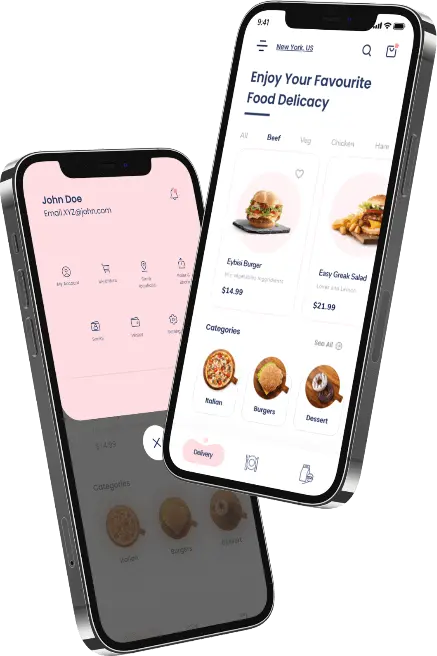

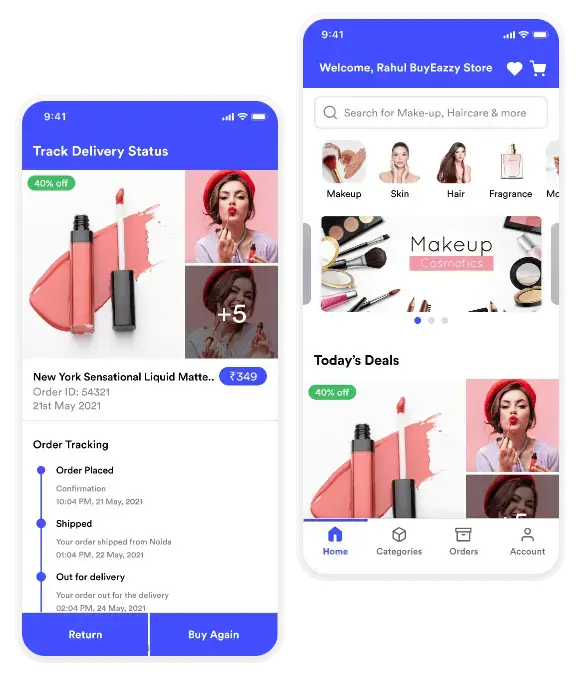




📌 Key Takeaways
- Pickup and delivery app development cost ranges from $20,000–$50,000 for an MVP to $80,000–$150,000+ for enterprise-level solutions.
- Real-time tracking, quick updates, and flexibility are just expected now in delivery app development, no extras anymore.
- Last-mile delivery services are pushing businesses to go smarter and more automated so delays don’t pile up.
- Delivery apps only work well when customer, driver, and admin panels actually sync and run smoothly together.
Someone places an order.
Ten minutes later, they’re already refreshing the tracking page.
We have all done it.
Now the reality is that delivery is not only about getting a package from point A to point B anymore. Because customers want to know where their order is, when it’s arriving and whether it’s actually on schedule. And if they cannot get those answers quickly… they’ll probably look elsewhere next time.
That’s a big reason why pickup and delivery app development has moved from being a nice-to-have to a business necessity.
As reported by Grand View Research, the worldwide market for last-mile delivery was assessed at $167.36 billion in 2025, with forecasts indicating it will climb to $348.85 billion by 2033.
Of course building one isn’t as simple as putting a tracking map into an app. From deciding on the right features to understanding the delivery app development cost, there are several factors that can influence the success of your platform.
In this guide we’ll break down the complete parcel delivery app development process, must-have features, costs, and the technologies driving modern delivery experiences.
Why businesses are investing in on-demand pickup and delivery app development
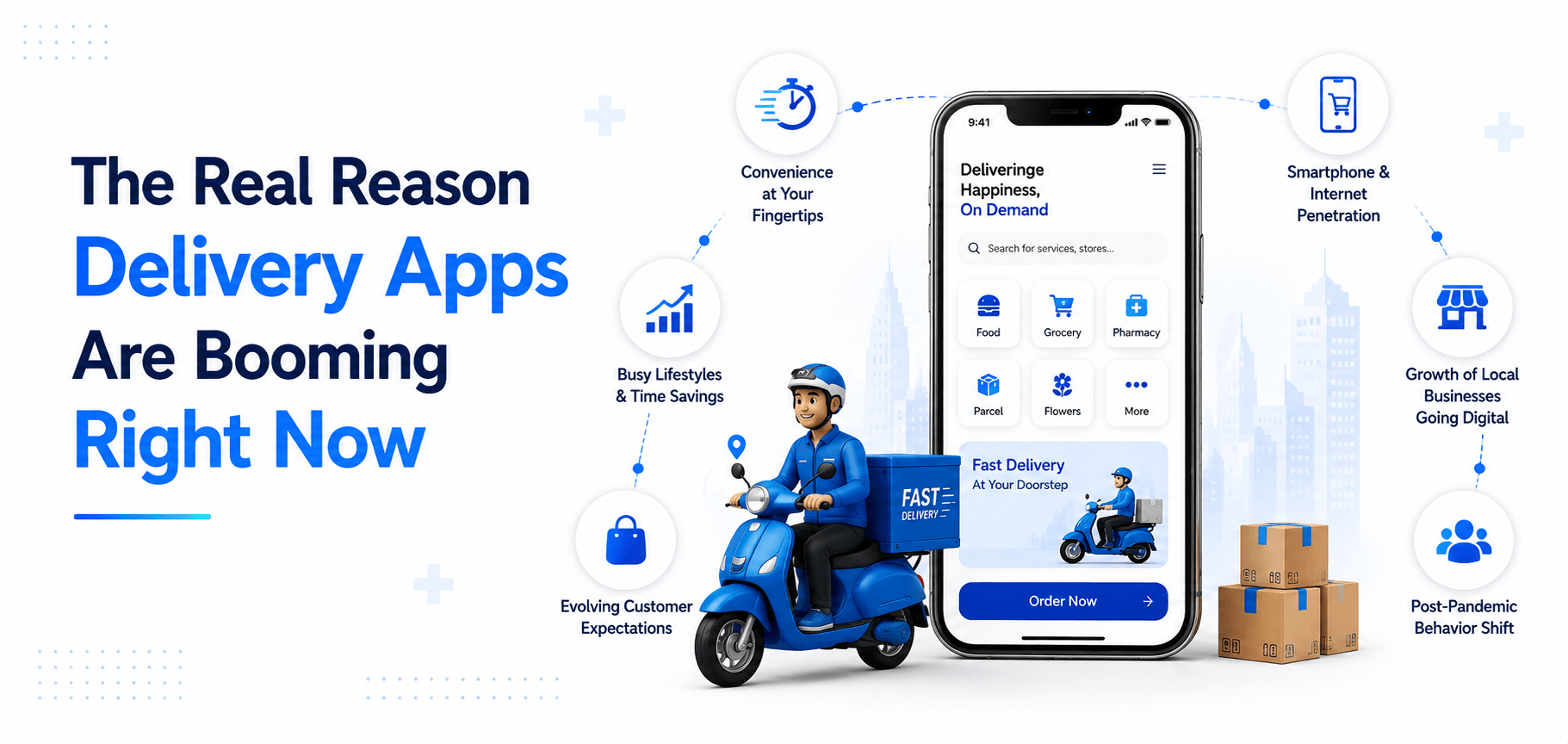
The way people shop and get stuff delivered today has honestly changed dramatically compared to a few years ago. Waiting patiently? That’s basically extinct. Fast delivery isn’t a “wow feature” anymore – it’s the bare minimum. Whether it’s groceries, medicine, clothes, or literally anything you can think of, businesses are now heavily investing in pickup and delivery app development.
And it’s not just about speed anymore. The real challenge is chaos control. More orders, more pressure, more “where is my order?” messages. That is precisely why tools like delivery scheduling software and custom delivery platforms are becoming the behind-the-scenes heroes: keeping everything from exploding when demand spikes.
Customer expectations for faster deliveries
Let’s be real – nobody today is sitting patiently waiting for updates. Everyone wants to know exactly where their order is, like it’s a live Netflix tracker.
Customers now expect:
- Real-time tracking that actually updates in real time
- Delivery timings that don’t feel like a guessing game
- Flexible slots because life doesn’t revolve around delivery trucks
- Speed, because if it’s not instant, it already feels late.
This is where parcel delivery app development comes in clutch. And when businesses work with an on-demand pickup and delivery app development company, they’re basically building systems that make deliveries feel less like “logistics” and more like “tap, track, done.” And honestly that’s what keeps customers hooked.
Growth of last-mile delivery services
The last mile: the place where delivery promises go to either succeed or completely fall apart.
With e-commerce and hyperlocal orders exploding, businesses are constantly juggling speed, traffic, delays, and that one driver stuck somewhere asking for directions. So naturally, delivery scheduling software and smarter routing tools are stepping in like the calm friend who actually has their life together.
With the right system in place, businesses can:
- Stop delivery delays from becoming a daily horror story
- Plan routes that don’t look like they were made by random guessing
- Help drivers actually finish shifts without chaos
- Handle peak orders without everything going into panic mode
At the end of the day, customers don’t care about backend complexity. They just want their order to arrive fast, smooth, and without them refreshing the tracking page 47 times.
Types of pickup and delivery apps
Pickup and delivery apps are built to serve different business models and customer needs, so understanding the types available is key to choosing the right one for you.
Food pickup and delivery apps
These are the apps that connect you with restaurants, cafes and food outlets so that orders can be placed for pickup or doorstep delivery. Real-time tracking, multiple payment options, and personalized recommendations are what make them popular.
Grocery delivery apps
Grocery delivery apps let you order daily essentials and fresh produce from nearby stores. They have been a go-to because same-day and scheduled deliveries are just that convenient.
Courier and parcel delivery apps
Designed for personal and business logistics – these apps help you send documents and packages quickly, but it were the route optimization and live tracking features that really set them apart.
Retail and e-commerce delivery apps
These support retailers and online stores so that product deliveries are managed directly to customers, and order fulfillment are streamlined because flexibility and delivery updates are built in.
Pharmacy delivery apps
These apps let you order prescription and over-the-counter medications from licensed pharmacies and features like prescription uploads and refill reminders are what make them especially useful.
On-demand service delivery apps
On-demand service delivery apps are platforms that deliver services rather than products, and it were things like laundry, dry cleaning, and home maintenance that have been made more convenient because scheduled pickups and service tracking are part of it.
The real benefits behind pickup and delivery platform development
Faster and smoother operations
Once everything moves into a proper system, things just stop getting stuck in loops of calls, messages, and manual coordination. Orders get assigned faster, drivers know exactly what they’re doing, and deliveries move without unnecessary delays piling up in between.
Better customer experience
People don’t just want their order delivered anymore — they want clarity. They want to know what’s happening without having to ask. Real-time tracking, live updates, and accurate ETAs quietly fix that gap and make the whole experience feel more trustworthy and predictable.
Easier business management
Instead of handling orders, drivers, and schedules across different tools or spreadsheets, everything comes together in one place. That alone removes a huge amount of daily confusion and makes operations feel way more under control.
Lower operational costs
When routes are optimized properly and deliveries are assigned smartly, there’s a lot less wasted travel. Less fuel, fewer delays, and better use of drivers eventually translate into real cost savings — even if that’s not obvious on day one.
Scalable growth without chaos
Manual systems usually start breaking the moment order volume increases. But with a proper pickup and delivery app setup, scaling doesn’t feel like everything is falling apart. It just feels like handling more demand within the same structure.
Better driver efficiency
Drivers get clear routes, structured assignments, and fewer last-minute changes. That means less confusion on the road and more completed deliveries in a shorter time frame, without unnecessary stress.
More consistent delivery performance
At the end of the day, the biggest win is consistency. Deliveries become more predictable, operations become more stable, and the business stops relying on guesswork to keep things running smoothly.
Pickup and delivery app development cost (MVP vs enterprise)
Before we talk about cost, you should know that every delivery app is not built equal.
When it comes to pickup and delivery app development cost, businesses usually end up seeing a wide pricing range, and this happens because features, platform complexity, and scalability needs all play a role. On average, an MVP can start from $20,000–$50,000, while a fully scalable enterprise solution can go up to $80,000–$150,000+. And the difference, really, is because of how advanced the logistics workflows are, and the integrations.
To get a clearer picture, here is a side-by-side view.
| Factor | MVP (basic version) | Enterprise Solution |
| Cost Range | $20,000 – $50,000 | $80,000 – $150,000+ |
| Timeline | 6–12 weeks | 4–9 months |
| Features | Basic booking, tracking, payments | AI-based routing, analytics, multi-role system |
| Users | Customers + Drivers | Full logistics ecosystem |
| Scalability | Limited | High-scale architecture |
For businesses that are planning growth, understanding this breakdown is key because it helps you choose the right development path, and avoid overbuilding or underestimating what you actually need.
If you are evaluating options then in that case, working with experienced pickup and delivery app development companies can help you balance cost, features, and long-term scalability effectively. So that you don’t just build an app, but you build something that actually works for you and the system it was meant for.
Factors affecting pickup and delivery app development cost
There’s no fixed number for building a pickup and delivery app because it really depends on what you are actually trying to build and how far you want to take it. A simple Minimum Viable Product and a full-scale logistics platform might look similar on the surface – but once you go under the hood, the effort, time, and complexity are completely different.
Features and app complexity
This is usually the biggest factor, because what you put into the app directly shapes the cost. If it’s just basic stuff like booking, tracking, and payments, then it stays relatively simple. But the moment you start adding live tracking, smart dispatching, AI-based routing, or detailed dashboards, the system becomes heavier – and so does the development effort.
Platform choice (Android, iOS, or both)
Then comes the platform decision. If you are only building for one platform, the cost obviously stays lower. But most businesses don’t stop there, they want both Android and iOS users covered, and that either means building separately for each or using cross-platform tools, which again changes the effort and pricing structure.
UI/UX design requirements
Design also plays a bigger role than people expect. A simple interface is faster to build, yes. But if you want something that feels smooth, intuitive, and easy to use (especially in delivery apps where every second matters) then more time goes into designing it properly, and therefore the cost goes up.
Third-party integrations
Delivery apps don’t really work alone because they depend on a lot of external systems. Payment gateways, maps, SMS or OTP services, push notifications and sometimes even CRM or ERP tools: all of these need to be integrated properly, and each one adds both development time and testing effort.
Real-time tracking and live updates
This is where things start getting more technical. Features like live tracking, driver location updates, and real-time order status aren’t just “features” – they need a backend that runs continuously and stays stable all the time so that data keeps syncing without delays or errors.
Backend architecture and scalability
If you are thinking long term, backend architecture becomes really important. A system that handles 100 orders a day is very different from one handling thousands, so you need to build it in a way that it can scale properly without breaking when demand increases.
AI and advanced features
Now when you add AI-based features like route optimization, demand forecasting, or smart dispatching, the complexity increases again because now it’s not just static logic – it is data-driven decision-making which needs more engineering effort and ongoing refinement.
Development team & location
Even the team you select also holds significance. Various regions present distinct pricing structures, and the expertise of the individuals involved is another factor. While more seasoned teams might command a higher price, they also tend to minimize errors and subsequent rework, which frequently proves advantageous overall.
Maintenance and ongoing support
And finally? There is maintenance. Because launching the app is not the end of the work. Updates, bug fixes, server monitoring and new feature rollouts all continue after launch – that ongoing effort is part of the real cost that many people don’t fully consider at the beginning.
How long does it take to build a pickup and delivery app?
Honestly there’s no definitive resolution to this. Some apps are pretty simple and can be built quickly while others? They are more like full systems running an entire delivery operation – and those obviously take time.
To understand the full picture… it helps to first look at the actual development timeline.
MVP stage (6–12 weeks)
If you’re just trying to get something out quickly to test your idea, an MVP is usually the fastest route. It covers the basics like user login, placing orders, payments and simple tracking. It’s not super advanced, but it does the job of helping you see how users actually respond in real life.
Full app with core features (3–6 months)
Once you start adding more serious features like real-time tracking, driver management, route optimization, notifications, and a proper admin panel, things naturally take longer. At this point, you’re not just building an app anymore – you are building a proper delivery system that actually runs operations.
Large-scale or enterprise platform (6–9+ months)
If you’re building something big, like a multi-city or high-volume logistics platform, the timeline stretches further. This is where things like AI-based routing, advanced analytics, multiple integrations, and scalability come into play. A lot more time goes into planning and making sure everything holds up when traffic increases.
But what actually changes the timeline?
No it’s not just the features.
A lot depends on how complex the design is, how many third-party services you’re connecting, how stable the backend needs to be and even how many changes come in during development. Sometimes the idea stays the same but small changes along the way can stretch timelines without anyone really noticing it happening.
At the end of the day it really comes down to this – if you just want to validate an idea, you can move fast. But if you want something solid that can actually handle real demand, then it’s going to take time. There’s no shortcut around that.
Essential pickup and delivery app features
Great delivery apps don’t succeed by chance – they succeed because the right pickup and delivery app features are built in from the start, and the whole system kind of depends on that.
In on-demand delivery app development, the real focus is not just the app itself but also how smoothly it can handle operations, users, and real-time delivery flow because if that part is weak, everything else starts to fall apart.
A well-structured feature set ensures better user experience, faster deliveries, and more reliable day-to-day performance, and therefore it becomes the core of how the app was actually designed to work – not just how it looks on paper.
Take a look at the core features that make it work.
Customer app features
For end users, the app should be simple, fast, and transparent so that they can place and track orders without friction.
- Real-time order tracking
- Delivery scheduling
- Multiple payment options
- Push notifications
- Order history
Driver app features
The driver side is the operational core of any on-demand delivery app development system, and it must support efficiency and accuracy.
- Route optimization
- Delivery status updates
- Navigation integration
- Proof of delivery (OTP/photo/signature)
Admin panel features
The admin panel acts as the control center, especially in parcel delivery app development, where managing logistics at scale is critical.
- Fleet management
- Order management
- Driver management
- Delivery analytics dashboard
AI features in delivery apps
Modern pickup and delivery app features are no longer limited to basic tracking and dispatch. AI is now playing a major role in improving speed, efficiency, and decision-making.
AI-based traffic analysis
AI helps delivery systems respond to real-world conditions in real time.
- Real-time traffic monitoring
- Dynamic route adjustments
- Reduced delivery delays
Smart delivery automation
Automation ensures faster and more accurate order handling.
- Intelligent order allocation
- Predictive delivery estimates
- AI-powered route optimization
Delivery demand forecasting
AI also helps businesses prepare ahead of demand spikes.
- Resource planning
- Fleet utilization optimization
- Operational efficiency improvements
Step-wise on-demand delivery app development process
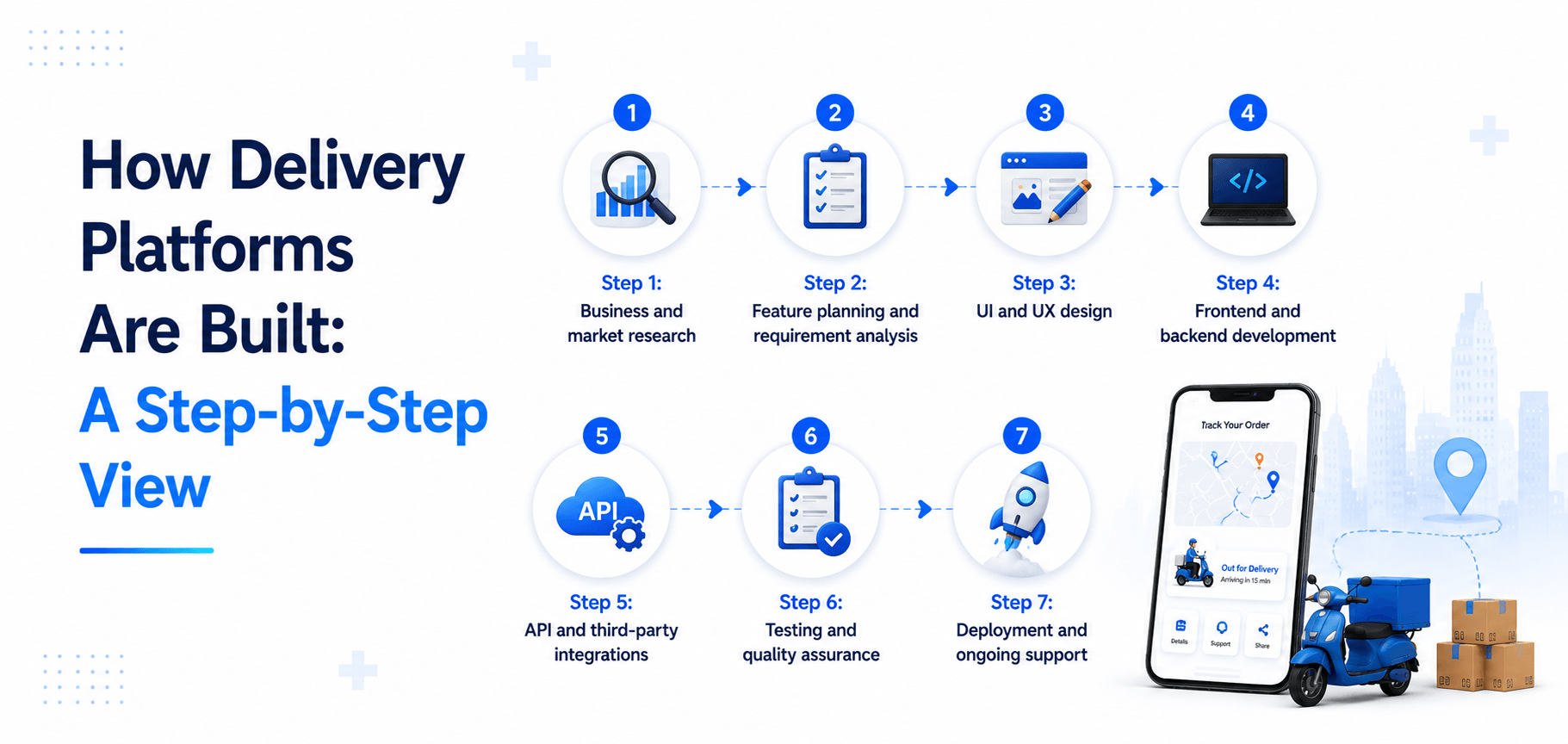
Step 1: Business and market research
Before anything gets built, the first thing you do is, understand what exactly you are solving and why it even matters. Who is the app for and what problems are users facing right now in logistics app development or pickup and delivery app development solutions, because without this clarity, everything else just becomes guesswork. This step is all about digging into the market, checking competitors, and also seeing where your idea actually fits, so that you are not just building another “me too” product, and yeah sometimes people skip this but it was always a mistake.
Step 2: Feature planning and requirement analysis
Now things start getting a bit more practical and structured, you look at what the app should actually do, and how it should behave in real usage. From live tracking and route optimization in logistics apps and also pickup scheduling and instant dispatch in delivery apps, everything gets mapped out here, but not in a perfect way at first, it keeps evolving. You basically turn ideas into a proper checklist that developers can follow, so that nothing important gets missed later on, or at least that’s the goal.
Step 3: UI and UX design
This is the point where things start to feel real, because you are no longer just thinking, you are actually seeing it. Screens are designed in a way that users can understand quickly, and not get confused or lost, because if they are thinking too much then something is wrong. Whether it is a logistics dashboard or a simple pickup booking screen, the focus is on making it smooth and easy, and also kind of obvious, so that users just flow through it without effort, or frustration really.
Step 4: Frontend and backend development
Here is where everything starts coming alive, the frontend is what you see and click, and the backend is everything that quietly makes it all work. From order placement to real-time tracking updates, it all runs together and sometimes things get complex but that’s normal. This is basically the engine behind pickup and delivery app development platforms, and without it, nothing really functions at all.
Step 5: API and third-party integrations
No modern app works alone anymore and that’s just how it is. Payments, maps, notifications and other services all get connected here, and it makes the system feel complete. These integrations make sure your app can process payments properly, show live locations & also keep users updated in real time so that everything feels smooth instead of manual or broken.
Step 6: Testing and quality assurance
The app is tested properly before anything goes live. And sometimes? Aggressively. Because you want to find issues before users do. Bugs, crashes, performance problems, everything gets checked, fixed and then checked again. It is a bit repetitive, yes, but it has to be done so that the final product feels stable, reliable and ready for real-world usage because otherwise users will just leave.
Step 7: Deployment & ongoing support
At last – the app goes live. But that is not really the end. It is more like the beginning of a new phase. Real users start interacting with it, and they behave in ways you did not always expect, so updates, fixes, and improvements keep happening over time. This is what keeps a logistics or delivery app running properly long after launch, and without this, even a good app slowly starts to fail.
Startup vs enterprise delivery app development requirements
The way you build a delivery app depends on one thing: are you trying to move fast or build something that lasts?
Let’s see how the approach splits when it comes to startups vs enterprises.
| Aspect | Delivery app development for startups | Delivery app development for enterprises |
| Goal | Validate idea quickly in the market | Scale operations across regions and users |
| Approach | MVP-first and lean build | Full-scale, robust system design |
| Time to launch | Fast launch with quick iterations | Longer development with structured phases |
| Features | Only essential features (booking, tracking, payment) | Advanced features (analytics, automation, integrations) |
| Cost focus | Budget-optimized development | Higher investment for scalability and performance |
| Architecture | Lightweight and flexible | Scalable, secure, and enterprise-grade |
| Integrations | Basic or limited third-party tools | Deep ERP, CRM, and system integrations |
Startups and enterprises don’t even speak the same “build language.” A startup app development company usually walks in thinking speed first – ship it, test it, break it, fix it. The idea is simple: get something alive in the market before overthinking kills it.
Enterprises, though, they build like they’re setting up infrastructure for a city. Everything has to connect, scale, and hold weight under pressure. So while startups are chasing proof, enterprises are building permanence – and the gap between the two is exactly where the real strategy lives.
Technologies used in logistics and delivery app development
At its heart, logistics app development merges live monitoring, intelligent navigation, and seamless orchestration to make the entire journey from collection to delivery appear effortless and managed, rather than chaotic or tardy.
Now, to actually make all of this work in real life – a strong tech stack sits behind it:
- Frontend: Flutter or React Native for building cross-platform mobile apps
- Backend: Node.js or Python for managing APIs, logic, and server operations
- Database: MongoDB or PostgreSQL for structured and unstructured data storage
- Real-time updates: WebSockets or Firebase for live tracking and instant status updates
- Maps & location: Google Maps API for route optimization and delivery tracking
- Payments: Stripe, Razorpay or similar gateways for secure transactions
- Push notifications: Firebase Cloud Messaging (FCM) for push alerts & updates
- AI integration: Used for route optimization, demand prediction, smart dispatching and delivery time estimation
5 key challenges in pickup & delivery app development
Building a delivery app sounds straightforward… until you’re in production and your GPS is drifting, your surge algorithm is alienating drivers, and a payment dispute is eating your support queue.
Here are the five challenges that trip up most teams, and how to get ahead of each one.
1. Real-time tracking accuracy
Real-time tracking is the feature users notice most and complain about loudest when it breaks. GPS signals drift in dense urban areas, and battery optimisation on Android devices can throttle location updates to every 30–60 seconds, making the map feel frozen. The result? Customers calling support because “the driver has been 2 minutes away for the last 10 minutes.”
The fix starts with WebSockets over REST polling: persistent connections push location updates instantly. Pair this with Google’s Fused Location API on Android, which blends GPS, Wi-Fi, and cell data for accuracy without draining the battery. For GPS dead zones like tunnels, dead reckoning (using speed and heading data) keeps the map moving. Map-snapping via the Google Roads API eliminates the classic “driver is in a field” problem.
2. Route optimisation at scale
A single pickup, single drop delivery is easy to route. The complexity kicks in with multi-stop trips – drivers handling 8–12 deliveries per shift, new orders dropping in dynamically, and customers with narrow time windows. Brute-forcing the optimal route is computationally expensive. Most startups either under-engineer this with manual assignment or over-engineer it by building a custom solver before they have the order volume to justify it.
The fix: use third-party APIs like Google Maps Route Optimisation or Routific early on. Cluster orders by delivery zone to reduce solver complexity, and only recalculate routes when something meaningful changes – a new order, a major traffic delay, or a significant driver deviation.
3. Driver supply-demand balancing
Your platform lives and dies by driver availability. When demand spikes during a flash sale or festival and drivers aren’t available, ETAs blow out and customers churn. When supply outpaces demand, drivers sit idle, earnings drop, and they quietly move to a competitor.
The fix: predictive surge detection. Using historical order data combined with external signals like weather and local events – lets you forecast demand 30–60 minutes ahead and pre-position drivers. Geofenced incentives push bonuses to low-supply zones in real time, which is far more cost-effective than blanket surge pricing.
4. Payments, payouts & disputes
Delivery apps are two-sided financial platforms. You’re collecting payments from customers, splitting payouts between drivers and the platform, managing merchant settlements, and issuing refunds: each with edge cases that break naive implementations. COD adds a physical cash reconciliation layer on top of all of this.
The fix: Use a payout platform like Stripe Connect or Razorpay Route rather than building split payments from scratch. Design all payment API calls with idempotency keys so retries on network failure never result in double charges. Build a structured dispute workflow with photo evidence and auto-refund thresholds from day one.
5. Scaling infrastructure under load
Most delivery apps are built for launch, not for scale. A monolith that handles 500 orders a day without issue will start showing cracks at 5,000 – slower ETAs, dropped location updates, delayed notifications – until it falls over entirely during a peak event.
The fix: Store live driver locations in Redis rather than your main database, use read replicas for dashboards and status queries, and route all notifications through an async queue so they never block order flow. Configure auto-scaling on your API servers before you need it, not after your first outage.
Future trends in modern delivery platforms & logistics systems
The whole game around last-mile delivery services is shifting fast, and it’s not just about moving parcels anymore – it’s about how everything is moving, in real time, and kind of thinking while it moves.
Here is where delivery apps are really headed next:
AI-powered route optimization
The system now decides faster than humans sometimes can and that’s not even an exaggeration. AI is quietly reshaping logistics because it reduces delays, cuts fuel costs and assigns the right driver at the right moment, but also keeps adjusting when things change on the road. For last-mile delivery services this means fewer errors, tighter ETAs, and a flow from pickup to drop that feels smoother, more controlled – almost too efficient at times.
Full delivery transparency
Nobody is really guessing anymore where their order is, and if they are then something feels broken. Users expect live movement, constant updates, and full clarity, because trust is now built on visibility. In pickup and delivery app development, real-time tracking is not just a feature it has become the baseline expectation, therefore every step is visible, every delay is noticed, and everything is tracked whether you want it or not.
Hyperlocal and micro-fulfillment models
Big warehouses were the old way, but now the shift is closer to the customer, literally closer. Hyperlocal hubs are changing how delivery services work because distance is getting smaller and speed is getting bigger at the same time. So same-hour delivery is not rare anymore, it is becoming normal in many areas, and it feels like logistics is shrinking into neighborhoods instead of cities.
Electric delivery ecosystems
Speed still matters but impact is now part of the equation too, and companies are starting to notice that. More platforms have been shifting toward electric fleets and cleaner delivery models, not just for image but because operations are actually becoming more efficient that way. So yes it’s sustainability, but also practicality, and both are working together more than people expected.
Predictive logistics systems
Instead of reacting to demand like before, systems are starting to predict it, and sometimes even before it fully shows up. From order spikes to auto-assigning deliveries, everything is becoming more proactive, so delays don’t even get a chance to build up. And this is where delivery app development is heading, toward systems that don’t just execute tasks but kind of anticipate them, therefore making logistics feel less like chaos and more like flow.
In pickup and delivery app development, the direction is clear the systems are getting faster, smarter, and honestly more connected than they were before so that there is less friction between order, pickup and final drop, and what used to be manual… is now becoming automated, predictive.
What makes Techugo a global leader in delivery app development
If you’re planning to build a pickup and delivery platform, the difference between a “working app” and a high-performing delivery ecosystem often comes down to execution. It is all about understanding logistics flow, user behavior, real-time systems, and how every micro-interaction impacts delivery speed and customer satisfaction.
That is where the right software app development company becomes critical.
At Techugo, a globally-trusted On-Demand App Development Company with 10+ years of experience, we focus on building scalable pickup and delivery app development solutions designed for real-world pressure – not just demos. From MVP builds for fast market validation to enterprise-grade logistics platforms with AI-powered routing, real-time tracking, and deep integrations, the goal is always the same: make delivery operations smoother, faster, and more predictable. We don’t just build apps; we engineer systems that can actually handle growth without breaking when demand spikes.
You already know where your logistics idea is headed, so why hold it back any longer? → Connect with us and start building today!
FAQs
What is logistics app development?
Logistics app development is the process of building digital platforms that help businesses manage transportation, track deliveries in real time, optimize routes, and streamline the entire supply chain from pickup to drop.
How much does pickup and delivery app development cost?
The cost depends on features, complexity, and scalability needs. A basic MVP can be built at a lower cost, while advanced apps with real-time tracking, AI, and integrations require a higher investment.
What features are important in a delivery app?
Key features include real-time tracking, order management, route optimization, secure payments, push notifications, and admin dashboards for managing operations efficiently.
How does AI help in delivery app development?
AI improves delivery efficiency by enabling smart route optimization, predicting demand, automating dispatching, and estimating accurate delivery times for better user experience.

Get in touch
We'd love to hear from you.