

 SA
SA  KW
KW  IE
IE AU
AU UAE
UAE UK
UK USA
USA  CA
CA DE
DE  QA
QA ZA
ZA  BH
BH NL
NL  MU
MU FR
FR 












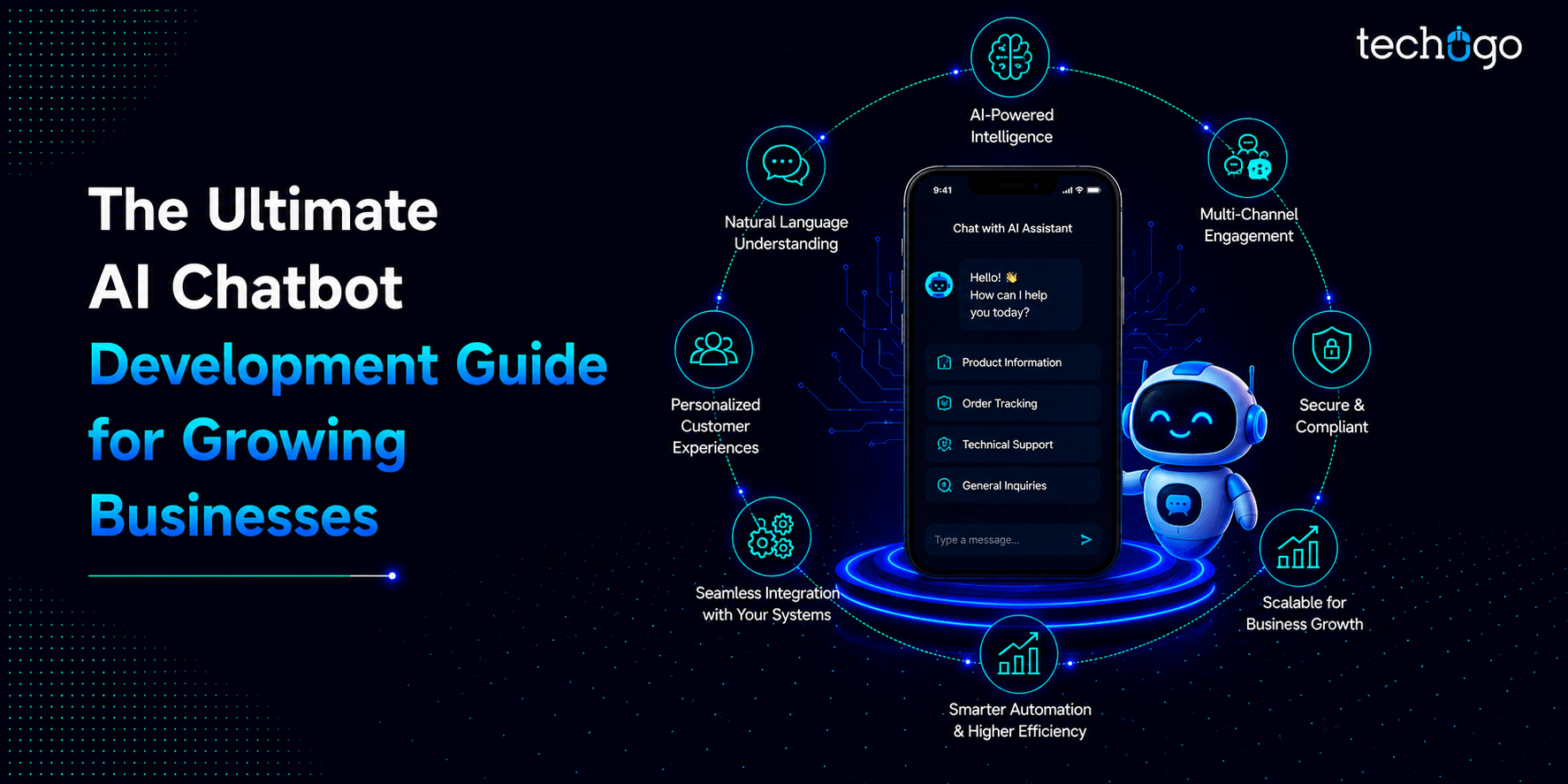


📌 Key Takeaways
- AI chatbots help businesses automate support, improve engagement, and respond instantly.
- Common AI chatbot use cases include healthcare, eCommerce, banking, education, travel, and real estate.
- Businesses can build different chatbot types, from customer support bots to advanced generative AI chatbots.
- A successful AI chatbot requires proper planning, development, testing, and continuous improvement.
- Investing in custom AI chatbot development services can improve efficiency and long-term growth.
The days of you waiting hours (or even just a few minutes) for a reply are pretty much over.
Today, you expect businesses to respond instantly, whether you’re browsing their website, making a purchase, or just looking for support. And honestly, that’s exactly why so many companies are now investing in AI chatbot development.
Instead of making you wait, chatbots can answer your questions right away, help generate leads, and take care of repetitive tasks in the background.
For businesses, it’s a way to work more efficiently.
And this shift isn’t slowing down anytime soon. According to Grand View Research, the U.S. chatbot market brought in around $1.96 billion in 2025 and is expected to hit $8.82 billion by 2033, growing at over 20% CAGR. That tells you just how quickly companies are moving toward automation and smarter tools.
Because of this, choosing to hire AI chatbot developers isn’t just a technical decision anymore – it’s a strategic one. It helps businesses stay responsive, improve engagement with people like you, and scale without slowing down.
In this guide, we’ll walk you through the benefits of using AI chatbots, where businesses are actually using them, what goes into building one, how much it costs, and the trends you should know about.
Key benefits of AI chatbot development for businesses
Businesses across the globe have been opting for a custom software development company, and it is not hard to see why. These intelligent assistants are proving to be incredibly valuable, but also surprisingly versatile – whether you are trying to keep customers happy or just trying to cut down on what it costs to run things.
1. Improved customer support
One of the biggest benefits of using AI chatbots, and honestly one of the most obvious ones, is better customer support. Because instead of making people wait in long queues, chatbots are able to handle thousands of conversations at the same time. And they respond instantly.
That means customers get answers faster. They do not feel stuck, and they do not feel ignored. But it is not just good for the customer – your support team benefits too because they get the breathing room to focus on the complex issues that actually need a human being behind them.
2. 24/7 availability
Unlike human teams, chatbots do not clock out. They are not built to sleep, take breaks, or log off – and so they do not. They are just always there.
So whether your customer reaches out at 2 PM or 2 AM, it does not matter. Help is still available. And if your audience has been spread across different time zones? This becomes even more valuable than you might expect.
3. Faster response times
People do not like waiting, and that is just the reality of it. Because when responses are slow, frustration builds – and sometimes, sales are lost because of it.
AI chatbots solve that. They give instant replies to the common questions so communication feels smooth, and immediate, and actually enjoyable for the person on the other end.
4. Cost reduction
Running large support teams can get expensive, and it gets that way fast. But with AI chatbots handling the repetitive queries, businesses have been able to cut down significantly on operational costs – without dropping the quality of service that customers were already used to.
That is also why so many companies have been working closely with AI chatbot developers, or partnering with an experienced AI chatbot development company. Because of the returns on that investment, they are real.
5. Personalized user experiences
This is where it gets interesting, and honestly where a lot of people are surprised. Modern AI chatbots do not just respond – they learn. They look at past behavior, preferences, and interactions, so that the responses start to feel more personal over time.
So instead of generic replies? Users get suggestions and guidance that actually feel relevant to them. And that small difference, it can really change how customers connect with a brand.
6. Increased operational efficiency
But it is not just about the customer-facing side of things. Chatbots have been proving useful inside the company too – automating workflows, collecting data, scheduling appointments, handling internal requests, and supporting employees in their day-to-day. Because of this, a lot of companies in enterprise software development are now integrating AI chatbots into their systems. Therefore things run faster, smoother, and with a lot less friction overall.
Popular AI chatbot use cases across industries
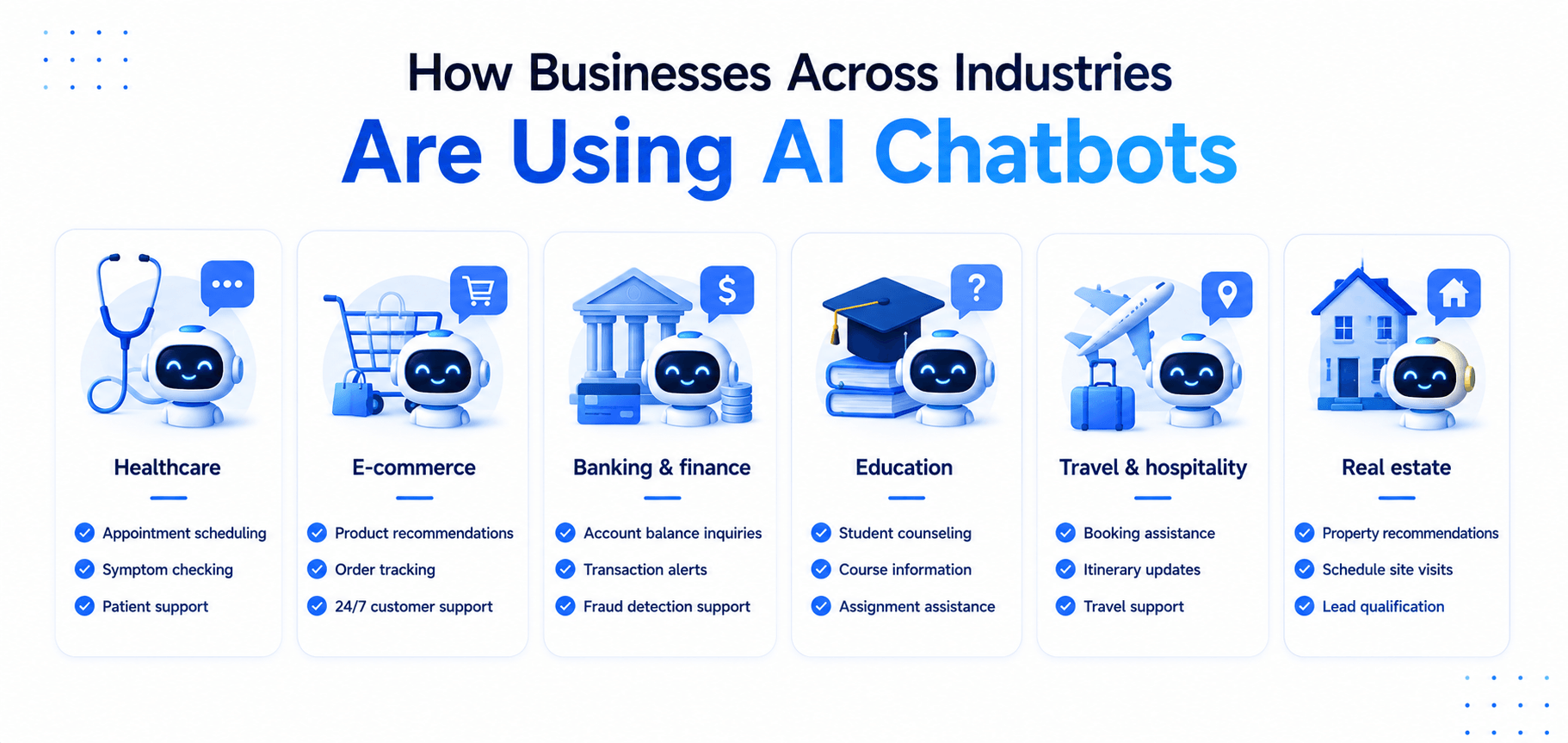 AI chatbots are not just something businesses use for customer support anymore. And honestly? Not even close to that.
These days, companies across all kinds of industries have been finding new AI chatbot use cases – so their day-to-day work feels smoother, faster, and a lot less overwhelming. From healthcare to real estate, it is slowly becoming part of how things actually run behind the scenes. Not just on the surface, but deep inside the operation itself.
1. Healthcare
In healthcare, chatbots have been helping with tasks that are simple but genuinely important. Booking appointments, checking symptoms, sending medication reminders, and answering the basic questions that patients were already flooding staff with anyway.
It may sound small. But it makes a real difference, because doctors and staff are no longer getting buried under repetitive queries – and patients, they get quicker help when they actually need it.
2. E-commerce
If you have shopped online recently, there is a good chance you have already talked to a chatbot and did not even think twice about it. Because in e-commerce, they have been helping recommend products, track orders, answer questions, and guide users all the way through checkout.
Also Read – Benefits of Chatbot for eCommerce Businesses in 2026
And it works. People get instant help, and businesses have been seeing better engagement because of it – higher conversions, less drop-off, and no delay in support when a customer needs something.
3. Banking & finance
Banks and financial services, they have also been leaning heavily into chatbots. And it makes sense, because the volume of repetitive queries in that space was always going to be a problem.
They handle account questions, transaction support, fraud alerts, and even basic financial guidance – so that customers stay informed without sitting on hold for twenty minutes. And internally? It reduces a lot of pressure on the teams that were handling all of that manually before.
4. Education
In education, chatbots have been quietly becoming a support system that students actually rely on. They answer questions, help with admissions, share academic updates, and point students toward the resources they need.
So instead of waiting on an email that may or may not come back the same day, students get answers. Fast. And that has been making a bigger difference than a lot of institutions expected it to.
5. Travel & hospitality
Travel can get stressful, but chatbots have been helping make it feel more manageable. Hotels, airlines, and travel platforms are using them for bookings, itinerary updates, travel queries, and customer support during trips because the last thing someone needs when their flight was delayed is to be put on hold.
It just makes everything feel more organized. And less chaotic, which is really the whole point. This is also a clear example of how AI in the transportation industry is quietly improving everyday travel experiences without people even noticing it most of the time.
6. Real estate
In real estate, chatbots are helping qualify leads, schedule property visits, answer buyer questions, and suggest listings so that agents are not burning time on repetitive back-and-forth that was never going to lead anywhere anyway. Because of that agents have been able to focus on the actual deals. The serious buyers. The conversations that were always worth having.
And at the end of it all, this is exactly why demand for AI chatbot development services has been growing the way it has.
Businesses want systems that save time, handle work automatically and do not require a full team behind them to keep running. Therefore, many of them have also been looking at custom SaaS solutions so that these chatbots plug directly into their platforms, and scale easily as the whole thing grows.
Types of AI chatbots businesses can build
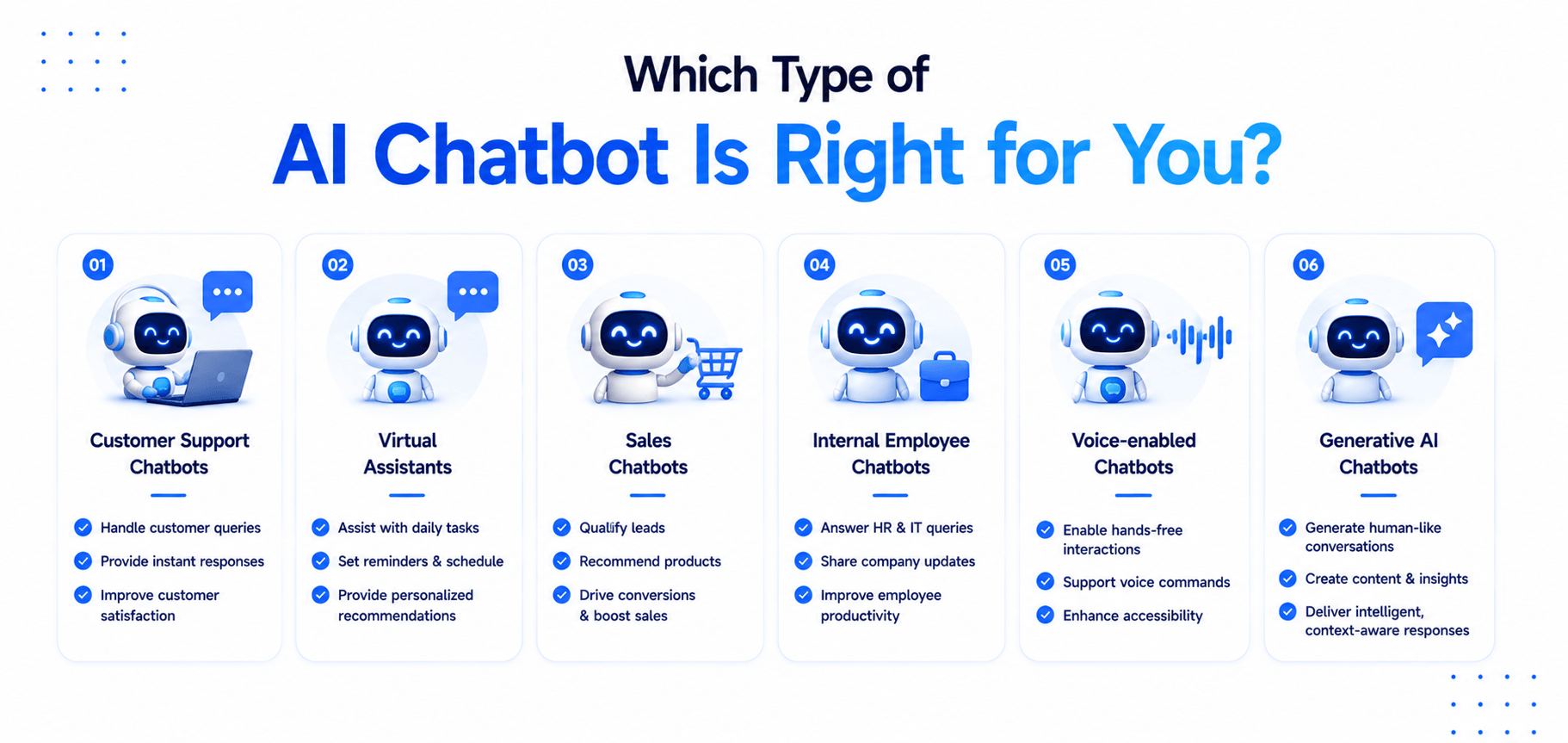
Not every chatbot is built for the same job. And it really does depend on what a business is actually trying to achieve – because sometimes that shifts too, based on what the needs are at that point in time.
Here is a quick breakdown of the different types of AI chatbots businesses usually come across, and how they are being used in real situations.
1. Customer support chatbots
These are the most common ones, and most people have already interacted with them at some point without really thinking about it. They handle FAQs, customer queries, complaints, and general support requests – basically anything repetitive that does not always need a human being on the other end.
2. Virtual assistants
Virtual assistants go one step further, and they are more like everyday helpers – or digital helpers, depending on how you look at it. They help with scheduling meetings, setting reminders, retrieving information, and managing simple workflows.
3. Sales chatbots
Sales chatbots are a bit different, because they are more focused on conversion but also on engagement – and both of those things are working together at the same time, not separately.
4. Internal employee chatbots
They help employees with HR queries, IT support, onboarding, company policies, and workflow-related tasks so instead of waiting on emails or open tickets, people just ask and get answers. Quickly. And it saves internal time, sometimes a lot more than anyone expected it to, honestly.
5. Voice-enabled chatbots
Voice-enabled chatbots make things more natural but also more accessible – especially when your hands are busy or you are multitasking and typing was never really going to work in that moment. They have become more common because smart devices and mobile apps are everywhere now, and people have been using voice input more and more over time. So it was only a matter of time before chatbots caught up with that.
6. Generative AI chatbots
This is where things start getting more advanced. And also, slightly unpredictable at times – which is part of what makes them interesting but also what makes businesses think carefully before jumping in.
Powered by large language models, generative AI chatbots are able to understand context, generate responses, create content, and handle open-ended conversations that older systems were never equipped for.
And because of that flexibility, many businesses that have been investing in custom AI chatbot development services have been shifting towards generative AI systems. In more complex setups, they have also been using custom SaaS solutions so that everything scales properly as the business grows, and changes, and needs something a little different from what it needed before.
Key features of AI chatbot development solutions
When businesses invest in AI chatbot development, they are really not just building a simple chat interface. They are creating something that can genuinely understand people, respond in real time and keep getting better with every single conversation.
Well, these are the core capabilities that make that possible.
Natural language understanding (NLU)
And the foundation of all that? It’s the ability to actually understand how humans talk. Not perfectly typed sentences, but real language – with weird phrasing, shortcuts, and all. Instead of hunting for exact keywords, the chatbot picks up on intent and context, and that’s what makes it feel less like a robot and more like an actual conversation.
Context-aware conversations
But it doesn’t stop there. A good chatbot remembers what you said five messages ago and uses that to respond smarter. So you’re not stuck repeating yourself every time, and the whole conversation just flows a lot better because of that.
Multi-channel integration
And then there’s the fact that these chatbots work everywhere your users already are — websites, mobile apps, WhatsApp, social media, you name it. So businesses don’t have to force people onto one specific platform. They can just meet them wherever they’re comfortable.
Personalization engine
On top of that, modern chatbots actually learn from you. They look at your behavior, your preferences, past interactions – and then use all of that to give you responses that actually feel relevant. Not generic copy-paste answers, but something that actually fits what you need.
Seamless API and system integration
Therefore, a well-built chatbot isn’t just sitting there answering questions in a vacuum. It’s plugged into CRMs, databases, payment systems, internal tools – so it can actually take action. Book an appointment, track an order, pull up account info. That’s a huge deal for businesses trying to automate real workflows.
Security & data protection
But of course, with all that data flying around, security has to be airtight. So encryption, proper authentication, and compliance with data protection standards aren’t optional – they are built right into the system from day one.
So at the end of the day, these aren’t just glorified FAQ bots anymore. They’re intelligent digital assistants that help businesses handle conversations at scale, improve the user experience, and grow – without having to constantly hire more people to keep up.
Step-by-step AI chatbot development process
Step 1: Understanding business requirements and goals
Well every strong AI chatbot development journey begins with a straightforward question: what do you actually want the chatbot to do? It could be handling customer support, generating leads, or automating repetitive tasks. Once that is clear… everything else becomes much easier to shape in the right direction.
Step 2: Designing conversation flow and user experience
At this stage the focus shifts to how the chatbot should actually communicate. Real conversations are mapped out instead of fixed scripts. The responses, handling of confusion – and overall interaction flow are designed in a way that feels smooth and natural rather than robotic.
Step 3: Choosing the right tech stack and platforms
The tech stack and the platforms are chosen next, and this is where things get more technical but it is still very practical. The required tools, frameworks & platforms are selected to power the chatbot effectively.
For example – if the product is being built for a global audience or scaling in the USA market, partnering with a mobile app development company in USA can help ensure seamless integration across apps, websites, and messaging platforms.
Step 4: Developing and training the AI chatbot
Development and training are where the real building begins. The system is built, trained on relevant datasets, and connected with APIs and backend systems. In setups involving enterprise software development, the chatbot is also integrated with CRMs, dashboards, and internal tools so it goes beyond basic responses and actually supports business operations.
Step 5: Testing and performance optimization
Testing comes before deployment, and it is thorough, because the responses and the accuracy and the behavior under different scenarios all have to be evaluated. This phase ensures reliability by identifying and fixing issues before users interact with it.
Step 6: Deployment and continuous improvement
And then once it is live, the work is not done. The interactions are monitored, the performance is analyzed, and updates are made regularly – so that the chatbot keeps getting smarter and faster and more useful over time.
Challenges in AI chatbot development and how to overcome them
Even though AI chatbot development has made it way easier for businesses to automate conversations and support users, it still comes with its own set of challenges that you can’t really ignore.
1. Understanding user intent accurately
This is probably one of the trickiest parts. People don’t always ask things the same way even when they mean the same thing. So sometimes the chatbot just gets it wrong. The way around this is pretty simple in theory – train it on varied real-world data and keep improving it based on actual conversations over time.
2. Handling complex or unclear queries
Not every question is neat or straightforward. Users often type half-thoughts or layered questions. In those cases, the chatbot either needs to ask follow-up questions or hand it over to a human so the user doesn’t feel stuck.
3. Integration with existing systems
This is another common hurdle. Connecting the chatbot with CRMs, payment systems, or older legacy tools can get messy if it’s not planned properly. That is why it’s better to design API integrations from the start instead of trying to force them later.
4. Data security and privacy concerns
Since chatbots deal with user data, security can’t be an afterthought. Things like encryption, secure logins, and following proper data rules are non-negotiable here.
5. Keeping performance stable at scale
Things usually work fine in the beginning, but once usage grows, performance can dip. Regular testing and updates help keep everything running smoothly.
At the end of the day these challenges are normal in such chatbot development but they’re all manageable if the foundation is done right.
How much does it cost to develop an AI chatbot?
Talking about pricing; there is no single fixed number for AI chatbot development because it really depends on what you’re trying to build. A basic chatbot that just handles simple queries will obviously sit at the lower end but once you start adding AI capabilities, integrations, and real business logic, the budget can scale quite quickly.
In most cases, the overall AI chatbot development cost falls somewhere between $10,000 and $150,000+. And that jump usually happens because of complexity – not just coding, but things like training data, system integrations, testing, and long-term scalability.
A lot of businesses also underestimate how much design and platform compatibility affect pricing. For example, if the chatbot needs to work smoothly inside mobile apps and web systems, teams often bring in support from a best mobile app development company to make sure everything actually connects properly instead of becoming a patchwork of tools.
AI chatbot development cost breakdown
| Type of Chatbot | What You Actually Get | Typical Cost Range |
| Simple Chatbot | Basic FAQ handling, rule-based responses, minimal intelligence | $10,000 – $25,000 |
| Mid-Level Chatbot | NLP support, API integrations, multi-platform presence | $25,000 – $75,000 |
| Advanced AI Chatbot | Machine learning models, analytics, CRM + third-party integrations | $75,000 – $150,000+ |
| Enterprise-Grade System | Deep customization, automation workflows, large-scale system integration | $150,000+ |
At the end of the day, pricing is less about “building a chatbot” and more about what role it plays inside the business. The more it replaces manual work or connects systems together, the higher the investment but also the higher the long-term value.
Emerging AI chatbot market trends in 2026
1. Smarter personalization & real-time responses
One of the biggest shifts right now is hyper-personalization. Chatbots aren’t just giving generic replies anymore. They’re actually picking up on user history and preferences and using that to respond in a more relevant way, in real time. It just makes the whole conversation feel more natural, less like a script.
2. Growth of multimodal capabilities
Another thing that stands out is how chatbots are no longer just “text-based tools.” They’re starting to handle voice, images, and other input types too. And honestly, that’s changing how people interact with them – it feels more flexible and a lot more user-friendly.
3. Industry-focused AI solutions
What’s also interesting in 2026 is how specific things are getting. For example, an automotive app development company is not merely building generic bots, they’re creating chatbot systems that help with vehicle service bookings, customer queries, and real-time updates right inside mobile apps. It makes the whole experience way more connected.
4. Stronger enterprise integration
And finally, chatbots are now sitting deeper inside business systems. They’re being plugged into CRMs, analytics tools, and other enterprise platforms, so instead of only answering questions they are actually helping automate work and improve decisions behind the scenes.
How to choose the right AI chatbot development company
Choosing the right partner for AI chatbot development is honestly just as important as the chatbot itself. Because even the best idea can completely fall flat if the execution isn’t there. So instead of rushing into a decision, it’s worth slowing down and looking at a few things that actually matter.
And these are the ones you really shouldn’t skip.
1. Check their experience with AI projects
First things first: look at whether the company has actually built AI-powered solutions before, not just generic software.
Because there’s a big difference. A solid portfolio in chatbot or AI-based systems tells you they understand how conversations, data, and automation work together in the real world. And that experience matters more than any sales pitch they’ll give you.
2. Evaluate technical expertise and tech stack
But beyond experience, you also need to look at what they actually know. Not all chatbots are built the same way – some need NLP models, some need generative AI, some need heavy system integrations. So you want a team that genuinely understands modern frameworks and can handle the full build without cutting corners halfway through.
3. Look at customization capabilities
And here’s something people overlook a lot – can they actually customize it for you? Because a good chatbot should fit your business, not the other way around. So check whether they build custom conversation flows and flexible integrations, or whether they’re just reskinning the same template for every client.
4. Understand their integration approach
On top of that, chatbots don’t just live on their own. They need to connect with your CRM, your website, your apps, your internal tools – all of it. Therefore, make sure the company knows how to plug into your existing ecosystem smoothly, because messy integrations cause headaches way down the line.
5. Check post-deployment support
But honestly, the build is only half the story. What happens after launch is where things really get decided. Therefore, look for a company that sticks around: proper support, performance monitoring, ongoing optimization. Because a chatbot that nobody’s maintaining is just going to slowly get worse over time.
6. Review client feedback and case studies
And before you sign anything, go through their actual reviews and case studies. Not just the testimonials on their homepage, but real feedback from real clients. That’s where you’ll see how they actually handle projects when things get complicated.
At the end of the day, the right partner isn’t just a vendor – they’re someone who genuinely gets what you’re trying to build, thinks about scale from day one, and treats your chatbot like something that grows with your business, not a one-time project they hand off and forget about.
Build next-gen AI chatbots with Techugo’s expertise
Are you planning to invest in AI chatbot development?
Techugo can help you turn that idea into a fully functional, scalable solution. Whether you’re a startup building your first digital product or an enterprise modernizing complex systems, the focus stays the same – creating intelligent chatbot solutions that improve customer experience, automate conversations, and support real business operations.
At Techugo, the approach goes far beyond basic development. From understanding requirements to designing smooth user interactions and integrating advanced AI capabilities, every step is aligned with business goals.
What makes the difference is how the solution is engineered – not just to function, but to scale, adapt, and evolve as user expectations and business needs grow over time. Be it customer support or enterprise automation, the solution is built to stay simple in experience but powerful in execution.
If your chatbot also requires mobile or cross-platform expansion, Techugo ensures seamless integration across apps, web, and enterprise systems, so users get a consistent experience everywhere.
After all why settle for basic when you can build next-gen AI chatbots with Techugo? Speak to our team and kickstart your project!
Conclusion
Overall, 2026 is clearly showing that chatbots are no longer just a “nice-to-have” feature. They’ve become a real part of how businesses operate. With better personalization, multimodal abilities, and deeper system integrations, they’re now handling much more than basic conversations.
As AI chatbot development continues to mature, it’s pushing companies to rethink how they engage with users, automate workflows, and deliver faster, more connected digital experiences – something now closely tied to what an AI app development company builds across modern digital products.
FAQs
1. How much does AI chatbot development cost?
The cost typically ranges between $10,000 and $150,000+, depending on features, complexity, integrations, and scalability requirements.
2. How long does it take to build an AI chatbot?
On average, it can take anywhere from a few weeks for a basic chatbot to several months for an advanced, enterprise-level solution.
3. What industries use AI chatbots the most?
AI chatbots are widely used in industries like eCommerce, healthcare, banking, travel, automotive, and enterprise software development.
4. Can AI chatbots integrate with mobile apps and websites?
Yes, modern chatbots are designed for seamless integration across apps, websites, and messaging platforms for a unified user experience.
5. Do startups also invest in AI chatbot development?
Yes, startups definitely do. Startups use chatbots to automate customer support, generate leads, and scale operations without increasing manual workload.

Get in touch
We'd love to hear from you.