

 SA
SA
 KW
KW
 IE
IE AU
AU UAE
UAE UK
UK USA
USA
 CA
CA DE
DE
 QA
QA ZA
ZA
 BH
BH NL
NL
 MU
MU FR
FR







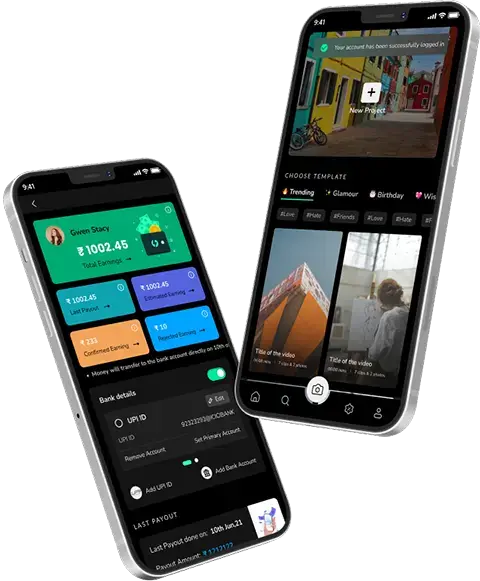








The hiring world… it’s not what it used to be a few years back. Not even close.
A few years ago, recruitment meant multiple & long email threads, multiple spreadsheets, and a time taking procedure to follow. But now, thanks to job portal apps like LinkedIn and Naukri.com, hiring as well as finding a job, both have become so easy, so it’s a win-win for recruiters, candidates, and job portals of course that make good money.
Around 70% of companies depend on job portals to hire talent. They’re no more using traditional methods of hiring. No offline systems, only digital platforms.
In fact, more than 60% of job applications now happen through mobile devices, which means if your platform isn’t mobile-first like LinkedIn and Naukri, it’s already behind.
If you are an entrepreneur and want to break the bridge between job seekers and job recruiters, then you must build a job portal app.
But worried about the cost to build a job portal?
Today, with this blog, we’ll explore the overall job portal development cost for your business and the factors that can impact cost. Also, we’ll learn the region-wise cost to develop a job portal as there are various regions where development cost is low as compared to other regions.
So, let’s get started.
Also Read – Building a Job Portal App Like GulfTalent: Key Features & Development Guide
Why 2026 is the Right Time to Invest in Job Portal Development
We all know that – HIRING and FIRING, similarly, RESIGNING (sometimes lay-off) and EXPLORING a new job. It’s something that happens constantly. It never stops.
So, why 2026? Well, it’s not just another year; it’s kind of the perfect moment for job portal development to make sense because everything is lining up – market, tech, and demand.
Rapid Market Growth
The online recruitment market is set to almost double, from about $53B in 2024 to $102B by 2030. That’s roughly an 11.5% CAGR. So investing now in a portal is like riding the growth wave.
High Adoption
Already, around 70% of companies rely on online hiring tools and moving hiring online is cutting time-to-hire by about 20%. So if your portal isn’t online-ready, you’re already falling behind. That’s why even a simple job portal app like Naukri or a job portal app like LinkedIn matters now.
Tech Trends
Portals are smarter than ever. AI, machine learning, video interviews, virtual job fairs – half of recruiters already use AI-driven systems. And candidates? They expect apps that are fast, intelligent, and mobile-first. So the recruitment app with these features can give you a modern, competitive product.
Global Demand
Emerging markets, like Asia-Pacific and the Middle East, are growing fast. Internet penetration is high, companies are hiring digitally, and everyone needs modern portals. So your job portal app development cost isn’t just local, it can scale globally.
Put it all together, the market is big, growing, and tech-ready. Companies are ready to invest, and candidates expect the best. 2026 isn’t early, and it’s not late. It’s that sweet spot to launch or upgrade a portal with the right job portal mobile app development company.
How Much Does it Cost to Develop a Job Portal in 2026
So, you’re thinking – what’s the job portal development cost in 2026? Well, it really depends on what you want. Because portals aren’t all the same, and the features you include directly affect the cost to build a job portal.
| Job Portal Complexity Level | Estimated Cost Ranges (2026) |
| Basic Job Portal | $20K–$45K |
| Mid-Level Job Portal | $50K–$120K |
| Advanced Job Portal | $150K–$350K |
Basic Job Portal
This is simple, really. Just the core things: job listings, user profiles, simple search and filters, and application submission. It’s straightforward to build, and the job portal app development cost for a web platform is roughly $20K–$45K. Yes, it’s modest, but it’s enough to get started.
Mid-Level Portal
Now it gets a little richer. You add employer dashboards, basic analytics, customizable filters (like a “Glassdoor Lite”), multi-role logins for candidates and recruiters, and features like saved searches or salary info. Because of all that, the cost to develop a job portal jumps to around $50K–$120K.
Advanced or Full Platform
This is the big one. AI-based matching, detailed analytics, mobile apps, ATS integration, anonymous reviews, and so on. Basically, you’re building something that could compete with a job portal app like LinkedIn or job portal app like Naukri. Here, the recruitment app development cost is typically $150K–$350K or more. It’s a major effort, but you get high scalability and cutting-edge tools.
These ranges match what the industry sees. Actual costs will still vary because things like AI features, multiple languages, or heavy integrations can push the price up.
But, even with these numbers, it gives you a good benchmark whether you’re planning a small portal or a full-scale platform with an experienced AI app development company.
Region-Wise Cost To Develop a Job Portal in 2026
Development rates vary dramatically by region. Below are rough estimates for simple vs complex portals in key markets. Currency is local for each country:
| Country | Estimated Cost | Notes |
| Job Portal Development Cost In UK | Basic portal £6.4K–£9.6K
Mid-tier £10.4K–£16K High-end £20K+ |
UK developers charge more due to living costs, especially in London/Manchester. |
| Job Portal Development Cost In USA | Basic $8K–$12K
Mid $13K–$20K Advanced $25K+ |
Major tech hubs push costs up; Silicon Valley rates are on the high end. |
| Job Portal Development Cost In New Zealand | Basic NZ$14.2K–21.2K
Mid $23K–35K Advanced NZ$44K+ |
— |
| Job Portal Development Cost In Australia | Basic A$12.7K–19.1K
Mid $20.7K–31.8K Advanced A$39.7K+ |
— |
| Job Portal Development Cost In UAE | Basic AED29.4K–44.1K
Mid 47.7K–73.5K High 91.8K+ |
Gulf countries with high salaries raise local rates. |
| Job Portal Development Cost In Saudi Arabia | Basic SAR30K–45K
Mid 48.8K–75K High 93.8K+ |
— |
| Job Portal Development Cost In India | Basic ₹0.69M–1.04M
Mid 1.13M–1.73M High 2.17M+ |
Even accounting for local pricing, the absolute INR figures show multi-million-rupee budgets. |
| Job Portal Development Cost In Qatar | Basic QAR29.1K–43.7K
Mid 47.3K–72.8K High 91.0K+ |
— |
| Job Portal Development Cost In Switzerland | Basic CHF7.3K–11.0K
Mid 11.9K–18.3K High 22.8K+ |
One of the highest in Europe due to living standards. |
These are illustrative ranges for a typical 2–3 month project; actual quotes can differ. “Basic” here means core features only, while “advanced/high” covers large-scale portals with many premium features.
Basic and Premium Features of Job Portal Development with Their Development Cost
When it comes to job portal app development cost, the features you include are what really decide the numbers. Let’s go step by step, from essentials to advanced.
1. Job Listings & Management
This is the heart of any portal. You need companies to post jobs and candidates to browse them. Without it, the portal doesn’t work. Adding this core feature usually costs around $5K–$10K.
2. User Registration & Profiles
Candidates need profiles, recruiters need accounts. So registration, login, and profile management are essential. This makes the portal functional and smooth UX here can save headaches later.
3. Search & Filters
Users want to find the right jobs quickly. That means search bars, filters, categories, location, experience – the basics. It sounds simple, but it’s a must-have. This is part of the core features, usually included in the $5K–$10K range.
4. Job Alerts & Notifications
Candidates don’t want to keep checking the portal. Alerts via email, push notifications, or SMS help keep them engaged. Core, simple, but very effective.
5. Messaging / Basic Communication
Applicants and recruiters need to communicate. Even simple messaging adds a lot of value. This keeps users on your portal and engaged.
Now, once the basics are done, you can move to premium features, which naturally push the job portal development cost higher.
6. Employer Dashboards
Recruiters need analytics, reports, and insights on applicants. Dashboards make this possible. Adding this can cost $12K–$18K extra depending on depth.
7. Advanced Analytics
Not just dashboards, deeper data analysis: which job listings perform, which candidates respond, trends over time. AI tools sometimes help here too.
8. Interview Scheduling & Video Interviews
Scheduling tools, calendar integrations, and video calls – these functionalities are very useful for modern portals. They add convenience but also add to recruitment portal development cost.
9. AI Resume Parsing & Matching
AI can scan resumes, match skills to jobs, and rank applicants. This is what makes a portal competitive, like a job portal app like Naukri or LinkedIn. Naturally, it increases the development cost.
10. Extras & Integrations
Chatbots, multi-language support, integration with HR software, ATS integration (applicant tracking systems)… each of these adds complexity and cost. The more features, the higher the cost to develop a job portal.
So basically the more advanced your portal, the more the job portal app development cost, but also, the more competitive and scalable your platform becomes.
Factors Affecting the Job Portal Development Cost
Okay, so this is something we’re already aware of, that the job portal development cost isn’t one fixed number, and it really depends on several moving parts, in which each one can push your budget up or down.
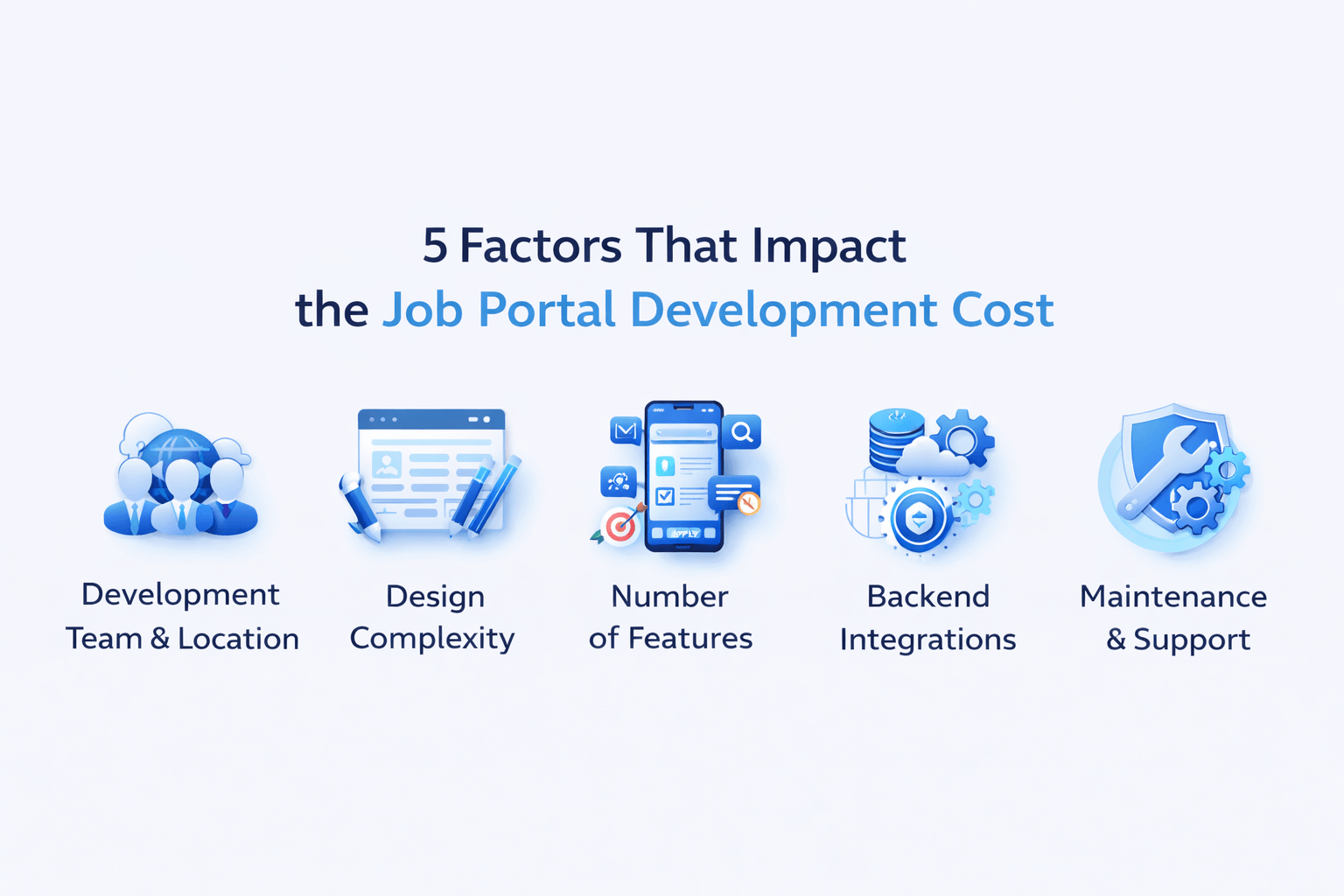
- Development Team & Location – where your team is based matters a lot. Hiring in North America or Western Europe can be costly in comparison to Eastern Europe and Asia. And it’s not just location – senior engineers cost more, but they bring expertise. So choosing your team affects your recruitment portal development cost.
- Design Complexity – a slick, custom UI/UX is more expensive than a basic template. so, yes, if you add complex animations or multiple workflows, the cost rises.
- Number of Features – the more modules you add, the more dev hours you need. Features such as – Jobs, profiles, messaging, analytics, payments, each one adds to the cost. Advanced features such as AI matching, live chat, video interviews – they push the job portal app development cost up quite a bit.
- Backend Integrations – connecting to payment gateways, background checks, HR systems, or building a scalable cloud backend adds complexity. A simple backend might cost $7K–$12K but a feature-rich backend can cost around $14K–$18K+.
- Maintenance & Support – don’t forget ongoing costs because updates, bug fixes, hosting, etc typically cost 10–20% of your total development cost per year. Planning strong architecture and clean coding from the start can save you money later.
So basically, anything that adds scope – extra devs, more features, complex integrations, maintenance – raises the cost to build a job portal. But simplifying features or timelines? That can shrink your budget.
How To Reduce The Job Portal Development Cost? (Proven Approaches)
So, you want to save money on a job portal app development cost but without killing quality, right? Well, there are ways… and some actually make your portal smarter too. Some proven approaches include:
-
Use Open-Source Frameworks
Frameworks like Django, Laravel, or React Native are free and full of pre-built components (authentication, UI kits). So you save on licenses, and development goes faster. Many devs report big savings just by building on these mature tools.
-
Build an MVP (Minimum Viable Product)
Start small. Focus on core features first, test your idea, get real user feedback, then add bells and whistles later. AI matching, advanced analytics — those can wait. This way, your upfront cost to develop a job portal stays low, but you still validate your concept.
-
Hire Freelancers or Offshore Teams
Not every task needs a local, expensive team. Freelancers or offshore agencies can do non-critical work at 30–50% lower rates. But yes, you need good project management, otherwise quality slips.
-
Streamline the Design
Fancy graphics are nice, but simple, clean, user-friendly layouts work just as well. Using basic templates or UI kits saves designer time. This is one of the best ways to keep budgets in check.
-
Use Cloud Services
Instead of buying and maintaining servers, go cloud (AWS, Azure, Google Cloud). Pay for what you use, scale on demand. Managed cloud databases are often cheaper and faster than building your own infrastructure.
Do this right, and many projects cut their estimates by 30% or more… while still ending up with a solid, functional job portal app like Naukri or a job portal app like LinkedIn.
Why Choose Techugo as a Trusted Job Portal App Development Company
So, why pick Techugo for your job portal app development?
Techugo is positioned as a specialist in recruitment app development. Here are a few reasons that really stand out.
- Recruitment Focus & Technology – Techugo isn’t just another developer. They focus on recruitment apps, offering AI-powered candidate matching, AR features, ATS integration, and other AI features. In other words, your portal works everywhere, and smart algorithms help match jobs with the right candidates.
- End-to-End Expertise – they handle everything, from strategy and design to launch and ongoing support. All is covered such as – real-time collaboration tools, custom recruiter dashboards, powerful cloud integrations. They handle everything (Front-end, back-end, AI, testing); you don’t need to manage multiple vendors.
- Proven Track Record – clients praise them for innovation and reliability. One said the team is “brimming with innovative ideas and dependable technical expertise,” and delivers projects on time. Another highlighted their prompt communication and problem-solving. Reviews like these show why Techugo is a trusted job portal app development company among UAE, USA, Australia, and India.
In short, Techugo combines a deep understanding of hiring workflows with technical strength (AI, cloud, mobile apps) to deliver quality portals efficiently.
So whether you’re a business or an agency, Techugo is a strong partner if you want a modern job portal app like Naukri or a job portal app like LinkedIn.
Let’s discuss over a call. Schedule your call with experts.
Frequently Asked Questions
Q. How long does it take to build a job portal?
Timeline depends on scope. A very basic portal might be completed in 3–4 months, while another complex, full-featured portal can take 6–9 months or more. For example, Taction Software notes a simple site can be done in 10–14 weeks, whereas a Glassdoor-scale app may need 5–8+ months. Key drivers are feature count, team size, and QA needs.
Q. What factors affect the development cost most?
Several:
- Team rates (e.g. US developers cost more than Asia-based ones)
- Design/UI choices (custom animations vs basic templates)
- Feature list (adding AI matching, video chat, etc.)
- Backend complexity (scalability, APIs)
- Maintenance and support requirements.
In short, more features and higher quality = higher cost.
Q. Is now a good time to invest in a job portal?
Absolutely. With post-2023 hiring rebounding and digital recruiting entrenched, demand is only growing. As cited, the market is already tens of billions of dollars and climbing. If your business or investment fund hasn’t jumped on the trend yet, 2026’s robust market growth and technology maturity make it a strategic window to build a competitive portal.
Q. Why partner with a specialized job portal app development company?
Working with a firm like Techugo (or another experienced portal developer) saves time and risk. You leverage their hiring domain expertise, get access to tested components (e.g. proven matching algorithms, UI patterns), and benefit from ongoing support. The citations above illustrate that the right partner not only knows the tech but understands recruitment needs – which is hard to achieve in-house without prior experience.
Q. What if we need global (multi-country) features?
Costs increase with localization such as languages, currency, and region-specific workflows. Also the design and architecture must accommodate users worldwide. However, building region by region (e.g. start in one country, then expand) and using cloud/global hosting can manage expenses. Many portals start with a core market and then add regions as usage grows.
Q. How do portals generate ROI?
Portals can earn revenue via paid job postings, premium subscriptions for employers, featured listings, advertising, and analytics services because a well-designed portal often pays for itself over time through these channels. Our earlier cost overview helps ensure you budget for development and build a sustainable business model on top.

Get in touch
We'd love to hear from you.