

 SA
SA
 KW
KW
 IE
IE AU
AU UAE
UAE UK
UK USA
USA
 CA
CA DE
DE
 QA
QA ZA
ZA
 BH
BH NL
NL
 MU
MU FR
FR















📌 Key Takeaways
- The on-demand roadside assistance app market is expanding as convenience becomes the default expectation.
- The global market growth shows strong opportunity, projected to reach $35.36 billion by 2030.
- Costs to develop a roadside assistance app can vary widely based on features, starting from minimum viable product to enterprise scale.
- GPS tracking and live updates are now essential features in any modern roadside assistance platform.
- AI is improving dispatch speed, route accuracy, and overall service efficiency in real time.
- A weak backend can break the entire experience during emergency usage.
Car breakdowns do not come when you least expect them. From a flat battery in the morning before work to a road trip and a low tire pressure, drivers want quick and dependable assistance when they’re in need.
During such times, people don’t want to waste time looking for help. They wish there were a quick answer and they wish they could be accompanied as soon as possible.
For that reason alone, roadside assistance apps are definitely a huge opportunity. More businesses are investing in roadside assistance app development to meet the expectations of road users with a quick response to their needs while improving customer experience, operations, and connectivity with tow and insurance companies, automotive service businesses, and startups.
And there are no indications of this trend abating anytime soon. The worldwide market for vehicle roadside assistance was valued at USD 26.58 billion in 2024 and is projected to reach USD 35.36 billion by 2030, exhibiting a compound annual growth rate of 5.0% throughout the projected timeframe, as reported by Grand View Research.
If you’re thinking about creating a roadside assistance platform, then you’ve likely been focused on just one aspect:
What is the cost to develop a roadside assistance app?
The answer? It ranges from $15,000 to $250,000+, and that’s just for what you are constructing. The driver-app will be much cheaper than the complete solution with tracking,
AI dispatching, user panel for multiple users, third party integration, etc.
Today we will take a look at where that investment goes, what features should be prioritized, how AI is transforming roadside assistance and what it actually takes to make an idea an app that drivers can rely on when they need help the most.
Let’s read…
Roadside assistance market trends in 2026
Growing demand for on-demand services
We live in an on-demand app development world now, and honestly it’s kind of obvious at this point. You need food, you open an app, you need a ride, same thing, you just do it. So when a car breaks down it’s not surprising that people expect the same thing, because why wouldn’t they? They don’t want phone numbers, or waiting, or being put on hold – they just want help, fast. That’s why demand for an on-demand roadside assistance app is going up, and businesses have been pushing more into roadside assistance app development because of it.
Increased vehicle ownership
More cars on the road, and it just means more problems too. Flat tires, dead batteries, random breakdowns, all of that stuff that nobody really plans for but it still happens every day. So as vehicle numbers are increasing globally, the need for roadside help is also growing, therefore companies are seeing a bigger market than before, simple as that.
Rising customer expectations
Getting help is one thing, but now people also want to know what’s happening. Like who’s coming, how far they are, how long it’ll take – and if they don’t get that info, it feels incomplete. So expectations have gone up, and businesses are kind of forced to match that level now, otherwise customers just move on.
GPS and mobile technology adoption
A few years ago this was messy, explaining location over calls, repeating landmarks, all that. But now it’s different because GPS is just there in every phone. You share your location once and that’s it, it works. Service providers can reach faster, routes are clearer, delays are lower, and overall the whole thing just runs smoother, because of mobile tech.
Growth of AI and automation
AI is everywhere, yeah, but in this case it actually makes sense. It helps with dispatching, routing, predicting demand, even handling basic customer queries sometimes. So instead of everything being manual and slow, things become quicker and more organized. That’s also why a lot of companies are now working with an automotive app development company, because they want systems that can actually handle this scale without breaking.
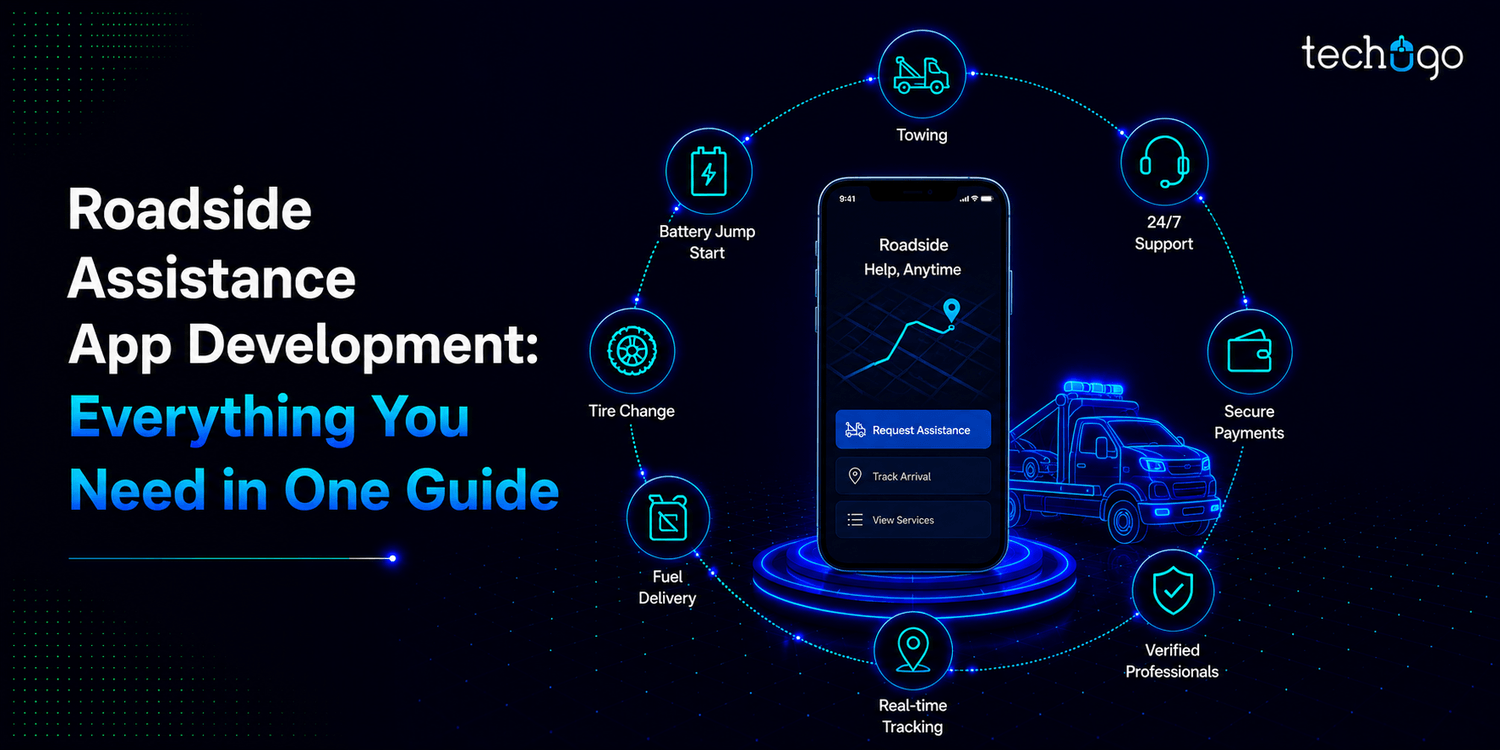
Must-have roadside assistance app development features
GPS-enabled roadside assistance
One of the most important parts of roadside assistance app development is GPS-enabled roadside assistance, because when a vehicle breaks down you don’t really have time to explain landmarks or “turn left near that shop” kind of directions. You just share the exact live location, and it is done, simple. This reduces confusion and, honestly, it speeds everything up so that service providers can reach the exact spot without unnecessary delays or back and forth.
Live tracking updates
Once help is on the way, users don’t want silence, and that’s where live tracking comes in. It shows where the technician is, how far they are, and roughly when they will arrive. It sounds basic but it actually changes the whole experience because instead of guessing “are they coming or not?”, you can literally see it moving toward you, therefore it builds trust and reduces panic in stressful moments.
Quick issue selection
A car breakdown assistance app should make reporting problems fast, like really fast, because nobody is sitting comfortably when their car stops working. So options like flat tire, dead battery, towing, fuel delivery, lockout, etc are used so that users just tap and move on. No long typing, no confusion, it is quick and the system can assign the right help without unnecessary delays or miscommunication.
Provider dashboard control
On the business side things were always messy before digital systems, but now a proper dashboard helps control everything. Requests come in, technicians are assigned based on location, availability is tracked, and workload is balanced especially when demand is high. So it keeps operations stable even when things get chaotic, because otherwise scaling this kind of service becomes difficult very quickly.
Expert developer support
To build something like this properly, many businesses choose to hire roadside assistance app developers who understand GPS systems, real-time tracking, and scalable backend architecture. Because it’s not just about building an app that looks good, it has to actually work when someone is stuck on the road and therefore reliability becomes the main thing, not extras.
In-app communication
Users should be able to talk to support or the technician directly inside the app, and not switch between calls or different platforms. Simple chat or call options make everything smoother, because during emergencies even small confusion feels big.
Secure payments
A proper roadside assistance system also includes secure payments, so that once the service is completed, users can just pay instantly without friction. It improves trust, and it makes the whole process cleaner, more transparent, and easier for repeat use.
Scalable architecture
Finally the system has to scale, because if more users come in and the app slows down, everything breaks. So backend systems are built in a way that they can handle growth, traffic spikes, and increasing requests without affecting performance.
Types of roadside assistance services you can offer through the app
A roadside assistance app isn’t just about “sending help” – it’s about being ready for every messy, unpredictable situation a driver can get stuck in. From a dead battery in the middle of nowhere to a locked car outside your own house, the value of the app comes down to how many real problems it can actually solve, fast.
Here are the key types of roadside assistance services you can build into your app:
Towing services
When the car simply won’t move, towing becomes the fallback. Users can instantly request a tow truck and shift their vehicle to a garage or preferred location. With live tracking, it doesn’t feel like waiting in the dark – they actually know what’s happening.
Flat tire assistance
A flat tire always shows up at the worst possible time. Instead of struggling roadside, users can get quick on-spot repair or a spare replacement and get moving again without turning it into a half-day problem.
Battery jumpstart services
Dead batteries don’t give warnings. They just end your plan. A technician reaches the spot and jumpstarts the vehicle, and if it’s beyond saving, a replacement can be arranged right there.
Fuel delivery
Running out of fuel is one of those situations that feels avoidable… until it happens. This service brings fuel straight to the user so they can reach the nearest station without stress or towing.
Vehicle lockout assistance
Keys locked inside the car is a classic. A professional helps unlock the vehicle safely without damage, turning a frustrating moment into a quick fix.
Mechanical breakdown support
Not every issue has an obvious answer. A mechanic can be sent to inspect the vehicle on-site, fix what’s possible immediately, or recommend towing if needed.
Winching and recovery services
Stuck in mud, sand, or a ditch? This is where recovery kicks in. Winching services pull the vehicle out safely when normal assistance just isn’t enough.
Minor on-site repairs
Some problems are small but annoying – and don’t need a workshop visit. Quick fixes like fuse changes or minor electrical issues can often be handled right where the car is.
AI-powered features for modern roadside assistance platforms
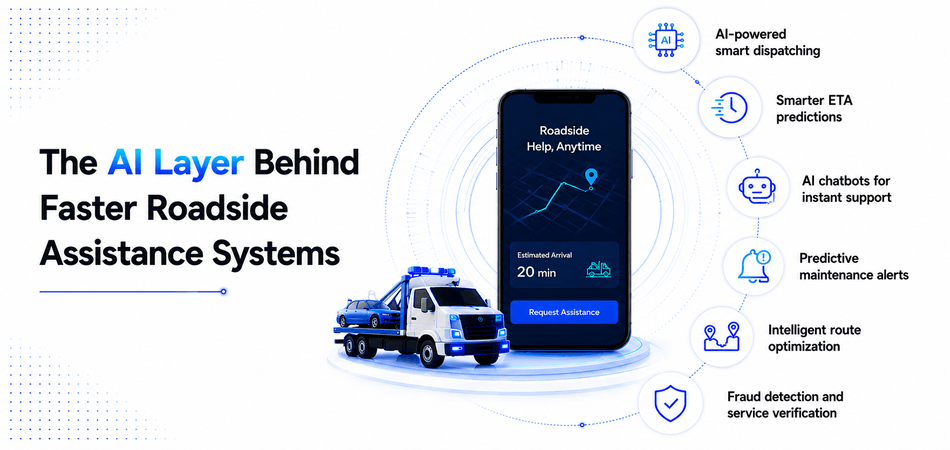
Artificial intelligence is changing how roadside assistance platforms operate.
Businesses that integrate AI capabilities gain a significant competitive advantage through automation, efficiency & enhanced customer experiences.
Let’s go through it.
AI-powered smart dispatching
AI can automatically assign service requests to the nearest and most suitable provider based on location, availability, traffic, and skill set and honestly it does this so fast that manual allocation (which was slow and kind of messy before) doesn’t even compare anymore. So instead of delays, the system just handles it instantly, because everything is automated therefore response time drops and efficiency improves in real situations.
Smarter ETA predictions
Instead of rough estimates like “20–30 minutes” which were never really accurate anyway, AI uses live traffic data and past patterns so arrival times are more precise. Because users don’t just want help, they want clarity – they want to know exactly when it will arrive, and it reduces frustration a lot, like seriously it was always guesswork before.
AI chatbots for instant support
AI chatbot development company can handle basic queries, collect breakdown details, and guide users step-by-step through the request process. So instead of waiting for a human agent (which used to take time and sometimes were annoying delays), users get instant responses, and it keeps things moving when someone is stuck on the road.
Predictive maintenance alerts
One of the more advanced uses of AI is predicting issues before they actually happen. By analyzing vehicle data, AI detects early warning signs and alerts users so that they can fix problems before it turns into a full breakdown – and yes, this is one of the biggest upgrades in a modern car breakdown assistance app, because it shifts things from reactive to proactive.
Intelligent route optimization
AI helps technicians take the fastest possible route by analyzing real-time traffic, roadblocks, and delays. This reduces travel time, and therefore more users get help faster. It directly improves performance in any emergency roadside assistance platform, especially during peak demand when everything is moving fast and chaotic.
Fraud detection and service verification
AI detects suspicious activity, verifies completed jobs, and reduces fake claims within the system. So the platform stays secure, clean, and reliable even when request volume is high because without it, things can get messy really quickly.
Business models for a roadside assistance app
A roadside assistance app isn’t just about connecting drivers with help It also needs a solid way to actually make money. And in this space, there isn’t just one “right” model. Most apps mix a few different approaches depending on their audience and scale.
Subscription model
This one is pretty straightforward. Users pay monthly or yearly, and in return they get access to roadside help whenever they need it. It works well for people who drive regularly and don’t want to think twice when something goes wrong – they just want coverage in place.
Pay-per-use model
Not everyone wants a subscription, and that’s where this fits in. Users simply pay when they request a service like towing, jumpstart, or fuel delivery. It’s simple, no commitment, and honestly a good way to bring in first-time users.
Commission-based model
Here, the app basically acts as a bridge between the customer and the service provider. Every completed job earns the platform a commission. As more service providers join and more requests come in, revenue scales naturally without forcing users into fixed plans.
Fleet or business plans
A lot of demand actually comes from companies: delivery services, taxi operators, logistics fleets, etc. Offering them dedicated plans with priority support and bulk pricing makes sense. It also brings in more stable, recurring revenue compared to individual users.
Insurance and OEM partnerships
This is a big one. Roadside assistance is often bundled with car insurance or even offered by vehicle manufacturers. So instead of acquiring every user directly, the app becomes part of an existing ecosystem – which is a huge growth shortcut if you can land those partnerships.
Ads and featured listings
Once the platform grows, garages, service centers, and auto brands may pay to be featured or promoted inside the app. It’s not the core revenue source, but it becomes a nice extra stream once you’ve got traffic.
Also Read – How To Start a Roadside Assistance Business
Roadside assistance app development process (step-by-step breakdown)
Building a successful roadside assistance platform requires careful planning and execution, and honestly it is not something that just happens overnight or randomly.
Here’s what the complete roadside assistance app process typically looks like.
Step 1. Discovery and requirement planning
The first step starts with understanding the idea, target users, and core problems the app is solving. Whether it is an on-demand roadside assistance app for individual drivers or a larger platform for businesses, this phase defines features, user roles, and overall app flow – and it sets the foundation for everything that follows because without clarity nothing really works properly, therefore this stage has always been the most important.
Step 2. UI/UX design and user flow
Once requirements are clear, the focus shifts to designing simple and intuitive interfaces. Roadside support mobile app users should be able to request help in just a few taps – and that is important because people are usually stressed. Time matters a lot in those situations. This is why the design must be clean and sometimes even minimal so that nothing feels confusing.
Step 3. App development and backend setup
This is where the actual development begins. Developers build both the frontend and backend systems, including GPS tracking, service matching, notifications, and user management. For a roadside support mobile app, real-time performance becomes critical because delays can directly impact user satisfaction, and therefore even small lag or errors were never ignored in this stage.
Step 4. Testing and quality assurance
Before launch, the app goes through multiple testing stages to check performance, speed, security & real-world usability. This ensures that the app works properly under different conditions, including high traffic and location-based scenarios… because it was necessary to make sure everything runs smoothly when real users start using it.
Step 5. Deployment and launch
After testing, the app is deployed on platforms like Android and iOS. At this stage, the focus is on stability and scalability so that the system can handle real users of a roadside assistance app without performance issues, and this is where everything gets real because launch is not theory anymore, it is actual usage.
Step 6. Maintenance and updates
Even after launch, the process continues… regular updates, bug fixes, and feature improvements keep the app running smoothly and aligned with user expectations as the market evolves, and it keeps changing over time therefore continuous improvement is always required.
From our development experts’ experience, this is the point where things stop being “on paper” and start behaving in the real world. Because features can look great in planning but if GPS lags or dispatch is slow, the whole roadside experience falls apart in seconds. And that is exactly why the focus shifts to speed, stability, and real-time performance.
Challenges in roadside assistance app development and their solutions
On the surface, roadside assistance app development might sound pretty straightforward: someone breaks down, they open the app, help arrives. But once you actually start building it, you realise there are a lot of real-world problems that can mess with that “simple” flow.
Here are some of the common challenges and how they’re usually handled:
Getting location right in real time
This is a big one. If the app can’t pin the user’s exact location, everything else falls apart. Even a small GPS mismatch can send help to the wrong place, which is the last thing you want in an emergency.
Solution: Most roadside assistance app development projects solve this by using continuous live tracking instead of one-time location sharing, along with reliable map APIs for better accuracy.
Dispatching help quickly
Speed matters a lot here. If it takes too long to assign a technician or tow truck, the user experience drops immediately. Manual assignment just doesn’t scale well.
Solution: This is where smart dispatch systems (often AI-based) come in. They automatically assign the nearest available provider based on location, traffic, and workload.
Keeping service quality consistent
Even if the app works perfectly, the experience can still fail if the service provider shows up late or doesn’t deliver properly.
Solution: Platforms usually build a verified network of providers, add ratings, and track performance so only reliable partners stay active.
Handling sudden traffic spikes
Breakdowns don’t happen evenly – bad weather or peak travel times can suddenly flood the system with requests.
Solution: Scalable cloud infrastructure is key here. Proper load balancing ensures the system doesn’t slow down or crash during high demand.
Making the app easy in stressful moments
People using a roadside assistance app are usually not relaxed — they’re stuck somewhere and just want quick help. If the app feels complicated, it only adds frustration.
Solution: Keep the flow extremely simple: quick issue selection, minimal steps, and fast request submission.
Payments and trust
A lot of users hesitate when money is involved during emergencies, especially if they’re unsure about the service quality.
Solution: Clear pricing, secure payment gateways, and upfront confirmation help build trust and reduce friction.
Preventing fake requests
Like any on-demand platform, there’s always a risk of misuse or fake service requests.
Solution: Verification steps like OTPs, tracked jobs, and basic fraud detection help keep things under control.
Cost to develop a roadside assistance app (2026)
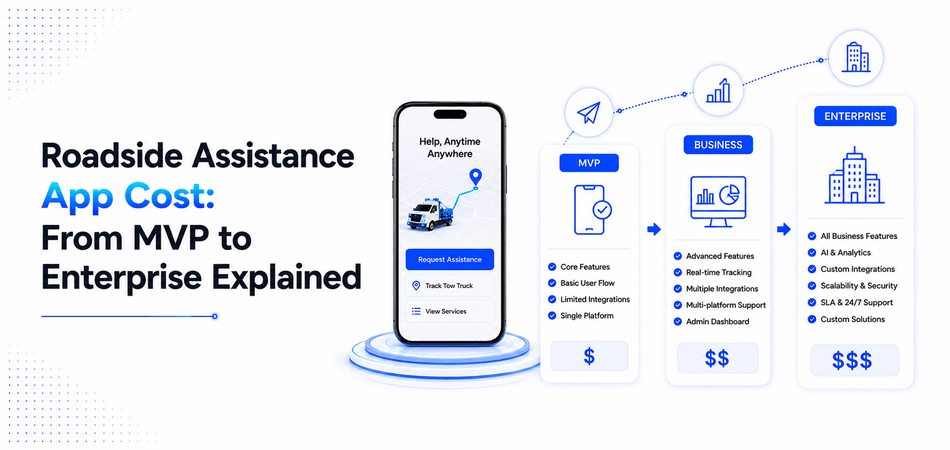
The roadside assistance app development cost depends heavily on the features you include, the level of automation, and how advanced the real-time system needs to be. A simple app that connects users with nearby service providers will cost much less compared to a full-scale platform with GPS tracking, AI dispatching, live updates, and multi-vendor support.
In general, the more real-time and intelligent the system becomes, the higher the development cost goes because backend complexity, APIs, and infrastructure requirements increase significantly.
Estimated development cost breakdown
| App type | Key features | Estimated cost |
| Basic MVP app development | User booking, basic listings, simple dashboard | $15,000 – $30,000 |
| Mid-level roadside assistance app | GPS tracking, live requests, provider app, push notifications | $30,000 – $80,000 |
| Advanced platform | Real-time tracking, AI dispatching, multiple vendors, analytics | $80,000 – $150,000+ |
| Enterprise-grade system | Full automation, AI optimization, scalable cloud backend, multi-region support | $150,000 – $250,000+ |
But what affects the cost most?
To be very honest, there are several factors that directly impact the final budget of a roadside assistance platform. Real-time GPS integration, backend architecture, third-party APIs, and scalability requirements usually take the biggest share of investment. Adding AI features like smart dispatching or predictive analytics also increases complexity, which in turn increases cost.
UI/UX design, admin dashboards, and cross-platform app development (iOS + Android) also add to the overall effort, especially when the goal is to build a smooth and reliable user experience during emergency situations.
Now beyond just development and planning, many businesses also rely on roadside assistance software development services to handle end-to-end execution, from architecture design to deployment, so the final product is stable, scalable, and production-ready from day one.
Launch your roadside assistance platform with Techugo
Let’s be real – a roadside assistance app isn’t just another mobile product. It’s something people rely on when they’re stuck, stressed, and expecting help fast. That means there’s no room for delays, glitches, or “almost working” systems.
At Techugo, we build exactly for those moments.
As one of the best mobile app development company in USA with decades of experience, we specialize in building scalable, high-performance mobile solutions, including roadside assistance app development tailored for startups, enterprises, and mobility businesses. From GPS-enabled tracking and smart dispatch systems to AI-powered features and seamless user experience, we leverage modern frameworks like Flutter app development , React Native app development, and native iOS/Android development to build apps that don’t just function, but perform under pressure when it matters most.
Our expert team handles the full journey – from discovery and UI/UX design to backend development, testing, deployment, and long-term support. So you don’t just get an app, you get a complete digital ecosystem built for reliability, speed, and growth.
Are you thinking about building something like this? Contact our team and get started today!!
Final words
At the end of the day, a roadside assistance app is only as good as it performs when someone is actually stuck on the road – not when it looks good in a pitch deck. Because in real moments like that, users don’t care about “features”, they care about speed, clarity and whether help is actually coming.
So whether you start small or go full scale, the real win is building something that does not break when things get real. Something that responds fast, feels simple, and just works when it’s needed most.
And that’s really the goal: turning an idea into an emergency roadside assistance platform people can trust without even thinking twice.
FAQs
What is a roadside assistance app?
A roadside assistance app is a digital platform that connects drivers with nearby service providers when their vehicle breaks down. It helps users request help instantly, track service, and get support for issues like flat tires, battery failure, towing, and more.
How much does roadside assistance app development cost?
The cost usually ranges from $15,000 to $250,000+, depending on features like GPS tracking, real-time updates, AI dispatching, number of user panels, and overall system complexity.
How long does it take to build a roadside assistance app?
On average, it can take 3 to 9 months depending on the scope. A basic MVP takes less time, while a full-scale platform with advanced features takes longer due to backend and real-time system complexity.
Can AI be used in roadside assistance apps?
Yes, AI is widely used for smart dispatching, ETA prediction, route optimization, predictive maintenance alerts, and fraud detection, making the system faster and more efficient.
“`html
“`

Get in touch
We'd love to hear from you.