

 SA
SA
 KW
KW
 IE
IE AU
AU UAE
UAE UK
UK USA
USA
 CA
CA DE
DE
 QA
QA ZA
ZA
 BH
BH NL
NL
 MU
MU FR
FR

















📌 Key Takeaways
- Insurance software helps you automate claims, policy management, underwriting, customer support, and other time-consuming processes.
- Custom insurance software gives you more flexibility, better security and also the ability to scale as your business grows.
- AI, cloud computing, IoT, blockchain, and predictive analytics are shaping the future of insurance – and they will continue to drive innovation.
- If you’re building custom insurance software, expect development costs to range from $30,000 to $300,000+.
Insurance isn’t exactly an industry people associate with speed.
You fill out a form, you wait, you fill out another form, you wait some more. Days can go by before you hear anything back, and that’s just accepted as normal. It’s been the norm.
Except people aren’t putting up with it as much anymore. If someone can check their bank balance or track a food delivery in seconds, they wonder why their insurance company still makes them call during business hours to get a straight answer. They want their claim handled quickly, they want to manage their policy without a hassle – and they don’t want to feel like they’ve stepped back in time to deal with all the paperwork.
That is a big part of why insurers are spending so much on insurance software development right now. Estimates put U.S. insurance tech spending at around $173 billion in 2026, up about 7.8% from the year before, with a lot of that going toward updating old systems and just generally making the digital experience less of a struggle. It’s also why more insurers are partnering with insurance software development companies.
So, in this guide, we’re covering pretty much everything: the benefits, the different types, the necessary features, what it’ll likely cost you, and how you can find a company that you can trust.
Let’s read!
Why the U.S. insurance industry is investing in insurance software development services?
Okay let’s start by first understanding what most of the insurers have to deal with today:
1. Old systems. Like, actually decades old.
2. Claims still getting processed by hand in some places.
3. Underwriting that takes way longer than it should.
4. Fraud slipping through because nobody’s got the tools to catch it fast enough.
Do we have a fix for this? Yes! Modern platforms bring modern solutions. And here it is – they automate the repetitive tasks so the people on your team can focus on the cases that need human judgment.
Reasons why insurance companies in USA have started investing in insurance software development services:
1. Nobody wants to wait three days for a quote. Nobody.
2. People want it now. On their phone.
3. That’s basically the landscape now. Insurance software is everywhere carriers look.
4. Customers changed. So the industry has to catch up if they want to survive and thrive.
One big reason – Insurance now makes up a real chunk of overall tech spending, i.e., 6% of total US tech budgets in 2026, so carriers clearly aren’t dabbling anymore, they’re committing.
Okay, most insurance companies aren’t software companies. They know insurance. But don’t know code. And building everything in-house means pulling a team that’s already stretched thin.
So what they do is partner with an insurance software development consulting company instead – one that’s done this before.
Types of insurance software you can build
1. Health insurance software
Health insurance software development is probably the most in-demand right now. Health insurance software helps insurers manage policies, process claims, verify eligibility, connect with providers, and also let members check their coverage from an app instead of calling someone.
2. Property, auto & life insurance platforms
These handle the day-to-day stuff like policy management, premium calculations, renewals, claims, customer communication.
3. Insurance product development software
Rolling out a new policy shouldn’t eat up months. Insurance product development software helps teams design, test, and launch products quicker, and adjust pricing or coverage rules as things change.
4. Claims management software
Claims are usually the most daunting part for insurers. This kind of software automates submissions, document checks, approvals and fraud detection. Pro – cases get settled faster instead of sitting in a queue.
5. Broker & customer portals
Self-service portals let customers buy, renew, and track claims on their own. Brokers get their own space too – managing clients, commissions, and paperwork all in one spot.
And, like, most of the top insurance software development companies build all this with room to grow. And as the business scales… new features just get added on. Also worth mentioning – while building these platforms, it’s smart to look into software developer insurance too, just to protect the dev team from any professional risk along the way.
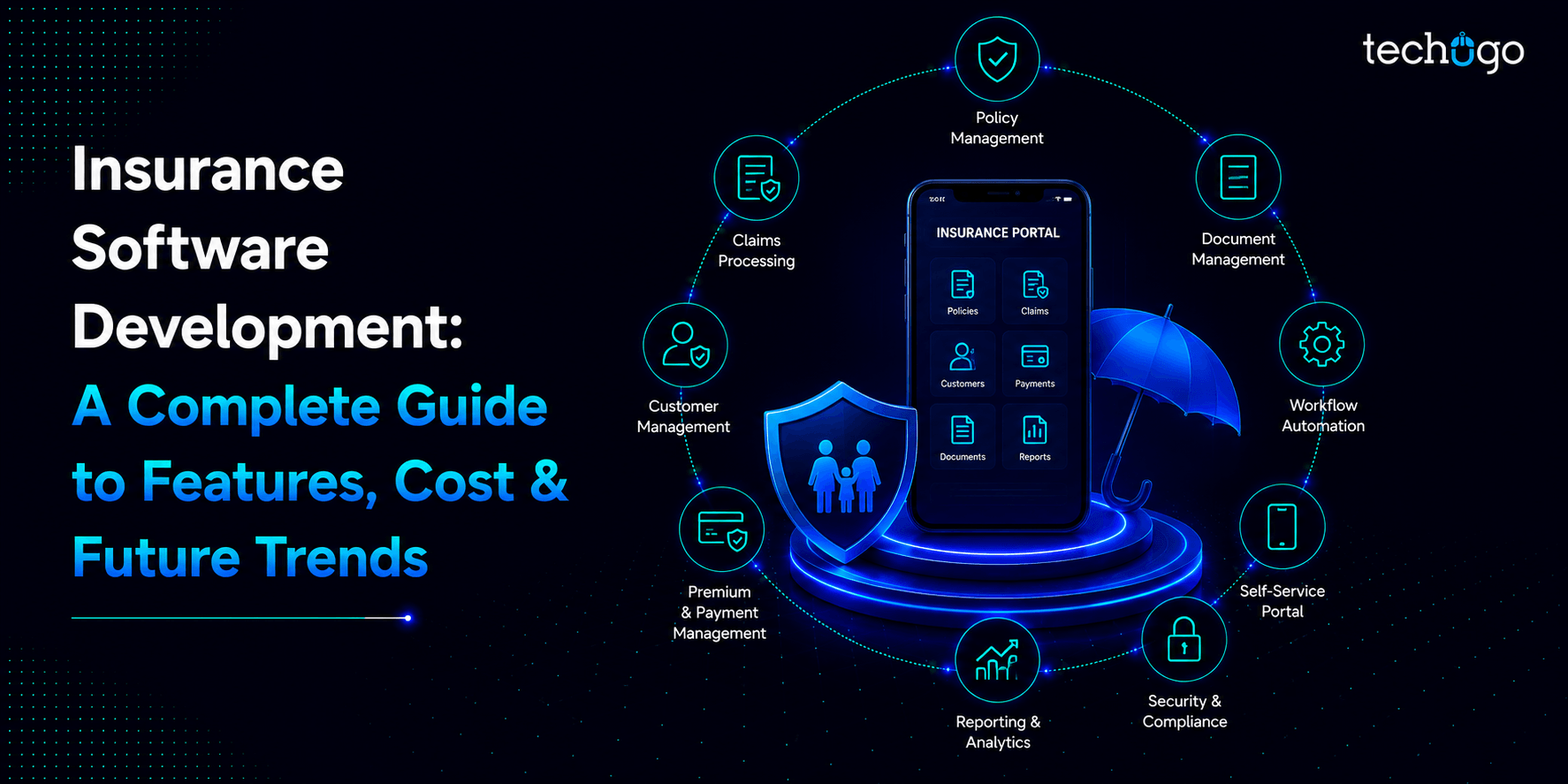
Must-have features of insurance software development
-
Policy management
Some insurers are juggling hundreds (sometimes thousands) of active policies at any given time. Is this practical? No. Insurance policy management software puts all of that on one dashboard (create, update, renew) instead of chasing paperwork across different systems. It’s usually one of the first things worth checking for in custom insurance software development.
-
Claims processing & tracking
Claims are at the heart of every insurance business. Handling them manually is labor-intensive. A good platform should let customers submit claims online, upload supporting documents & track their status in real time. On the insurer’s side, automated workflows help speed up approvals and reduce processing delays.
-
Customer self-service portal
A self-service portal lets customers buy policies, renew coverage, make payments, download documents – and check claim status on their own time.
-
AI-powered fraud detection
Fraud costs insurers billions – every year. But these tools scan claims for unusual patterns and flag anything suspicious before a payout goes through, without holding up the claims that are perfectly fine.
-
Underwriting automation
Applications get run against set rules automatically, which means faster decisions and fewer inconsistencies between reviewers.
-
Secure Payment Integration
Customers expect quick and secure payment options. Insurance software should support online premium payments, recurring billing, refunds, and payment reminders while keeping financial transactions protected.
-
Analytics & reporting
Dashboards give a live view of claims, renewals, and overall performance (which makes it easier to catch trends early).
-
Security & compliance
Sensitive customer data needs encryption, access controls, and audit trails built in from the start. Good software development insurance practices and secure coding habits along the way go a long way toward mitigating the risk.
Business benefits of custom insurance software development
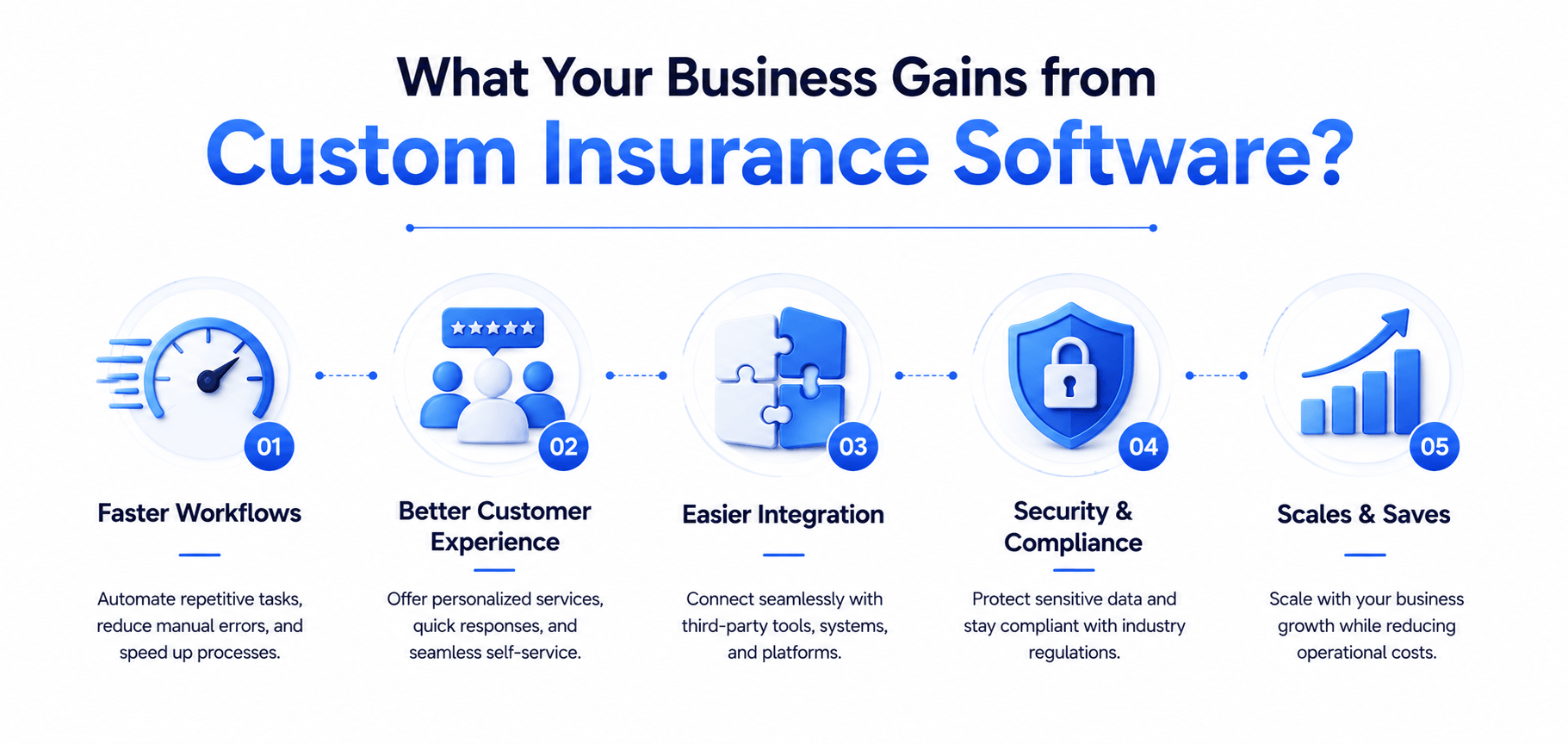
Faster Workflows – Manual paperwork slows teams down. Custom software development for insurance industry needs automates policy creation, renewals, and claims tracking, freeing staff for higher value work.
Better Customer Experience – Software development for insurance enables fast quotes, self-service portals & real-time claim updates.
Easier Integration – Custom insurance software development services connect with your existing CRM, payment, and accounting tools (no need to replace them).
Security & Compliance – Insurance software developers build in encryption, audit logs, and compliance with HIPAA/GDPR.
Scales & Saves – Grows with your business while lowering long-term costs.
Custom insurance software vs off-the-shelf solutions
Off-the-shelf software gets you started fast but it won’t fit every business. A custom insurance software development service on the other hand, is built around the way you work.
Both have their place, but they’re built for different needs. Let’s see how they compare –
| Feature | Custom Insurance Software | Off-the-Shelf Software |
| Customization | Built around your business processes | Limited customization options |
| Scalability | Easily grows with your business | May become restrictive as you scale |
| Integration | Connects seamlessly with existing systems | Limited or pre-built integrations |
| Upfront Cost | Higher initial investment | Lower upfront cost |
| Long-Term Cost | Better ROI over time | Ongoing licensing and upgrade fees |
| Deployment Time | Takes longer to build | Ready to use quickly |
| Security & Compliance | Tailored to your security and regulatory needs | Standard security features for general use |
| Support & Updates | Personalized maintenance and feature updates | Vendor-controlled updates |
| Best For | Growing insurers, agencies, and enterprises | Small businesses with basic requirements |
If you need more flexibility and room to grow, working with an experienced insurance software developer would be a better long-term choice.
The process of building an insurance platform
Different insurance business means different goals, which is why the development process starts with understanding exactly what the platform needs to do.
This is how it usually goes –
1. Discovery and planning
The first step is obviously understanding your business goals. This is where a good insurance software development firm gets to know your business goals, target users, compliance requirements, and must-have features, helping define scope, timeline – and tech stack.
2. UI/UX design
Designers map out simple, intuitive journeys for policyholders, agents, and admins (including insurance mobile app development for customers who want everything on their phone).
3. Development
This is the core build phase –
- policy management
- claims processing
- Portals
- payments
- push otifications
- and reporting
All part of custom software development for insurance done right.
4. Testing
Performance, security, usability, and device compatibility are all checked before launch.
5. Deployment
A carefully planned rollout minimizes downtime and keeps the transition smooth.
6. Maintenance and Improvements
Ongoing updates and patches from skilled insurance tech software developers keep the platform reliable – a hallmark of the best custom insurance software development companies.
How AI is transforming insurance software
Among surveyed U.S. insurers:
1. 88% of auto insurers reported they use, plan to use, or are exploring AI/ML models.
2. 70% of home insurers reported the same.
3. 92% of health insurers reported they use, plan to use, or plan to explore AI/ML.
In other words, AI has moved well beyond the testing phase.
Let’s look at how it’s transforming every stage of the insurance lifecycle.
1. Faster claims processing
AI can check documents and spot missing info in minutes. This cuts approval times dramatically and takes a huge chunk of manual review off claims teams’ plates.
2. Smarter fraud detection
Fraud quietly drains a lot of money from this industry every single year. Good insurance fraud detection software development catches unusual patterns early, suspicious claims get flagged for a closer look, while honest customers still get paid out fast.
It’s a win for insurers and an even bigger win for honest policyholders.
3. More accurate risk assessment
Driving habits, medical history, past claims – it’s easy for AI to process all that data and price risk more fairly with custom insurance automation software development.
4. AI-powered customer support
Customers don’t care what time it is when they have a question. Round-the-clock chat support handles all the basics like policy details, claim status. Most companies that hire insurance software developers do it specifically to get this piece right.
5. Personalized policy recommendations
AI looks at what a customer’s actually interacted with and suggests plans that fit, which does wonders for keeping people around long-term.
6. Predictive analytics
It also helps to know when claims are about to spike or customers might leave – that’s the sort of thing an AI insurance software development company is good at.
How much does insurance software development cost?
This is the question insurers ask first, and fair enough – insurance app development cost can vary widely depending on what you’re actually building.
A basic app looks nothing like a full platform with AI and custom insurance fraud detection software development built in, so the price tag reflects that. Generally you can expect around $30,000 and $300,000+.
Here’s the breakdown –
| Project Type | Estimated Cost | Timeline |
| Basic MVP | $40,000–$80,000 | 3–5 months |
| Mid-Level Insurance Platform | $80,000–$180,000 | 5–8 months |
| Enterprise-Grade Insurance Software | $180,000–$300,000+ | 8–12+ months |
Your final investment will largely depend on the software development company you partner with.
If you’re thinking about how to hire software developer for insurance projects, just know the final number really depends on your features, what you need integrated, compliance requirements, and how big the scope actually gets. There’s no one-size-fits-all price when it comes to software development for insurance business, it’s only about matching the investment to what your company actually needs.
Common challenges in building insurance software (and how to overcome them)
1. Meeting compliance requirements
HIPAA, GDPR, PCI DSS – miss even one small requirement and you’re looking at fines or a delayed launch.
Solution: Work with a custom insurance software development company that can build compliance in from day one.
2. Protecting sensitive customer data
Insurers hold a lot of personal and financial data and that makes them a target.
Solution: Use end-to-end encryption, multi-factor authentication, role-based access controls – and regular security testing in order to keep customer data protected.
3. Integrating with legacy systems
There are insurers who still rely on outdated software that does not easily connect with modern applications.
Solution: APIs let you build a bridge between the old and the new, so modern tools can plug into what’s already there. Then you modernize piece by piece.
4. Handling high claim volumes
As you grow, it gets difficult to keep up with the manual claims processing.
Solution: Automating the grunt work with the right financial & insurance software development services stops the backlog from piling up (yes, even during busy periods).
5. Preventing insurance fraud
Fraud costs billions a year and manual reviews aren’t enough to catch every suspicious claim.
Solution: AI flags suspicious patterns early. Some companies are also exploring smart contracts in insurance industry use cases to automate claim verification & payouts.
Future trends in insurance software development
-
AI-powered underwriting and claims processing
AI now handles most of the application review process, and it’s genuinely fast – checking details, flagging issues, catching patterns humans might miss, and getting approvals out in seconds instead of days. This is where insurance agency software development has made the biggest jump, since claims that used to sit in a queue for a week can now move almost instantly.
-
Hyper-personalized insurance products
It’s rare for two people to have the same risk profile. But a lot of older systems still price them the same way. Good insurance software development changes that by pulling in real data (your habits, your history, your actual situation) so the pricing ends up fairer and more accurate, not just a flat rate applied to everyone.
-
IoT and telematics
Car sensors and wearables are constantly sending back data, like driving speed, braking patterns, or health metrics, and that means safer habits can lower your premium. It also means risks get caught early.
-
Embedded insurance
Coverage shows up right when you need it – at checkout, through a simple API integration. You don’t need no separate app and not even extra forms.
-
Blockchain for claims
Smart contracts cut down on fraud and speed up payouts, and there’s a lot less paperwork involved which benefits everyone.
How to hire insurance software developer that fits your business needs
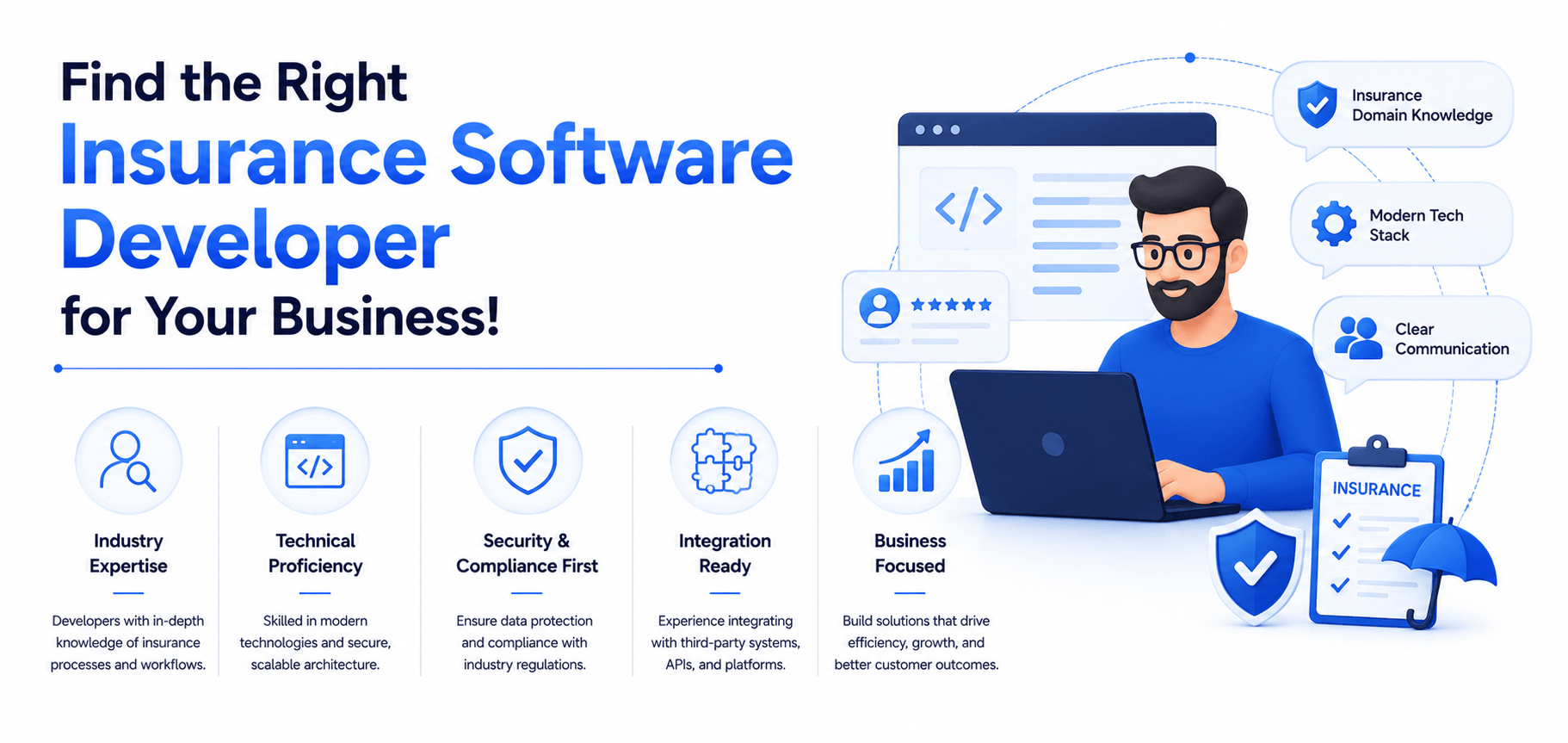
Don’t get fooled by the lowest quote. Even the lowest cost has the potential to cost you a lot if they don’t actually get your business. So pick someone who is experienced enough to understand your business and your customers.
Here’s what else you should keep in mind –
1. Define your requirements
Before you even start looking, figure out what you’re building – a claims platform, policy management system, customer app, whatever it is. Clear goals make it way easier to find the right fit.
2. Look for insurance industry experience
This industry has its own specific demands – compliance, security, workflows. You want a developer who’s dealt with this before, with a good background and good experience.
3. Evaluate technical skills and long-term support
Look at their past work, tech stack, and process. And just make sure they’ll stick around for support after launch because your software needs to grow with you.
Why Techugo is the right insurance technology partner for your business
When you’re building an insurance software, you are just looking for a development team, you are looking for a partner who understands your business goals.
Techugo is that partner.
At Techugo, we help businesses build custom insurance software that are secure, scalable, and fully designed around your needs. So whether you want to automate claims or add AI-powered features or just modernize a system that’s been outdated for years, our team will work with you at every step.
Even after the launch, we provide maintenance and support to fix bugs and handle updates, so you’re never left dealing with problems on your own.
We have been in software development for over 10 years now, and throughout this journey we’ve helped startups, enterprises, including Fortune 500 companies build their platform. Our expert team works with technologies like AI, cloud platforms, Flutter, React Native, Node.js, and Python, so that the solutions we create are built for today but are ready for what comes next.
The next big insurance solution won’t build itself. Good thing you know a mobile app development company that can help. Reach out to the Techugo team, and we will help you out!
FAQs
1. What is insurance software development?
Insurance software development involves building digital solutions that help insurers manage policies, process claims, automate workflows and also improve customer experiences.
2. How much does insurance software development cost?
Costs typically range from $30,000 to $300,000+, depending on the features, complexity, integrations and customization required.
3. Why should I invest in custom insurance software?
You should invest because custom software fits your business processes, improves efficiency, enhances customer satisfaction and even scales as your business grows.
4. How long does it take to develop insurance software?
A basic solution can take 3–6 months, while a complex enterprise platform may take 9–18 months.
5. What features should insurance software include?
Key features of an insurance software include – policy management, claims processing, customer portals, analytics, payment integration, security, and reporting.

Get in touch
We'd love to hear from you.