

 SA
SA  KW
KW  IE
IE AU
AU UAE
UAE UK
UK USA
USA  CA
CA DE
DE  QA
QA ZA
ZA  BH
BH NL
NL  MU
MU FR
FR 














📌 Key Takeaways
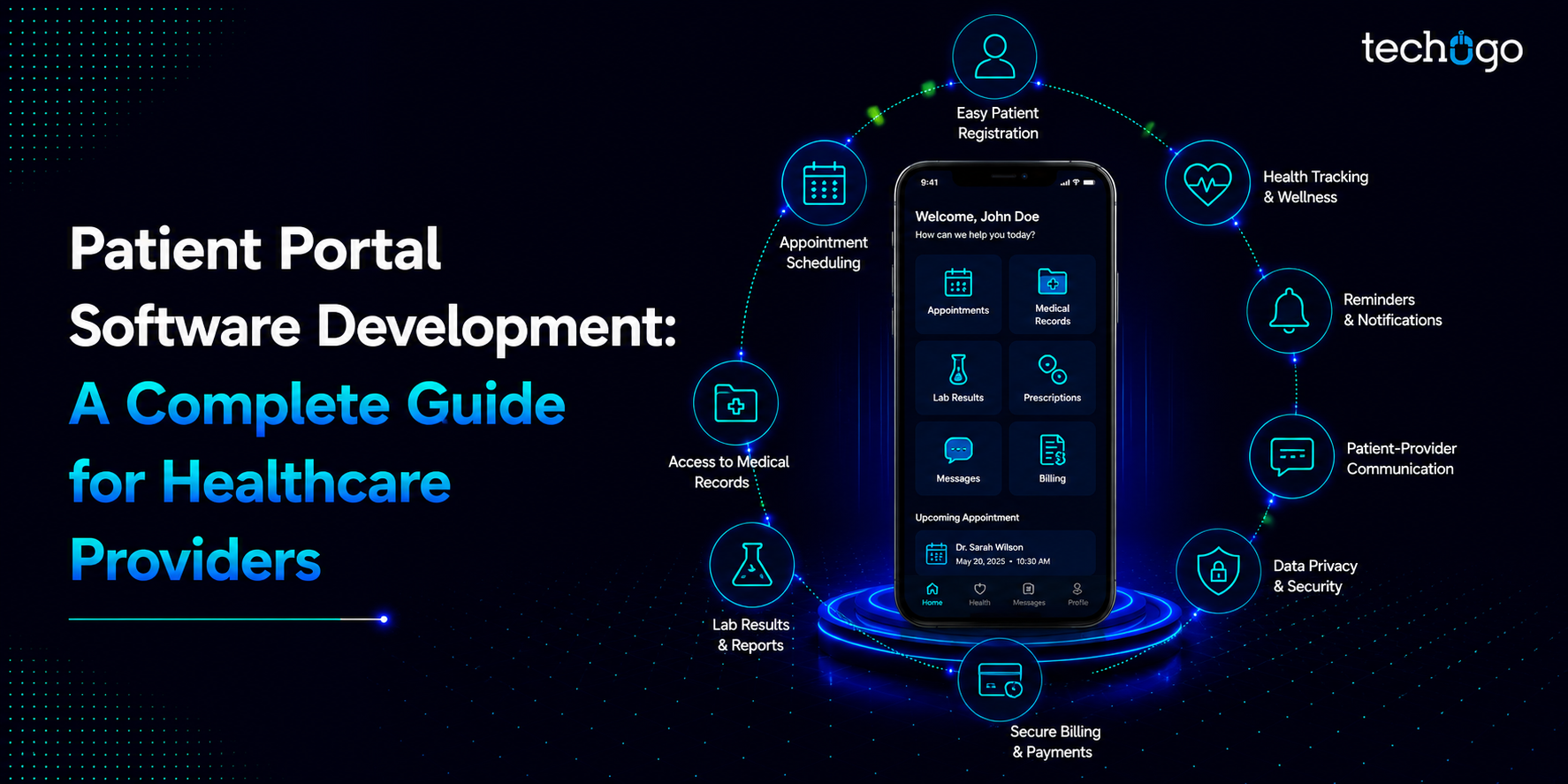
- A patient portal makes it easier for patients to book appointments, access records, pay bills and stay connected with their healthcare provider.
- Your patient portal software cost will depend on the features & complexity ($50,000 – $300,000+)
- AI is making everything from support to follow-ups faster and more personalized.
- More than anything, choosing the right patient portal software development company will help you build a secure, scalable and future-ready platform.
Patients today expect more than quality healthcare.
They want to –
- check their records
- book appointments in a couple of clicks
- message their doctor securely
- pay bills online
And generally… they want an experience that doesn’t feel like it’s stuck in the past.
If your organization can’t offer that, then patients won’t hesitate to find a provider that can (which is fair).
This is why there’s a need for patient portal software development in healthcare organizations everywhere.
And in this guide, we’re covering everything – the benefits, features, key integrations, real use cases, what development actually looks like, costs, where AI is headed, common roadblocks, and what to expect in 2026. Whether you’re running a hospital, clinic, or healthcare startup, this will help you build a portal that’s secure, scalable, and built for how healthcare works today.
Why patient portal software development services are in high demand
Honest answer? Because expecting patients to call during business hours to book an appointment or drive across town for a lab result is starting to feel almost preposterous.
That’s not how anyone lives anymore. We are in 2026.
And patients expect healthcare to be just as easy as everything else they do online. And it’s possible now with a patient portal software.
Here are all the reasons why the demand for patient portal software development services is skyrocketing –
1. Patients expect self-service. Calling the front desk during business hours just to book a routine checkup is not a thing anymore. A portal lets people do it themselves, whenever they want.
2. Records shouldn’t require a trip. Waiting on a callback (or worse, driving in) just to see a lab result is outdated. Patients want that information the second it’s ready.
3. Communication needs to be instant and secure. Email isn’t private enough, and phone calls are slow. Secure messaging bridges that gap without compromising HIPAA compliance.
4. Admin teams are stretched thin. Every task a portal automates (scheduling, reminders, intake forms) is one less thing pulling staff away from actual patient care.
5. Digital-first care is where the money’s going. With billions pouring into digital health, providers who don’t modernize risk looking behind the curve – and losing patients to those who aren’t.
6. More providers are getting on board. As demand grows, more patient portal software companies are stepping up with solutions built specifically for healthcare (this makes it easier than ever for providers to finally make the switch).
Our experts observed that usually, healthcare organizations try to build everything at once. That’s a mistake. The smart thing you can do is start with an MVP that covers the essentials like appointment scheduling, medical records and secure messaging. Because if your platform is built right from the very start, you don’t need to tear it down to add any of that later. It will grow with you.
Types of patient portal software
1. Standalone patient portal
A dedicated space where patients can book appointments, check medical records, view prescriptions, pay bills and message their provider securely.
2. EHR-integrated patient portal
This one plugs directly into your EHR system, so records, lab results, prescriptions, and clinical updates all sync automatically in real time.
3. Telehealth patient portal
Made for virtual care – video visits, secure messaging, digital prescriptions, and remote follow-ups, on top of the usual portal features.
4. Custom patient portal
Now comes custom. This is usually where organizations land once they realize their needs are just too specific for a generic solution.
At that point, patient portal software development becomes a necessity.
And a lot of them end up partnering with a healthcare app development company rather than relying on generic patient portal software vendors only because custom builds offer far more flexibility and room to scale than an off-the-shelf option ever could.
Key features every patient portal software should have
1. Secure patient registration and login
Patient data is sensitive so this has to be locked down properly. That means encrypted logins, multi-factor authentication – and role-based access so only the right people see the right information. It should still be simple enough that patients don’t struggle to get into their own accounts.
2. Online appointment scheduling
Patients want to book, move, or cancel an appointment without calling anyone. A good scheduling feature handles that in just a couple of clicks.
3. Access to medical records
Prescriptions, lab results, visit summaries, vaccination history – patients should be able to pull all of this up on their own instead of waiting on a callback. It saves time for everyone involved.
4. Secure messaging
This is basically replacing the back-and-forth phone calls. Patients can message their provider directly, ask something quick, get a status update, or follow up on a treatment plan without it turning into a whole thing.
It’s a small feature, but it’s usually one of the first things organizations ask for when they start patient portal software development.
5. Online payments and billing
Allows patients to see what they owe, pay it and check their insurance details, all in a single place. It cuts down on the confused billing calls your staff probably gets a lot of.
6. Telehealth and mHealth integration
The portal isn’t just for records anymore. It’s something patients open every day. Connect it with virtual visit tools and mHealth apps in healthcare, and now they can check in with a doctor, track their own health data, and manage appointments, all from the same patient portal platform.
7. Automated reminders and notifications
Push notifications for reminders like –
- upcoming appointments
- refills due
- screenings coming up
Patient portal software use cases across healthcare
1. Hospitals and multi-specialty healthcare networks
Big hospitals rely on portals for appointments, records access, secure messaging, and keeping departments in sync. This is usually where patient portal software development pays off most.
2. Clinics and private practices
Smaller clinics use portals for the everyday stuff – booking, refill requests, payments, follow-ups.
3. Telehealth providers
For virtual care, the portal basically is the practice – video visits, document sharing, prescriptions and post-visit follow up.
4. Diagnostic labs and imaging centers
Patients book their own tests and get notified the moment results are ready instead of calling in to check.
5. Specialty healthcare providers
- Dental
- mental health
- fertility
- rehab
These often don’t fit what patient portal software vendors offer off the shelf. So many turn to a patient portal software development company to get their custom patient portal platform built.
Business benefits of custom patient portal software
1. Better patient engagement
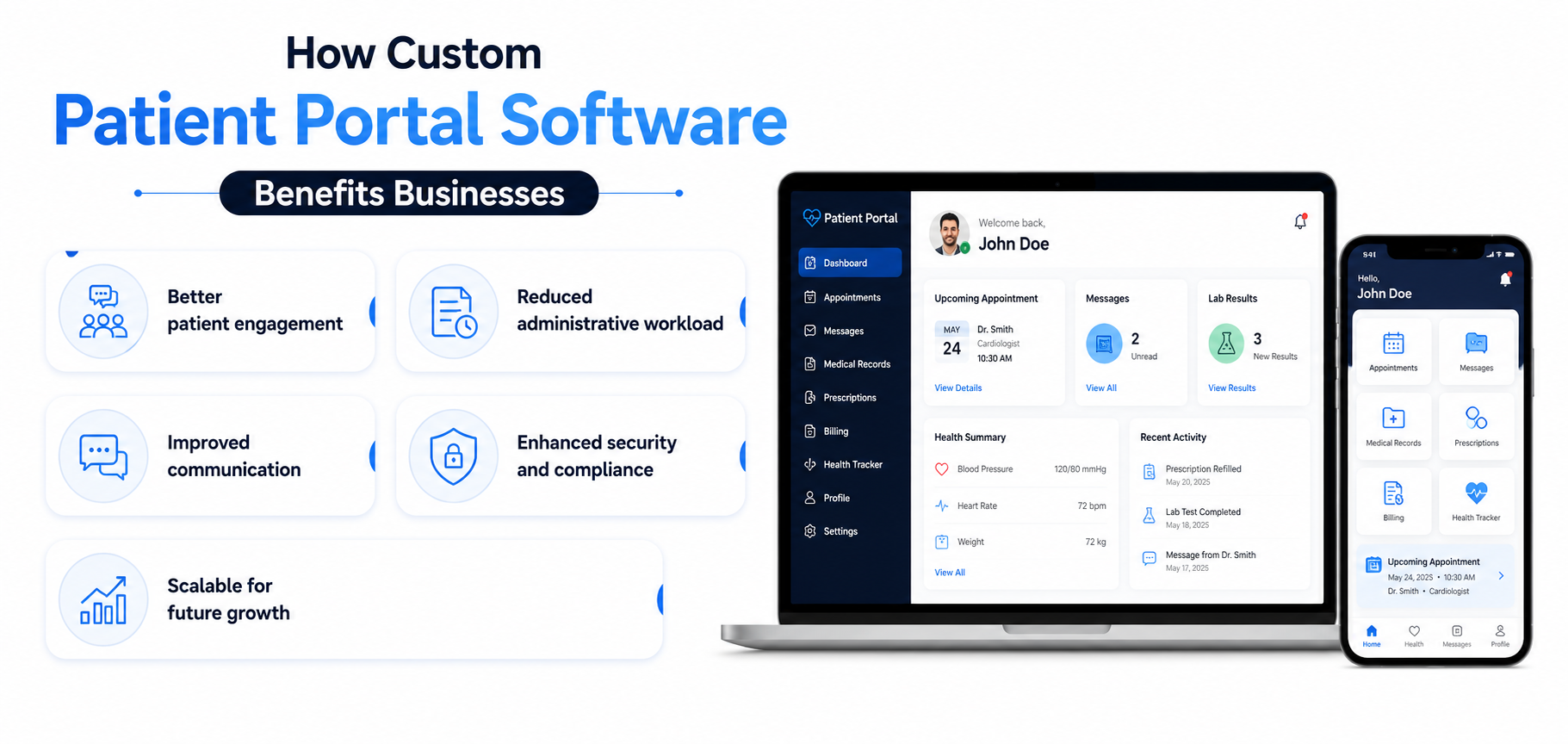
A custom patient portal makes things easier for patients who want to stay involved. They can book appointments and access records and request refills, but also message providers whenever it’s convenient for them.
2. Reduced administrative workload
Once scheduling, bill payments, and reminders run on autopilot, staff aren’t stuck doing it all manually. They get more time to look after their patients.
3. Improved communication
Secure messaging, and real-time notifications too, they keep patients informed. Test results. Treatment updates. It builds trust, and that’s what matters.
4. Enhanced security and compliance
The good patient portal software companies, they build in encryption and role-based access, because compliance is the foundation.
5. Scalable for future growth
You start small, but with patient portal software development, it grows with you. New features get added, integrations too, and that’s why custom patient portal development ends up being worth it, in long term.
Patient portal vs patient app vs healthcare CRM
People often use these three terms interchangeably. But they’re anything but same.
Here’s how they differ –
| Parameter | Patient Portal | Patient App | Healthcare CRM |
| Purpose | Secure access to health information | Mobile healthcare services | Patient engagement and relationship management |
| Primary users | Patients | Patients | Healthcare providers and staff |
| Key features | Medical records, appointments, secure messaging | Appointment booking, telehealth, reminders | Follow-ups, campaigns, patient communication, analytics |
| Integrations | EHR/EMR, billing, labs | Patient portal, wearables, telehealth | EHR/EMR, billing, telemedicine, patient portals |
| Best for | Managing healthcare information | Accessing healthcare anytime, anywhere | Building stronger patient relationships |
So – a patient portal gives patients access to their info. A patient/healthcare app like Patient Access, though, is about convenience and going mobile. And a CRM? That’s for providers, managing relationships, therefore knowing this helps you choose right.
The best results come from using these solutions together. And if you are planning a digital healthcare platform, partnering with one of the best companies to build patient portal software would help you create a solution that not only fits your patients’ needs but also scales.
Must-have integrations for a patient portal platform
1. Electronic health records (EHR/EMR)
Connecting your patient portal with an EHR or EMR system basically gives patients secure access to their medical history, prescriptions, diagnoses and lab results (also ensures providers always work with the most up-to-date patient information).
2. Appointment scheduling
Patients book or cancel without calling anyone, and reminders minimize the number of missed appointments big time.
3. Telemedicine platforms
Virtual visits are pretty much normal now, so a telemedicine integration lets patients join video calls, check consultation notes – and get follow-up instructions right from the portal.
4. Payment gateways
A secure payment integration means patients can pay bills, view invoices and get confirmations in a just few clicks (makes billing way less of a hassle).
5. Laboratory and diagnostic systems
Waiting for a phone call for test results is something no one would prefer. So it’s replaced with lab integrations that let reports show up in the portal as soon as they’re ready.
6. Pharmacy and ePrescription systems
Doctors can send prescriptions electronically, and patients can track meds, request refills and skip the paperwork entirely.
7. Secure messaging and notifications
Secure messaging keeps patients and providers connected safely, and pairing it with SMS or push notifications keeps everyone updated on appointments, prescriptions, and results.
8. Wearables & remote patient monitoring
Wearables synced to the portal let providers track – heart rate, blood pressure, and glucose levels automatically which really helps with managing chronic conditions.
This is basically why getting patient portal software development right matters so much, and if you’re looking for a mobile app development company in USA that delivers software development services, that’s the partner worth finding.
Step-by-step process to build patient portal software
1. Define your goals and requirements
First things first – figure out who’s actually using this portal and what problems it needs to fix. Figure out all the must-have features, compliance needs and integrations.
2. Design the user experience
The UI should be simple. Because it’s important for the patients to be able to check records, book appointments and message their provider without getting lost.
3. Develop the patient portal
Your actual patient portal software development starts in this stage. It includes – HIPAA compliance, logins, and connecting it to EHRs and payment systems.
4. Test and ensure compliance
Test everything (like performance, security, usability) and fix the bugs before you launch.
5. Launch and continuously improve
Now that it’s live, keep listening to feedback and rolling out updates. Honestly, partnering with someone offering good mobile app development services would help you in the long run.
Patient portal software cost: MVP vs enterprise solutions
So how will you end up spending on patient portal software development?
Here’s a quick breakdown of what an MVP patient portal looks like versus a full enterprise setup.
| Aspect | MVP Patient Portal | Enterprise Patient Portal Software |
| Estimated Cost | $50,000–$100,000 | $150,000–$300,000+ |
| Best For | Startups, private clinics, small practices | Hospitals, healthcare networks, multi location providers |
| Core Features | Patient registration, appointment booking, medical records, secure messaging | Everything in an MVP, plus telemedicine, AI features, analytics, billing, role based access, multi location support |
| Integrations | Simple EHR/EMR and payment gateway integrations | Advanced EHR/EMR, pharmacy, lab, insurance, CRM and third-party healthcare systems |
| Scalability | Supports initial growth | Made to handle high patient volumes and complex workflows |
Ultimately, the patient portal software cost depends on factors like –
- the scope of your project
- the features you need
- the level of customization involved
- third-party integrations
- technology stack like Flutter & React Native
Look, if you want to launch quickly, an MVP is the most “cost-effective” option.
However… organizations with complex operational needs should invest in enterprise patient portal software, as it offers greater scalability, stronger security, and seamless integration with existing healthcare ecosystems.
Common challenges in patient portal software development (& how to solve them)
Like any healthcare software, patient portals come with a few development challenges.
Here’s what you should watch out for and the best ways to tackle them –
| Challenge | Solution |
| Keeping patient data secure | Health info is sensitive, so encryption, multi-factor authentication, and HIPAA compliance has to be a part of it from the start. |
| Connecting with existing healthcare systems | Use standards like HL7 and FHIR to integrate with EHRs, labs, billing platforms and other healthcare tools. |
| Getting patients to actually use the portal | Keep the interface simple, easy to navigate & accessible so patients of all ages feel comfortable using it. |
| Supporting future growth | Build on a scalable cloud infrastructure that can handle more users, data & new features as your organization grows. |
| Maintaining accurate patient information | When systems sync in real time, everyone’s working off the same, current info (results in fewer errors). |
AI trends transforming patient portal software in 2026
1. AI-powered virtual assistants
AI chatbots now help book appointments & answer quick questions – so patients aren’t stuck waiting on hold and staff have less on their plate.
2. Predictive patient care
Looking at patient data early on can catch warning signs sooner, so providers can step in before something turns into a bigger problem.
3. Smarter medical records
Medical records used to be confusing to read. Now (with the help of Generative AI) they’re getting summarized into plain language that patients can understand.
4. Intelligent automation
Reminders, refill requests, paperwork – the repetitive tasks is handled automatically by AI. And the teams get to focus on patients instead.
Tip – Find a patient portal software company that is experienced enough to build this in well.
Future scope of patient portal software development
1. Patient portals will evolve into complete healthcare platforms
Right now, most patient portals just let you book appointments and peek at your records. That’s changing fast. Soon you’ll be able to do pretty much everything in one place – chat with your doctor, pull up test results, pay your bills, etc.
2. AI and automation will drive more personalized care
We’re already seeing hints of this. But it’s going to get much bigger. Smart reminders that know your schedule, virtual assistants to answer your queries and health insights.
3. Deeper integration with wearables and remote monitoring
Wearables are connecting deeper now, so real-time data (heart rate, sleep, glucose and whatever else is relevant) – it helps doctors act early. Because right now a lot of that data just sits there doing nothing, and that’s kind of a waste, so linking it up means risks get flagged way before your next scheduled checkup even happens.
4. Improved interoperability across healthcare systems
As healthcare gets more connected, patient portals are going to focus a lot more on making sure data actually moves between hospitals, clinics, labs, and whatever other platforms are involved. So better interoperability basically means you and your doctor both have accurate info whenever it’s needed.
How Techugo helps healthcare organizations build better patient portals
Patient portal software development is a big decision.
But with the right partner, it doesn’t have to be a difficult one.
And as an expert mobile app development company, we focus on building secure, scalable, and genuinely easy-to-use portals that fit what healthcare organizations need.
EHR integrations, telemedicine, appointment scheduling, secure messaging, payment systems – we build all of it in so care feels easy for patients and providers alike. Sure, a patient portal can handle the basics like appointments and medical records. But we also bring AI and other advanced technologies so you always stay relevant and even better – ahead of the time.
Whether you’re starting from scratch or upgrading something that already exists, Techugo’s got you covered with a portal that’s built to last and stays compliant.
If you’ve made it this far, chances are you’re serious about building a better patient portal. We’d love to help. Connect with our team today!
FAQs
How much does patient portal software cost?
It depends on the features and level of customization you need. An MVP usually starts at around $50,000, while an enterprise solution can cost $300,000 or more.
What are the features of patient portal software?
The essentials include appointment booking, secure messaging, medical records, online payments, telemedicine, prescription refills & EHR/EMR integration.
How long does it take to build a patient portal?
Most patient portals take 3 to 5 months to build. But if you want a more complex or an enterprise-level platform can take 6 -12 months (or longer).
5. How do I choose the right patient portal software development company?
Look for a company with healthcare experience, strong security practices & expertise in EHR/EMR integrations. A good partner should also offer ongoing support as your platform grows.

Get in touch
We'd love to hear from you.