

 SA
SA  KW
KW  IE
IE AU
AU UAE
UAE UK
UK USA
USA  CA
CA DE
DE  QA
QA ZA
ZA  BH
BH NL
NL  MU
MU FR
FR [ LET’S TALK AI ]
X
Discover AI-
Powered Solutions
Get ready to explore cutting-edge AI technologies that can transform your workflow!



Get ready to explore cutting-edge AI technologies that can transform your workflow!






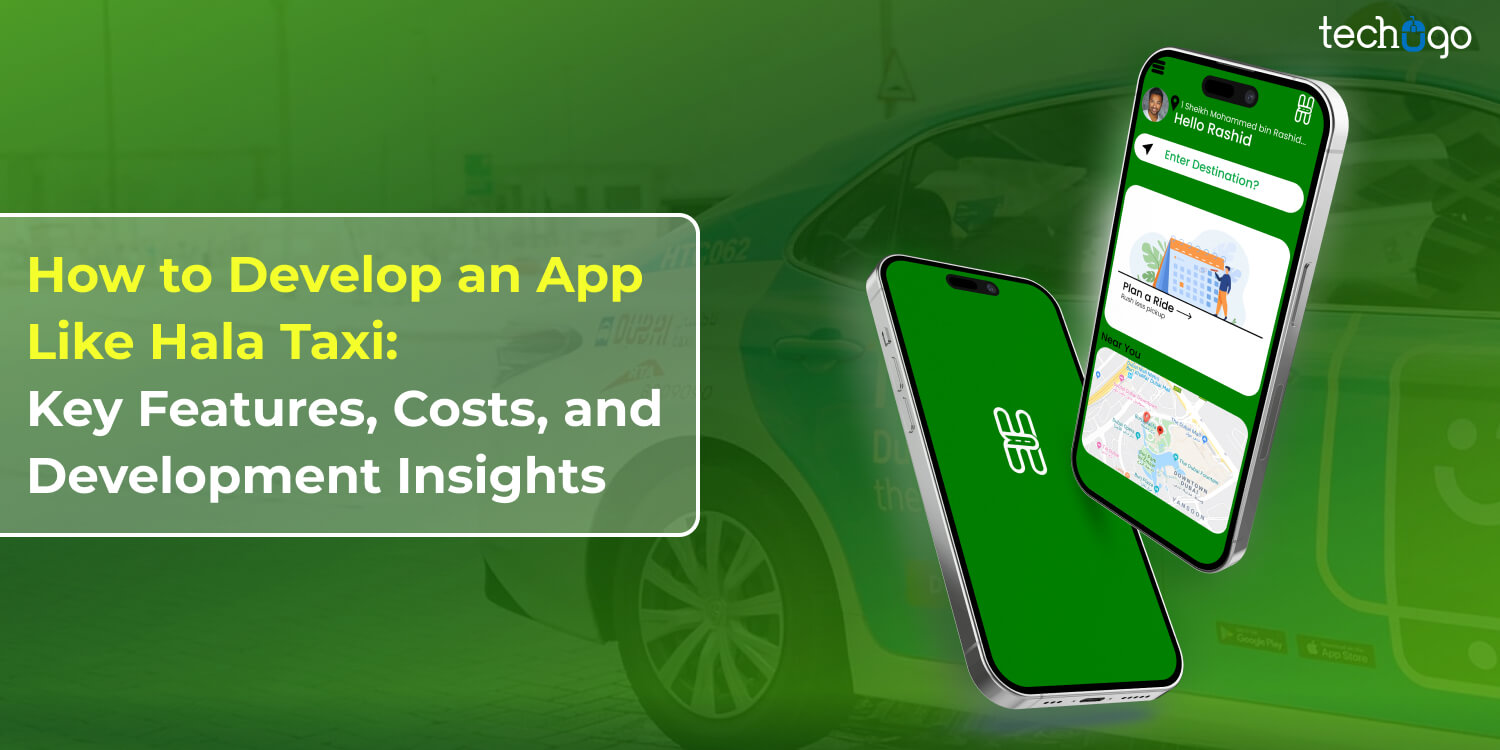
Waiting for a taxi in Dubai feels unnecessary now. People don’t stand on roads anymore. They open apps. They tap a button. And they expect a car in minutes, not someday. For tourists rushing between landmarks, and for residents moving through busy streets, speed matters. This is why apps like Hala Taxi are not just useful, but are normal.
Statista says the Middle East ride-hailing market is expected to cross $10 billion by 2026. GSMA also reports that over 96% of people in the UAE use smartphones.
This is the reason why on-demand taxi booking app development is growing because people want transport, and they want it instantly.
Still, many founders think the hard part is just design. It’s not. To build an app like Hala Taxi, you need more than a nice screen. You need live driver tracking, smart ride matching, stable payments, and systems that don’t crash when traffic spikes. All of this affects the final cost.
That is why taxi app development costs usually fall between $35,000 and $400,000 (AED 125,000 to AED 1,470,000). Depending on features, security, and how complex your app really is.
So if you are planning on-demand mobile app development for taxi booking in 2026, the question is not “should I invest in it?”
It’s more like how do I build it right. With the right features, the right tech, and a cost model that makes sense.
Let’s break it down. Step by step.
Also Read: Top 10 Best Taxi Apps in Dubai: A Simple Guide to Launching Yours
At first glance, the Hala Taxi app looks simple. Open app. Enter location. Book ride.
But behind that smooth screen, a lot is happening.
When a user requests a ride, the system checks nearby drivers. It matches the closest one with availability, with route logic, and with traffic data. The driver gets the request. Accepts it. And the trip begins. Real-time tracking starts working. Maps update and ETA adjusts, and payments stay ready in the background.
This is where taxi booking app development becomes more than just UI design. The app runs on GPS systems, live databases, driver apps, and customer apps. All connected. If one part fails, the whole experience feels slow or broken which users hate.
So technically, the flow looks like this:
User > App > Server > Driver > Ride > Payment > Review
Now comes the business side. How does Hala taxi app actually make money?
Every completed trip sends a percentage to the platform. This is the core model. No rides = no revenue. Which is why ride-hailing app features focus heavily on retention and speed.
During peak hours, fares increase. More demand. Fewer cars. Prices adjust. This is not random. It is algorithm-driven, and it directly improves platform revenue while keeping drivers active.
Airport rides. Hotel tie-ups. Tourism routes. These bring consistent traffic and predictable income.
And the numbers show it’s not small. In 2022 alone, Hala bookings grew by 40%, with over 9 million trips made through the app in Dubai, and the taxi fleet operating under the service expanded with around 4,700 vehicles on the road.
More recently, in the first half of 2025, Hala’s trips rose by about 12%, while active users increased by around 10%, showing stronger user adoption as demand for on-demand travel keeps climbing.
There’s also value in savings and loyalty. Passengers using the subscription benefits of services connected to Hala have collectively saved over AED 15 million on rides over recent years. It is proof that users aren’t just booking rides, they’re engaging with the platform deeply.
There is also data value.
Trip data. Route patterns. Peak zones. These insights help optimize operations, and future services, and are used internally to grow profit.
This working model explains why many startups now want to build an app like Hala Taxi instead of launching a generic transport app. Because the real value is not in booking. It’s in coordination. Automation. Scale.
And this is exactly why taxi app development cost changes so much from project to project.
A basic booking app is cheap. A smart dispatch system is not. A full on-demand taxi app development platform? That’s a different game.
Also Read: How AI is Revolutionizing Taxi Booking App Development
The development of an application similar to Hala Taxi requires understanding total project expenses as your priority. This isn’t only about spending funds—it’s about investing in invention and remaining competitive in a rapidly evolving market. The total cost to build a mobile app relies on several aspects, including the app’s features, scalability, and user experience.
The development costs for a taxi booking app like Hala Taxi work in three different pricing classifications based on increasing features.
Also Read: Building a Ride-Sharing App Like Grab in 2026: Is It Worth the Investment?
For those just starting out, creating a simple ride-hailing app is a solid first step. A fundamental app implements the core functionality, which comprises user accounts, driver licensing, positional analytics, and trip scheduling with payment options.
The basic nature of this version enables starting your market entry at a reduced cost while meeting standard customer requirements.
Designing an app with middle-tier complexity is recommended if you want to create software with better usability alongside premium functionalities.
At this stage of development, your application integrates various advanced features, such as payment gateways and real-time status updates. It analyzes data while offering loyalty benefits. Users benefit from this solution’s affordability and functional capabilities, which leads to enhanced user experience and budget management.
For entrepreneurs who want to build a world-class taxi booking app that competes with industry leaders like Hala Taxi, an advanced-level app is the way to go.
Such an app integrates up-to-date technologies, including artificial intelligence route optimization technology, alongside multi-language support, predictive analytics capabilities, and dynamic pricing solutions.
The advantage of these apps is their scalable design, which enables you to manage extensive user bases without compromising on personalized premium service.
Now comes the part most founders underestimate, the reason why taxi app development cost for a platform like Hala Taxi never stays fixed and why two projects that look similar on the surface end up with very different budgets once development begins, because the price is not driven by appearance but by how many systems are running underneath the interface.
The first major factor is features, since a simple booking flow with login and ride requests requires far fewer development hours than a product packed with advanced ride-hailing app features such as real-time driver tracking, smart ride allocation, surge or dynamic pricing, route optimization, and in-app communication, where every additional function adds logic layers, testing cycles, and long-term maintenance work — and this is usually where costs quietly start expanding.
Then comes platform selection, which seems like a small decision at first but quickly becomes a pricing lever, because building only for Android or only for iOS reduces scope, while launching on both platforms immediately doubles interface work, increases testing time, and raises overall investment, which is why multi-platform taxi mobile app development almost always costs more than a single-platform release.
Another heavy contributor is backend and scalability, since an app designed for limited daily trips can survive on a lightweight server setup, but a system expected to grow like a citywide ride-hailing service must handle thousands of live requests at the same time, such as store trip histories, manage driver availability, and process location updates without lag. This makes backend architecture one of the most expensive components of serious on-demand taxi app development.
Real-time systems also reshape the budget, because GPS tracking, map rendering, traffic analysis, and instant driver matching cannot afford delays or failures, which means developers must build continuously running services that process live data streams rather than static requests. Because static requests increase engineering complexity and push development hours higher than most early estimates suggest.
Security and payments bring their own weight, since integrating multiple gateways, supporting wallets and refunds, and protecting transactions from fraud requires compliance with financial standards and data protection rules, and these legal and technical safeguards raise taxi booking app development costs far beyond what a basic booking application would need.
UI/UX design also influences pricing more than expected, because a confusing interface reduces trust and retention, while a well-structured journey improves engagement. So time spent on usability research, wireframes, and interaction logic is not decoration but a business investment… and one that adds to development timelines.
And finally, regional regulations and operational compliance, especially in markets like Dubai. Introduce licensing rules, data hosting policies, and transport authority requirements that demand extra development work, additional testing, and approval cycles. All of this, quietly expands the total cost to build an app like Hala Taxi without always being obvious at the planning stage.
So while rough estimates can point you in the right direction, the real cost is shaped by how many systems you connect, how intelligent they need to be, and how far your platform is expected to scale once real users begin booking real rides.
Now that we’ve covered the general cost estimates, let’s dive deeper into the various factors that influence the overall taxi booking app development cost in Dubai, starting with the essential features.
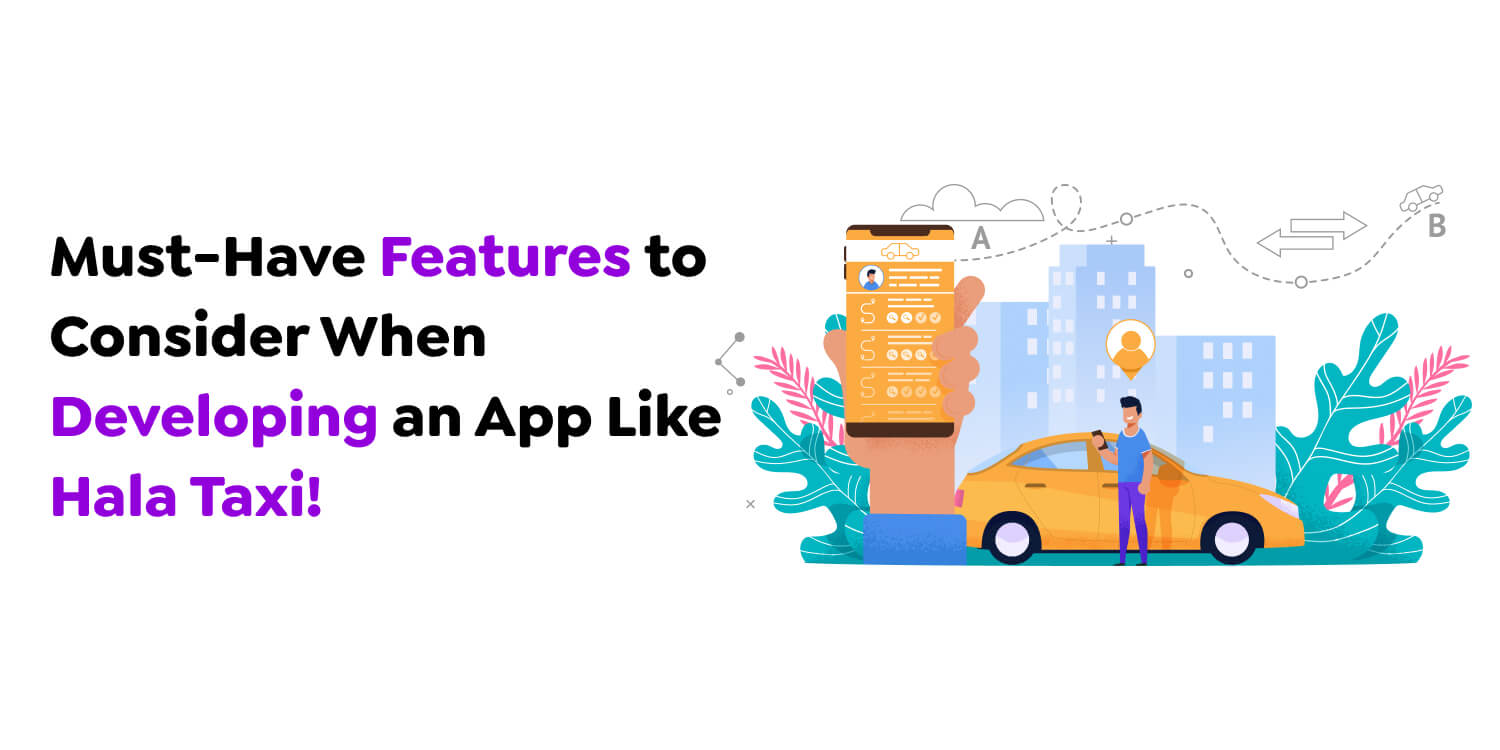
The triumph of any taxi-booking platform, like Hala Taxi, relies on its capacity to deliver a smooth, efficient, and pleasant experience for both customers and drivers. In fast-paced and tech-savvy circumstances, having the right elements is essential for constructing an app that stands out. Below, we analyze the key functionalities you’ll want to consider when building your own ride-hailing app, with a look at how they work.
The first step for any user interacting with your app is a smooth onboarding experience. A simple and secure login process – whether via phone number, email, or social media accounts – ensures a hassle-free start. Once logged in, users can set up their profiles, save frequently used locations, and store payment details for quicker and more efficient bookings.
The ability to book a ride with ease is at the core of any ride-hailing app like Hala Taxi. Users should be able to quickly choose their pickup and drop-off points via an interactive map. Along with economy transport options, taxi applications must incorporate premium and shared ride capabilities to enable customers to select customized service methods. Requests through the app’s backend algorithm are matched with the nearest accessible drivers, which improves operational efficiency.
Trackable real-time monitoring of drivers’ locations has become a highly demanded feature in taxi-hailing apps after bookings. GPS tracking lets riders monitor their transportation progress, calculate estimated travel times, and maintain journey security and transparency. The feature improves trust levels while facilitating clear expectations about the process.
Safety and transparency are key to building a trusted app. Before a ride begins, users need to access the driver’s photo, license plate number, vehicle information, and full name. This personalized feature creates trust while showing users their personal information for a safe vehicle entry experience.
Affordable pricing with ride-sharing integration helps passengers maximize cost efficiency. The app’s algorithm can match passengers traveling along similar routes, splitting the fare, which also contributes to eco-friendliness in a busy city like Dubai.
A flexible payment solution is crucial for user convenience. The app must support diverse payment methods, combining credit or debit card strategies with digital wallet capabilities and cash options to serve various preferences. Local users will benefit from a streamlined payment experience through payment platform integration, which supports widespread Dubai payment methods.
Quality service maintenance tools allow riders to provide service quality ratings and share feedback on their experience. Users can submit ratings through this feature, which drives accountability functions alongside quality service standards. It’s also important to allow drivers to rate passengers, creating a balanced ecosystem of mutual respect.
Rides sometimes may have problems, so accessible and responsive customer support must be available to fix them. The app should include real-time communication tools with helpful contact options and extensive customer service capabilities through live support and written resources, offering instant help that creates an optimal experience for users and drivers.
Users should have access to ride history, which displays journey details, including cost breakdowns and the overall duration of the trip. E-receipts enable easy expense tracking because they are accessible by email and directly inside the mobile app, which benefits business travelers.
To manage demand effectively, the app should implement surge pricing during high-demand periods, such as rush hours or adverse weather. This ensures drivers are fairly compensated while helping passengers plan accordingly. Implementing this feature during the taxi booking app development process enhances user experience and optimizes revenue generation.
In a global city like Dubai, multi-language support is crucial for attracting many users. Multiple language support for your app benefits users, including residents and tourists, by making the platform navigation system more straightforward, thus creating happier customers.
Safety functions as a primary requirement of any ride-hailing app through emergency-button access combined with trusted contacts sharing for ride details and background-verified driver checks, which create secure experiences for passengers.
Users who organize their rides in advance will find more value in the platform’s advanced scheduling capabilities. End-users benefit significantly from the ride planner because they gain assurance about their rides to airports or business functions.
By incorporating these features into a user-friendly interface, you can replicate the success of the Hala Taxi app and create a ride-hailing app that meets the needs of today’s commuters. The next step is to understand how app design plays a vital role in enhancing these features, which directly impacts the overall cost of developing a top-tier taxi booking app.
Also Read – Exploring the Thriving Limousine Business in Dubai

Designing a successful ride-hailing app involves more than creating an appealing visual layout. It requires crafting a smooth, intuitive experience that aligns with the fast-paced needs of both passengers and drivers. Every aspect, from booking a ride to completing payments, should feel effortless. This user-centered design approach significantly impacts the overall development cost of the app, making it essential to partner with a travel app development company that specializes in building seamless and efficient solutions.
Here are some key considerations to keep in mind when designing an app like Hala Taxi:
A successful ride-hailing application platform requires dedicated features that meet passengers’ and drivers’ needs. The passenger experience requires an interface that simplifies trip booking, precise journey tracking, and robust payment security. Driver features must maintain accessibility by providing straightforward mechanisms for ride requests, navigation tools, and earnings summary displays.
For an uninterrupted user experience, the navigation system must remain straightforward and easy to follow. All key operations in the system must have essential functionality, including location selection and history review. The application must maintain an easy navigation system that allows entry-level users to understand and repetitive users to access quickly.
Your app requires a unified brand design element that maintains a solid and consistent image. This includes using cohesive colors, fonts, and design elements to foster trust and recognition. Reliability emerges from having a professional design; thus, users develop trust in your products.
A multilingual interface is an essential requirement for any service that operates in the diverse environment of Dubai. The mobile app requires intuitive language options that are accessible to all users who need the application, regardless of their ethnic background. Investing in travel app development in Dubai guarantees that the app caters to a wide audience, improving user experience and engagement across various demographics.
Guaranteeing your app is available to everyone, including those with disabilities, widens your potential user base. Add adjustable text viewing options, speech-based navigation instructions, and contrast adjustment patterns to improve accessibility and fulfill regulatory mandates.
Maps play a crucial role in any ride-hailing app. Ensure that the maps are responsive, clear, and visually appealing. The application must present real-time driver location updates and route changes using smooth delivery mechanics to maintain user engagement with a dynamic interface.
Implementing design minimality results in an app that users can use more comfortably. The application performs better and remains user-friendly when essential functions gain focus, while other visuals stay minimal because this design guides users through booking rides and payment solutions without distraction.
Users need immediate notification after they perform actions, including confirmation messages that show their booking status and information about their ride’s progress. Real-time feedback strengthens user trust irrespective of request progress, thereby maintaining user information about request status, boosting confidence, and diminishing doubt.
The majority of users interact through mobile devices, so smartphone applications must be optimized. The mobile application should provide responsive designs, quick loading times, and cross-platform functionality, which ensures optimal performance between iOS and Android systems.
Safety is a top priority for any ride-hailing app. Make sure to prominently display safety features, such as an emergency button, ride tracking for friends, and verified drivers. These features help increase trust in the app and make passengers feel more secure.
The driver’s app interface should be simple, allowing them to easily access key features like ride notifications, navigation, and earnings summaries. This ensures drivers can operate the app efficiently, even during busy periods.
By focusing on these design principles, you can form an on-demand app that offers a user-friendly and dedicated experience, making it stand out in the competitive ride-hailing industry.
In the next section, we will examine the development intricacies of forming these features and how they affect the overall cost of building a taxi booking app in Dubai.

Building an app like Hala Taxi Dubai involves tackling various complexities to ensure smooth functionality, scalability, and user experience. Here’s a summary of the key challenges:
1. Multi-Platform Development: Developing for both iOS and android increases complexity due to different design and framework requirements. Cross-platform tools like Flutter help but still need effort for consistency.
2. Real-Time Features: Real-time features like ride tracking require advanced backend systems and integration with geolocation, mapping, and traffic data APIs.
3. Backend Infrastructure: A reliable backend is crucial for managing ride requests, user authentication, and payment processing. Technologies like Node.js or Python are used to ensure scalability.
4. Matching Algorithms: Advanced algorithms are needed to match drivers with passengers, calculate routes, and estimate fares, adding to the development complexity.
5. Third-Party Integrations: Payment gateway integration, along with SMS capabilities and mapping API integration, needs careful testing because it makes smooth functionality a necessity.
6. Security and Compliance: To ensure data security and compliance with regional laws, you must deploy protected storage systems, use encrypted communications, and implement robust authentication protocols.
7. Scalability: Reliability under peak loads becomes possible through selections of appropriate cloud services, databases, and architectural choices that manage fluctuating demand.
8. Testing: To achieve smooth performance, extensive testing of various device platforms and operating systems and multiple network environment conditions is essential.
9. Localization: For Dubai, the app needs multilingual support, regional payment system integrations, and cultural adjustments.
10. Maintenance and Updates: The app requires continuous updates alongside maintenance activities to resolve issues and handle feature additions while sustaining market competitiveness.
By addressing these factors, mobile app developers can create a successful, scalable, and user-friendly ride-hailing app.
Developing a feature-packed ride-hailing app with the help of a mobile app development company in UAE requires a well-planned and structured approach.
Each phase is designed to meet user needs, maintain quality, and align with your business goals. Here’s a simplified breakdown of the stages involved in building a taxi booking app:
This structured approach ensures a reliable, user-focused ride-hailing app that is both scalable and adaptable to future needs. It sets the foundation for a successful launch and long-term success in the competitive ride-hailing market.
In conclusion, developing a ride-hailing app like Hala Taxi requires careful planning, a deep understanding of key features, and a robust technology stack.
Every element plays a critical role in creating a successful app, from essential features like seamless ride booking and real-time tracking to advanced functionalities such as dynamic pricing and multi-language support.
While the cost of development can vary based on the complexity and desired features, careful consideration of design, security, and scalability will ensure that your app stands out in the competitive market.
Partnering with a mobile app development company in Dubai can help you build a user-friendly, secure, and efficient ride-hailing platform that meets the needs of both passengers and drivers.
What makes Techugo a strong partner for this journey is its deep experience in on-demand mobile app development, combined with a business-first approach.
As an experienced mobile app development company, Techugo’s development process begins with market analysis and product strategy, so that your app is aligned with real user behavior and operational goals rather than just visual design.
Our Team builds secure backend architectures, intelligent driver-passenger matching systems, and performance-driven interfaces that support growth from day one. Every feature, whether payment gateway integration or GPS-based tracking, is engineered to support long-term growth and reliability.
Beyond development, our team also provides post-launch support and continuous feature enhancement, which are critical for businesses looking to compete in the ride-hailing space.
Techugo helps startups and enterprises build an app like Hala Taxi that is not only functional but commercially viable in competitive markets such as Dubai and the wider Middle East.
If your goal is to create a future-ready ride-hailing platform with strong user experience and dependable infrastructure, partnering with Techugo gives you access to a proven mobile app development team that understands both technology and transportation business models.
Get in touch with Techugo today to turn your vision into reality with expert app development solutions!

People in Saudi Arabia order food on apps, shop on apps, and look for discounts on apps. They make payments on apps and even look for ride hailing ser..


The whole process from conception through young children is a huge transition that can lead to a lot of stress, uncertainty, and difficulties in findi..


Write Us
sales@techugo.comOr fill this form