

 SA
SA  KW
KW  IE
IE AU
AU UAE
UAE UK
UK USA
USA  CA
CA DE
DE  QA
QA ZA
ZA  BH
BH NL
NL  MU
MU FR
FR [ LET’S TALK AI ]
X
Discover AI-
Powered Solutions
Get ready to explore cutting-edge AI technologies that can transform your workflow!



Get ready to explore cutting-edge AI technologies that can transform your workflow!






When people talk about building an app, the conversation almost always starts with one question: how much does it cost to develop a mobile app in 2026?
So, the mobile app development cost in 2026 is not a simple number anymore.
Because it depends on the real-world problems your app will solve and the customers it will serve. The more features, AI integrations, and complexity, the higher the cost.
Plus, it’s also about what you want to achieve in the long run with the app you build.
But to give you an overview, it ranges between $35,000 for simple apps to $1,150,000 for complex, enterprise level apps powered by AI.
Read this guide to know the detailed breakdown of mobile app development cost in 2026 and the factors contributing to the cost.
In 2026, the global mobile app ecosystem has become a cornerstone of the digital economy, shaping how people work, communicate, shop, and entertain themselves.
The mobile app market is about to get really big in the next few years. It is supposed to be worth about 330 billion dollars by 2026 and more than 1 trillion dollars by 2034.
This is because more people are using apps on a daily basis, and the mobile app market is getting better, with new technologies.
In 2024, mobile apps accounted for around 4.2 trillion hours of usage globally, with users spending an average of approximately 3.5 hours per day inside apps.
People around the world spent about 150 billion US dollars on apps in 2024. Global consumer spending on apps is getting bigger because of this growth in in-app purchases and app spending.
India had around 24.3 billion downloads in 2023 and 2024. On the other hand, the United States and China made the most money from app downloads.
App development costs change a lot based on what the app does, how it works, and who builds it. Here’s a look at typical cost ranges, what affects them, and real-world budgeting.
| Cost Component | What It Covers | Estimated Cost (USD) |
| Basic App (MVP) | Core features, simple UI, limited backend, basic hosting | $30,000 – $60,000 |
| Mid-Level App | Custom UI/UX, secure backend, integrations, scalability | $60,000 – $120,000 |
| Complex / Enterprise App | Advanced features, AI, real-time systems, global scale | $120,000 – $250,000+ |
| UI/UX Design | Research, wireframes, visual design, user flows | $8,000 – $25,000 |
| Backend & Infrastructure | APIs, databases, auth, cloud setup | $15,000 – $80,000 |
| Testing & QA | Functional, performance, device & security testing | $10,000 – $30,000 |
| Security & Compliance | Data protection, encryption, regulatory alignment | $5,000 – $20,000 |
| App Store Launch | Store setup, compliance checks, release management | $2,000 – $8,000 |
| Annual Maintenance | Updates, bug fixes, monitoring, optimization | 15–25% of build cost / year |
These apps have core features, simple interfaces, and minimal backend. They’re good for testing ideas or creating MVPs.
Expect 5-10 screens, basic logins, content display, and simple backend.
Examples: internal tools, info apps, or basic utilities.
These apps need custom designs, backend APIs, data storage, push notifications, and user profiles. They connect to services like payments or maps and need good security.
Examples: e-commerce, booking systems, social features, and work tools.
This means advanced tech and bigger scale.
Expect real-time data (messaging), custom backend, advanced interfaces, and connections to payments or analytics. They also need top-notch security.
Examples: on-demand services, marketplaces, finance tools, and healthcare apps that follow rules.
An MVP (Minimum Viable Product) is the fastest and most cost-efficient way to bring an app idea to market.
Instead of building everything at once, an MVP focuses only on the core features needed to solve a specific user problem.
Typical MVP features include user login, a simple interface, one primary user flow, basic backend logic, and lightweight analytics.
Design is functional rather than highly polished, and advanced scalability is usually planned for later phases.
Costs vary based on platform choice (iOS, Android, or cross-platform), feature scope, and third-party integrations like payments or notifications.
A single-platform MVP stays closer to the lower end, while multi-platform builds increase costs.
MVP development helps startups and businesses test demand, attract early users, and refine the product roadmap before making larger investments.
AI app development involves more than standard mobile features.
Along with frontend and backend work, it includes data handling, AI model integration, and performance optimization.
Common AI features include chatbots, recommendation engines, predictive analytics, image or speech recognition, and personalization systems.
Many apps use third-party AI APIs, while advanced solutions require custom-trained models, which significantly increase costs.
Pricing depends on data complexity, real-time processing needs, and accuracy requirements.
Simple AI integrations cost less, while custom AI workflows built on large datasets cost more.
AI apps also come with ongoing expenses, such as cloud computing, model retraining, and monitoring.
When aligned with real business goals, AI can deliver strong long-term value—but it requires careful budgeting and planning upfront.

Building an app shouldn’t feel like a guessing game. With Techugo, you get clear, realistic cost estimates backed by real-world experience, not vague numbers or surprises later.
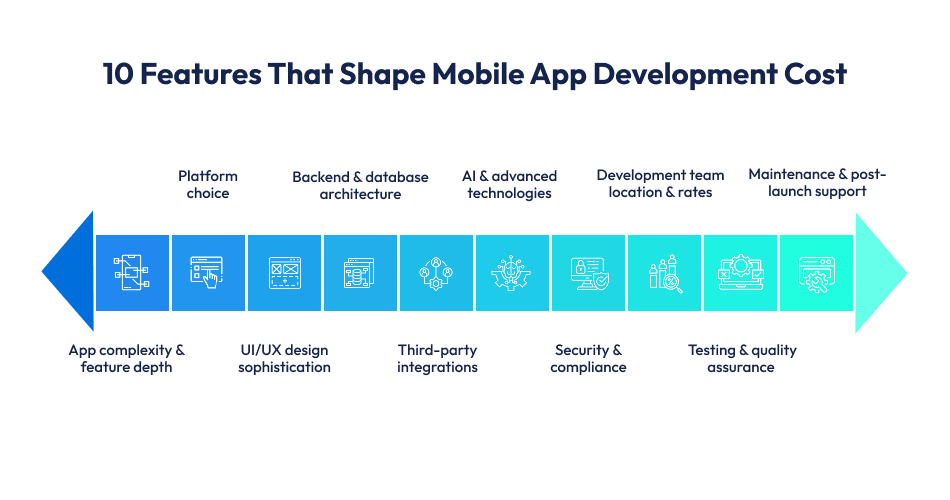
When estimating app development cost in 2026, features matter more than almost anything else.
The reason is simple: every feature adds design effort, development hours, testing complexity, and long-term maintenance.
Below is a practical breakdown of common mobile app features and how they impact timelines and budgets.
Almost every modern app needs user accounts, but complexity varies.
Design is not just about visuals. It affects usability, retention, and development effort.
Backend decisions are a major cost driver, especially for scalable apps.
Integrations save time but aren’t free from cost.
Common integrations include:
Monetization adds both technical and compliance complexity.
Real-time functionality dramatically affects development effort.
Examples include:
AI is becoming more common—but it’s rarely inexpensive.
Cost drivers include:
Supporting multiple platforms affects cost more than many teams expect.
Each platform adds testing, deployment, and maintenance effort, which compounds over time.
Offline access improves user experience but increases complexity.
Internal tools are often overlooked during estimation.
Admin panels may include:
The key takeaway is this: features don’t add cost linearly.
Some features increase complexity across design, backend, security, and QA all at once. Others are relatively contained.
As per Ankit Singh, the COO of Techugo,
A practical approach is to:
This approach helps control the budget while still building a scalable product.
One of the earliest and most consequential decisions in mobile app development is choosing which platforms to build for and how to build them.
In 2026, the debate is no longer about which option is “better,” but which option is right for your product goals, users, and budget.
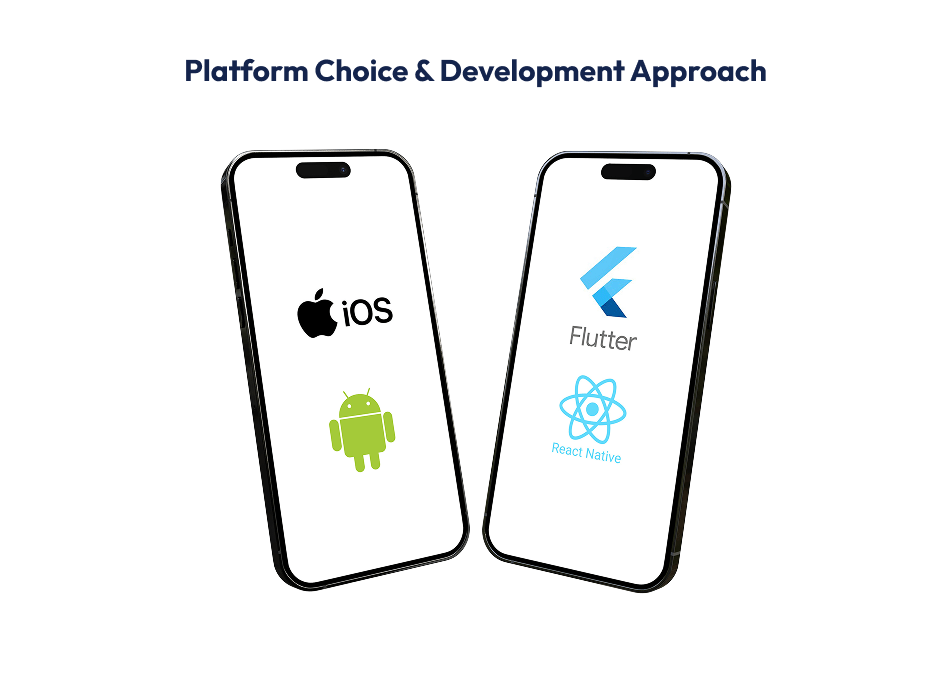
Native apps have direct access to device hardware and system APIs, which translates into superior performance, smoother animations, and deeper platform integration.
Native development is the choice for apps that need to be really responsive. This means things like fintech apps or big company solutions work well with development.
Graphics heavy products are another example of apps that’re a good fit for native development.
Native development is ideal for apps, like these because it makes them work smoothly and quickly.
However, native development comes with higher costs. Two codebases mean more development hours, separate testing cycles, and increased maintenance effort.
Cross-platform development, on the other hand, uses a single codebase to deploy apps on multiple platforms.
Startups and businesses like this approach because it helps them launch faster and validate their ideas quickly.
From a cost perspective, cross-platform development often reduces initial build time and lowers development expenses by 25–40% compared to building two fully native apps.
Native development requires platform-specialized developers, while cross-platform development relies on teams experienced with specific frameworks.
A practical way to decide is to align the approach with your product stage:
The best outcomes come from balancing user experience, speed to market, scalability, and cost, rather than defaulting to a one-size-fits-all approach.
People often think that UI/UX design is about how an app looks.
But UI/UX design is actually crucial as it helps users understand the app. It also helps build users’ trust and impact their perception of how useful the app is.
Good UX design is about usability, clarity and flow. It is about how users move through the app, how many steps it takes to do something and how quickly users get what they want.
Some of the key design factors that impact the cost of app development:
The first thing is the design depth. Basic apps that have simpler layouts and standard components do not need as many design hours.
Apps, like fintech platforms, enterprise dashboards or multi-role systems, are different. These design depth cases need user flows, edge-case handling and a lot of wireframing.
The app for multiple user roles like admins, customers, vendors and support teams costs more because each user role needs its way of doing things, its own rules and its own screens.
Each user role, like admins, customers, vendors and support teams, needs to have ways to use the app.
The third factor is how complicated the interaction is.
Things like interactions, navigating with gestures, getting feedback right away and having things change dynamically make the experience better for the user.
While it costs more to perform these actions at first, they usually make people more interested and less likely to stop using the app over time, thus making it extremely important for business growth.
Accessibility and inclusivity are also becoming key contributors when it comes to the cost of developing a mobile app in 2026.
This takes a bit of work to do, but it means you are doing things right, and more people can use the app you made.
In a lot of places, accessibility is not something that is nice to have; it is something that must be there in the app.
Accessibility is a key component of any successful mobile app in 2026.
Design validation is another factor that can impact the cost of your mobile app.
When prototypes are being created and tested to find issues within the app, design validation plays a key role.
It’s extremely important to get the design validation right, as this factor alone can cut costs from your overall app development budget.
When we talk about the cost of making an app, the UI/UX design part usually takes up about 10 to 25% of the cost.
Strong UI/UX design is not an expense; it’s a cost control mechanism.
Apps that are intuitive from day one require fewer fixes, fewer support resources, and enjoy stronger user adoption over time.
The people building your app have a bigger impact on cost than almost anything else, often more than the technology or even the feature set.
Who you hire, where they’re based, and how the team is structured can change your total budget dramatically, even for the exact same app idea.
Most companies choose one of three approaches: building an in-house team, hiring freelancers, or working with an external development company.
Each option comes with very different cost implications and trade-offs.
Building an internal team gives you full control over priorities, communication, and long-term product ownership.
However, this is also the most expensive route.
In-house costs go far beyond salaries. You also pay for:
For startups or companies building a first version, these fixed costs can quickly become overwhelming unless the app is mission-critical and continuously evolving.
Freelancers are often attractive because of lower upfront costs and flexibility. The challenge appears when projects grow.
If you hire separate freelancers for design, frontend, backend, and testing, coordination becomes difficult.
Availability can be inconsistent, accountability is spread thin, and quality can vary. Common risks include:
Over time, these issues quietly increase the total cost, even if the hourly rates seem low.
This is why many businesses choose external development teams or agencies.
You get a complete, ready-to-go team that includes designers, developers, QA engineers, and project managers working under one structure.
While the hourly rate may look higher at first, these teams often reduce risk, improve speed, and minimize costly mistakes.
For complex apps or long-term projects, this approach often results in better cost efficiency overall.
Hourly rates vary significantly by geography, which strongly influences budgets:
| Region | Average Hourly Rate (2026) | Key Characteristics |
| United States | $80–$150/hour | Strong product thinking and communication; best suited for well-funded startups and enterprises |
| Western Europe | $60–$120/hour | High engineering standards and user-centric design, but relatively expensive |
| Eastern Europe | $40–$70/hour | Popular for quality-to-cost balance, especially for technically complex apps |
| Middle East | $40–$90/hour | Chosen for regional expertise, enterprise experience, and time-zone alignment |
| India & Southeast Asia | $20–$45/hour | Cost-effective, scalable teams with strong technical skills; widely used by startups and global companies |
Lower hourly rates do not automatically mean lower total cost. What matters more than location is whether the team:
Choosing the right team isn’t about minimizing cost. It is about maximizing efficiency.
When estimating app development costs in 2026, many teams focus heavily on design and frontend features but overlook the backend and infrastructure.
That’s a mistake. The backend is the engine of your app.
It handles everything users don’t see but depend on: logins, data storage, payments, notifications, syncing across devices, and overall performance.
Estimated backend cost: $5,000–$15,000
Common components:
For complex apps, like marketplaces, fintech platforms, social apps, or AI-powered mobile apps, backend work becomes significantly more involved.
Estimated backend cost: $30,000–$80,000+
Cost-driving features include:

Most modern apps run on cloud platforms such as AWS, Google Cloud, or Microsoft Azure. These platforms use a pay-as-you-go model, meaning costs scale with usage.
Typical monthly infrastructure costs:
These costs cover servers, databases, storage, bandwidth, monitoring, and backups.
Planning for growth early matters. Poor backend structure may work initially but becomes expensive to fix later.
Rewriting APIs, migrating databases, or reconfiguring infrastructure after launch can be risky and costly.
Security also adds to backend costs, especially for apps handling sensitive data.
This includes:
Many teams budget 15–25% of the initial development cost per year for backend maintenance, updates, and infrastructure optimization.
In short, the frontend attracts users, but the backend keeps your app stable, secure, and scalable. Cutting corners here almost always costs more in the long run.
Testing and Quality Assurance (QA) is one of the most underestimated parts of app development cost, yet it has one of the highest returns on investment.
QA ensures that your app works as expected across devices, operating systems, screen sizes, and real-world usage scenarios.
With users accessing apps on hundreds of device models and OS versions, skipping proper testing is a costly gamble.
At a basic level, QA includes functional testing that checks whether features work as intended.
This covers login flows, forms, navigation, payments, and data syncing.
For simple apps, functional testing may cost $3,000–$8,000, depending on the number of screens and workflows.
Modern apps also require performance testing to ensure they can handle real traffic.
Performance testing can add $5,000–$15,000 to the total cost, especially for apps expecting rapid growth.
Another major cost factor is device and compatibility testing.
Manual testing across physical devices is time-consuming but essential.
Many teams supplement this with cloud-based device labs, which add recurring costs but improve coverage.
Security testing is equally important, particularly for fintech, healthcare, or enterprise apps.
Security-focused QA can range from $5,000 to $20,000+, depending on regulatory requirements and risk level.
Automated testing frameworks reduce long-term costs by catching regressions quickly, especially during frequent updates.
Teams typically spend 10–20% more initially on QA automation, but recover that cost over time through faster releases and fewer production issues.
On average, QA accounts for 15–25% of total app development cost. While that may feel significant, the alternative is far more expensive.
According to industry studies, fixing a bug after release can cost 5–10 times more than resolving it during development.
In short, testing is a financial safeguard.
Security costs start with secure architecture and coding practices.
This includes encrypted data storage, secure APIs, protected authentication flows, and proper session management.
Even for a moderately complex app, implementing baseline security measures can add $4,000–$10,000 to development costs.
One major contributor is authentication and access control.
Features like multi-factor authentication (MFA), biometric login, role-based access, and secure password handling require additional development and testing.
These typically add $2,000–$6,000, depending on complexity and integrations.
If your app serves users in the EU, UK, Middle East, or North America, you must account for regulations like GDPR, regional data protection laws, and evolving privacy frameworks.
Compliance work includes consent management, data access controls, audit logs, and clear privacy policies built into the app experience.
This can add $3,000–$12,000 depending on the number of regions and data types involved.
Apps operating in regulated industries, fintech, healthcare, or enterprise, often need advanced security testing.
These services alone can cost $5,000–$20,000+, but they significantly reduce the risk of breaches and legal exposure.
Ongoing security is another hidden cost many teams underestimate.
Post-launch, companies typically spend 10–15% of annual development cost on maintaining security and compliance.
This isn’t wasted spend, it’s insurance against reputational damage and downtime.
There’s also a strong business case here. Studies consistently show that the cost of a data breach far exceeds the cost of prevention.
In practical terms, security and compliance usually account for 10–20% of total app development cost, depending on your app’s domain and geography.
Launching a mobile app is a structured, cost-bearing phase that many teams underestimate.
App Store deployment involves preparation, compliance, testing, and marketing alignment, all of which influence the overall app development cost in subtle but real ways.
The first cost layer is developer account setup. Apple charges $99 per year for the Apple Developer Program, while Google Play requires a one-time $25 fee.
These are minor expenses, but they’re mandatory and recurring on the Apple side.
Next comes store compliance and submission preparation.
Preparing store-ready assets, app descriptions, keywords, screenshots, preview videos, and icons, often requires design and copywriting support.
This typically adds $1,000–$3,000, depending on quality and localization needs.
ASO is another optional but increasingly important cost. While not mandatory, ASO can significantly improve early traction.
Basic ASO efforts usually cost $500–$2,000, while advanced campaigns can go higher.
Then there’s pre-launch testing and review readiness. Apple, in particular, is strict about crashes, broken flows, and privacy missteps.
Teams often allocate time for additional bug fixes, performance tuning, and compliance updates just before submission.
This final polish phase can add $1,500–$5,000, especially if rejections require multiple resubmissions.
For apps launching in multiple regions, localization costs come into play.
Translating app store listings, onboarding screens, and legal text into different languages can cost $1,000–$4,000+, depending on the number of markets.
Post-approval, launch support and monitoring also carry costs.
Teams track crash reports, user reviews, analytics, and early performance metrics.
Rapid hotfixes or minor updates in the first few weeks are common and should be budgeted as part of launch, not maintenance.
In total, app store deployment and launch activities typically account for $3,000–$10,000 of the total project cost for most professional apps.
Apps that succeed over the years are not static products; they evolve continuously with users, devices, platforms, and business goals.
On average, annual app maintenance costs range from 15–25% of the initial development cost.
So if an app costs $100,000 to build, you should expect to spend $15,000–$25,000 every year to keep it stable, secure, and relevant.
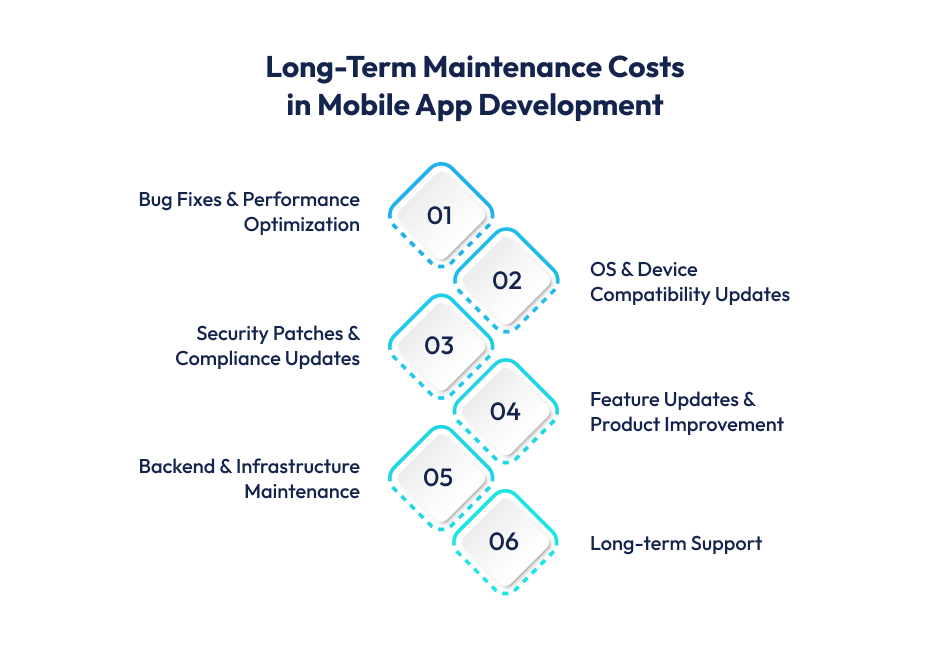
The first layer of maintenance is bug fixes and performance optimization.
No matter how thorough testing is, real users, real devices, and real network conditions expose issues that didn’t appear earlier.
Crash fixes, UI glitches, slow load times, and memory leaks need ongoing attention, especially in the first 3–6 months after release.
Next comes OS and device compatibility updates.
Apple and Google release major OS updates every year, often changing APIs, permissions, and security rules.
An app built today may break or behave unpredictably after an iOS or Android update if it’s not maintained.
Supporting new devices, screen sizes, and hardware capabilities is a recurring effort, not a one-time task.
Security patches and compliance updates are another non-negotiable cost.
Vulnerabilities emerge constantly, and data protection laws evolve across regions.
Regular updates are required to maintain compliance with privacy regulations, payment security standards, and platform policies.
Apps that delay security updates can lose user trust, face store penalties, or even be removed from the app store.
Then there are feature updates and product improvements.
User feedback, analytics, and market trends often reveal what’s missing or what needs refinement.
Successful apps ship incremental improvements, better onboarding, smarter notifications, improved search, or AI-driven personalization.
These updates keep users engaged and prevent churn. Over time, feature evolution often costs more than the original MVP.
Backend and infrastructure maintenance also grow as usage scales.
Increased traffic leads to higher server, database, and cloud service costs.
Apps may need load balancing, database optimization, caching layers, or infrastructure upgrades to maintain performance.
These costs scale with users and are essential for reliability.
Long-term support also includes analytics, monitoring, and customer support tooling.
Teams invest in crash reporting, performance monitoring, and user behavior analytics to guide decisions.
Support systems, like in-app chat or ticketing, add operational costs but are critical for retention and trust.
From a team perspective, maintenance usually involves a lean, ongoing setup rather than a full development team.
This may include:
Monthly maintenance budgets often range from $1,000–$5,000 for small to mid-sized apps, and significantly more for enterprise or high-traffic platforms.
The key mindset shift is this: maintenance is not a cost of fixing mistakes, it’s the cost of staying relevant.
In mobile app development, longevity isn’t accidental. It’s designed, funded, and maintained, one update at a time.
When teams budget for app development, they usually focus on the obvious line items: design, development, testing, and launch.
What’s easier to miss, and often the reason projects go over budget, is the set of hidden and contingency costs that don’t fit neatly into those buckets but become unavoidable once work begins.
Here are the most common ones teams overlook, why they matter, and how to plan for them.
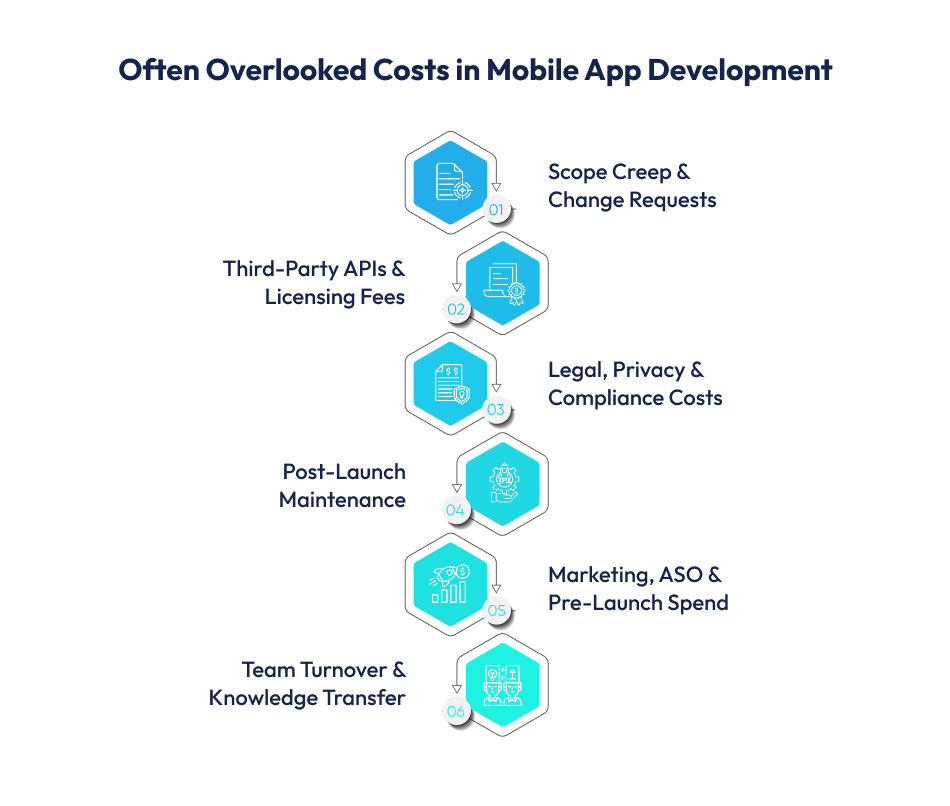
In early estimates, app requirements are often written at a high level. As discussions deepen, stakeholders refine and expand features.
Suddenly, what felt like a minor change can trigger revisions across design, backend logic, testing, and performance optimization.
A practical approach is to reserve 10–15% of project cost for change requests or postpone non-critical changes to later phases.
Many features rely on external services—payment gateways, maps, analytics, push notifications, or AI APIs.
While initial development may account for integration time, recurring licensing or usage fees are often forgotten.
These costs vary widely. For example:
Budgeting only for integration but not ongoing cost leads to surprises once the app is live.
Data protection laws like GDPR, CCPA, and emerging regional regulations require privacy disclosures, data handling rules, and sometimes legal consultation.
Many teams assume compliance is “free,” but reviewing privacy policies, drafting terms of use, and aligning with legal experts often adds thousands of dollars—especially if you operate in multiple regions.
Most budgets include maintenance, but only for planned updates.
What’s often missing is a contingency reserve for emergency fixes—security patches, major OS changes, unanticipated bugs, or API deprecations.
A contingency buffer of 10–20% of the original development cost helps absorb these without derailing monthly operating budgets.
App Store Optimization (ASO), pre-launch marketing pages, promo videos, and user acquisition campaigns are often separate from development but are necessary for uptake.
If you only budget for build and launch mechanics, you could be underfunded for what actually brings users.
In longer projects, team members may change due to availability, turnover, or reallocation.
New developers require time to ramp up, understand prior work, and sometimes rework parts of the codebase – a hidden cost that impacts both budget and schedule.
Hidden costs aren’t flaws in planning. They are signals of realism in project budgeting.
Planning for them protects your money as well as protects your timeline, reputation, and long-term success.
Mobile app development costs vary significantly depending on where the work is done.
Geography doe affect hourly rates and it also influences communication styles, cultural expectations, access to talent, regulatory familiarity, and even quality standards.
Below is a practical comparison of typical development costs and considerations across major regions.
| Region | Typical Rate | Strengths | Best Fit |
| USA | $100–$200+ | High quality, native expertise | Enterprise, high-performance apps |
| UAE/Saudi | $50–$100 | Regional compliance, bilingual UX | Gulf market apps |
| Eastern Europe | $40–$80 | Strong engineers, good balance | SMBs, startups |
| India/South Asia | $20–$45 | Cost efficiency + scale | Budget constrained products |
| Western Europe | $70–$130 | UX, product focus | Mature product markets |
| Latin America | $35–$70 | Time zone alignment with US | US market outsourcing |
In the USA, mobile app development rates are among the highest globally.
Experienced developers, especially those comfortable with native iOS and Android, often charge between $100–$200+ per hour.
Why costs are high:
The advantage of US-based teams is their familiarity with global market standards, rigorous development practices, and strong project management.
In the Middle East, particularly the UAE and Saudi Arabia, mobile app development has grown rapidly in recent years.
Typical developer rates here range from $50–$100 per hour, though enterprise specialists or boutique firms may charge more.
Regional considerations:
For businesses targeting Gulf Cooperation Council markets, local or regional agencies offer an advantage in understanding regulatory needs, payment systems, and multi-market UX expectations.
Countries such as Poland, Ukraine, Romania, and the Baltic states have become popular outsourcing destinations due to strong technical education and competitive rates.
Developers here typically charge between $40–$80 per hour.
Why Eastern Europe is attractive:
Eastern Europe is frequently chosen by startups and mid-sized companies that want higher engineering throughput without the premium rates of Western Europe or the US.
India and neighboring regions continue to offer some of the most competitive development costs worldwide.
Mobile app developers often charge between $20–$45 per hour, with full service agencies grouping design, development, testing, and project management into predictable packages.
Advantages:
Considerations:
For many startups and global businesses, India remains a go-to for cost optimization, provided the team has solid processes and strong references.
Slightly lower rates than the US, typically $70–$130 per hour. Known for strong UX and product management skills.
Middle ground with $35–$70 per hour, good overlap with North American time zones.
Competitive rates similar to India, $25–$50 per hour, with rapidly growing talent pools.
Hourly rates are a starting point, not the whole story.
When comparing regions for app development, consider:
For example, a $30/hour developer may seem cheaper than a $100/hour one, but if miscommunication results in rework or missed deadlines, the total cost could be higher in time and money.
Ultimately, regional costs are a guide, not a rule. The best choice depends on your product goals, team structure, and quality expectations.
A well-managed team in any region can deliver excellent results—what matters most is clarity of scope, communication, and a process that supports reliable delivery.
Reducing app development cost in 2026 is less about shortcuts and more about making informed, strategic choices from day one.
Below are practical ways to control costs without compromising quality.
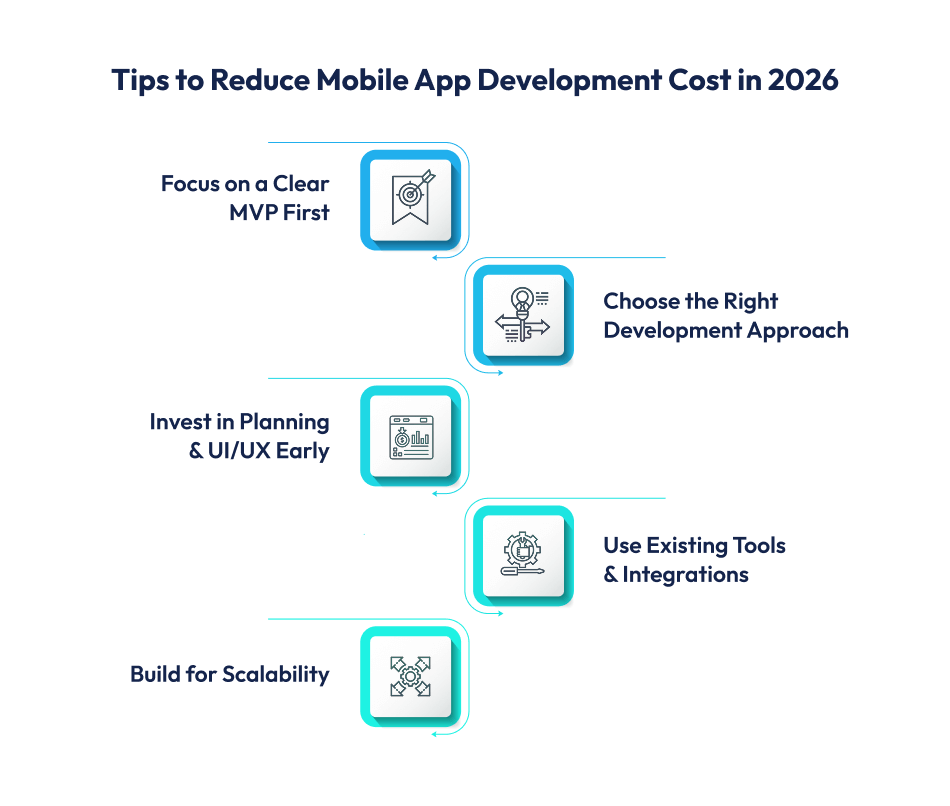
One of the biggest cost drivers is overbuilding.
Instead of launching with every possible feature, start with a Minimum Viable Product that solves one clear problem.
This helps validate your idea with real users while keeping initial development lean and manageable.
Your choice between native and cross-platform development has a major impact on cost.
Cross-platform frameworks can reduce development time by reusing code across platforms, while native development is better suited for performance-heavy or complex apps.
The right choice depends on your app’s goals, not trends.
Unclear requirements and rushed design decisions lead to rework, which is expensive.
Spending time on proper planning, wireframes, and user flows helps development teams build correctly the first time, saving both time and money.
Avoid reinventing the wheel.
Using third-party services for payments, authentication, analytics, and notifications can drastically reduce development effort and cost while improving reliability.
Designing a scalable backend, adding testing early, and planning for maintenance may cost slightly more upfront, but they prevent expensive fixes later.
Smart upfront decisions are the most effective way to reduce long-term app development costs.
By 2026, app development costs are no longer just a technical concern, they’re a strategic one because the total cost to develop a mobile app depends on far more than features or platforms.
It’s shaped by your business goals, the level of scalability you expect, the markets you’re targeting, and how thoughtfully decisions are made early on.
In short, accurate app cost estimation isn’t about finding the cheapest option. It’s about aligning budget, expectations, and execution, so the product you launch is worth the investment.


Making an app in 2026 is a lot more than just writing code and hitting the publish button. Mobile app development in 2026 is really about making somet..



Write Us
sales@techugo.comOr fill this form